St. Paulinus of Aquileia

Paulinus II was Patriarch of Aquileia under Charlemagne.

Read the essentials →
Feast January 11 · Patriarch

St. Paulinus of Aquileia

Current feast

January 11
Secondary source · Wikipedia infobox

Traditional feast

January 28
1914 / pre-1969 calendar, per Baring-Gould (1914)

Represents

Patriarch

Feast days

Feast: January 11
Traditional: January 28

This Saint’s Story

The Catholic Encyclopedia places his birth at Premariacco, near Cividale, about 730–740, and his death in 802; Baring-Gould gives about 726 for the birth and 804 for the death, and once has him ascending about 776, whereas the encyclopedia dates the appointment to 787. He was probably of a Roman family under Longobard rule, educated in the patriarchal schools at Cividale, and after ordination became master of the school. His Latin culture, jurisprudence, and Scriptural and patristic learning won Charlemagne’s favour. After the fall of the Lombard kingdom in 774, Charles invited him to Francia in 776 as royal master of grammar. Favours followed, including a property grant and, in 787, the patriarchate of Aquileia.

He took a leading part against Adoptionism (the claim that Christ was God's son only by adoption). In 792 he attended the Council of Ratisbon, which condemned Elipandus and Felix of Urgel; in 794 he helped shape the Synod of Frankfurt, wrote against the heresy for Spain in the council’s name, and later opposed it again at Cividale in 796, where he also taught the procession of the Holy Spirit from the Father and the Son. Fourteen canons on discipline and marriage were framed there. He accompanied Pepin against the Avars, presided at Salzburg on evangelisation and baptism, served as missus dominicus at Pistoia in 798, and went to Rome as imperial legate. A Council of Altinum is sometimes ascribed to him, but Hefele showed that no such council was held. Baring-Gould’s shorter notice adds Aix-la-Chapelle in 782 and a Friuli council in 791 or 796—points to weigh beside the encyclopedia’s fuller list.

Among his works are the Libellus Sacrosyllabus against Elipandus, three books against Felix, and a protocol of the Danube conference with Pepin. As a poet he left a Carmen on the rule of faith, an elegy for Duke Heric (killed in 799), a rhythm on Aquileia’s fall, church hymns, and verses on Lazarus. He died revered as a saint. Manuscripts earlier than Usuard keep his feast on 11 January; later Aquileia calendars gave it a special rubric; Francesco Barbaro moved it to 9 February; Cividale keeps 2 March; Baring-Gould notes the festival on 28 January. After several translations his relics rest under the altar of the crypt of the basilica at Cividale del Friuli.

Thin entry · the 1914 book gives only 102 words. We have not filled the gap with invented detail.

What he represents

How he teaches us to live

Drawn from themes in the original account

Celebrate this saint’s feast day. Remember him on January 11 with a short prayer, and ask for his help.

The full story

Baring-Gould’s account retold in modern English

Read the full story · 108 words · about 1 min

Pauline, born around 726, was one of the most notable patriarchs who held the position in Aquileia. He took on this role around the year 776. He participated in the council of Aix-la-Chapelle in 782, the council of Ratisbon in 792, and the council of Frankfort in 794. He also held a council himself in Friuli in either 791 or 796. He fought against a form of Nestorianism spread by Felix, the Bishop of Urgel, and Elipandus, the Bishop of Toledo, with such effectiveness that their heresy did not gain traction in the West. In 802, Paulinus convened a council at Altino. He died on January 11, 804.

Read the original 1870s text

Baring-Gould’s sources: S. Paulinus died on Jan. 11th, but his festival is observed on Jan. 28th. Authorities: various histories of his time, and the writings of himself and Alcuin.

S. Paulinus, born about 726, was one of the most illustrious of the patriarchs who sat in the throne of Aquileia, which he ascended, about the year 776. He assisted at the council of Aix-la-Chapelle in 782, of Ratisbon [Regensburg in Bavaria] in 792, and of Frankfort in 794; and he held one himself, at Friuli, in 791 or 796. He combated a form of Nestorianism [Nestorius (d. c. 451), whose teaching split Christ into two persons; condemned at Ephesus in 431] propagated by Felix, Bishop of Urgel, and Elipandus, Bishop of Toledo, with such success that their heresy made no headway in the West. In 802, S. Paulinus assembled a council at Altino. He died on the 11th Jan., 804.

From the Catholic Encyclopedia

1913 · 791 words

Born at Premariacco, near Cividale, Italy, about 730-40; died 802. Born probably of a Roman family during Longobardic rule in Italy, he was brought up in the patriarchal schools at Cividale. After ordination he became master of the school. He acquired a thorough Latin culture, pagan and Christian. He had also a deep knowledge of jurisprudence, and extensive Scriptural, theological, and patristic training. This learning won him the favour of Charlemagne [king of the Franks, crowned emperor in 800]. After the destruction of the Kingdom of the Longobards in 774, Charles invited Paulinus to France in 776, to be royal master of grammar". He assisted in restoring civilization in the West. In 777 Paulinus made his first acquaintance with Petrus of Pisa, Alcuin, Arno, Albrico, Bona, Riculph, Raefgot, Rado, Lullus, Bassinus, Fuldrad, Eginard, Adalard, and Adelbert, the leading men of that age. His devotion to Charlemagne was rewarded by many favours, among them the gift of the property of Waldand, son of Mimo of Lavariano, with a diploma dated from Ivrea, and his appointment by Charles as Patriarch of Aquileia in 787. Paulinus took a prominent part in the important matters of his day. In his relations with the churches of Istria, or with the Patriarch of Grado, the representative of Byzantine interests, he showed the greatest prudence and pastoral zeal. Paulinus obtained diplomas for the free election of the future patriarchs, and other privileges for the Church of Aquileia, viz. the monastery of St. Mary in Organo, the church of St. Laurence of Buia, the hospitals of St. John at Cividale and St. Mary at Verona. He helped in preparing the new Christian legislation, and we find some canons of his synods. In 792 he was present at the Council of Ratisbon [Regensburg in Bavaria], which condemned the heresy of Adoptionism taught by Eliphand and Felix, Bishop of Urgel. In 794 he took a leading part in the national Synod of Frankfort-on-the-Main, where Adoptionism was again condemned, and wrote a book against it which was sent to Spain in the name of the council. Leaving Frankfort Paulinus paid a visit to Cividale and accompanied Pepin against the Avars. At Salzburg he presided over a synod of bishops, in which were discussed the evangelization of the barbarians, and baptism, as we learn from letters of Charles, Alcuin, Arno, and Paulinus. Returning from the expedition the patriarch [the title of the bishops of the great ancient sees: Rome, Constantinople, Alexandria, Antioch, Jerusalem] once more opposed the Adoptionists at the Synod of Cividale in 796. Paulinus expounded the Catholic doctrine about the Blessed Trinity, especially about the procession of the Holy Ghost from the Father and the Son. At this synod fourteen "canons" on ecclesiastical discipline, and on the sacrament of marriage, were framed and a copy of the Acts was sent to the emperor. Paulinus is said to have assisted at the Council of Altinum, but Hefele has proved that a council was never held there. In 798 he was "Missus Dominicus" of Charlemagne at Pistoia, with Arno and ten other bishops; and afterwards he went to Rome as imperial legate [an official representative sent by the pope] to the Pope. The activity of Paulinus as metropolitan [the archbishop who heads a group of dioceses] is clear from the "Sponsio Episcoporum ad S. Aquileiensem Sedem . Among his works are: Libellus Sacrosyllabus contra Elipandum ; Libri III contra Felicem ; the protocol of the conference with Pepin and the bishops on the Danube, a work very important for the history of that expedition. Paulinus was also a poet, and we till possess some of his poetical productions: "Carmen de regula fidei ; the rythmus or elegy for the death of his friend, Duke Heric, killed in battle, 799; another rhythm on the destruction of Aquileia; eight rhythms or hymns to be sung in his own church for Christmas, the Purification, Lent [the forty days of fasting before Easter], Easter, St. Mark, Sts. Peter and Paul, the dedication, and "Versus de Lazaro". He died revered as a saint. In MSS. prior to the Martyrology of Usuard his feast is recorded on 11 Jan. In the calendars of saints of the thirteenth, fourteenth and fifteenth centuries, used in the Church of Aquileia and Cividale, his feast has a special rubric. The first appearance of the name St. Paulinus in the Liturgy occurs in the "Litaniae" of Charles the Bald of the ninth century. It appears also in the "Litaniae Carolinae", in the Litaniae a S. Patribus constitutae", and finally in the Litaniae" of the Gertrudian MS. of the tenth century. Down to the sixteenth century the feast was celebrated on 11 Jan., during the privileged octave of the Epiphany. The patriarch Francesco Barbaro at the beginning of the seventeenth century translated the feast to 9 Feb. The Church of Cividale keeps his feast on 2 March. After several translations the relics [the bodily remains of a saint, or objects they used, kept with honor] of the saintly patriarch were laid to rest under the altar of the crypt of the basilica of Cividale del Friuli.
Help us add to this saint's story

Everything is read by a person before anything appears. Facts are checked against trusted sources first.

Facts are welcome; a source link helps (optional).With your permission we may share it on this page.

Nine days · Free

Pray the novena
with us.

One short email a day for nine days. The day's prayer, a line from St. Paulinus of Aquileia's story, and a nudge to keep going.

Also on January 28
T

Sts. Thyrsus

January 28 · Martyrs
St. Valerius of Saragossa

St. Valerius of Saragossa

January 28 · Bishop
P

St. Palladius in Syria

January 28 · Hermit
← All 1970 saints in the library
Sources & notes

Feast-day sources

Story sources

Sources

Credits

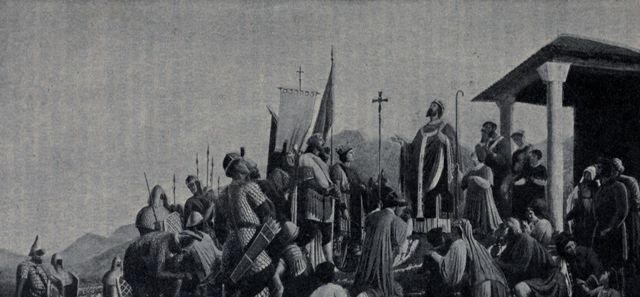
Image: Blessing of Friulo-slavic Army by Paulinus II of Aquilea.PNG · Josip Gruden († 1922) · Public domain, via Wikimedia Commons

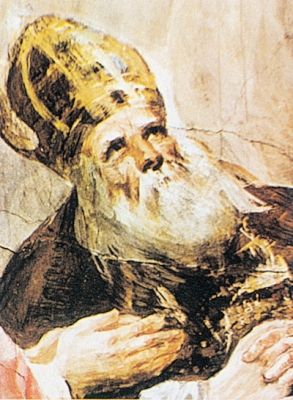
Image: Josip Gruden († 1922), Wikimedia Commons (Public domain)

From “Catholic Encyclopedia (1913)/St. Paulinus II, Patriarch of Aquileia,” The Catholic Encyclopedia (New York: Robert Appleton Company, 1907–1914), via Wikisource. Public domain. Matched by name and feast date; text unedited except for our bracketed notes in grey.

Retold in plain modern English from Baring-Gould’s public-domain text, sentence by sentence, keeping the same facts and order. Short explanations in parentheses are ours.

From Sabine Baring-Gould, The Lives of the Saints, new and revised edition (Edinburgh: John Grant, 1914; first edition 1872). Public domain in the United States. Reproduced unedited, except for short bracketed notes in grey that we added to explain names and terms (“S.” is the old abbreviation for Saint). Some history and judgments reflect 19th-century scholarship.

Notes

Story retold in our own words from the cited sources.