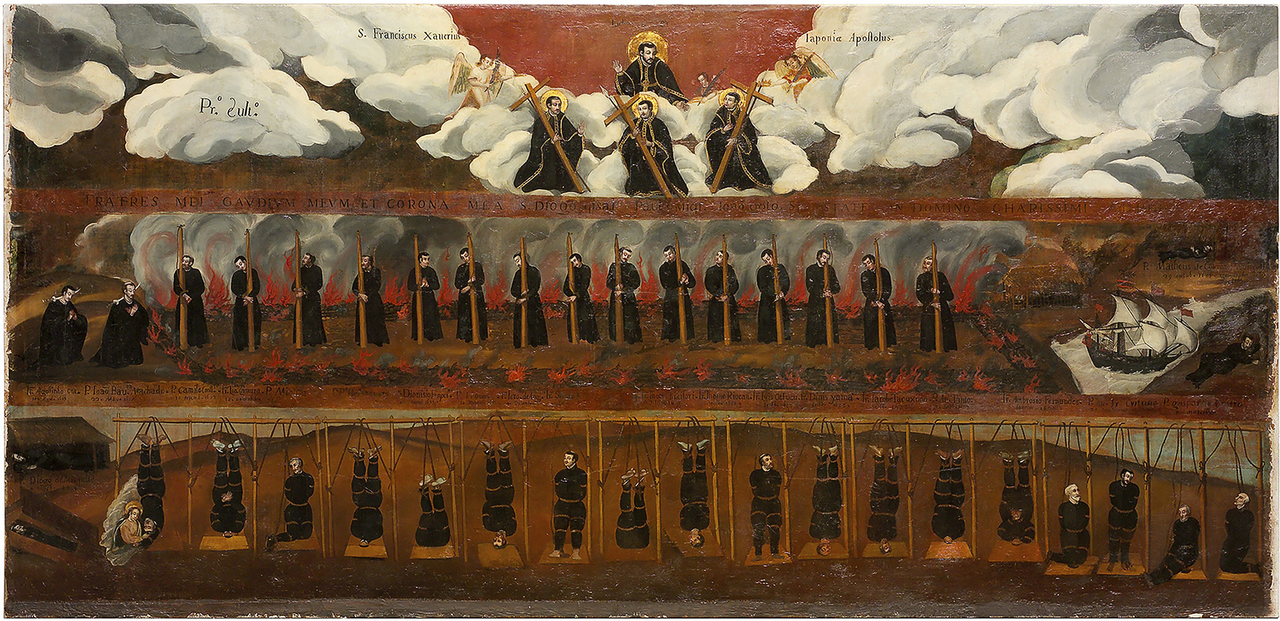
This Saint’s Story
Paul Miki was born about 1562 into a well-to-do family near Osaka. His whole family became Christian. At twenty he entered the Jesuit (member of the Society of Jesus, founded by St. Ignatius of Loyola) seminary at Azuchi; two years later he joined the Society of Jesus. He was a gifted preacher who drew many Japanese hearers to the faith, and he was only months from ordination when he was arrested.
After Francis Xavier's arrival in 1549, the Church had grown quickly in Japan. By the late sixteenth century rulers feared foreign power. Toyotomi Hideyoshi ordered missionaries expelled in 1587; the decree was unevenly enforced until the San Felipe incident of 1596 hardened his policy. In early 1597 police in the Kyoto region arrested Franciscan (the order of friars founded by St. Francis of Assisi) missionaries from the Philippines together with the Japanese Jesuits (the Society of Jesus, founded by St. Ignatius of Loyola) Paul Miki and James Kisai and the catechist John de Goto, who was seeking admission to the Society.
Twenty-six Catholics in all—European friars and Japanese Jesuits and lay tertiaries, including three boys—were condemned as Christians. Their left earlobes were cut off, and they were marched for about a month from the Kyoto area to Nagasaki under insult and abuse. Miki and a Franciscan priest preached to the crowds along the way. Just before the execution, Jesuit priests were able to visit the prisoners; Miki renewed his vows, and de Goto and Kisai made theirs.
On February 5, 1597, they were crucified on a hill outside Nagasaki, later called Martyrs' Hill. Tied to their crosses with metal bands at the neck, they were lifted into place and pierced with lances. From the cross Miki proclaimed that he was dying as a Christian, invited the people to follow Christ, and forgave his enemies. Pope Urban VIII beatified (declared 'Blessed', the step before sainthood) the twenty-six in 1627; Pope Pius IX canonized (officially declared a saint by the pope) them on June 8, 1862. The Church keeps their memorial on February 6 (February 5 is St. Agatha's feast). They are patrons of Japan and of persecuted Christians.
