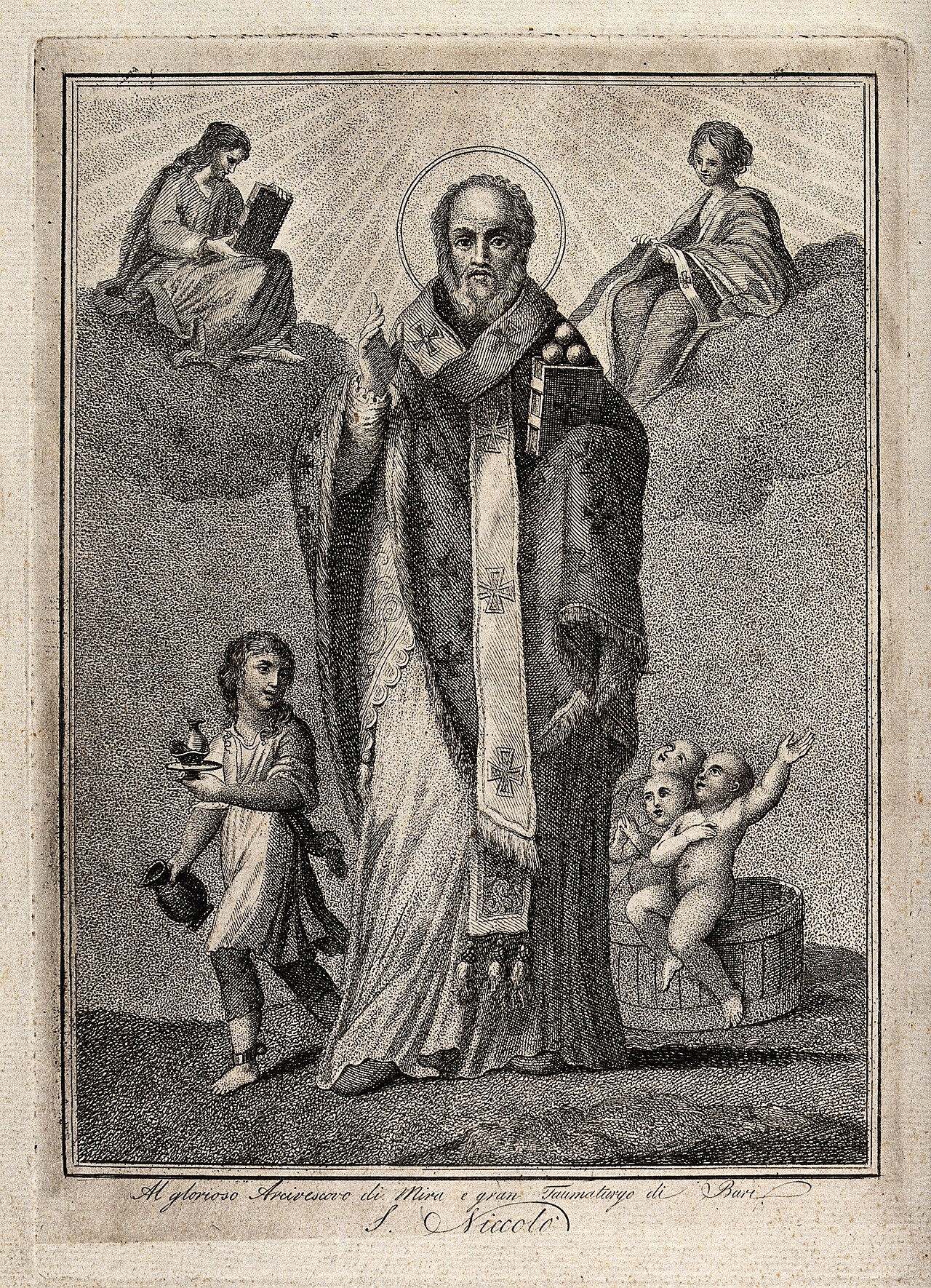
St. Nicholas of Myra

Nicholas of Myra, also called Nicholas of Bari, was a bishop in Lycia, on the south coast of Asia Minor, in the fourth century.

Read the essentials →
Feast December 6 · Bishop

St. Nicholas of Myra

Current feast

December 6
Verified · General Roman Calendar (Wikipedia list)

Traditional feast

December 6
Traditional date (see Catholic Encyclopedia, 1913)

Represents

Bishop

Feast days

Feast: December 6

This Saint’s Story

In our own words, from the sources listed below. Legend is labelled as legend.

The Catholic Encyclopedia is frank: almost the only thing historically certain about him is that he was bishop of Myra. It says he died on 6 December, in 345 or 352. Wikipedia's traditional dates are 15 March 270 and 6 December 343. The day in December is stable. The year of his death is not.

The stories told of him come from lives written centuries later. They say he was born at Patara in Lycia to Christian parents, went on pilgrimage to Egypt and the Holy Land as a young man, and became bishop soon after he came home. They say he was imprisoned in the persecution under Diocletian (Roman emperor 284–305, who launched the last and fiercest persecution of Christians in 303) and freed when Constantine came to power. They even place him at the Council of Nicaea (the first worldwide council of bishops, 325, which defined that the Son is fully God) in 325, but his name is missing from the old lists of bishops who attended, so that too is doubtful. Legend says he gave gold, by night, so that three daughters of a poor man could marry and would not be sold. Legend says he calmed a storm and saved three soldiers from execution. A later story about children and a barrel is later still. The Encyclopedia lists these as the outgrowth of a long tradition.

What is certain is how far his memory spread. The Emperor Justinian built a church to him in Constantinople in the sixth century. In 1087 Italian merchants carried his body from Myra to Bari in southern Italy, where it still rests in the church of San Nicola, and his cult grew across the West. Russia, Greece, Lorraine, and many cities took him as patron. Sailors, children, merchants, bakers, and travellers have long asked for his prayers.

In Germany, Switzerland, and the Netherlands he became the secret bringer of gifts to children on his feast day, 6 December. The gift-giving legend, passed through Dutch Sinterklaas, is one root of the Santa Claus custom in the United States, where the gifts came to be given on Christmas Eve instead. The General Roman Calendar keeps him on 6 December.

For today: You can give a gift in secret on his day and still tell the truth about the history. A fourth-century bishop of Myra is the certain part. The gold at the window is a story the Church has long told. The feast is 6 December.

What he represents

How he teaches us to live

Drawn from themes in the original account

Celebrate this saint’s feast day. Remember him on December 6 with a short prayer, and ask for his help.

Read more

The full original · 463 words

Read the full Catholic Encyclopedia article

Bishop of Myra in Lycia; died 6 December, 345 or 352. Though he is one of the most popular saints in the Greek as well as the Latin Church, there is scarcely anything historically certain about him except that he was Bishop of Myra in the fourth century.

Some of the main points in his legend are as follows: He was born at Parara, a city of Lycia in Asia Minor; in his youth he made a pilgrimage to Egypt and Palestine; shortly after his return he became Bishop of Myra; cast into prison during the persecution of Diocletian [Roman emperor 284–305, who began the ‘Great Persecution’ of Christians in 303], he was released after the accession of Constantine, and was present at the Council of Nicaea. In 1087 Italian merchants stole his body at Myra, bringing it to Bari in Italy.

The numerous miracles St. Nicholas is said to have wrought, both before and after his death, are outgrowths of a long tradition. There is reason to doubt his presence at Nicaea, since his name is not mentioned in any of the old lists of bishops that attended this council. His cult in the Greek Church is old and especially popular in Russia. As early as the sixth century Emperor Justinian [Byzantine emperor 527–565] I built a church in his honour at Constantinople, and his name occurs in the liturgy ascribed to St. Chrysostom. In Italy his cult seems to have begun with the translation [the solemn moving of a saint’s relics to a new shrine] of his relics [the bodily remains of a saint, or objects they used, kept with honor] to Bari, but in Germany it began already under Otto II [German king and emperor, co-ruler with his father Otto I from 967 and sole ruler 973–983], probably because his wife Theophano was a Grecian. Bishop Reginald of Eichstaedt (d. 991) is known to have written a metric, "Vita S. Nicholai." The course of centuries has not lessened his popularity. The following places honour him as patron: Greece, Russia, the Kingdom of Naples, Sicily, Lorraine, the Diocese of Liège; many cities in Italy, Germany, Austria, and Belgium; Campen in the Netherlands; Corfu in Greece; Freiburg in Switzerland; and Moscow in Russia. He is patron of mariners, merchants, bakers, travellers, children, etc. His representations in art are as various as his alleged miracles. In Germany, Switzerland, and the Netherlands, they have the custom of making him the secret purveyor of gifts to children on 6 December, the day on which the Church celebrates his feast; in the United States and some other countries St. Nicholas has become identified with Santa Claus who distributes gifts to children on Christmas eve. His relics are still preserved in the church of San Nicola in Bari; up to the present day an oily substance, known as Manna di S. Nicola, which is highly valued for its medicinal powers, is said to flow from them.

The traditional legends of St. Nicholas were first collected and written in Greek by Metaphrastes in the tenth century. They are printed in P.G. 116 sq.

Patron saint of

  • Sailors Tradition
    Named in the Catholic Encyclopedia (1913).
  • Children Tradition
    Named in the Catholic Encyclopedia (1913); behind the gift-giving custom.
  • Merchants, bakers and travellers Tradition
    Named in the Catholic Encyclopedia (1913).

Help us add to this saint's story

Everything is read by a person before anything appears. Facts are checked against trusted sources first.

Facts are welcome; a source link helps (optional).With your permission we may share it on this page.

Nine days · Free

Pray the novena
with us.

One short email a day for nine days. The day's prayer, a line from St. Nicholas of Myra's story, and a nudge to keep going.

Also on December 6
A

St. Asella

December 6 · Virgin
D

Sts. Dionysia

December 6 · Martyrs
G

St. Gertrude

December 6 · Widow, Abbess
← All 1970 saints in the library

Did you know

Sources & notes

Feast-day sources

Story sources

Sources

Credits

Image: Saint Nicholas of Myra and Bari. Engraving. Wellcome V0032755.jpg · Unknown · CC BY 4.0, via Wikimedia Commons

Image: Unknown, Wikimedia Commons (CC BY 4.0)

From The Catholic Encyclopedia (New York: Robert Appleton Company, 1907–1914), via Wikisource. Public domain in the United States. Reproduced unedited, except for short bracketed notes in grey that we added to explain names and terms (“S.” is the old abbreviation for Saint). Some history and judgments reflect 19th-century scholarship.