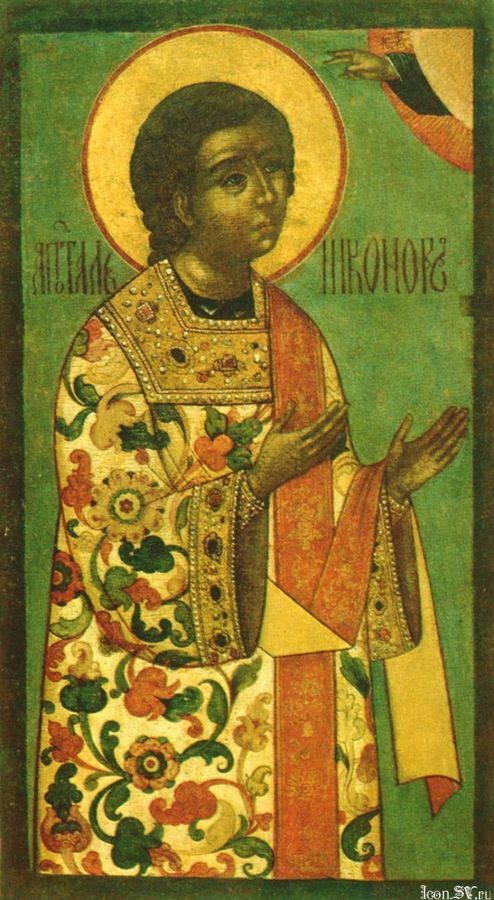
St. Nicanor

Nicanor was one of the seven men chosen by the first Christian community in Jerusalem to serve at the daily distribution of food, as told in Acts 6:1–6. Saint Nicanor, one of the first seven deacons appointed by the Apostles, was a native of Cyprus, to which he returned, that he might preach the Gospel on the dispersion of the Apostles.

Read the essentials →
Feast July 28 · Martyr

St. Nicanor

Current feast

July 28 (also listed: December 28)
Secondary source · Wikipedia infobox

Traditional feast

January 10
1914 / pre-1969 calendar, per Baring-Gould (1914)

Represents

Martyr

Feast days

Feast: July 28
Traditional: January 10

This Saint’s Story

In our own words, from Wikipedia and Baring-Gould (1897)

Greek-speaking believers had complained that their widows were being overlooked. The apostles asked the community to choose seven men of good reputation, full of the Spirit and wisdom, so that the apostles could give themselves to prayer and preaching. The seven were Stephen, Philip, Prochorus, Nicanor, Timon, Parmenas and Nicholas, and the apostles prayed over them and laid hands on them. Christian tradition sees in this the origin of the order of deacons.

Like most of the seven, Nicanor has a Greek name, and many scholars think he came from the Greek-speaking Jewish community. The New Testament says nothing more about him.

Later tradition, recorded by Baring-Gould, says he went back to Cyprus, his native island, to preach the gospel after the apostles dispersed. It also says he was tortured and put to death under Vespasian, though the place is unknown. He is venerated as a martyr; the Roman Martyrology (the Church's official list of saints for each day) names him on January 10, and the Greek churches remember him in July and December.

Thin entry · the 1914 book gives only 50 words. We have not filled the gap with invented detail.

What he represents

How he teaches us to live

Drawn from themes in the original account

Stay faithful when it costs you. Holding firm under pressure is part of this story.

Share your faith, in words and by example. Preaching and conversion are part of this story.

The full story

Baring-Gould’s account retold in modern English

Read the full story · 50 words · about 1 min

Saint Nicanor, one of the first seven deacons appointed by the Apostles, was from Cyprus. He returned there to preach the Gospel after the Apostles were dispersed. He was tortured in various ways and then executed during the reign of Vespasian, but the location of his execution is not known.

Read the original 1870s text

Baring-Gould’s sources: Roman Martyrology. Commemorated by the Greeks on July 28th and December 28th.

Saint Nicanor, one of the first seven deacons appointed by the Apostles, was a native of Cyprus, to which he returned, that he might preach the Gospel on the dispersion of the Apostles. He was variously tortured and then executed, in the reign of Vespasian, but where is not known.

Help us add to this saint's story

Everything is read by a person before anything appears. Facts are checked against trusted sources first.

Facts are welcome; a source link helps (optional).With your permission we may share it on this page.

Nine days · Free

Pray the novena
with us.

One short email a day for nine days. The day's prayer, a line from St. Nicanor's story, and a nudge to keep going.

Also on January 10
T

Sts. Thecla and Justina

January 10 · Virgin
M

St. Marcian (January 10)

January 10 · Priest
D

St. Domitian

January 10 · Bishop, Confessor
← All 1970 saints in the library
Sources & notes

Feast-day sources

Story sources

Sources

Credits

Image: Nicanor the Deacon by Fedor Zubov (1685, Smolensky cathedral of Novodevichiy convent).jpg · Федор Зубов. · Public domain, via Wikimedia Commons

Image: Федор Зубов., Wikimedia Commons (Public domain)

Retold in plain modern English from Baring-Gould’s public-domain text, sentence by sentence, keeping the same facts and order. Short explanations in parentheses are ours.

From Sabine Baring-Gould, The Lives of the Saints, new and revised edition (Edinburgh: John Grant, 1914; first edition 1872). Public domain in the United States. Reproduced unedited, except for short bracketed notes in grey that we added to explain names and terms (“S.” is the old abbreviation for Saint). Some history and judgments reflect 19th-century scholarship.