St. Melania the Younger

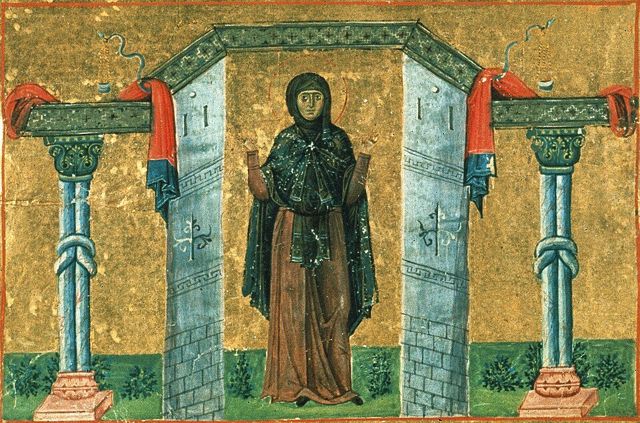
Melania the Younger (born about 382) came from one of the richest families in the Roman Empire. Isidore had been brought up among the solitaries of Nitria, and as he spoke of their virtues to Melania, she resolved to visit the desert where they dwelt, and there she saw and conversed with St. Pambo and other illustrious anchorites.

Read the essentials →
Feast December 31 · —

St. Melania the Younger

Current feast

December 31
Secondary source · Wikipedia infobox

Traditional feast

December 31
1914 / pre-1969 calendar, per Baring-Gould (1897)

Represents

Feast

Feast days

Feast: December 31

This Saint’s Story

Adapted in modern English from Baring-Gould (1897–98) · original text below

Her grandmother, Melania the Elder, had been widowed young and gone east. She supported exiled monks and bishops in Egypt and Palestine and founded a convent in Jerusalem. Baring-Gould notes that her support of Rufinus in his quarrel with St. Jerome over the teaching of Origen kept her out of the official martyrologies. The granddaughter was raised to admire her.

At fourteen Melania was married to Pinianus, who was seventeen. She longed for a life of continence and begged him to let them live apart. He agreed only when she nearly died in her second childbirth; that baby died just after baptism, and their daughter also died in infancy. In 401 they began a religious life together. They sold vast estates in Italy, Spain, Aquitaine, Africa and Britain, despite fierce opposition from his family, which the emperor Honorius overruled. The money went to monasteries, churches and the poor, and she freed her slaves.

Before Alaric's Goths sacked Rome in 410, they withdrew to Sicily and then to Africa. At Tagaste (in modern Algeria), where St. Alypius was bishop, they built two monasteries, one for eighty monks and one for 130 virgins, and they visited St. Augustine at Hippo. There a crowd demanded that the wealthy Pinianus be ordained their priest, which caused a scene, and Augustine had to answer Melania's mother Albina's indignant letter. In 417 they went to the Holy Land. When they had doubts about Pelagius (whose teaching about grace the Church rejected), they wrote to Augustine, who addressed two books to them in reply.

St. Jerome prepared a cell for Melania on the Mount of Olives, and she lived there enclosed for fourteen years. After her mother's death in 432 she founded a convent of virgins. Pinianus died about 435. She travelled to Constantinople to her pagan uncle Volusianus and saw him baptized before he died. Back in Jerusalem she built another monastery and received the Empress (whom the source calls Eudoxia). She caught a chill while praying in St. Stephen's church and died on December 31, apparently in 439 or 440.

Struggles & surrender

This saint’s struggles

  • Grief and opposition ·
    She lost both her children in infancy, then faced her husband's family's anger as she gave away the family fortune, before going into exile when the Goths threatened Rome (Baring-Gould).

What this saint represents

How this saint teaches us to live

Drawn from themes in the original account

Make time for silence. Time alone in prayer is part of this story.

Build up the community you belong to. Community life is part of this story.

Stay faithful when it costs you. Holding firm under pressure is part of this story.

The full story

Baring-Gould’s account retold in modern English

Read the full story · 2,254 words · about 10 min

Melania was married to a man in a high position, whose name is not recorded. She bore him three children. He died and left her a widow when she was only twenty-three. She lost two of her children, and only her son, Publicola, remained. She then placed her child with guardians and started on a pilgrimage to the East with Rufinus, a priest from Aquileia. She arrived in Alexandria in 372, the last year of the life of Saint Athanasius. She saw the great bishop of Alexandria and received from him a relic from the Thebaid, a sheepskin that he had received from the holy abbot Macarius. She also met the priest Isidore the Hospitaller, who had accompanied Saint Athanasius to Rome during the consulate of her grandfather, Marcellinus. She visited the virgin Alexandra. This young woman was a slave girl who, fearing her own beauty and out of pity for the poor soul of the man who loved her, had buried herself alive in an empty tomb and remained there for ten years without allowing anyone to see her face.

Isidore had been raised among the solitaries of Nitria, and as he spoke of their virtues to Melania, she decided to visit the desert where they lived. There, she saw and conversed with Saint Pambo and other notable anchorites.

After the death of Saint Athanasius, the Arians, supported by the emperor Valens, persecuted the Catholics in Egypt. Many bishops, priests, and hermits were banished. Melania used her wealth to help meet their needs. This is related by Saint Paulinus in a letter to Sulpicius Severus. He mentions that she fed 5,000 solitaries who were in hiding for three days, putting herself at great risk. Melania followed 126 exiled bishops and hermits to Diocaesarea in Palestine and supported them from her own fortune. Since the guards were forbidden to allow their friends to visit them, Melania disguised herself as a slave and brought them food every evening. She was arrested by the governor and put in prison.

She sent the consular magistrate this message: “I am the daughter of a consul. I have been the wife of a man renowned in his time; now I am the servant of Christ. Do not despise me because of my simple dress, for I can attain a higher status if I choose; and I have enough influence to keep me from fearing you, and to prevent you from taking my possessions. But in case you might act wrongly out of ignorance, I thought it best to inform you of who I am.” She added, “We must stand firm against fools, matching our pride against their arrogance, just as we release a hound or a falcon against the deer.”

When the magistrate heard who she was and to what a powerful and wealthy family she belonged, he quickly opened the prison doors, showed her great respect, and granted her full freedom to visit the exiles. She founded a monastery in Jerusalem, where she placed fifty virgins. For twenty-five years, she dedicated herself to helping the poor and hosting bishops, monks, and pilgrims of all kinds who came in large numbers to the holy sites, using her own services and the income from her lands in Spain and Aquitaine, which were earned from hardworking laborers. She was guided and supported by Rufinus, who lived in a cell on the Mount of Olives and was at that time an old and dear friend of Jerome. A dispute later arose between Rufinus and Jerome, as described in Jerome's life, caused by the teachings of Origen. Their conflict caused much turmoil in the church and led to sad insults exchanged between them. Naturally, Melania sided with her guide Rufinus, and for supporting Origenist errors, she has been excluded from the Martyrology of the Latin Church and the Menaeas of the East. She is referred to as Melania the Elder.

Meanwhile, her son Publicola had grown up and married Albina, the daughter of Albinus and sister of Volusianus, the praefect (governor) of Rome, whose family was one of the most distinguished in the empire.

From this marriage came S. Melania the Younger. She was born around the year 382 and was raised from childhood with her grandmother's example held up to her as worthy of imitation. At the age of fourteen, she married Pinianus, the son of Severus, who was the praefect (governor) of Italy and Africa; her husband was only seventeen at the time. She became the mother of a daughter, whom she dedicated to virginity from her cradle. She had no interest in, and held a religious prejudice against, marital relations, and she asked her husband to allow them to separate. He refused until Melania was pregnant for a second time, when, fearing for her life, he vowed to agree to the separation. She gave birth to a child, who was baptized but died immediately afterward. Her daughter also did not survive infancy. Therefore, as soon as Melania recovered in 401, when she was twenty years old and he was twenty-four, they arranged to separate. When Melania the Elder heard in Palestine about her granddaughter's decision, her enthusiasm and happiness were immense. Although she was sixty years old, she immediately set out for Rome to support her granddaughter in her decision and to help prevent any foolish or sinful weakness from causing Melania to return to the husband she had vowed to love and cherish for life. Albina, the mother of the young Melania, disapproved of her actions, but Melania the Elder was able to change this disapproval into approval and persuade her to leave her husband as well, joining her in the religious life instead of the family life. The brother of Pinianus and his father Severus were understandably angry, and they believed that Melania, without any objection from her husband, was, in their view, wasting his resources.

Fortune favored beggars and hermits, so they took over his estates and managed them for him. However, Melania complained to the empress, who was her relative, and through her influence, Honorius relieved Melania and her husband from all troubles caused by his relatives. They sold their estates in Rome, Italy, Aquitaine, Spain, and Britain, and the proceeds from this sale amounted to such a large sum that it was believed that only the emperor had more wealth.

The father and brother of Pinianus watched this division of the family estates with mixed feelings of anger and disdain, but they could not oppose the emperor, who had approved it. The only estates that were not sold were some in Campania, Sicily, and Africa, which belonged to Melania herself, and she could not sell them until her father's death. The money from the sales was used to establish monasteries, support the idle and the needy, and decorate churches with gold and silver vessels. She freed her slaves, but many of them refused their freedom and chose to serve her brother Publicola instead.

She sent messengers to Egypt, Antioch, and Jerusalem carrying money for the support of hermits and monks. The two Melanias and Albina, who now lived together almost inseparably, often visited Saint Paulinus of Nola, their relative, and received warm encouragement from him. Palladius, the bishop of Helenopolis in Bithynia, like Rufinus, who praised the desert dwellers, came to Rome in 404 or 405 and stayed there until early 406. He was received by the three ladies with great honor and affection. “When we were in Rome," he says, “they welcomed us with every sign of respect and provided us with the best hospitality, making themselves worthy, through their kindness and holy way of life, of sharing in the eternal life of our Lord Jesus Christ."

Publicola, the father of the younger Melania and the son of the elder Melania, did not allow his daughter, mother, and wife to leave Rome and indulge in the extreme asceticism of their passionate desires. However, after his death in 407, Albina and Melania the Younger were free. The elder Melania was then in Africa, visiting and comforting the hermits in the desert. The younger Melania and Albina sought advice from Saint Paulinus, while Pinianus was assigned to gardening with thirty solitary men.

Pinianus put his palace in Rome up for sale, but it was so magnificent that no one could offer a suitable price for it until after 410, when the Goths entered Rome, or until the palace had been burned and looted, which decreased its value. Before Alaric led his Goths to Rome, Melania, Albina, and Pinianus had sought refuge in Sicily with their treasures. Melania the Elder traveled on to Jerusalem, where she died forty days after her arrival.

Melania the Younger, accompanied by her mother and husband, left Sicily for Africa. She wanted to nourish her spirit by contemplating the ascetic lives of the hermits in the desert, of whom she had heard so much. She hoped that their example would inspire Pinianus to settle in the desolate regions of Scete or Nitria among them, thus freeing her from his somewhat burdensome company. On their journey, they stopped at Malta and found the locals suffering from a raid by barbarians, who threatened to loot their homes unless they paid a hefty ransom.

Melania and her husband donated a large sum to the bishop, who then paid the ransom to the Vandal raiders, who subsequently left the island without causing further trouble. From there, Melania and her group traveled to Africa and visited Tagaste, where Alypius, a friend of Saint Augustine, was the bishop. They donated valuable items to his church and established two monasteries: one for eighty monks and the other for 130 virgins. They were unable to meet Saint Augustine in Tagaste because he was in Hippo; therefore, they visited him in his see and generously gave to the poor and the Church.

Pinianus was worried that the people would choose him as their priest in Hippo because of his wealth, so he obtained a promise from Saint Augustine that he would not ordain him.

One day, the people began to shout for Pinianus to be their priest. Saint Augustine then reminded them of the promise he had made. The crowd then started to insult Saint Alypius, believing that he wanted the wealthy man as priest for one of his churches. They would not calm down until Pinianus swore solemnly that he would only be ordained as priest in Hippo.

Albina, who had stayed behind in Tagaste, wrote a letter full of complaints to Saint Augustine when she heard what had happened. She said, “As for the people of Hippo, all they wanted was a man of fortune who could throw away money among them.” Augustine wrote back to calm her down and to present a more favorable view of his people’s motives. After staying in Tagaste and Hippo for seven years, Melania took her mother and husband with her to the Holy Land in the year 417, visiting Saint Cyril in Alexandria along the way. In Palestine, they met Pelagius and began to have some doubts about the validity of his teachings. They wrote to Saint Augustine about their concerns, and in response, he sent them his two books titled “The Grace of Jesus Christ” and “Original Sin,” which he addressed to them in 418. After their time in Palestine, Melania took her husband to Egypt to visit the hermits of Nitria, but they returned before 419. In that year, Saint Jerome wrote to Saint Augustine, greeting him on behalf of Melania and Albina, whose age had prevented her from accompanying Melania and Pinianus to Egypt. While Melania was away, Saint Jerome prepared a cell for her on the Mount of Olives. Upon her return, she confined herself to it and saw no one except her mother, her husband, and a cousin, who were allowed to visit her once every five days.

Melania spent fourteen years in this cell and only left it to fulfill her final duties to her mother, who died in 432. After that, she moved to another cell but left it after a year to join a community of virgins in a convent that she built to house them.

Pinianus died around the end of the year 435. Albina's brother was Volusianus, who was a pagan. In fact, the actions of his sister and niece likely seemed so foolish and offensive to him that he became even more disgusted with Christianity. However, Volusianus may have realized that the days of the old Roman religion were over and that it was pointless to hope for its revival. Therefore, he accepted the inevitable and prepared to submit to the religion of the emperors. He sent for Melania, and she quickly went to Constantinople, where she found him incapacitated by an accident. She was pleased to see him baptized before he passed away.

She returned full of joy in the winter to Jerusalem. She then built another monastery, and the Empress Eudoxia visited Jerusalem while it was being built. Eudoxia dislocated her ankle during that visit; Melania skillfully put it back in place, and, as the empress said with Eastern courtesy and exaggeration, without really hinting at it at all. Four years after the death of her husband, Melania visited Bethlehem at Christmas, and then hurried to Jerusalem. She caught a chill while praying in the church of Saint Stephen, and died on the last day of the year, apparently the year after 439, in which Eudoxia came to Jerusalem.

Footnotes

  1. Saint Paulinus relates Melania's acts of charity in a letter to Sulpicius Severus.
  2. Palladius, bishop of Helenopolis in Bithynia, came to Rome in 404 or 405.
  3. Publicola was the father of the younger Melania and son of the elder Melania.
  4. Melania the Elder traveled to Jerusalem and died there.
  5. Melania the Younger sought inspiration from desert hermits.
  6. The Vandal raiders were paid off to leave Malta.
  7. Alypius was a friend of Saint Augustine and bishop in Tagaste.
  8. Pinianus was concerned about being chosen as priest due to his wealth.
  9. Volusianus was a heathen.
  10. Melania took her husband into Egypt to visit the solitaries of Nitria.
  11. Saint Jerome prepared a cell for Melania on the Mount of Olives.
  12. Eudoxia was the wife of Emperor Arcadius and a prominent figure in the early 5th century.
  13. Saint Stephen is recognized as the first Christian martyr.

Baring-Gould’s own footnotes, in modern English.

Read the original 1870s text

Baring-Gould’s sources: Roman Martyrology, introduced from the Greek Menaea. Authorities: — A Life by Metaphrastes; and one in the 11 Lives of the Fathers of the Desert” She is mentioned also by S. Paulinus of Nola and S. Augustine.] Melania, daughter of a consul, mother of a praetor, belonged to the illustrious family of Marcellinus, of Spanish origin. She was related to S. Paulinus of Nola, and was second to none in Aquitaine and Spain for wealth and nobility. She was bom at Rome in 342 or 343, about two years after the consulate of Marcellinus, whose granddaughter she was.

Melania was married to a man in high office, whose name 1 Metaphrastes gives a long story of Sylvester withstanding in argument a Jew named Zambres, and of his raising a dead bull to life, at sight of which miracle S. Helena asked for baptism.

k beaucoup de monde par Finfection de son haleine.” — Guerin et Giry. is, however, not recorded; and she bore him three children. He died and left her a widow when she was only twentythree. She lost two of her children, and there remained to her only a son, Publicola. She then placed her child with guardians, and started on a pilgrimage to the East with Rufinus, priest of Aquileja. She arrived in Alexandria in 372, the last year of the life of S. Athanasius [bishop of Alexandria (d. 373), great defender of the Nicene faith]. She saw the great bishop of Alexandria, and received from his hands a relic of the Thebaid [the desert region of Upper (southern) Egypt], a sheepskin which he had received from the holy abbot Macarius. She also met the priest Isidore the Hospitaller, who had attended S. Athanasius to Rome during the consulate of her grandfather, Marcellinus. She also visited the virgin Alexandra. This maiden was a slave girl, who, fearing her own beauty, and in pity for the poor soul of him who loved her, had buried herself alive in an empty tomb, and remained ten years without permitting any one to see her face.

Isidore had been brought up among the solitaries of Nitria [a desert monastic settlement west of the Nile Delta], and as he spoke of their virtues to Melania, she resolved to visit the desert where they dwelt, and there she saw and conversed with S. Pambo and other illustrious anchorites.

On the death of S. Athanasius, the Arians [followers of Arius, who taught that the Son is a created being, not fully God], protected by the emperor Valens, persecuted the Catholics in Egypt. Many bishops, priests, and hermits were banished. Melania used her fortune to relieve their necessities. This S. Paulinus relates in a letter to Sulpicius Severus. He says that she fed during three days 5,000 solitaries who were in concealment, at great risk to herself. Melania followed 126 exiled bishops and hermits to Diocaesarea in Palestine, and supported them from her private fortune. As the guards were forbidden to allow their friends to visit them, Melania disguised herself as a slave, and carried them every evening their food. She was arrested by the governor, and put in prison.

She sent the consular magistrate this message: “I am the daughter of a consul. I have been the wife of a man illustrious in his generation; now I am the servant of Christ. Despise me not because of my mean dress, for I can attain a higher rank if I will; and I have sufficient credit to keep me from fearing you, and to hinder you from touching my goods. But lest you should do wrong by ignorance, I have thought fit to let you know who I am.” And she added, “ We must make head against fools, setting our pride against their insolence, as we loose a hound or a falcon against the deer.”

When the magistrate heard who she was, and to what a powerful and wealthy family she belonged, he precipitately threw open the prison doors, showed her the most profound respect, and gave her full liberty to visit the exiles. She founded a monastery at Jerusalem, in which she placed fifty virgins. For twenty-five years she devoted to the relief of the poor, and the entertainment of the bishops, monks, and pilgrims of every description, who came in swarms to the holy places, her own services, and the revenues drawn from her lands in Spain and Aquitaine, wrung from the hardworking labourers. She was guided and seconded by Rufinus, who inhabited a cell on the Mount of Olives, and who was at that period the old and tender friend of S. Jerome [translator of the Bible into Latin (d. 420)]. A dispute afterwards took place between Rufinus and Jerome, as related in the life of the latter, occasioned by the doctrines of Origen. Their rupture long agitated the durch, and drew from them melancholy invectives against each other. Melania naturally sided with her guide Rufinus, and for having countenanced Origenist errors, has been excluded from the Martyrology of the Latin Church and the Menaeas of the East. She is called Melania the Elder.

In the meantime her son Publicola had grown up, and married Albina, daughter of Albinus and sister of Volusianus, praefect of Rome, whose family was one of the most illustrious in the empire.

From this marriage issued S. Melania the Younger. She was born about 382, and was brought up from infancy with the example of her grandmother held up to her as deserving of imitation. At the age of fourteen she was married to Pinianus, son of Severus, praefect of Italy and Africa; her husband was only seventeen. She became the mother of a daughter, whom she dedicated from her cradle to virginity. She had no taste for, or a religious prejudice against, conjugal union, and she besought her husband to let them separate. He refused till Melania was being confined a second time, when, in his alarm for her life, he vowed to yield She gave birth to a child, which was baptized, and died immediately after. Her daughter also did not survive infancy. Accordingly, so soon as Melania was well, in 401, when she was aged twenty, and he twenty-four, it was arranged between them that they should separate. When Melania the Elder heard in Palestine of the determination of her granddaughter, nothing could exceed her enthusiasm and gratification. Although aged sixty, she at once started for Rome to encourage her granddaughter in her resolution, and by her presence prevent a foolish or sinful weakness from overcoming Melania, and drawing her back to the arms of the husband whom she had sworn to love and cherish so long as life should last Albina, mother of the young Melania, disapproved of her conduct, but Melania the Elder was able to overcome this disapproval, and convert it into approval, and persuade her also to desert her husband, and join her in the exercises of the religious, as opposed to the family, life. The brother of Pinianus, and his father Severus, were naturally incensed; and finding that Melania, without protest from her husband, was, as they thought, squandering his j£ gi S. Melania the Younger.

fortune on beggars and hermits, they seized on his estates and administered them for him. But Melania complained to the empress, her relative, and by her influence Honorius relieved Melania and her husband from all inconvenience from the relations of the latter. They sold their estates in Rome, Italy, Aquitaine, Spain, and Britain, and the result of this sale produced such a sum that it was thought that none but the emperor possessed more. The father and brother of Pinianus beheld this dispersion of the family estates with mingled emotions of rage and contempt; but they were unable to oppose the emperor, who had sanctioned it. The only estates not disposed of were some in Campania, Sicily, and Africa, which belonged to Melania herself, and of which she could not dispose till her father's death. The money obtained by the sales was spent in founding monasteries, feeding the idle and the indigent, and adorning churches with vessels of gold and silver. She emancipated her slaves, but many of them would not receive their freedom, and passed to the service of her brother Publicola. She sent messengers to Egypt, Antioch, and Jerusalem laden with money for the use of hermits and monks. The two * Melanias and Albina, who now lived together almost inseparably, often visited S. Paulinus of Nola, their kinsman, and received from him warm encouragement. Palladius, bishop of Helenopolis in Bithynia, like Rufinus, the panegyrist of the desert dwellers, came to Rome in 404 or 405, and remained there till the beginning of 406, and was received by the three ladies with much honour and affection. “ When we were in Rome," he says, “ they received us with every demonstration of respect, and made us the best cheer, rendering themselves worthy, by their hospitality and their holy manner of life, of participating in the eternal life of our Lord Jesus Christ."

Publicola, father of the younger Melania and son of the elder of that name, would not allow his daughter and mother and wife to leave Rome, and give themselves up to all the extravagant asceticism of their highly enthusiastic desires. But on his death, in 407, Albina and Melania the Younger were free. The elder Melania was then in Africa, visiting and consoling the hermits in the desert. The younger Melania and Albina went to S. Paulinus for his advice, and Pinianus was consigned to cabbage-gardening with thirty solitaries.

Pinianus offered for sale his palace in Rome, but it was so splendid that no one could bid for it a worthy price till after 410, when Rome had been entered by the Goths [Germanic peoples who invaded the Roman Empire, many of them Arian Christians], or the palace had been fired and plundered, by which its value was reduced. But before Alaric came to Rome at the head of his Goths, Melania, Albina, and Pinianus had taken refuge in Sicily with their treasures. Melania the Elder went on to Jerusalem, and there died, forty days after her arrival Melania the Younger, drawing in her train her mother and husband, now left Sicily for Africa, that she might refresh her soul by a contemplation of the ascetic lives of the anchorites of the desert, of whom she had heard so much, and in the hope that their example would inspire Pinianus with ambition to settle in the wastes of Scete or Nitria among them, and disembarrass her of his somewhat burdensome society. On their way they landed at Malta, and found the inhabitants suffering from a visit of barbarians, who threatened to pillage them and bum their houses unless they paid a heavy ransom. Melania and her husband gave large alms to the bishop, and he paid it to the Vandal freebooters, who thereupon left the island without further molestation. Thence Melania and her party went to Africa and visited Tagaste, where Alypius, the friend of S. Augustine, was bishop. They gave costly ornaments to his church, and endowed and built two monasteries there: one for eighty monks, the other Doc.3x.] S. Melania the Younger. < 423 for 130 virgins. They were unable to see S. Augustine at Tagaste, for he was at Hippo; they therefore visited him in his see, and gave liberal presents to the poor and to the Church. Pinianus was fearful of being chosen by the people to be priest at Hippo, for the sake of his wealth, and he extracted from S. Augustine a promise that he would not ordain him.

One day the people began to clamour for Pinianus as their priest, S. Augustine then told them of the promise he had made. The crowd thereupon broke into abuse of S. Alypius, who, they thought, wanted the wealthy man as priest for one of his churches; and they would not be pacified till Pinianus swore solemnly that he would be ordained priest nowhere else but at Hippo.

Albina, who had remained behind at Tagaste, on hearing what had taken place wrote a letter full of feminine scolding to S. Augustine: “ As for the people of Hippo,” she said, " all they wanted was a man of fortune who could throw away money among them.” Augustine wrote to pacify her and to give a better colour to the motives of his people. After seven years stay at Tagaste and Hippo, Melania carried her mother and husband with her to the Holy Land, a.d. 417, visiting S. Cyril on the way, at Alexandria. In Palestine they met Pelagius, and were thrown into some doubt as to the soundness of his doctrines. They wrote to S. Augustine about them, and he sent to them in reply his two books on “ The Grace of Jesus Christ ” and on “ Original Sin,” which he addressed to them in 418. From Palestine Melania took her husband into Egypt to visit the solitaries of Nitria, but they returned before 419; for S. Jerome in writing to S. Augustine in that year, saluted him on their part and that of Albina, whose age had prevented her accompanying Melania and Pinianus to Egypt. Whilst Melania was absent, S. Jerome prepared for her a cell on the Mount of Olives, and on her return she shut herself up in it, and saw no one but her mother, her husband, and a cousin, who were allowed to visit her once every five days.

Melania passed fourteen years in this cell, and only left it to pay her last duties to her mother, who died in 432. Then she went into another cell, but left it after a year, to place herself with a community of virgins in a convent she built to receive them.

Pinianus died about the end of the year 435. The brother of Albina was Volusianus, who was a heathen; indeed the conduct of his sister and his niece had probably seemed so foolish and offensive in his eyes, that he had been hardened in his disgust at Christianity. But Volusianus may have seen that the days of the old religion of Rome were ended past revival, and that it was in vain to hope for its restoration. He therefore bowed to the inevitable, and prepared to give in his submission to the religion of the emperors. He sent for Melania, and she hastened to Constantinople, and found him prostrated by an accident. She had the satisfaction of seeing him baptized before he died.

She returned full of joy in the winter to Jerusalem. She then built another monastery, and the Empress Eudoxia visited Jerusalem whilst it was being built. Eudoxia put her ankle out of joint on that visit; Melania replaced it with skill, and, as the empress said with Oriental courtesy and exaggeration, without really hinting her at alL Four years after the death of her husband, Melania made a visit to Bethlehem at Christmas, and then hastened to Jerusalem. She caught a chill whilst praying in the church of S. Stephen, and died on the last day of the year, apparently that following the year 439, in which Eudoxia came to Jerusalem.
Help us add to this saint's story

Everything is read by a person before anything appears. Facts are checked against trusted sources first.

Facts are welcome; a source link helps (optional).With your permission we may share it on this page.

Nine days · Free

Pray the novena
with us.

One short email a day for nine days. The day's prayer, a line from St. Melania the Younger's story, and a nudge to keep going.

Also on December 31
C

St. Columba (December 31)

December 31 · Virgin, Martyr
St. Sylvester, Pope

St. Sylvester

December 31 · Feast
M

St. Marius of Avenches

December 31 · Bishop
← All 1970 saints in the library
Sources & notes

Feast-day sources

Story sources

Sources

Credits

Image: Melania the Younger, nun of Rome (Menologion of Basil II).jpg · Authors of Menologion of Basil II (circa 985 AC, Constantinople), Byzantine manuscript illuminators[1]: Pantoleon with G · Public domain, via Wikimedia Commons

Image: Authors of Menologion of Basil II (circa 985 AC, Constantinople), Byzantine manuscript illuminators[1]: Pantoleon with G, Wikimedia Commons (Public domain)

Retold in plain modern English from Baring-Gould’s public-domain text, sentence by sentence, keeping the same facts and order. Short explanations in parentheses are ours.

From Sabine Baring-Gould, The Lives of the Saints, new edition in 16 vols. (London: John C. Nimmo, 1897–98); text from the Internet Archive scan (OCR, lightly cleaned; errors possible). Public domain in the United States. Reproduced unedited, except for short bracketed notes in grey that we added to explain names and terms (“S.” is the old abbreviation for Saint). Some history and judgments reflect 19th-century scholarship.