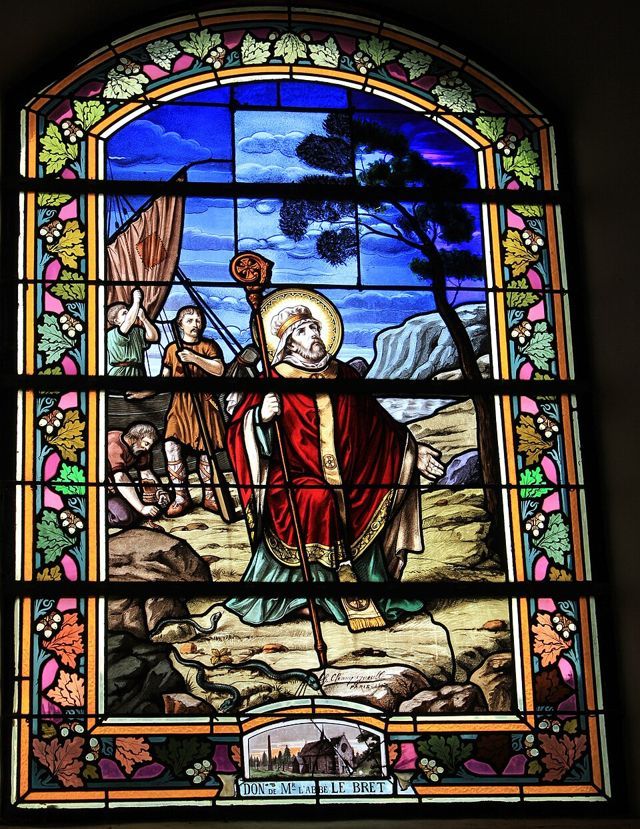
St. Maudez

Maudez is a Breton saint of the fifth or sixth century, also called Maudé, Maudet, Maodez, Modez, and Maudetus. He was born in Ulster, and his father’s name is said to have been Ardseus.

Read the essentials →
Feast November 18 · Abbot

St. Maudez

Current feast

November 18
Secondary source · Wikipedia infobox

Traditional feast

November 18
1914 / pre-1969 calendar, per Baring-Gould (1897)

Represents

Abbot

Feast days

Feast: November 18

This Saint’s Story

In our own words, from Baring-Gould (1897–98), whose original account remains further down this page.

In Cornwall he is known as St. Mawes. The Breton calendar keeps him on 18 November, which is also the Dedication of the Basilicas of Sts. Peter and Paul. They are different feasts, and they have different pages.

The longer story already on this page comes from Baring-Gould's Lives of the Saints, the text this page was built from. That account says he was born in Ulster, the tenth son of a father named Ardseus — probably the title ard-righ, 'high king', taken as a name — and a mother called Getusa or Vernosa, and that his parents gave him to God as a tithe of their children. It says he passed briefly through the monastery of Dol, then went to Tréguier, looked for solitude on the seashore near Plou Bihan, and fled to an island near Enez-Glaz because crowds followed him. It says the island swarmed with snakes and that he drove them all into the sea. It says he died and was buried on the island, and that his relics were taken to Bourges in 878. Breton mothers, in that same account, took earth from the island, mixed it with water, and gave it to their children against worms. The snakes, the tithe of sons, and the earth are the shape of the legend. They are not a contemporary record.

For today: You can honour a saint whose story is mostly a legend, and you can say so. On 18 November remember Maudez as the Breton hermit behind the name Mawes, and keep the basilicas of Peter and Paul as their own feast on the same date.
What he represents

How he teaches us to live

Drawn from themes in the original account

Build up the community you belong to. Community life is part of this story.

Take one thing from this life into your own. Maudez is a Breton saint of the fifth or sixth century, also called Maudé, Maudet, Maodez, Modez, and Maudetus.

The full story

Baring-Gould’s account retold in modern English

Read the full story · 285 words · about 1 min

Fland was born at an early age in Ulster, and his father's name is said to have been Ardseus. This is probably the title Ard-righ, which means chief king, taken as a name. His mother is called variously Getusa and Vernosa. He was the tenth son of his parents, and they dedicated him to God as a tithe of their children.

He came to Brittany and stayed at the monastery of Dol for a short time. He then went to Treguier and visited S. Tugduval in the town of Cozgueaudet, also known as Lexobie, who gave him the abbey of Trecor as a place of retreat under the holy abbot Ruelin. After some years, he sought a solitary place on the shore of the sea near Plou Bihan, now called Ues-Modez, or the church of S. Maudez. However, he was pursued by such crowds that he fled to an island near Enez Glaz, in the diocese of Treguier. It is said that the island was full of serpents, and that S. Maudez drove them all into the sea. He died and was buried on the island, but his relics were moved to Bourges in 878. A portion of his right arm is preserved in the church of Lesneven, a portion of his left arm is in the church of Saint Jean-du-Doigt, and some bones are in the cathedral of Treguier. The earth from the island of S. Maudez is carefully collected and mixed with water, and Breton mothers give it to their children, hoping that, just as S. Maudez expelled snakes from the island, the earth blessed by him will act as a remedy against worms. S. Maudez is known as S. Mawes in Cornwall.

Footnotes

  1. The title Ard-righ means chief king.
  2. Cozgueaudet is also known as Lexobie.
  3. Enez Glaz is in the diocese of Treguier.
  4. S. Mawes is the Cornish name for S. Maudez.

Baring-Gould’s own footnotes, in modern English.

Read the original 1870s text

Baring-Gould’s sources: Gallican Martyrologies. Authorities: — A MS. Life written before 878, used by Lobineau and Le Grand. The Lections in the Breviaries of Leon; and the MS. Legendaries of Treguer, used by Albert Le Grand.] S. Maudez, Modez, or Mondez, was an Irishman. In Ireland he bears the name of Moditeus, but little or nothing is related of him. The reason is^ that he left his native 1 See Hon. E. Twisleton: “The Tongue not essential to Speech.” Nov. iS.l 61 Maudez.

Fland at an early age. He was born in Ulster, and his father’s name is said to have been Ardseus. This is probably the title Ard-righ, or chief king, taken as a name. The mother is called variously Getusa and Vernosa. He was the tenth son of his parents, and was given by them to God as a tithe of their offspring.

He came to Brittany, and placed himself in the monastery of Dol for a short time. He then went to Treguier, and visited S. Tugduval in the town of Cozgueaudet, or Lexobie, who gave him the abbey of Trecor, as a place of retreat under the holy abbot Ruelin. After some years he sought a solitary place on the shore of the sea near Plou Bihan, now called Ues-Modez, or the church ofS. Maudez, but was pursued by such crowds that he fled to an island near EnezGlaz, in the diocese of Treguier. It is said that the island abounded with serpents, and that S. Maudez drove them all into the sea. He died, and was buried in the island, but his relics [the bodily remains of a saint, or objects they used, kept with honor] were removed to Bourges in 878. A portion of the right arm is preserved in the church of Lesneven, a portion of the left arm in the church of Saint Jean-du-Doigt; some bones in the cathedral of Treguier. The earth of the island of S. Maudez is diligently collected and mixed with water, and given by Breton mothers to their children, hoping that as S. Maudez expelled snakes from the island, so the earth blessed by him will act as a vermifuge. S. Maudez is S. Mawes in Cornwall.

Help us add to this saint's story

Everything is read by a person before anything appears. Facts are checked against trusted sources first.

Facts are welcome; a source link helps (optional).With your permission we may share it on this page.

Nine days · Free

Pray the novena
with us.

One short email a day for nine days. The day's prayer, a line from St. Maudez's story, and a nudge to keep going.

Also on November 18
R

St. Romanus (November 18)

November 18 · Martyr
St. Odo of Cluny

St. Odo of Cluny

November 18 · Abbot
Bl. Karolina Kózka

Bl. Karolina Kózka

November 18 · Virgin, Martyr
← All 1970 saints in the library
Sources & notes

Feast-day sources

Story sources

Sources

Credits

Image: Église Sainte-Croix (La Croix-Helléan) 5037.JPG · XIIIfromTOKYO · CC BY-SA 3.0, via Wikimedia Commons

Image: XIIIfromTOKYO, Wikimedia Commons (CC BY-SA 3.0)

Retold in plain modern English from Baring-Gould’s public-domain text, sentence by sentence, keeping the same facts and order. Short explanations in parentheses are ours.

From Sabine Baring-Gould, The Lives of the Saints, new edition in 16 vols. (London: John C. Nimmo, 1897–98); text from the Internet Archive scan (OCR, lightly cleaned; errors possible). Public domain in the United States. Reproduced unedited, except for short bracketed notes in grey that we added to explain names and terms (“S.” is the old abbreviation for Saint). Some history and judgments reflect 19th-century scholarship.