For a special position, the curator chosen by the Government was usually an experienced soldier who had long been trusted. Early Christian history also reflects positively on the moral qualities of Roman officers. These qualities were primarily shaped by their thoroughness in work and discipline.
Martin spent three years in the army before he was baptized. He shared a tent with one servant, dividing work and hardships with him. His unit was stationed in Gaul, at Ambianum, which is now known as Amiens. One cold winter day, as he was passing through the city gate, he saw a poor beggar who was nearly naked, so tattered were his clothes. Filled with compassion, Martin cut his cloak in half and gave one part to the beggar. The onlookers mocked him, but Martin ignored their jeers. That night, while he slept, he had a vision of Christ Jesus seated on His throne, surrounded by the hosts of heaven, wearing the half cloak of Martin over His shoulders. “See!” he heard the Saviour say, “this is the cloak which Martin, still a catechumen, gave me.”
Popular belief identified a specific location in Amiens as the site of Martin's act of charity, and a chapel was built there before the time of Gregory of Tours. This chapel eventually became an abbey, known as S. Martin aux Jumeaux, named after the twin towers of the nearby church of S. Nicolas. In 1472, King Louis XI. provided an endowment to the church of S. Martin at Tours for the ongoing support of a poor bedesman. This bedesman was to wear a two-colored cloak, one part red and the other white, in memory of Martin's severed cloak. Martin was baptized after this dream in Amiens when he was eighteen years old. He remained in the army for two more years, until 358. In 355 and 356, the Franks and Allemanni invaded Gaul and devastated parts of the province. Cities such as Cologne, Worms, Trier, Speyer, Strasbourg, Tongeren, and others—forty-five in total—were affected.
MARTIN DIVIDING HIS CLOAK WITH THE BEGGAR. After a picture by Rubens in the possession of the Queen. November 11.
November 11. Martin, along with many villages, had been attacked and burned by the barbarians. The legions in Gaul, lacking pay, supplies, and weapons, and reduced in number, could not resist the invaders. In 356, Julian was sent to Gaul with a small group of 360 soldiers. While wintering in Vienne, he learned that Autun had been attacked but was saved from falling due to the brave actions of some veterans who took up arms to defend their country. The following spring, Julian marched north to Rheims, where he was likely joined by the legion in which Martin served as tribune. Leading a small army that had been gathered from Gaul, the determined Julian set out in search of the enemy. The Allemanni, familiar with the terrain, secretly gathered their scattered forces and, seizing the chance on a dark and rainy day, launched a sudden attack on the rear-guard of the Romans, destroying two legions. Julian quickly sought to avenge this disaster by attacking the barbarians, who, unable to withstand the disciplined fervor of the Romans, scattered into the hills and forests, leaving Julian with a hollow victory. He advanced to the Rhine, surveyed the ruins of Cologne, and then, warned of the approaching winter and aware of the challenges of the campaign, retreated disheartened to Sens. His retreat was troubled by the bold Germans, who followed him to the city's walls and surrounded it. However, finding themselves unable to breach the city's defenses, they withdrew after a siege of thirty days.
The next year, the campaign was conducted with more energy. An army of thirty thousand men crossed the Alps, built a bridge over the Rhine at Basle, and threatened the Germans in the south, while Julian marched against them from Gaul. However, the southern army under Barbatis withdrew without achieving anything significant, leaving Julian to face the barbarian hordes alone. Julian, leading thirteen thousand men, was camped near Strassburg.
The Allemanni attacked him, and after a furious and bloody battle, they were defeated. He then marched north and defeated the Franks on the Meuse River. His maneuvers in 359 were met with brilliant successes, and in 360 he was proclaimed Emperor by the Gallic legions in Paris.
Apparently in 358, during the war against the Franks and Allemanni, when Julian was at Worms, Martin, the young tribune, made the untimely request to be released from military duty. Julian was indignant. A battle was imminent, and he scornfully refused the request, saying that Martin was a coward and feared the battle. The young tribune replied, “Put me in the forefront of the army, without weapons or armor; but I will not draw sword again. I have become the soldier of Christ.” Julian ordered him to be put in chains.
The Allemanni then asked for terms of peace, and Martin was allowed to leave. It is hardly possible to excuse Martin for prioritizing his own interests and welfare over those of his country by deserting the army at a time of great peril. However, the battle of Strasbourg may have led him to conclude, prematurely, that the barbarians were effectively humbled and their invasions permanently checked.
After leaving the army, Martin went to Poitiers and placed himself under the teaching of Saint Hilary. The bishop wanted to confer on him the diaconate, but Martin's modesty was alarmed, and he was with difficulty persuaded to accept the lesser office of exorcist. This office, according to a modern biographer of Saint Martin, “exposes the bearer to insult from the devil, who attacks him with outrageous abuse, and even beats him.”
Not long after, Martin felt compelled by affection for his parents to visit them in Pannonia. As he crossed the Alps, he was attacked by robbers, and one of them threatened him with a sword. He was robbed of his money and other valuables, and then dismissed, but not before he had spoken such words of Baptism.
Grace was given to the robber who had charge of him, and he was converted. The robber left his life of crime and became a peaceful citizen. He shared the details of his conversion with Sulpicius Severus, who included them in his account of the saint.
When Martin reached Sabaria, he succeeded in converting his mother to Christianity, but his father remained committed to paganism. At that time, Arianism was widespread in Illyricum (an ancient region in the western Balkans) and Pannonia (a region in what is now Hungary). Martin strongly opposed the heresy promoted by the bishops and was publicly whipped and expelled from Sabaria. He returned to Italy and learned that Saint Hilary had been removed from his position by the Arians. Martin settled in Milan in a secluded area, where he lived as a hermit. His passionate and defiant commitment to orthodox beliefs led him into trouble again, and Auxentius, the Arian bishop, expelled him from his solitude.
He then sought refuge on the island of Gallinaria, now known as Isoletta d'Albenga, located opposite Albenga along the Comiche Road. It was a beautiful place, a small white island set in the deep blue of the calm sea, with the Maritime Alps blocking the northern winds and lining the northern horizon with their jagged, barren peaks.
On this island, Martin survived by eating roots, but he nearly poisoned himself by accidentally consuming hellebore, which is attractive with its dark green leaves and pale green flowers, growing abundantly on the limestone slopes. Fortunately, the spasms caused by the poison came on so quickly that they prevented him from eating enough to be fatal; however, he experienced great pain and was close to death.
After some time, learning that Saint Hilary was returning to Poitiers, Martin left his sunny island and followed him. Hilary was delighted to see him again and provided him with a place to stay near Poitiers, where he founded the monastery that is now known as Ligugé. Sulpicius Severus recounts the following story about what happened next.
place in his monastery. A catechumen joined him, wanting to learn from this holy man, and a few days later, he fell ill with weakness and a high fever. By chance, Martin was away at that time. On the third day, when he returned, he found the man lifeless. Death had come so suddenly that there had not been time for his baptism. His brothers, overwhelmed with grief, surrounded the corpse and performed their sorrowful duties, weeping and lamenting as Martin approached. But then the Holy Spirit inspired him. He made everyone leave and shut himself in alone with the body. After praying for some time, informed by the Spirit of the Lord about the coming miracle, he raised himself slightly and fixed his eyes on the face of the dead man, waiting confidently for the outcome of his prayer and the mercy of the Lord. Within two hours, Martin saw the dead man gradually regain the use of his limbs and reopen his eyes. Then Martin cried out to the Lord and thanked Him. The cry of the blessed man echoed through the cell, and those who were waiting outside the door, upon hearing it, rushed in. What a wonderful sight! They saw him alive whom they had left for dead. Sulpicius Severus saw and spoke with this man.
Around the year 371, the Church of Tours lost its pastor, S. Lidorius, and the people decided to get Martin as their bishop. However, it was suspected that Martin would refuse and try to escape if he heard what was proposed, so they resorted to a trick. Ruridus, a citizen of Tours, went to the monastery of Ligugd and fell at Martin's feet, begging him to come and see his wife, who was ill. Martin unsuspectingly followed him. On the way, as he approached Tours, a group of people ambushed him; some blocked the road.
lest he should attempt to return, and others, surrounding him, led him in triumph to Tours. The bishops present to consecrate a successor to Saint Lidorius objected. They said that Martin was not a suitable person to be a bishop; he was dirty, poorly dressed, and his hair was messy and uncombed. But the people were determined to have him as their pastor, and the bishops had to give in. Among those who objected most strongly to his consecration was Defensor, who was believed to be the bishop of Angers. During the ceremony, the crowd was so large that the lector could not make his way through the throng to his place to read the lesson. There was a pause; the clergy waited, and then one of them picked up a psalter and opened it at random to read any passage in place of the lesson. He landed on the words of the psalm: “Out of the mouths of babes and sucklings hast Thou ordained praise, that Thou mightest still the enemy and the Defender.” At these words, the people shouted, and the unfortunate bishop Defensor was filled with embarrassment.
Martin remained a monk even after being made a bishop. He lived for some time in a cell near the church. However, being tired of the number of visitors who came to him, he moved to the place where the abbey of Marmoutier would later be built, in a secluded area on the banks of the Loire River, surrounded by sandstone cliffs and forest, and accessible only by a narrow path. Martin stayed in a cabin made of branches; several of his monks dug out caves in the sandstone and made comfortable homes for themselves this way. Martin had eighty disciples. They wore skins, ate only once a day, drank no wine, and shared everything in common.
Not far from Tours, near the monastery, was a tomb of a
It is not known if this saint was truly a saint, at which one of the earlier bishops of Tours, either Saint Lidorius or Saint Gatianus, or perhaps another bishop whose name has not been recorded, had raised an altar. The people held the relics of this saint in high regard and flocked to it to seek the intercession of the martyr and the miraculous healing of their ailments. Saint Martin suspected that this martyr, whom the people and his predecessors honored, was not worthy of such commemoration. He conducted thorough inquiries and discovered that instead of being a martyr, the man had been a highway robber, executed on the spot for his crimes. Sulpicius states that Martin saw the ghost of the robber, who informed him that he was in hell, not in heaven as the people believed.
Martin found that the local people were very attached to their old religion and honored a large pine tree. He insisted on cutting it down; however, when he realized that this would cause a disturbance and possibly bloodshed, he offered to be tied up and sit where the tree was likely to fall if the pagans would cut it down themselves. They agreed, hoping to see their enemy crushed. But instead of falling where Martin sat, the tree crashed down in the opposite direction. His escape from the death that threatened him led to the conversion of many peasants. Martin demolished their temple and built a church on that site. Wherever he went, he destroyed the ancient temples with a crowbar and firebrand.
Guibert of Nogent states that in the early 12th century, all sorts of bones were revered as those of confessors and martyrs, and that a drunken man who fell into a well was elevated to martyr status. In a village near Beauvais, a youth of no particular merit was regarded as a saint solely because he died on Good Friday, and the monks and abbot of the monastery church where he was buried encouraged this devotion because it brought them great profit. Guibert notes that in every place, old women canonize new saints by inventing all sorts of gossip about them. A priest displayed a piece of bread with a bite taken out of it, claiming it had been bitten by Christ, and was furious with Guibert because he would not accept it as genuine.
FROM A TAPESTRY AT MONTPEZAT, SIXTEENTH CENTURY.
Saint Martin was a figure the people often worshipped, and they built churches on the ruins of their old temples. At Levroux, he tried to destroy a very wealthy and impressive temple, but faced so much opposition that he had to retreat and call for help from some Roman soldiers. Surrounded by their shields and spears, he re-entered Levroux and set fire to the temple. He uprooted the foundations and smashed the idols and altars in front of an angry crowd, who immediately regretted the loss of a major landmark in their city and a temple where they and their ancestors had worshipped.
In the area around Autun, the pagan peasants attacked him in their fury, waving their weapons. Martin threw off his cloak, knelt down, and offered his neck to the sword. However, the peasants did not dare to go that far, knowing that the Roman emperor would impose severe punishment if they killed a bishop. The pagans tried other ineffective ways to scare Martin. They dressed up as Jupiter, Minerva, and Mercury, and one young woman, more enthusiastic about her religion than modest, appeared before the startled bishop in his cell without any disguise, as Venus rising from the sea foam. Others dressed as woodland spirits, resembling the devils of popular imagination, to frighten him. Mercury was a clever trickster and annoyed the saint greatly, as he admitted to Sulpicius, but Jupiter was a “stupid drunkard.”
Once, a man dressed in a black ox-skin burst into Martin's monastery, howling and holding a bloody cow's horn. Martin was convinced he had seen the devil. We can understand how the mid-winter and spring celebrations of the old Gauls, where young people wore all sorts of fantastic costumes, led Martin to believe he was surrounded by devils and pagan gods. These practical jokes played on him by his unruly followers so rattled his nerves that he constantly imagined he saw goblins.
Once, while visiting the home of a prominent man in Trèves, as he entered the door, he claimed to see a hideous devil lurking in the shadows of the pillars. This statement caused such panic in the house that one of the servants suffered from severe colic. Martin immediately declared that the devil had fled from him and taken refuge down the man's throat into his bowels. The servant was carried outside to allow the devil to escape from him.
Sulpicius Severus provides us with a curious insight into the superstitions of that time, and we should not be surprised if Martin viewed the pagan attempts to frighten or seduce him as the work of demons. He did not scrutinize the disguised Mercury or the unveiled Venus too closely. His fears were stirred, and he fought them with faith, not with skeptical curiosity.
In one of the monasteries governed by the priest Clams, a young man named Anatolius also experienced visitations, but these were entirely angelic. He told the brothers that he was in direct communication with angels and gained widespread belief. Clams remained skeptical; Anatolius warned him of divine punishment for his disbelief. He claimed that the Lord would provide him with a white robe from heaven that night. Excitement spread throughout the monastery.
At midnight, Anatolius's cell was suddenly filled with light. Steps and voices, as if from several people, were heard, and then Anatolius emerged holding a long white garment. Clams and the monks examined the vestment with awe and attention. It was very white and fine, but it appeared to be made by earthly looms. At the suggestion of the superior, the monks prayed throughout the rest of the night. When morning came, Clams said he...
would carry the shirt to Martin, so that he could examine and make a judgment about it. Anatolius objected and grabbed at the garment. Clams grasped it at the other end. Some of the monks sided with Anatolius and pulled at the vestment to get it out of the hands of the abbot. Others, agreeing with their superior, tried to pull it from Anatolius. Still others, taking a middle position, attempted to take it from both. A scuffle broke out, and the shirt was torn to rags.
Around the same time, a young man in Spain claimed to be Elias, come to predict the imminent end of the world. He went even further; he claimed to be Christ. A bishop named Rufus worshiped him and was removed from his position for doing so. At the same time, Martin was predicting the return of Nero, who was not dead but hiding among the Parthians. He would conquer ten kings and reign in the West, while Antichrist would establish his throne in Jerusalem. Ultimately, Antichrist would kill Nero and reign supreme over both East and West. Martin declared that Antichrist was already born. Eight years had passed since he made that announcement when it was published by Sulpicius in his “Dialogues.” Sulpicius adds, “Judge then how near at hand is that event which we dread!”
One night, the devil appeared to St. Martin, crowned with gold and gems, and wearing a magnificent garment sparkling with jewels. "I have come in judgment,” he said. “Adore me.” “Where,” asked Martin, “are the marks of the nails? Where is the piercing of the spear? Where is the crown of thorns? When I see the marks of the Passion, I shall adore my Lord.”
The devil vanished. Some of those who were constantly with Martin believed that his visions were merely the dreams of a man weakened by excessive fasting and the exhaustion caused by extreme austerities.
become a prey to hallucinations. Even his miracles were questioned by educated laypeople. When Sulpicius Severus discussed them in his house, he only allowed the clergy to attend, as the laypeople were deeply skeptical. A soldier had embraced monastic life in a moment of enthusiasm. He laid his baldric (a belt worn over the shoulder) at the foot of the altar and established himself in a cell alone. Martin locked his wife in a convent. However, the soldier's sudden fervor cooled, and he went to Martin to ask for his wife back. Martin refused to restore her. “It is not appropriate for a man who has renounced the world to take a woman to live with him. By renouncing the world, he has ceased to have a wife. Living with her now would be sinful.” The soldier insisted on having his wife back. “Just give her back to me,” he pleaded; “I will live as before, but I do want her to talk to. Let us fight together under Christ's banner, encouraging one another in the battle.”
Martin replied, “Do women fight in the Roman armies? No. It is for men to fight, not women. In what battle have you seen a man fighting with his wife by his side?” He sent the embarrassed and disappointed soldier back to his lonely cell.
Martin greatly admired the conduct of a certain virgin who had shut herself away and refused even to look at men. She was so determined on this point that she refused to receive and show hospitality to the old bishop when he passed through her land. Martin, we are told, was filled with joy at her strictness. “At Chartres, the father of a family presented his young daughter, aged twelve, to Martin and asked him to loosen her tongue by his merits, for she was born unable to speak.
By showing respect to the bishops Valentinus and Victricius, who were with him at the time, Martin replied that such a cure was beyond his abilities, but not beyond those of the holy bishops beside him. Valentinus and Victricius joined their heartfelt prayers to the pleas of the father and asked Martin to heal the girl. Then Martin, being both humble and merciful, made the crowd step back, and in the presence of the bishops and the girl's father alone, he prostrated himself, as was customary, and began to pray. He blessed a small amount of oil, reciting an exorcism over it, and poured it into the mouth of the girl, holding her tongue between his fingers; and the miracle occurred. The saint asked the girl for her father's name, and she answered immediately. The father cried out in joy, shedding tears and embracing Martin's knees. In the midst of everyone's happiness, he declared that this was the first word he had ever heard his daughter say.
Count Avitianus was known for his cruelty. He came to Tours with a long chain of miserable captives, and orders were given for their torture and execution. Then the great saint rose to his true calling, moving from fantastic dreams and questionable miracle-working to taking action for the eternal principles of justice and mercy. The next day was set for torture and slaughter. Upon hearing this in his retreat at Marraoutier, he hurried to Tours. It was night when he arrived in the town. The count was in bed and asleep; the palace was locked, and everything was quiet inside. Martin lay down on the doorstep and surrounded the house with his cries. Avitianus, tossing in bed, heard him and called to his servants that Martin was outside. The servants, waking up, having heard nothing and thinking their master was dreaming, “as is typical of servants,” as Sulpicius sarcastically noted, pretended to go to the door and assured Avitianus that no one was outside. However, once again, Martin's cries reached the count's ears, and frustrated by the delay and the servants' denials, he jumped out of bed, ran down to the entrance, opened the door, and found the old bishop with his white hair lying on the doorstep, his hands stretched out in supplication. The count was moved; he lifted the aged prelate. "Do not even speak,” he said, “I know your request. Every prisoner shall be spared. I grant them their lives and freedom at your unspoken petition.”
He rises to an even greater height in his actions toward Ithacius at Trier. Martin went there, where Emperor Maximus was present, along with a crowd of bishops gathered to ordain a successor to Britto, the bishop of Trier, and to discuss the issue of the Priscillianists in 384. After the council of Saragossa in 380, which condemned Priscillian, the two Priscillianist bishops, Salvian and Justantius, had made Priscillian bishop of Avila. Priscillian, a well-born and eloquent Spaniard, had adopted a strange mix of various errors that were originally brought into Spain from Egypt. Its main elements were: Pantheism, which teaches the essential divinity of the human soul; Sabellianism, which claims that the Son is only a power; Docetism, which led to a fast being kept on Sunday; Fatalism; Astrology; and the belief in the pre-existence of souls, where their previous sins were punished by their detention in bodies; the idea that man's body is the devil's work; marriage was condemned; and the resurrection of the body was denied. Idacius, along with another bishop named Ithacius, who is described by Sulpicius as having “nothing of holiness” about him, secured the exile of the heretics. Emperor Gratian allowed them to return. Ithacius denounced them to Maximus, who referred the case to a council in Bordeaux. Priscillian was permitted to appeal to Maximus there. At the Court of Trier, where Maximus was the object of extreme flattery from a crowd of bishops, “Martin alone among them all,” says his biographer, “preserved the dignity of an apostle.” He protested against the involvement of secular power in church matters and against the punishment of the heretic Priscillian and his associates. Emperor Maximus had given in to the pleas of the Spanish bishops, who, having barely escaped from the swords of pagan executioners, were already clamoring for the blood of heretics. Martin pursued the accusers with his reproaches and the emperor with his pleas. He insisted that the excommunication pronounced against the heretics by the bishops was sufficient, and more than sufficient, to punish them. He believed he had succeeded and left Trier only after receiving the emperor's promise that mercy would be shown to the culprits.
However, after his departure, the unworthy bishops returned to their demands and forced Maximus to order the execution of Priscillian and his main disciples, as well as to send orders to Spain for a general search for and massacre of the Priscillianists. Torture extracted a confession from Priscillian, likely false, regarding impure practices; based on this, he and six others were beheaded. This was the first execution for heresy that stained the Church's history with blood. Upon learning what had happened, Martin returned from Tours to Trier in 385 to seek the safety of the remaining members of the sect. He and Saint Ambrose, who was also in Trier, solemnly rejected communion with the persecuting bishops. A bishop named Theognotus publicly declared their excommunication.
Martin was also eager to obtain forgiveness.
Priscillian and his two priests, Felicissimus and Armenius, a lady named Euchrocia, and others were executed. Justandus and others were banished, some to the isle of Qinia, on the coast of Brittany, and the rest to various places in Gaul.
Some of the followers of the late Emperor Gratian were threatened with death by Maximus. The emperor flattered Martin and tried to persuade him to communicate with Ithadus and the other bishops who had joined in obtaining the execution of the Priscillianists. When flattery failed, the emperor ordered the execution of the servants of Gratian for the next day.
It was night when Martin heard of this cruel sentence. He rushed to the palace but could only secure their lives on the condition that he would communicate the next day with the Ithacians, when the new bishop, Felix, one of their group, would be consecrated to the see of Treves. Martin only agreed when the emperor also solemnly promised to recall the tribunes sent into Spain to hunt down the Priscillianists, confiscate their goods, and kill them.
The next day, reluctantly and with great doubts about whether he was acting rightly, Martin communicated in the great church of Treves, which was formed out of the palace of Helena, the mother of Constantine, with Felix, Ithacius, and the entire persecuting group. But afterward, he reproached himself for this concession and declared with tears that he felt his virtue diminished by it.
During the sixteen remaining years of his life, he avoided all assemblies of bishops, fearing to meet men whom he considered guilty of a crime unprecedented in the history of the Church. He thus upheld the noble promise made by his master, Saint Hilary, when denouncing to the Emperor Constantius the horrific cruelties of the Arians against the Catholics: “If such violence were used to uphold the true faith, the wisdom of the bishops should oppose it; they would say, God will not accept forced homage. What need does He have for a profession of faith produced by violence? We must not try to deceive Him; He must be sought with simplicity, served by charity, honored and gained by the Church of Saint Martin at Tours, restored.”
Saint Martin spoke about the honest exercise of our free will. He added, “Woe to the times when divine faith needs earthly power; when the name of Christ, stripped of its virtue, is used as a pretext and reproach for ambition; when the Church threatens her adversaries with exile and prison, trying to force them to believe, she who has been supported by exiles and prisoners; when she relies on the greatness of her protectors, she who has been sanctified by the cruelty of her persecutors.”
When Martin returned to his diocese, he faced the envy and hostility of many bishops and priests in Gaul who had quickly become corrupted by Roman luxury. These priests were already noticeable for the extravagance of their carriages, their clothing, and their homes. He even had to reprimand Brice, his disciple whom he had trained in his monastery, for purchasing not only male slaves but also young and beautiful girls, and for keeping a stable of handsome horses.
At the end of his life, at eighty years old and eager to receive his heavenly reward, he gave in to the tears of his disciples and agreed to ask God to prolong his life. “Lord,” he said, “if I am still needed by Your people, I will not shy away from the work.” Non recuso laborem (I do not refuse the work) are noble words that should be the motto of every Christian.
But God decided that he was ready for heaven: he died; and when his body was carried to the tomb that would become the most revered sanctuary in Gaul, two thousand monks formed the funeral procession. Sulpicius Severus, his devoted disciple, had written his life story before the old man died. He completed the record in his letters and dialogues, and his narrative, which gained immense popularity in the West, spread the glory of the saint everywhere.
S. Martin died on November 9th, 401, not in Tours, but in a small town named Candes, located at the junction of the rivers Loire and Vienne. The people of Poitiers and the people of Tours each believed they had a right to the body of the saintly bishop. The people of Tours were successful and brought the corpse to their own town. Tradition says that the vessel on which it was placed floated upstream without sails or oars; that the trees on either side burst into bloom, the sick regained their health, and heavenly music was heard accompanying the boat until it arrived at Tours.
The body was first laid on the banks of the Loire, watched over by the clergy and the people, and was buried on November 11th, in a cemetery just outside the current town. Eleven years later, S. Brice, his successor, built a chapel on the tomb, dedicated to S. Stephen; because at that time, churches were dedicated only to martyrs. Seventy-two years after the death of S. Martin, S. Perpetuus, who was then bishop, constructed a larger church, which S. Gregory of Tours described as the richest and most remarkable building existing at that time; and on July 4th, A.D. 473, the body was moved to the new tomb.
This is the tomb whose masonry seems to be preserved to this day. The bones of S. Martin, wrapped in white silk, were placed in an alabaster vessel, which was enclosed in a shrine made of precious metal, and laid in the tomb. A marble stone rested on top, which could be lifted, allowing the shrine to be taken out and carried in processions. The basilica built by S. Perpetuus was destroyed by fire, but it was rebuilt by Clothair and became increasingly sacred in the eyes of the Christian world.
S. Martin came there to ask for health or victory; queens came to prepare for death. Under the direction of Alcuin, a school was established there that became the cradle of all the universities of France. The chapter held authority directly from the Pope, under the protection of the king. It was wealthy; it had the privilege of coining money and could send armed men to battle in defense of its property. The church suffered from fire repeatedly, but the tomb remained unharmed until 1562, when the Calvinists looted the sacred building and scattered the saint's bones. An arm bone and part of the skull were saved and placed in the cathedral of Tours.
During the French Revolution, the magnificent church, one of the finest in France, was wantonly destroyed, and the apse was torn down. It remained that way until 1802, when the grand and expansive nave was also demolished, leaving only the towers to testify to the glory of the ancient church and the vandalism of its destroyers. The name of the prefect who carried out this act of destruction must be remembered with infamy for generations to come. It was Pomereuil. The final act of demolition was based on a geometric plan or map created by the Commune in 1801, which laid out streets and measured houses over the entire site of the basilica. This was done without any opposition, and a crowd of unattractive houses, oddly contrasting with the older structures of wood and stone nearby, now clutter the consecrated ground. The Rue S. Martin runs nearly parallel to the ancient nave, and the Rue Descartes follows the line of the transept. Given these circumstances, anyone would have thought that the pilgrimage to the tomb of S. Martin, cherished by the entire region, was a hopeless dream for the future; however, the people of Tours refused to accept this idea. During the Restoration, M. Jacquet-Delahay organized a subscription for the
The rebuilding of the basilica was abandoned due to what seemed at the time to be an insurmountable objection. The objection was that the site of the tomb was crossed by a public road. Nevertheless, the popular devotion to Saint Martin began to regain life and energy. Efforts were made to find plans that would allow the exact dimensions of the old church to be determined. Using a plan made in 1802, which was found in the archives of the prefecture, the exact location of the tomb was identified. It was shown that, contrary to popular belief, the tomb was not under the public road but was instead covered by one or more small houses.
In 1857, Cardinal Morlot, who was then the archbishop of Tours, managed to purchase these houses, but he did not take actual possession until three years later. On October 2, 1860, a commission began excavations in the cellar and found, as they had expected, part of the old foundations of the choir. The house covered the site of the high altar and a large part of the chapter house behind it, which had been called “Le Repos de Saint Martin.” However, the tomb itself could not be located. It was clearly beyond the limits of the cellar wall, in the adjoining house, and the work was halted until possession of that house could also be obtained.
A small chapel was set up in one of the upper rooms of the first house. On November 12, the archbishop of Tours celebrated Mass there once again, after a gap of seventy years since the destruction of the ancient altar. For the next seven days, Masses were celebrated almost continuously, and the small chapel and the cellar were always filled with people. A large red cross was drawn on the wall of the cellar, opposite where the tomb was believed to be, and a small lamp was hung from the ceiling, kept burning day and night. A month later, the commission was able to continue their work.
They excavated under the adjoining house, and before evening, the continuation of the foundations of the choir was uncovered. Crossed and somewhat damaged by a thick wall of modern construction, there appeared a small oblong enclosure made of stone, resembling something between a coffin and a box. It showed signs of having once been arched over, and there was a strong likelihood that it was the sepulchre where the bones of S. Martin had once rested.
It was now eleven o’clock at night. An hour had passed in slow and careful search among the confused masses of ancient and modern foundations, and more than thirty people were waiting in the outer cellar, communicating with others only through a hole in the wall. When those inside called out that the ancient sepulchre had been found, a spontaneous burst of voices began to sing the “Magnificat,” which echoed from cellar to cellar and out into the starlit street. A modern church, built in terrible taste, has been erected on the site.
At Montmorency, there is an arm-bone of the saint. Some fragments are at Ligugé; others are at S. Martin’s in Liège; and others are in Cologne. A body is at Salzburg. Some oil, believed to have been brought from heaven to soothe the saint's sore skin, was used for the anointing of King Henry IV in place of the oil of S. Remigius at Rheims.
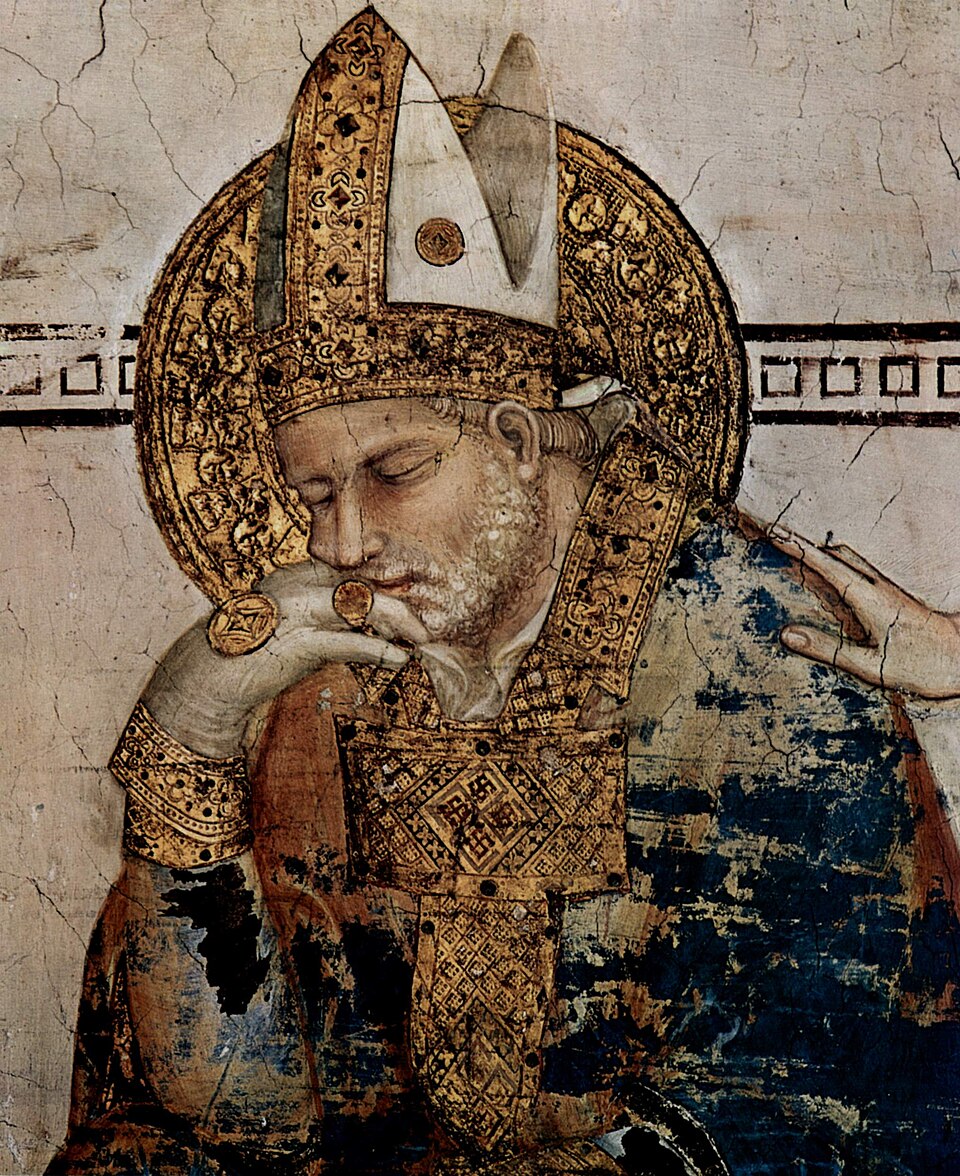
In art, S. Martin is usually depicted as a young tribune on horseback, dividing his cloak to give half to a beggar.
Footnotes
- Gregory of Tours was a historian and bishop in the 6th century.
- Louis XI. was the King of France from 1461 to 1483.
- The Franks and Allemanni were Germanic tribes that invaded Roman territories.
- Baptism of S. Martin by S. Hilary.
- The Devil appearing to S. Martin in human form.
- Sulpicius Severus tells the following story of what took place.
- Apparently a fainting fit caused by exhaustion following the fever.
- The old Gallic version of the Psalms before the Vulgate was introduced, which has “ultorem,” not “defensorem.”
- Guibert of Nogent, “De pignoribus Sanctorum,” ed. d’Achdry, Paris, 1651, f. 337 sq.
- Sulpicius Severus: a Christian writer and biographer of Saint Martin.
- Sulpicius adds, “Judge then how near at hand is that event which we dread!”
- A baldric is a belt worn over the shoulder.
- Sulpicius refers to Sulpicius Severus, a Christian historian and biographer.
- Torture wrung from Priscillian a confession, probably false, of impure practices.
- It was the first infliction of death for heresy which had stained with blood the annals of the Church.
- Sulp. Sever. Hist. Sacr. lib. ii. in fin. “Satis superque sufficere, ut episcopal! sen ten da haeretici judicad ecclesiis pellerentur.”
- Non recuso laborem: Latin phrase meaning "I do not refuse the work."
- Sulpicius Severus was a Christian writer and historian.
- S. Gregory of Tours was a bishop and historian of the early church.
- Clothair was a king of the Franks.
- Pomereuil was the prefect responsible for the destruction of the church.
- Some fragments at Ligugé; others at S. Martin’s in Liège; and others are in Cologne.
Baring-Gould’s own footnotes, in modern English.
Read the original 1870s text
Baring-Gould’s sources: All Latin Martyrologies. Roman. Usuardns, Ado, &c. Sarum, York, Hereford, and Durham Kalendars. Anglican Reformed Kalendar. The Translation and Ordination of S. Martin on July 4. Authorities: — (1) A Life by Sulpicius Severus, an admirer of S. Martin. He died in 410.* He was the Boswell of the saint. His Life is a panegyric. A credulous, superstitious man, he has given us, however, a very valuable biography. (2) Three Letters of Sulpicius Severus about S. Martin. (3) The second and third books of his “ Dialogues.” (4) A metrical Life by S. Paulinus of Nola (d. 431). (5) The “ Hist. Eccl. Francorum ” of Gregory of Tours (d. 594). (6) A Life in hexameters by Fortunatus of Poitiers (d. 600), founded entirely on the work of Sulpicius Severus. (7) A Life by Alcuin (d.804). (8) “Antiphonae septem de S. Martino, ” by Odo of Clugny (d. 942). Among modem biographers, Dupuis, “Histoirede S. Martin,” Paris, 1858.] This illustrious saint was bom at Sabaria, in Pannonia, the present town of Steinamanger 2 His father and mother were heathens, but Martin felt an early attraction towards Christianity, and even towards the monastic life. His father, seeing this, enrolled him in the army at the age of fifteen. A better school for the training of the soldier of Christ could hardly have been found. In the Roman camps the old-fashioned virtues of faithfulness, straightforwardness, and hardihood were cultivated, and in them were to be found the best types of the old Roman character, which, as moralists complained, were to be found elsewhere no more. If the funds of a country town had fallen into disorder, or uprightness was needed 1 This Life was written in 39a or 393, after a visit to Tours of some duration, and before S. Martin was dead. Sulpicius Severus dedicated the book to a priest, Desiderius of Cominges. He sent the book at once to S. Paulinus of Nola, who greatly admired it. According to a passage in the “ Dialogues/' it had an enormous and rapid sale in Rome, Carthage, and elsewhere. the district of Gyor in Hungary, where a large monastery was built by S. Stephen ot Hungary. But it is plain from Sulpicius that he was born at Sabaria. VOL XIII. t6 [Nov. ix.
…for a special post, the curator chosen by the Government was generally an old soldier, who had long been tried and trusted; and early Christian history throws, incidentally, a favourable light upon the moral qualities of the Roman officers. These qualities were mainly formed by thoroughness of work and discipline.
Martin spent three years in the army before he was baptized; he spent them with one servant as his companion in the tent, sharing with him work and privations. His corps was in Gaul [roughly modern France and Belgium], at Ambianum, the modern Amiens. One bitter winter’s day, as he was passing the gate of the city, he saw a poor beggar nearly naked, so utterly ragged were his clothes. Martin, filled with pity, cut his mantle in two, and gave half to the beggar. The bystanders jeered, but Martin heeded them not. Next night, as he slept, he saw Christ Jesus seated on his throne, surrounded by the hosts of heaven, wearing the half mantle of Martin over his shoulders. “See !” he heard the Saviour say, “ this is the mantle which Martin, yet a catechumen [a person preparing for baptism], gave me.”
Popular imagination fixed on a certain spot at Amiens as the scene of the charity of Martin; a chapel was built there before the time of Gregory of Tours [bishop and historian of the Franks (d. 594)]. It grew to be an abbey, S. Martin [St. Martin of Tours (d. 397), soldier turned bishop] aux Jumeaux, so called from the twin towers of the neighbouring church of S. Nicolas. King Louis XI., in 1472, gave an endowment to the church of S. Martin at Tours, for the perpetual support of a poor bedesman, who should wear as his livery a mantle of two colours, part red, the other white, in commemoration of the severed mantle of Martin. Martin was baptized after this dream at Amiens, when aged eighteen. He remained in the army two years longer, till 358. In 355 and 356 the Franks [the Germanic people who ruled Gaul and gave France its name] and Allemanni had broken through the frontiers of Gaul and devastated a portion of the province. Cologne, Worms, Trèves, Spires, Strassburg, Tongem, and other cities, forty-five in all, togethei 8. MARTIN DIVIDING HIS CLOAK WITH THE BEGGAR. After a Picture by Rubens in the possession of the Queen. Nov. iz.
Nov. xij 5*. Martin. with many villages, had been sacked and burnt by the barbarians. The legions in Gaul, destitute of pay, provisions, and arms, and reduced in numbers, could make no head against the invaders. In 356 Julian was sent into Gaul, with a feeble retinue of 360 soldiers. At Vienne, where he passed the winter, he heard that Autun had been attacked, but saved from falling by the resolute conduct of some veterans who resumed their arms for the defence of their country. Next spring Julian marched north to Rheims, and was there probably joined by the legion in which Martin was tribune. At the head of an army recruited from Gaul, but still small, the resolute Julian marched in search of the enemy. The Allemanni, familiar with the country, secretly collected their scattered forces, and seizing the opportunity of a dark and rainy day, poured with unexpected fury on the rear-guard of the Romans, destroying two legions. Julian hastened to revenge this disaster by assailing the barbarians, who, unable to withstand the disciplined ardour of the Romans, dispersed among the hills and forests, leaving them a fruitless victory. Julian advanced to the Rhine, surveyed the ruins of Cologne, and then, warned of the approach of winter, and aware of the difficulties of the campaign, retired dispirited to Sens; his retreat harassed by the audacious Germans, who followed him under the walls of the city, and surrounded it. But finding themselves unable to break through its ring of walls, after a siege of thirty days, they retired.
Next year the campaign was earned on with greater vigour. An army of thirty thousand men crossed the Alps, bridged the Rhine at Basle, and threatened the Germans in the south, whilst Julian marched against them from Gaul. But the southern army under Barbatis retired without effecting anything of consequence, and Julian was left alone to contest the ground with the barbarian hordes. Julian, at the head of thirteen thousand men, was camped near Strassburg. The [Not. iz.
Allemanni attacked him, and after a furious and bloody battle, were routed. He then marched north, and defeated the Franks on the Meuse. His manoeuvres in 359 met with brilliant successes, and in 360 he was proclaimed Emperor by the Gallic legions at Paris. Apparently in 358, in the midst of the war against the Franks and Allemanni, when Julian was at Worms, Martin, the young tribune, made the untimely claim to be released from military duty. Julian was indignant. A battle was imminent, and he scornfully refused the petition, saying that Martin was a coward and feared the battle. The young tribune answered, “ Put me in the forefront of the army, without weapons or armour; but I will not draw sword again. I am become the soldier of Christ” Julian ordered him into irons. The Allemanni asked for terms of peace, and then Martin was allowed to depart It is hardly possible to exonerate Martin from a culpable preference for his own interests and welfare over those of his country, in thus deserting the army at a time of great peril But the battle of Strassbuig may have led him to conclude, prematurely, that the barbarians were effectually humbled, and their invasions permanently checked. On leaving the army, Martin went to Poitiers, and placed himself under the teaching of S. Hilary. The bishop desired to confer on him diaconal orders, but the modesty of Martin was alarmed, and he was with difficulty induced to receive the inferior office of exorcist, an office which, according to the statement of a modem biographer of S. Martin, u exposes the bearer to insult from the devil, who attacks him with outrageous abuse, and even beats him.” Not long after, Martin felt himself impelled by affection for his parents to revisit them in Pannonia [a Roman province roughly covering western Hungary and parts of Austria and Croatia]. As he crossed the Alps he was attacked by robbers, and one threatened him with his sword. He was plundered of his money and other valuables, and then dismissed, but not before he had spoken such words of Baptism of S. Martin b y 3. Hilary. The Devil appearing to 3. Martin in human form. F&OM A WINDOW DATED 1$2$, IN THE CHURCH Of 3. FfcORENTlN (YONNE).
grace to the robber who had charge of him, that he converted him. The robber left his lawless trade, and became a peaceable citizen; he related the circumstances to Sulpicius Severus, who has inserted them in his Life of the saint On reaching Sabaria, Martin succeeded in converting his mother to Christ, but his father persisted in his paganism. Arianism [followers of Arius, who taught that the Son is a created being, not fully God] was at that time prevalent in Illyrium and Pannonia. Martin protested loudly against the heresy of the bishops, and was publicly whipped and driven out of Sabaria. He returned to Italy, and hearing that S. Hilary had been expelled his see by the Arians, settled at Milan in a solitary place, where he led an eremitical life. His vehement, defiant orthodoxy brought him again into trouble, and Auxentius, the Arian bishop, drove him from his retirement. He then took refuge in the isle of Gallinaria, now called Isoletta d'Albenga, opposite Albenga on the Comiche Road. It was a lovely spot, a tiny white islet set in the deep blue of the tranquil sea, with the Maritime Alps cutting off the north winds, fringing the northern horizon with their ragged, barren peaks.
In this islet Martin nourished himself on roots; and nearly poisoned himself by accidentally eating the hellebore, attractive by its dark green leaves and pale green flowers, growing in profusion over the limestone slopes. Providentially the spasms caused by the poison came on so rapidly as to check him from eating enough to kill him; but he suffered great pain, and lay at death's door.
After a while, having learned that S. Hilary was on his way back to Poitiers, Martin left his sunny isle and followed him. Hilary was rejoiced to see him again, and gave him a retreat near Poitiers, where he founded the monastery since called Ligugd Sulpicius Severus tells the following story of what took fNov. xx.
place in his monastery. " A catechumen joined him, desiring to form himself in the school of this holy man, and a few days after he was laid up with languor and a bad fever. By accident Martin was absent at the time. On the third day, on his return, he found the man lifeless. Death had supervened so suddenly that there had not been time for his baptism.1 His brethren, overwhelmed with grief, surrounded the corpse, and rendered it their sorrowful duties, weeping and lamenting, as Martin came up. But then the Holy Spirit inspired him. He made all go forth, and shut in alone with the body, he laid himself upon it After having been in prayer some time, informed by the Spirit of the Lord of the approach of the miracle, he raised himself a little, and fixing his eyes on the face of the dead, awaited with confidence the effect of his prayer and of the mercy of the Lord. Two hours had not elapsed when Martin saw the dead man recover by degrees the use of his members, and reopen his eyes. Then Martin uttered a great cry to the Lord, and gave him thanks. The cry of the blessed man rang through the cell, and those who were waiting outside the door, on hearing it, burst in. Wonderful sight I they saw him alive whom they had left dead.” Sulpicius Severus saw and conversed with this man.
About the year 371 the Church of Tours was deprived of its pastor, S. Lidorius, and the people resolved on getting Martin for their bishop. But as it was suspected that Martin would refuse and escape, should he hear what was proposed, they had recourse to a stratagem. Ruridus, dtizen of Tours, went to the monastery of Ligugd, and casting himself at the feet of Martin implored him to come and see his wife, who was ill. Martin unsuspiciously followed him. On the road, as he approached Tours, an ambuscade of the people rushed forth; some blocked the way, ' Apparently a fainting fit. caused by exhaustion following the fever. Not. it.] S. Martin.
lest he should attempt to return, and others, encircling him, conducted him in triumph to Tours. The bishops present to consecrate a successor to S. Lidorius objected. Martin, they said, was not a suitable person to be a bishop; he was dirty, badly clothed, and with his hair rumpled and uncombed. But the people were bent on having him as their pastor, and the bishops were obliged to yield. Amongst those who objected most strenuously to his consecration was Defensor, bishop (it is believed) of Angers. During the ceremony, so great was the crowd, that the lector could not work his way through the throng to his place to read the lesson. There was a pause; the clergy waited, and then one took up a psalter, and opening it at random to read any passage in place of the lesson, lit on the words of the psalm: “ Out of the mouths of babes and sucklings hast Thou ordained praise, that Thou mightest still the enemy and the Defender.” 1 At these words the people gave a shout, and the unfortunate bishop Defensor was covered with confusion.
Martin remained a monk, after having been made a bishop. He lived for some time in a cell near the church. But being wearied with the number of visitors who came to him, he removed to the place where afterwards stood the abbey of Marmoutier, in a lonely spot on the banks of the Loire, shut in by sandstone cliffs and forest, and only to be reached by a narrow path. Martin lodged in a cabin made of branches; several of his monks bored out caves in the sandstone, and made themselves by this means commodious dwellings. Martin had eighty disciples. They dressed in skins, ate only once a day, drank no wine, and had all things in common.
Not far from Tours, near the monastery, was a tomb of a 1 The old Gallic version of the Psalms before the Vulgate was introduced, which has “ultorem,” not “defensorem.”
[Not. it reputed saint, at which one of the preceding bishops of Tours, S. Lidorius or S. Gatianus, or perhaps some other bishop whose name has not come down to us, had raised an altar. The people held the relics [the bodily remains of a saint, or objects they used, kept with honor] of this saint in high honour, and flocked to it to obtain the intercession of the martyr, and the miraculous cure of their infirmities. S. Martin had his suspicions that this martyr whom the people and his predecessors honoured was not of such a character as deserved commemoration. He instituted close inquiries, and found that instead of being a martyr, the man had been a highway robber, executed on the spot for his crimes. Sulpicius says that Martin saw the ghost of the robber, who informed him that he was in hell, and not in heaven as the people supposed.1 Martin found that the country people were greatly addicted to their old religion, and honoured a huge pine. He insisted on cutting it down; and when he found that it would cause a disturbance, and perhaps bloodshed, he offered to be bound and sit where the tree would probably fall, if the heathens would themselves cut down the tree. They consented, hoping to see the enemy of their religion crushed. But the tree, instead of falling where Martin sat, crashed down in an opposite direction. His escape from the death that threatened him was the occasion of the conversion of a number of peasants. Martin pulled down their temple, and built a church on the site. Wherever he went, he destroyed with crowbar and firebrand the ancient temples in which 1 Guibert of Nogent, “ De pignoribus Sanctorum,1* ed. d’Achdry, Paris, 1651, f. 337 sq-» *ay», that in the beginning of the lath century all sorts of bones were reverenced as those of confessors and martyrs; and that a drunken man who had tumbled into a well was exalted into a martyr. In a village near Beauvais a youth of no particular merit was regarded as a saint solely because he had died on Good Friday, and the monks and abbot of the monastery church where he was buried encouraged this devotion because it brought them in great gain. In everyplace, says Guibert, old women canonize new saints by inventing all sorts of gossiping stories about them. A priest exhibited a piece of bread with a bite taken*ut of it as having been done by the teeth of Christ, and was furious with Guibert because he would not accept it as real.
PROM A TAPE8TRT AT MONTPEZAT, XVI. CENTURY. S. Martin. the people were wont to worship, and built churches on their ruins. At Levroux he attempted the destruction of a very rich and stately temple, but met with so much opposition that he was obliged to retire and call to his aid some of the Roman military, and surrounded by their shields and pikes, he re-entered Levroux and put the torch to the temple. He tore up the foundations, and pounded to dust the idols and altars before the eyes of an indignant people, who regretted at once the fall of a chief ornament of their city, and a temple in which they and their forefathers had been wont to worship. In the neighbourhood of Autun, the heathen peasants fell on him in their rage, brandishing their weapons. Martin cast aside his cloak, knelt down, and extended his neck for the sword. But the peasants did not dare to proceed to extremities, knowing that the 'Roman emperor would exact a terrible retribution should they kill a bishop. The pagans had recourse to equally ineffectual means of frightening Martin. They disguised themselves as Jupiter, Minerva, and Mercury, and some damsel with more enthusiasm for her religion than delicacy, presented herself before the startled modesty of the bishop in his cell without disguise of any sort, as Venus rising from the foam of the sea. Some dressed as wood Duses, very much like the devils of popular fancy, to terrify him. Mercury was a sharp, shrewd wag, and bothered the saint greatly, as he admitted to Sulpicius, but Jupiter was a “ stupid sot.” Once a man disguised in a black ox-skin rushed howling into the monastery of Martin with a bloody cow-horn in his hand; and Martin was quite persuaded that he had seen the devil We can understand how the mid-winter and spring festivities of the old Gauls, when the young people disguised themselves in all kinds of fantastic costumes, led Martin to believe that he was surrounded by devils and heathen deities. These practical jokes played on him by his unruly flock so shook his nerves that he was constantly fancying he saw hobgoblins. Once, when visiting the mansion of a man of position in Trèves, as he entered the door he declared that he saw a hideous devil lurking about in the shadows of the pillars. This statement caused such alarm in the house that one of the slaves was attacked with violent colic. Martin at once pronounced that the devil had rushed for refuge from him down the man’s throat into his bowels. The slave was carried forth, to allow the devil to escape from him outside the house. Sulpicius Severus gives us a curious insight into the superstition which then prevailed, and we must not be at all surprised if the pagan efforts to frighten or seduce Martin should have been regarded by him as the work of demons. He neither examined too curiously the disguised Mercury nor the undisguised Venus. His fears were appealed to, and he combated them with faith, not with inquisitive scepticism. In one of the monasteries of Martin governed by the priest Clams, a young man named Anatolius also had visitations, but these were wholly angelic. He announced to the brethren that he was in direct communication with angels, and obtained very general credence. Clams remained incredulous; Anatolius threatened him with divine chastisement for his unbelief. He announced that the Lord would that night furnish him from heaven with a white robe. Great was the excitement in the monastery. The cell of Anatolius was suddenly illumined at midnight. Steps and voices as of several persons were heard, and then Anatolius came forth with a long white shirt in his hand. Clams and the monks examined the vestment with awe and attention. It was very white and very fine, but it had all the appearance of being the product of earthly looms. At the instigation of the superior, the monks had recourse to prayer for the rest of the night When morning came, Clams said he S. Martin.
would carry the shirt to Martin, to be examined and adjudicated upon by him. Anatolius objected, and snatched at the garment. Clams grasped it at the other end; some of the monks took the part of Anatolius, and pulled at the vestment to get it out of the hands of the abbot Others, concurring with their superior, tried to drag it from Anatolius; others adopting a middle course, attempted to withdraw it from both. A scuffle ensued, in which the shirt was tom to rags.
About the same time a young man in Spain gave himself out to be Elias, come to predict the approaching consummation of all things. He went further; he said he was Christ A bishop named Rufus adored him; and was deposed from his see for doing so. At the same time Martin was predicting the reappearance of Nero, who was not dead, but hiding among the Parthians. He would subjugate ten kings and reign in the West, whilst Antichrist would establish his throne at Jerusalem. Finally Antichrist would kill Nero and reign supreme over East and West Antichrist, Martin declared, was already bom. Eight years had passed since he made that announcement, when it was published by Sulpicius in his “ Dialogues." Sulpicius adds, “ Judge then how near at hand is that event which we dread I" One night the devil appeared to S. Martin crowned with gold and gems, and in a magnificent vestment sparkling with jewels. " I am come in judgment,” he said. “ Adore me.” “Where,” asked Martin, “are the marks of the nails? Where the piercing of the spear? Where the crown of thorns ? When I see the marks of the Passion I shall adore my Lord.”
The devil disappeared. Some of those constantly about Martin saw in his visions only the dreams of a man prostrated by much fasting, and liable by the exhaustion produced by excessive austerities to [Nor. ix.
become a prey to hallucinations.1 Even his miracles were called in question by the educated laity, and when Sulpicius Severus had them discussed in his house, he would only admit the clergy, as the laity were inveterate in their scepticism.3 A soldier had embraced the monastic state in a fit of enthusiasm, and had laid his baldric at the foot of the altar, and established himself in a cell by himself. Martin shut up his wife in a convent But the sudden fervour of the man cooled down, and he went to Martin to ask for his wife. Martin refused to restore her. “ It is not seemly for a man who has renounced the world to take a woman to live with him. On renouncing the world he has ceased to have a wife. To live with her now would be sinful.” The soldier persisted in demanding his wife. “Only give her back to me,” he entreated; “ I will live as before, but I do desire to have her to talk to. Let us fight together under Christ's banner, mutually encouraging one another in the battle.”
Martin answered, “ Do women fight in the Roman armies ? No. It is for men to fight, not women. In what battle hast thou seen a man fighting with his wife at his side?” And he sent the abashed and disappointed soldier back to his desolate cell.
Martin admired greatly the conduct of a certain viigin who had closely shut herself in, and refused even to look at men. So resolved was she on this point that she refused to receive and show hospitality to the old bishop when he passed through her property. Martin, we are told, was filled with transports of joy at her scrupulosity. “ At Chartres, the father of a family presented his young daughter, aged twelve, to Martin, and asked him to loosen, by his merits, her tongue, for she was born dumb. Martin, naan; FF.NF.TR e FT; NSliA^SUlTDl [A^tFybEi ljES'hvtm: m>t['LE £;ij«FRETLWqN!
THE TOU RAN OEOIS CARRYING OFF THE BODY OP 8. MARTIN. Design for a Window by M. Claudius Lavergne. Nov. ii.
by deference to the bishops Valentinus1 and Victricius, who were then with him, replied that such a cure surpassed his powers, but not those of the holy bishops at his side. Valentinus and Victricius joined their affectionate intercession to the supplications of the father, and prayed Martin to heal the girl. Then Martin, at once humble and merciful, made the crowd withdraw, and in the presence of the bishops and of the girl's father alone he prostrated himself, according to custom, and began to pray. Then he blessed a little oil, reciting over it an exorcism, and poured it into the mouth of the girl, whose tongue he held between his fingers; and the miracle was wrought. The saint asked the girl the name of her father; she replied immediately. The father uttered a cry of joy, shedding tears, and embracing the knees of Martin. In the midst of the general satisfaction he declared that this was the first word he had heard his daughter utter." Count Avitianus was noted for his barbarity. He came to Tours with a long chain of miserable captives, and orders were issued for their torture and execution. Then the great saint rose to his true level, from fantastic dreams and doubtful miracle-working to action for the eternal principles of justice and mercy. The morrow was fixed for torture and butchery. On hearing it in his retreat at Marraoutier he hasted to Tours. It was night when he reached the town. The count was in bed and asleep; the palace was closed, and all was hushed within. Martin threw himself on the doorstep, and besieged the house with his cries. Avitianus, tossing in bed, heard him, and called to his slaves that Martin was without The servants waking, having heard nothing, and believing that their master had been dreaming, “ after the way of servants,” says Sulpicius, sarcastically, pretended to go to the door, and assured Avitianus that there was no one* without. Again, however, the cries of Martin reached the ears of the count, and impatient at the delay and denials of the slaves, he sprang from bed, and ran down to the entrance, opened the door, and found the old bishop with his white hair lying on his doorstep, his hands stretched forth in supplication. The count was moved, he raised the aged prelate. " Do not even speak,” he said, “ I know thy request. Every prisoner shall be spared. I grant them their lives and liberty at thy unspoken petition.”
He rises to even a grander height in his conduct to Ithacius at Trèves. Martin went thither, where was the Emperor Maximus, and a crowd of bishops assembled to ordain a successor to Britto, bishop of Trèves, and to consult about the matter of the Priscillianists (384). After the council of Saragossa in 380, in which Priscillian had been condemned, the two Prisdllianist bishops, Salvian and Justantius, had made Priscillian bishop of Avila. Priscillian, a well-born and eloquent Spaniard, had adopted a strange compound of various errors originally brought into Spain from Egypt. Its chief elements were: — Pantheism, the essential divinity of the human soul; Sabellianism, the Son only a power; Docetism, hence a fast was kept on Sunday; Fatalism; Astrology; Pre-existence of souls, — their previous sins punished by their detention in bodies; man's body the devil's work; marriage condemned; the resurrection of the body denied. Idacius, and another prelate named Ithacius, who is described by Sulpicius as having “ nothing of holiness" about him, procured the exile of the heretics. The Emperor Gratian suffered them to return. Ithacius denounced them to Maximus, who referred the case to a council at Bordeaux. Priscillian was there permitted to appeal to Maximus. At the Court of Trèves, where Maximus was an object of abject adulation to a crowd of bishops, “ Martin alone among them all," says his biographer, “preserved the dignity of an apostle.” He protested against the intervention of secular power in ecclesiastical causes, and against the punishment of the heretic Priscillian and his associates. The Emperor Maximus had yielded to the importunities of the Spanish bishops, who, themselves scarcely escaped from the sword of pagan executioners, already clamoured for the blood of heretics. Martin pursued the accusers with his reproaches, and the emperor with his supplications. He insisted that excommunication, pronounced against the heretics by episcopal sentence, was sufficient, and more than sufficient, to punish them.1 He believed that he had succeeded, and left Trèves only on receiving the imperial promise that mercy should be extended to the culprits.
But, after his departure, the unworthy bishops returned to the charge, and wrested from Maximus the order to execute Priscillian and his principal disciples, and to send orders into Spain that a general search for, and massacre of the Priscillianists should be executed. Torture wrung from Priscillian a confession, probably false, of impure practices; and on this ground he, with six others, was beheaded. It was the first infliction of death for heresy which had stained with blood the annals of the Church.2 Informed of what had taken place, Martin returned from Tours to Trèves (385), to procure the safety, at least, of the rest of the sect. He and S. Ambrose [bishop of Milan (d. 397)], who was also at Treves [Trier in Germany], solemnly rejected the communion of persecuting bishops. A bishop named Theognotus publicly pronounced their excommunication.
Martin was at the same time anxious to obtain the pardon ’ Sulp. Sever. Hist. Sacr. lib. ii. in fin. “ Satis superque sufficere, ut episcopal! sen ten da haeretici judicad ecclesiis pellerentur.” 1 Priscillian and his two priests, Felicissimus and Armenius, a lady, Euchrocia, and others were executed; Justandus and others were banished, some to the isle of Qinia, on the coast of Brittany, and the rest to various places in Gaul. [Nov. ix.
of some of the followers of the late Emperor Gratian, threatened with death by Maximus. The emperor flattered Martin, and endeavoured to persuade him to communicate with Ithadus and the other bishops who had united in obtaining the execution of the Priscillianists. When flattery failed, the emperor issued orders for the execution on the morrow of the servants of Gratian. It was night when Martin heard of this barbarous sentence. He flew to the palace, but could only obtain their lives on condition of communicating next day with the Ithacians, when the new bishop, Felix, one of their party, would be consecrated to the see of Trèves [a bishop’s “see” is his diocese, named from his seat (Latin sedes)]. Martin only gave way when the emperor also solemnly promised to recall the tribunes sent into Spain to hunt out the Priscillianists, confiscate their goods, and put them to the sword.
Next day accordingly, reluctantly, and with great doubts whether he was acting rightly, Martin communicated in the great church of Trèves, formed out of the palace of Helena, mother of Constantine, with Felix, Ithacius, and the whole persecuting body. But ever after he reproached himself for the concession; and he declared with tears that he felt his virtue lessened by it. During the sixteen remaining years of his life he kept back from all the assemblies of bishops, fearful of meeting men whom he regarded as guilty of a crime of unheard-of novelty in the annals of the Church. He thus kept the noble promise which his master, S. Hilary, had made, when denouncing to the Emperor Constantius the atrocious cruelties of the Arians against the Catholics: “ If such violence were employed to sustain the true faith, the wisdom of the bishops should oppose it; they would say, God will not have a forced homage. What need has He of a profession of faith produced by violence? We must not attempt to deceive Him; He must be sought with simplicity, served by charity, honoured and gained by the CHURCH OP 8. MARTIN AT T0UR8, RE8T0RED. Nov. ix. Not. xx.
S. Martin. honest exercise of our free will.”1 And the glorious confessor [in old usage, a saint who was not martyred, or who suffered for the faith without being killed] added, “Woe to the times when the divine faith stands in need of earthly power; when the name of Christ, despoiled of its virtue, is reduced to serve as a pretext and reproach to ambition; when the Church threatens her adversaries with exile and prison, by means of which she would force them to believe, she who has been upheld by exiles and prisoners; when she leans upon the greatness of her protectors, she who has been consecrated by the cruelty of her persecutors.”* Martin, on returning to his diocese, had also to undergo the envy and enmity of many bishops, and of those priests of Gaul who had been so soon tainted by Roman luxury, and who already made themselves remarked by the pomp of their equipages, their costumes, and their dwellings.3 He had even to rebuke Brice, his disciple, trained by him in his monastery, for buying numbers, not only of male slaves, but of young and beautiful girls; and keeping a stable of handsome horses.
Arrived at the end of his career, eighty years old, and eager to receive his celestial reward, he yielded to the tears of his disciples, and consented to ask from God the prolongation of his days. “ Lord,” said he, “ if I am still necessary to Thy people, I would not draw back from the work.” Non recuso laborem / Noble words, which ought to be the motto of every Christian.
But God decided that he was ripe for heaven: he died; and when his body was carried to the tomb which was to become the most venerated sanctuary in Gaul, two thousand 1 S. Hilarii, Ad Constant lib. L c. 6. * Ibid. Cont. Auxent lib. ii. c. 4.... Inter episcopos saevientes cum fere quotidianis scandalis bine atque inde premeretur.... non illi ego quemquam audebo monachorum, certe nec episcoporum quempiam comparare.... Nec tamen huic crimini miscebo populates soli ilium derid, soli nesdunt sacerdotes.’* — Sulp. Sever. Dialog. 14, 17, x8. VOL. XIIL 17 monks formed the funeral train. Sulpicius Severus, his enthusiastic disciple, had written his life before the old man died. He completed the record in his letters and dialogues, and his narrative, which attained an enormous popularity in the West, diffused everywhere the glory of the saint S. Martin died on November 9th, 401, not at Tours, but at a little town named Candes, situated at the junction of the rivers Loire and Vienne. The Poitevins and the Tourangeois each conceived they had a claim to the body of the saintly bishop. The Tourangeois were successful, and brought the corpse to their own town. Tradition says that the vessel on which it was embarked floated up stream without sails or oars; that the trees on either side burst into blossom, the sick recovered their health, and heavenly music was heard to accompany the boat till it arrived at Tours. The body was first deposited on the banks of the Loire, guarded by the clergy and people, and was interred on November nth, in a cemetery just outside the existing town. Eleven years afterwards, S. Brice, his successor, built a chapel on the tomb, dedicated to S. Stephen; because at that time churches were dedicated to martyrs only. Seventy- two years after the death of S. Martin, S. Perpetuus, at that time bishop, built a more spacious church, of which S. Gregory of Toms gives the description as the richest and most remarkable edifice then existing; and on the 4th of July, a.d. 473, the body was transferred to the new tomb. This is the tomb of which the masonry appears to be preserved to this day. The bones of S. Martin, wrapped in white samite, were placed in an alabaster vessel, which was enclosed in a shrine of costly metal, and laid in the tomb. A marble stone lay on the top, which could be raised, and the shrine lifted out to be borne about in processions. The basilica built by S. Perpetuus was destroyed by fire, but was rebuilt by Clothair, and became increasingly sacred in the eyes of the Christian world. Kings Nov. it.
Not. zz.] S. Martin. came thither to ask for health or victory; queens, that they might prepare for death. Under the direction of Alcuin a school was here established which became the cradle of all the universities of France. The chapter held directly from the Pope, under the protection of the king. It was rich; it possessed the privilege of coining money \ and could send armed men to battle in defence of its patrimony. The church suffered from fire again and again, but the tomb remained uninjured till 1562, when the Calvinists pillaged the sacred edifice, and scattered the bones of the saint. An arm-bone and part of the skull were saved, and placed in the cathedral of Tours.
At the French Revolution the magnificent church, one of the finest in France, was wantonly ruined, and the apse pulled down. It remained thus till 1802, when the noble and vast nave was also destroyed, and only the towers now attest the glory of the ancient church and the Vandalism of its destroyers. The name of the prefect who carried out this act of destruction must be handed down branded with infamy to the last generation. It was Pomereuil. The final act of demolition was consequent on a geometrical plan or map executed by the Commune in 1801, which laid down streets and measured out houses over the whole site of the basilica. It was executed without the slightest opposition, and a crowd of mean-looking houses, strangely contrasting with the older piles of wood and stone in the vicinity, now encumber the consecrated ground. The Rue S. Martin runs nearly parallel with the ancient nave, and the Rue Descartes follows the line of the transept Under these circumstances anybody would have thought that the pilgrimage to the tomb of S. Martin, dear to all the country-side, was for the future a hopeless desire; but the piety of Tours refused to admit the idea. Under the Restoration M. Jacquet-Delahay organized a subscription for the [Not. iz.
rebuilding of the basilica, but his project was abandoned on account of what seemed at the time an insuperable objection. He himself stated that the site of the tomb was traversed by the public way. Nevertheless the popular devotion to S. Martin began to recover life and vigour. Researches were made for such plans as might enable the exact proportions of the old church to be ascertained, and by means of the one made in 1802, which was discovered in the archives of the prefecture, the exact position of the tomb itself was fixed upon; and it was proved that, contrary to the general opinion, the spot was not under the public way, but covered by one or more small houses. In 1857 Cardinal Morlot, then archbishop of Tours, succeeded in purchasing these houses, but did not enter on actual possession until three years later. On the 2nd of October, i860, a commission began their excavations in the cellar, and found, as they expected, part of the old foundations of the choir. The house covered the site of the high altar, and of a large part of the chapter in the rear, which had been called “ Le Repos de Saint Martin.” But the tomb itself could not be found. It was evidently beyond the limits of the cellar-wall, in that of the adjoining house; and the works were suspended until possession could be obtained of that also. A small chapel having been arranged in one of the upper rooms of the first-mentioned dwelling, on November 12 th, the archbishop of Tours celebrated mass once more, after a lapse of seventy years from the destruction of the ancient altar. For the succeeding seven days masses were celebrated almost without cessation, and the small chapel and the cellar were constantly full of people. A large red cross was traced on the wall of the latter, opposite to where the tomb was supposed to be; and a little lamp, hung from the ceiling, was kept burning day and night. A month later the commission were enabled to
excavate under the adjoining house, and before evening the continuation of the foundations of the choir were laid bare, and, crossed and somewhat injured by a thick wall of modem date, appeared a small oblong enclosure of stone, something between a coffin and a box. It showed signs of having once been arched over, and there was every probability that it was the sepulchre where the bones of S. Martin had once reposed. It was now eleven o’clock at night; hour after horn: had passed in slow and careful search amidst the confused masses of ancient and modem foundations, and more than thirty persons were waiting in the outer cellar, communicating with others by only a hole in the wall. When those within called out that the ancient sepulchre had been found, a spontaneous burst of voices gave out the “ Magnificat,” which was echoed from cellar to cellar, and forth into the starlit street A modem church, in execrable taste, has been erected on the site.
At Montmorency is an arm-bone of the saint. Some fragments at Ligugé; others at S. Martin’s at Ltege; others at Cologne. A body at Salzburg. Some oil, brought from heaven to mb the skin of the saint when sore, was used for the anointing of King Henry IV. in place of the oil of S. Remigius [bishop of Reims who baptized Clovis, king of the Franks] at Rheims.
In art S. Martin is usually represented as a young tribune on horseback, dividing his cloak to give half to a beggar. [Nor. xx.