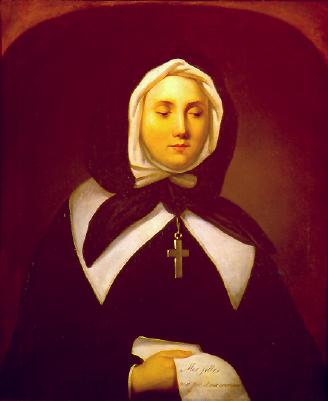
This Saint’s Story
Growing up in a Christian environment, she initially did not aspire to join the cloistered life of the Congregation Notre-Dame, which focused on helping the poor but remained within the confines of the monastery. At the age of fifteen, she joined a sodality that aimed to educate impoverished children, marking the beginning of her commitment to education and service.
In 1652, Marguerite met Paul de Chomedey, the governor of Montreal, who invited her to establish a school in New France. Feeling a divine call, she accepted and sailed to Ville-Marie (now Montreal) in 1653. Upon her arrival, she chose to live among the poor settlers rather than accept hospitality from the Ursulines, which reflected her dedication to serving the community directly.
Bourgeoys quickly began her mission by organizing the construction of the first permanent church in Ville-Marie, dedicated to Our Lady of Good Counsel. In 1658, she began her educational work in a stable provided by the governor, thus initiating public education in the area. Her efforts extended to recruiting women from France to serve as teachers, creating a network of education and social services that would benefit the colony's families and children.
Throughout her life, Marguerite faced challenges, including the struggle for official recognition of her congregation. In 1669, she gained permission from François de Laval, the highest religious authority in New France, to teach across the island of Montreal. By 1671, she secured a civil charter from King Louis XIV, allowing her community to operate as secular Sisters, which was a significant innovation for the time.
Marguerite Bourgeoys continued her work until her death on January 12, 1700. She was known for her holiness and selflessness, reportedly offering her life for the recovery of a sick sister. Following her passing, she was venerated as a saint by the local community. The formal process for her canonization began in 1878, and she was beatified (declared 'Blessed', the step before sainthood) by Pope Pius XII in 1950. Finally, on October 31, 1982, Pope John Paul II canonized (officially declared a saint by the pope) her, making her the first woman saint of Canada.
