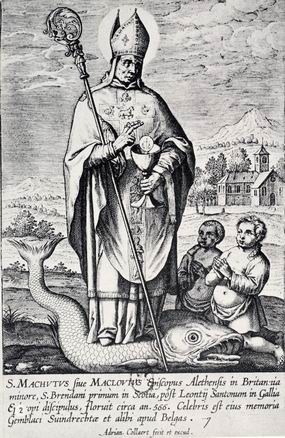
St. Malo

Malo, called Machutus or Maclovius in Latin and Maclou in French, gave his name to the Breton port of Saint-Malo.

Read the story →
November 15 · Bishop, Monk, Founder

St. Malo

Feast

November 15
Secondary source · Wikipedia

Status

Saint
One of the seven founding saints of Brittany. Venerated long before formal canonization began.

Represents

Bishop
Monk
Founder

Feast days

Feast: November 15

This Saint’s Story

In our own words, from the Catholic Encyclopedia and Baring-Gould, whose original account remains further down this page. Wikipedia is used as a secondary source for the disputed year of death.

He is one of the seven founding saints of Brittany. The Catholic Encyclopedia says he was born about 520, probably in Wales, and baptized by St. Brendan, whose favourite disciple he became. Baring-Gould, whose older account remains on this page, follows Welsh genealogies that make him a son of Caradog of Gwent, born at Caerwent in his parents' old age, and a kinsman of St. Samson of Dol and St. Magloire.

The two accounts differ on where he was trained. The Encyclopedia has him stay for some years at Llancarfan while Brendan was there, then sail with Brendan and many companions in search of the “Island of the Blest”; on a second voyage it says he evangelized the Orkneys and the northern isles of Scotland. Those voyages belong to the Brendan tradition, and should be read as tradition. Baring-Gould doubts that Brendan was ever abbot of Llancarfan and thinks Malo was trained at Aleth in Brittany, where Brendan had a foundation.

At Aleth, opposite the present town, Malo placed himself under an old hermit named Aaron. When Aaron died in 543 or 544, Malo succeeded to the spiritual charge of the district and was consecrated first Bishop of Aleth. Later lives tell wonders of him: that as a boy he slept safely on a heap of kelp while the tide rose around it, and that he carried live coals in his bosom to light the church lamps without harm. Baring-Gould himself calls these legends.

In his old age, disorder among his people drove him away for a time, and he took refuge near Saintes. Recalled, he set matters right, then went back to spend his last days in prayer and penance at Archambiac (Baring-Gould's Archambray) in the Diocese of Saintes. Wikipedia dates his death to 15 November 621. The Catholic Encyclopedia allows 618, 620, or 622. Baring-Gould gives about 627. The day is 15 November in all of them. The year is not agreed. His relics were later carried back to Aleth, taken to Paris in 975, and lost at the Revolution.

For today: If the people you serve drive you out, you can still come back when they ask, do the work, and then look for a quiet place to finish. Malo's last move was to Archambiac. Finish a task you were asked to return to, and leave the wonders in the old lives labelled as wonders.

What he represents

How he teaches us to live

Drawn from their life story

The name He is called Machutus or Maclovius in Latin and Maclou in French. The Breton port of Saint-Malo takes its name from him.

The sources The Catholic Encyclopedia and Baring-Gould, whose older account remains on this page, disagree on where he was trained and on the year of his death. The day, 15 November, is the same in both.

The wonders Later lives tell of a boy sleeping on a heap of kelp as the tide rose, and of live coals carried in his bosom. Baring-Gould himself calls these legends.

The full story

Baring-Gould’s account retold in modern English

Read the full story · 1,015 words · about 4 min

Anyone who has been to Saint Malo knows the extraordinary speed and height to which the tide rises there. It is a well-known phenomenon connected with the place, caused by the shape of the coast.

One day, Saint Malo and some of the boys from the monastery school were playing on the sands. When Malo felt tired, he lay down on a pile of kelp and fell asleep. The children returned to school without noticing he was missing. The tide rushed over the sands and rose, roaring up the rocks of Aaron and Grand Bey. Saint Brendan, worried about the disappearance of his pupil, ran out onto the rocks and called for him, but received no answer. However, according to the legend, Malo was not overwhelmed by the waves. The sand and kelp on which he lay rose with the tide and formed an islet, high and dry above the water.

The next morning, Brendan went down to the shore again. He saw the new islet above the waves, with Malo resting on it. The boy called to his master to pass him his breviary, as he wanted to recite his prayers. Brendan, full of faith, threw his psalter into the waves, and the tide carried the book to the feet of his disciple.

When he reached an age of maturity, Saint Malo received the monastic habit from his master. His virtues stirred jealousy among some of the other monks. When it was his turn to light the candles for matins, some of them, out of spite, extinguished every lamp in the dormitory and church. Malo went to the fireplace and tried to rake out live coals, but they were all cold. Then he put some cinders in his bosom and hurried to the abbot. Miraculously, the warmth of his zeal had ignited the charcoal, and when he took the pieces from his breast, they were red and glowing.

Next day, Saint Brendan summoned the mischievous and envious monks before him. However, finding them unchangeable, he decided to abandon them. Taking Saint Malo with him, he left them by ship and sailed in search of a solitary island where they could serve God without disturbance. But an angel instructed them to return, and they came back to Aleth, where Malo became bishop of that see. Aleth was an old city on the mainland, at the mouth of the Ranee River, and the island of Aaron, now occupied by the town of Saint Malo, was then inhabited by a hermit named Aaron. Malo converted the island into a monastery and filled it with monks. Many wonderful miracles are attributed to Malo. He blessed a marble cup, and it was transformed into crystal. A chief who held a grudge against him tied the baker of his monastery hand and foot to a stone and left him on the sands at low tide. The tide rose and covered him, except for his head, and the water left a chimney between his mouth and the air above, allowing him to breathe until the tide fell. Saint Malo made a wolf, which had eaten a donkey belonging to an old woman, carry firewood for her on its back.

However, the wickedness of the people and the opposition of the chiefs in the area forced Malo to leave his see for a time. He went to Saintes, where he was well received by the bishop, Leontius, who gave him a cell at Brie, and there he remained until he was recalled to Aleth. According to Sigebert, Malo was born “on the coast of the sea of Britain,” which may mean that he was born in Brittany, not in Britain. Some believe his father was the Count of Gien on the Loire River, but from Welsh accounts, it is clear that he was the son of Caradog, brother of Amwn Ddu, and probably born at Caer-gwent. The biographers state that he was a disciple of Saint Brendan at Llancanran, and after the voyage, they carried him back to Llancarvan and then to Aleth. However, since Saint Brendan was abbot of Aleth and not of Llancarvan, it seems that Malo settled again at Aleth upon his return from the voyage. What is said about his having been elected in Wales to the bishopric of Caer-gwent is questionable and should be omitted. He probably died in 626.

He did not, however, stay long there but returned to Saintes and settled at Archambray with some monks he had brought with him from Brittany, where he died. His relics remained there until the 7th century when the church of Aleth, or Saint Malo, recovered them in a rather disreputable manner.

A young man had to flee from Brittany to escape the daggers of his brothers, who wanted his estate. He found refuge at Archambray with the sacristan, who kindly welcomed and sheltered him. After some years, the young man, believing he was safe, returned to Brittany. When he arrived in Aleth, he told Bili, the bishop, where he was staying and how easily he could obtain the body of Saint Malo and take it away. Bili urged him to go back to Archambray, hide his intentions, and seize the first opportunity to steal the relics.

The young man returned to his host, the sacristan, and claimed that his life was still not safe from his brothers. The sacristan, as willingly as before, offered him hospitality. The young man waited until the sacristan had to leave on a journey and had entrusted him with the keys. Then he packed up the body of the saint and ran away with it to Aleth, after preparing for the theft through confession and communion. The relics were received with great ceremony by the bishop, clergy, and people of Aleth, and they were divided. One portion was given to the monastery on the isle of Aaron, while the other was kept in the cathedral. In 975, they were taken to Paris. They were lost during the Revolution. The only relic that remains is a shoulder bone at Saint Maclou-de-Moiselles, near Versailles.

Footnotes

  1. The tides rise here higher than at any other point in the Channel, reaching an elevation of forty-five to fifty feet above low-water mark.
  2. The hymn for his festival mentions these miracles: "Safe amidst the waves he carries the embers, untouched by the water; here he serves the powerful Fire and Water."
  3. According to Sigebert, Malo was born “on the coast of the sea of Britain.”
  4. The monastery on the isle of Aaron is a religious community located on an island.
  5. Saint Maclou-de-Moiselles is a location near Versailles, France.

Baring-Gould’s own footnotes, in modern English.

Read the original 1890s text

Any one who has been at S. Malo knows the extraordinary rapidity and height to which the tide there mounts* It is a 1 Also in French S. Maclou. In Welsh Maelog; not, however, to be confounded with S. Maelog, son of Caw, and disciple of Cattwg. a MALO, aliaa MACHUTUS and MACLOV1U3. After Cahier. Nov. 15. S. Maclovius.

well-known phenomenon connected with the place, and is occasioned by the configuration of the coast.1 One day S. Malo and some of the boys of the monastery school were playing on the sands, when Malo, feeling tired, lay down on a heap of kelp, and fell asleep. The children returned to school without missing him. The tide rushed over the sands, and rose roaring up the rocks of Aaron and Grand Bey. S. Brendan, alarmed at the disappearance of his pupil, ran out on the rocks and called, but received no answer. S. Malo was not, however, overwhelmed by the waves, says the legend; the sand and kelp on which he lay rose with the tide, and formed an islet, high and dry above the waters. Next morning Brendan went down again to the shore. He saw above the waves the new islet, with Malo reposing on it. The boy called to his master to pass him over his breviary, as he wished to recite his offices. Brendan, full of faith, flung his psalter into the waves, and the tide carried the book to the feet of the disciple On reaching years of discretion S. Malo received the habit from his master. His virtues aroused the jealousy of some of the other monks. When it was his turn to light the candles for matins, some of them out of malice extinguished every lamp in the dormitory and church. Malo went to the fireplace, and tried to rake out live coals, but they were all dead. Then he put some cinders in his bosom, and hastened to the abbot, and, lo ! the warmth of his zeal had kindled the charcoal, and when he took the pieces from his breast they were red and glowing.2 1 "The tides rise here higher than at any other point in the Channel, viz. to an elevation of forty-five to fifty feet above low-water mark.” — Murray’s Handbook of France.

3 The hymn for his festival mentions these miracles. " Fluctibus tutus mediis quiesdt Gestat et prunas, nihil inde laesa, Veste; hie parent famulo Potentis Ignis et unda.”

VOL. XIII. 22 Next day S. Brendan summoned the mischievous and envious monks before him, but finding them incorrigible, he determined to abandon them, and taking with him S. Malo, he left them by ship, and sailed in search of some solitary islet, in which they might serve God unmolested.1 But an angel bade them return, and they came back to Aleth, and Malo became bishop of that see. Aleth was an old city on the mainland, at the mouth of the Rance, and the isle of Aaron, now occupied by the town of S. Malo, was then inhabited by a hermit named Aaron. Malo converted the island into a monastery, and filled it with monks. Many wonderful miracles are told of Malo. He blessed a marble cup, and it was transformed into crystal A chief who owed him a grudge, tied the baker of his monastery hand and foot to a stone, and left him on the sands at low water. The tide rose and covered him, with the exception of his head, and the water left a chimney between his mouth and the upper air, by which he was enabled to breathe till the tide fell. S. Malo made a wolf which had eaten an ass belonging to an old woman, carry faggots for her on its back.

However, the perversity of the people, and the opposition of the chiefs in the neighbourhood, obliged Malo to leave his see for a while, and he went to Saintes, where he was well received by the bishop, Leontius,2 who gave him a cell at Brie, and there he remained till he was recalled to Aleth. 1 According to Sigebert, Malo was born “ citra oram Britannia maris," which may mean that he was born in Brittany, and not in Britain; and some think his father was Count of Gien on the Loire (Gianum); but from the Welsh accounts it is clear that he was son of Caradog, brother of Amwn Ddu, and probably born at Caer-gwent. The biographers make him disciple of S. Brendan at Llancarvan, and after the voyage carry him back to Llancarvan, and then to Aleth. But as S. Brendan was abbot of Aleth. and not of Llancarvan, it would seem that Malo on his return from the voyage settled again at Aleth, and that what is said of his having been elected in Wales to the bishopric of Caer-gwent is to be omitted. of which is doubtful. He probably died in 626. Nov. xsO S. Maclovius.

He did not, however, remain long there, but went back to Saintes, and settled at Archambray with some monks he had brought with him from Brittany, and there he died. The relics remained there till the 7 th century, when the church of Aleth, or S. Malo, recovered them in a not very creditable manner.

A young man was obliged to fly from Brittany to escape the daggers of his brothers, who sought his estate. He took refuge at Archambray with the sacristan, who kindly received and sheltered him. After some years the youth, thinking he was safe, revisited Brittany, and on going to Aleth, told Bili, the bishop, where he was lodged, how easily he could get hold of the body of S. Malo, and carry it off. Bili urged him to return to Archambray, dissemble his purpose, and on the first opportunity make off with the relics. The young man accordingly went back to his host the sacristan, saying that his life was not yet in security from his brothers, and the sacristan, as readily as before, offered him hospitality. The youth waited till the sacristan was obliged to make a journey, and had left him in charge of the keys, when he packed up the body of the saint, and ran away with it to Aleth, after having prepared himself for the theft by confession and communion. The relics were received with great pomp by the bishop and clergy and people of Aleth, and were divided. One portion was given to the monastery of the isle of Aaron, the other was kept in the cathedral In 975 they were taken to Paris. They were lost at the Revolution. The only relic that remains is a shoulder-bone a S. Maclou-de-Moiselles, near Versailles.
More about St. Malo

Checked against at least two sources, in our own words

A note on sources

The voyages with Brendan, and the wonders of the kelp and the live coals, belong to later tradition. Baring-Gould himself calls the wonders legends.

Help us add to this saint's story

Everything is read by a person before anything appears. Facts are checked against trusted sources first.

Facts are welcome; a source link helps (optional).With your permission we may share it on this page.

Nine days · Free

Pray the novena
with us.

One short email a day for nine days. The day's prayer, a line from St. Malo's story, and a nudge to keep going.

Also on November 15
G

Sts. Gurias

November 15 · Martyrs
St. Leopold

St. Leopold

November 15 · Confessor
St. Albert the Great

St. Albert the Great

November 15 · Bishop, Doctor of the Church, Religious
← All 1970 saints in the library
Sources & notes

Feast-day sources

Story sources

Sources

Credits

Image: Saint Malo (engraving).jpg · Adriaen Collaert (engraving inscribed S. Machutus sive Maclovius) · Public domain, via Wikimedia Commons

Retold in plain modern English from Baring-Gould’s public-domain text, sentence by sentence, keeping the same facts and order. Short explanations in parentheses are ours. Some history and judgments reflect 19th-century scholarship; the feast date above is the current one.

From Sabine Baring-Gould, The Lives of the Saints, new edition in 16 vols. (London: John C. Nimmo, 1897–98); text from the Internet Archive scan (OCR, lightly cleaned; errors possible). Public domain in the United States. Reproduced unedited.