St. Macarius of Jerusalem

Macarius was Bishop of Jerusalem from 312 to about 334.

Read the essentials →
Feast March 10 · Bishop

St. Macarius of Jerusalem

Current feast

March 10
Secondary source · Wikipedia infobox

Traditional feast

March 10
1914 / pre-1969 calendar, per Baring-Gould (1897)

Represents

Bishop

Feast days

Feast: March 10

This Saint’s Story

The Catholic Encyclopedia, following St. Jerome's version of Eusebius's Chronicle, places his accession in that year, and notes that he must have died before the council at Tyre in 335, where his successor Maximus appears among the bishops. St. Alexander of Alexandria warned him against Arius; the vigour of Macarius's opposition is clear from the abusive way Arius spoke of him to Eusebius of Nicomedia. He was present at the Council of Nicaea (the first worldwide council of bishops, 325, which defined that the Son is fully God). Two scholarly conjectures, which the encyclopedia reports without treating them as proven fact, are that he contended with his metropolitan Eusebius of Caesarea over the dignity of their sees—the vague seventh Nicene canon on honouring the bishop of Aelia (Jerusalem) without prejudice to the metropolis suggests a drawn battle—and that, with Eustathius of Antioch, he had a share in drafting the Creed finally adopted.

From conjecture the encyclopedia turns to fiction: in the History of the Council of Nicaea attributed to Gelasius of Cyzicus, imaginary disputations make Macarius the bishops' spokesman defending the Descent into Hell. His name stands first among the Palestinian bishops who subscribed at Nicaea; Eusebius's comes fifth. St. Athanasius later ranked him among bishops renowned for orthodoxy. Sozomen reports that Macarius named Maximus Bishop of Lydia, but that either the people of Jerusalem refused to part with Maximus or Macarius himself changed his mind, fearing an unorthodox successor; Tillemont questions the tale because Aetius of Lydda was still alive in 331.

St. Theophanes says that Constantine, at the end of Nicaea, ordered Macarius to search for the sites of the Passion and Resurrection and the True Cross. Excavations began soon afterward under his oversight: the Hadrianic mound and temple of Venus over the Holy Sepulchre were cleared, and Eusebius (bishop of Caesarea, d. c. 339, the first historian of the Church) records the unexpected uncovering of the monument of the Resurrection. Constantine wrote to Macarius with lavish orders for a church on the site, and later ordered a church at Mambre; churches rose also at the Nativity and Ascension sites. The encyclopedia refers elsewhere for the finding of the True Cross. His feast falls on 10 March.

Short entry · the summary here is 83 words; Baring-Gould’s fuller original text and its sources are below. We have not filled any gap with invented detail.

What he represents

How he teaches us to live

Drawn from themes in the original account

Celebrate this saint’s feast day. Remember him on March 10 with a short prayer, and ask for his help.

The full story

Baring-Gould’s account retold in modern English

Read the full story · 84 words · about 1 min

Macarius was made bishop of Jerusalem in the year 314. He attended the great council of Nicaea, where he opposed Arius, whom he had always opposed since the start of his heretical teachings. The historian Socrates has preserved a letter written to him by Emperor Constantine. There was another Macarius, bishop of the same see, during the reign of Emperor Justinian, who was removed from his position for defending the heresy of the Origenists. However, after he recanted, he was restored to his position.

Footnotes

  1. Socrates: a historian from the 5th century.
  2. Nicaea: a city in what is now Turkey.
  3. Origenists: followers of Origen, an early Christian theologian.

Baring-Gould’s own footnotes, in modern English.

Read the original 1870s text

Baring-Gould’s sources: Roman Martyrology. Authorities:—Eusebius, Theodoret, Socrates.

S. Macarius was created bishop of Jerusalem in the year 314. He was present at the great council of Nicæa, against Arius, whom he always opposed from the beginning of his heretical teaching. The historian Socrates has preserved for us a letter written to him by the Emperor Constantine. There was another Macarius, bishop of the same see, in the reign of the Emperor Justinian [Byzantine emperor 527–565], who was driven from his see for defending the heresy of the Origenists; but having recanted, was restored.

From the Catholic Encyclopedia

1913 · 857 words

Bishop of Jerusalem (312-34). The date of Macarius's accession to the episcopate is found in St. Jerome's version of Eusebius's "Chronicle" (ann. Abr. 2330). His death must have been before the council at Tyre, in 335, at which his successor, Maximus, was apparently one of the bishops present. Macarius was one of the bishops to whom St. Alexander of Alexandria wrote warning them against Arius (Epiph., "Hær.", LXIX, iv). The vigour of his opposition to the new heresy is shown by the abusive manner in which Arius speaks of him in his letter to Eusebius of Nicomedia (Theodoret, "H. E.", I, 4). He was present at the Council of Nicæa, and two conjectures as to the part he played there are worth mentioning. The first is that there was a passage of arms between him and his metropolitan [the archbishop who heads a group of dioceses], Eusebius of Cæsarea, concerning the rights of their respective sees. The seventh canon of the council-"As custom and ancient tradition show that the bishop of Ælia [Jerusalem] ought to be honoured, he shall have precedence; without prejudice, however, to the dignity which belongs to the Metropolis"-by its vagueness suggests that it was the result of a drawn battle. The second conjecture is that Macharius, together with Eustathius of Antioch, had a good deal to do with the drafting of the Creed finally adopted by the Council of Nicæa. For the grounds of this conjecture (expressions in the Creed recalling those of Jerusalem and Antioch) the reader may consult Hort, "Two Dissertations", etc., 58 sqq.; Harnack, "Dogmengesch.", II (3rd edition), 231; Kattenbusch, "Das Apost. Symbol." (See index in vol. II.)

From conjectures we may turn to fiction. In the "History of the Council of Nicæa" attributed to Gelasius of Cyzicus there are a number of imaginary disputations between Fathers of the Council and philosophers in the pay of Arius. In one of these disputes where Macarius is spokesman for the bishops he defends the Descent into Hell. This, in view of the question whether the Descent into Hell was found in the Jerusalem Creed, is interesting, especially as in other respects Macarius's language is made conformable to that Creed (cf Hahn, "Symbole", 133). Macarius's name appears first among those of the bishops of Palestine who subscribed to the Council of Nicæa; that of Eusebius comes fifth. St. Athanasius, in his encyclical letter to the bishops of Egypt and Libya, places the name of Macarius (who had been long dead at that time) among those of bishops renowned for their orthodoxy. Sozomen (H. E., II, 20) narrates that Macarius appointed Maximus, who afterwards succeeded him, Bishop of Lydia, and that the appointment did not take effect because the poeple of Jerusalem refused to part with Maximus. He also gives another version of the story, to the effect that Macarius himself changed his mind, fearing that, if Maximus was out of the way, an unorthodox bishop would be appointed to succeed him (Macarius). Tillemont (Mém. Ecclés., VI, 741) discredits this story (1) because Macarius by so acting would have contravened the seventh canon of Nicæa; (2) because Aetius, who at the time of the council was Bishop of Lydda, was certainly alive in 331, and very probably in 349. Of course, if Aetius outlived Macarius, the story breaks down; but if he died shortly after 331, it seems plausible enough. The fact that Macarius was then nearing his end would explain the reluctance, whether on his part or that of his flock, to be deprived of Maximus. Tillemont's first objection carries no weight. The seventh canon was too vague to secure from an orthodox bishop like Macarius very strict views as to the metropolitan rights of a Semi-Arian [followers of Arius, who taught that the Son is a created being, not fully God] like Eusebius. St. Theophanes (d. 818) in his "Chronography" makes Constantine, at the end of the Council of Nicæa, order Macarius to search for the sites of the Resurrection and the Passion, and the True Cross. It is likely enough that this is what happened, for excavations were begun very soon after the council, and, it would seem under the superintendence of Macarius. The huge mound and stonework with the temple of Venus on the top, which in the time of Hadrian had been piled up over the Holy Sepulchre, were demolished, and "when the original surface of the ground appeared, forthwith, contrary to all expectation, the hallowed monument of our Saviour's Resurrection was discovered" (Euseb., Vit. Const., III, 28). On hearing the news Constantine wrote to Macarius giving lavish orders for the erection of a church on the site (Euseb., Ib., III, 30; Theodoret, H. E., I, 16). Later on, he wrote another letter "To Macarius and the rest of the Bishops of Palestine" ordering a church to be built at Mambre, which also had been defiled by a pagan shrine. Eusebius, though he gives the superscription as above, speaks of this letter as "addressed to me", thinking, perhaps of his metropolitan dignity (Vit. Const., III, 51-53). Churches were also built on the sites of the Nativity and Ascension.

(For the story of the finding of the True Cross see I, 4.)

Read the rest of the article

Acta SS., 10 March; Venables in Dict. Christ. Biog., s. v.
Help us add to this saint's story

Everything is read by a person before anything appears. Facts are checked against trusted sources first.

Facts are welcome; a source link helps (optional).With your permission we may share it on this page.

Nine days · Free

Pray the novena
with us.

One short email a day for nine days. The day's prayer, a line from St. Macarius of Jerusalem's story, and a nudge to keep going.

Also on March 10
C

Sts. Codratus

March 10 · Martyrs
F

The Forty Martyrs of…

March 10 · Feast
← All 1970 saints in the library
Sources & notes

Feast-day sources

Story sources

Sources

Credits

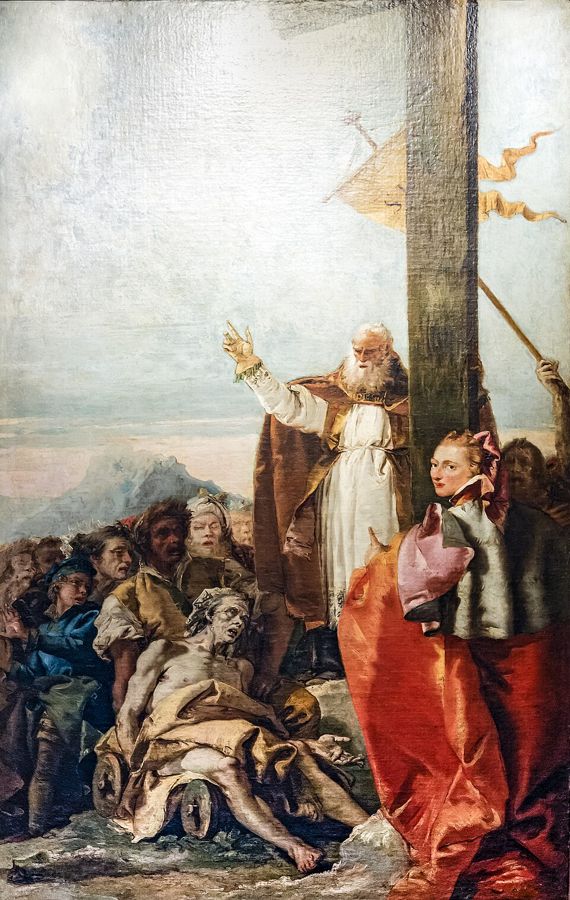
Image: Chiesa di San Polo (Venice) - Oratorio del Crocifisso - Saints Helena and Macarius by Giandomenico Tiepolo.jpg · Didier Descouens · CC BY-SA 4.0, via Wikimedia Commons

Image: Didier Descouens, Wikimedia Commons (CC BY-SA 4.0)

From “Catholic Encyclopedia (1913)/St. Macarius,” The Catholic Encyclopedia (New York: Robert Appleton Company, 1907–1914), via Wikisource. Public domain. Matched by name and feast date; text unedited except for our bracketed notes in grey.

Retold in plain modern English from Baring-Gould’s public-domain text, sentence by sentence, keeping the same facts and order. Short explanations in parentheses are ours.

From Sabine Baring-Gould, The Lives of the Saints, new edition in 16 vols. (London: John C. Nimmo, 1897), digitized text from Project Gutenberg. Public domain in the United States. Reproduced unedited, except for short bracketed notes in grey that we added to explain names and terms (“S.” is the old abbreviation for Saint). Some history and judgments reflect 19th-century scholarship.

Notes

Story retold in our own words from the cited sources.