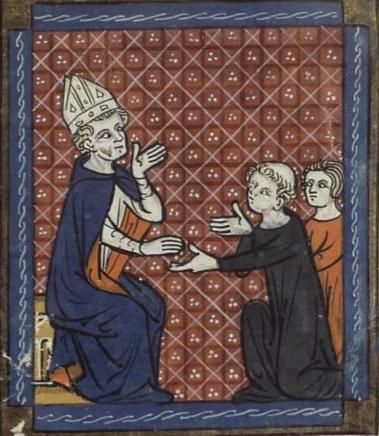
The piety, gentleness, and zeal of the bishop became well-known. However, among the coarse-minded courtiers of King Theoderic II and Brunehaut, many scandalous jokes and slanderous tales circulated about the prominent churchmen of the time, and Lupus was not exempt from this. Verosa, the daughter of the late bishop, was often seen with Lupus, and the bishop appeared to be very fond of her. Folkar, a nobleman and godson of Betto, the bishop’s father, was filled with indignation. He hurried to Sens and informed Lupus about what was being said about him. The bishop smiled and called the young girl into his presence before Folkar. Then, placing his hands on her shoulders, he bent down and kissed her pure forehead. “The ugly words of men mean nothing when the conscience is clear,” said Lupus. “I love the maiden dearly, but purely, in Jesus Christ my King.”
After the death of Theoderic, Clothair II, the son of Chilperic and King of Neustria, invaded Austrasia and Burgundy. His officer, Blidebod, laid siege to Sens and captured it by storm. The troops rushed in and began to kill everyone they encountered. In response, Lupus ran to the church, grabbed the bell rope, and pulled it. The sound of the bell stopped the soldiers, causing panic among them, and they retreated.
After Burgundy fell under Clothair's control, the king exiled Lupus to Neustria, which still had many Pagans. During his banishment, the saintly bishop spent his time preaching to and baptizing the idolaters. The main accuser of Lupus was Medegisl, the Abbot of S. Remi, who hoped to gain the archbishopric once Lupus was removed. However, the people, enraged by his actions, stormed the church of S. Remi and killed the abbot. At that time, S. Winebald was the abbot at Troyes, known for his great holiness and general esteem. At the request of the Archdeacon of Sens, he approached Clothair and pleaded with him to restore Lupus to his suffering flock. The abbot managed to gain the king's consent and then hurried to Neustria to find the bishop and bring him back to Sens.
Lupus's return to his diocese was a triumph, with miracles and enthusiastic crowds demonstrating his holiness and popularity. One day, it is said that while Lupus was saying Mass, a jewel suddenly fell into the chalice. This was seen as miraculous, although it likely had become detached from his mitre or other vestments. It was kept in the treasury as a relic. Clothair requested the bell of S. Stephen, which had caused such panic among his soldiers and had stopped the massacre of the Senonese. The bell was taken to Paris, but since it did not seem remarkable to him, he sent it back. It was received with great ceremony, including banners and a procession, by the people.
Lupus died in A.D. 623 in the village of Brinon and was buried under the eaves of the church of St. Columba in Sens, according to his dying wish.
It is said that when he was exiled from Sens, he threw his ring into the moat. Shortly before his return, a fisherman caught a barbel at Melun, and inside its belly, he found the ring. The ring was taken back to the cathedral, where it is still preserved.
The same story is also told of St. Kentigern, St. Atilal of Zamora, St. Amald, Bishop of Metz, St. Maurillus, St. Benno, and St. Egwin, Bishop of Worcester. They are said to have thrown away the keys to their churches and later found them again in fish.
However, this story is very common and ancient. It is also told of Solomon, who lost his ring and with it his power. He then became a captive, and it was not until the ring was found in a fish’s stomach and returned to his finger that he regained his throne and power.
This story is found in the "Arabian Nights" (Night 495), and it is similar to the Indian legend of Sakontala. It also appears in Aleutian tales, where a golden bowl is swallowed instead.
Footnotes
- Medegisl was the Abbot of S. Remi.
- S. Winebald was the abbot at Troyes.
- Tendlau, Judischer Legende, Nr. 39.
- Radloff, Volksliteratur d. Tükrischen Stamme Slid Sibiriens, Petersb. i. p. 115, 868—902. Compare also Pauli, Schimpf u. Ernst, No. 635, Jubinal, Nouveau Recueil, i. p. 1, Heidelberger Jahrbucher, Nr. 1867.
Baring-Gould’s own footnotes, in modern English.
Read the original 1870s text
Baring-Gould’s sources: Roman and Gallican Martyrologies. Ado, Usuardus, Notker, and Wandelbert, Peter de Natalibus, Molanus, Canisius, &c. The “Life" is very ancient, probably of the 7th cent., and is trustworthy.] S. Lupus, in French Leu, was born in a.d. 573, near Orleans, and was the son of a prince named Betto, and Austregild, who was of royal blood. The brothers of Austregild were Austrenius, Bishop of Orleans, and Aunarius, Bishop of Auxerre. Contrary to the custom of the time, Austregild nourished her child at her own breast, instead of confiding him to a foster-mother. When the child grew to the age when he could discern good from evil, she committed him to the care of his uncles. It is said that his boyish voice was so sweet and soft, that when he sang in the churches men doubted if an angel were not chanting. Having manifested from childhood a desire to serve God at the altar, no opposition was offered to his inclination, and he retired to learn perfection into the holy isle of Lerins, the nursery of saints. On the death of S. Arthemius, Bishop of Sens, in a.d. 609, with the consent of the king, Lupus was elected to the vacant seat.
The piety, gentleness, and zeal of the bishop became renowned; but among the coarse-minded courtiers of King Theoderic II. and Brunehaut, many a scandalous jest or slanderous tale circulated relative to the great churchmen of the day, and Lupus was not spared. Verosa, the daughter of the late bishop, was always about with Lupus, and the bishop seemed very fond of her. Folkar, a noble, godson of Betto, the bishop’s father, full of indignation, hastened to Sens, and told Lupus what was said of him. The bishop smiled, and summoned the young girl into [Sept. x.
his presence before Folkar; then, laying his hands on her shoulders, he stooped and kissed her pure brow. “ The ugly words of men matter nothing, when the conscience is white,” said Lupus; “ I love the maiden dearly, but purely, in Jesus Christ my King.” On the death of Theoderic, Clothair II., son of Chilperic, and King of Neustria, invaded Austrasia and Burgundy. His officer, Blidebod, laid siege to Sens, and took it by storm; the troops bursting in began to cut down and spear every one they met, when Lupus, flying to the church, caught the bell-rope and pulled it. The clang of the bell arrested the soldiers, panic fell on them, and they retired.
Burgundy having fallen under the power of Clothair, the king exiled Lupus to Neustria, which was still in part Pagan: and the saintly prelate spent his time, whilst in banishment, preaching to and baptizing the idolaters. The chief accuser of Lupus had been Medegisl, Abbot of S. Remi, who hoped to obtain the archbishopric when Lupus was removed; but the people, infuriated at his conduct, burst into the church of S. Remi, and tore the abbot to pieces. At this time S. Winebald was abbot at Troyes, a man of great sanctity and generally esteemed. At the request of the Archdeacon of Sens, he sought Clothair, and entreated him to restore Lupus to his afflicted flock. The abbot wrung consent from the king, and then hastened into Neustria to find the bishop and bring him back to Sens.
The return of Lupus to his diocese was a triumph, miracles and enthusiastic crowds attested his sanctity and popularity. One day, we are told, Lupus was saying mass, when a jewel suddenly dropped into the chalice. This was regarded as miraculous, though it had probably become detached
from his mitre or other vestments; and it was preserved in the treasury as a relic. Clothair sent for the bell of S. Stephen’s, which had wrought such a panic among his soldiers, and had arrested the massacre of the Senonese, and it was taken to Paris, but as it did not seem to him very remarkable, he sent it back again, and it was received with pomp of banners and procession by the people.
Lupus died in a.d. 623, in the village of Brinon, and was buried under the eaves of the church of S. Columba [Irish abbot of Iona (d. 597), apostle of Scotland] at Sens, according to his dying wish. The story is told of him, that when exiled from Sens, he cast his ring into the moat. Shortly before his return, a fisherman caught a barbel at Melun, in whose belly he found the ring, which was taken back to the cathedral, where it is still preserved. The story is told also of S. Kentigern, S. Atilal of Zamora, S. Amald, Bishop of Metz; S. Maurillus, S. Benno, and S. Egwin, Bishop of Worcester, who are said in like manner to have thrown away the keys of their churches, and to have found them again in fishes. But the story is a very common and ancient one; it is told of Solomon, who lost his ring and with it his power; he then became captive, and not till it was found in a fish’s stomach and returned to his finger, did he recover his throne and power.1 The story is found also in the “ Arabian Nights (Night 495), and is the same as the Indian legend of Sakontala. It is found among Aleutian tales, but in this case it is a golden bowl which is swallowed.2 1 Tendlau, Judischer Legende, Nr. 39.
2 Radloff, Volkslittcratur d. Txirkischen Stamme Slid Sibiriens, Petersb. i. p. 1 15, 868—902. Compare also Pauli, Schimpf u. Ernst, No. 635, Jubinal, Nouveau Recueil, i. p. 1, Heidelberger Jahrbucher, Nr. 1867. P* 78. [Sept. i.