Driven to rebellion by the unprecedented brutality and violence committed by French soldiers in Sicily, the people united and massacred the arrogant and cruel invaders on March 31, 1282. At that time, Charles of Anjou was in Naples. When he learned of the revolt and the complete loss of Sicily, he sat in silence, glaring angrily around him and gnawing on the top of his scepter. Then he broke into terrible vows of revenge: “If he could live a thousand years, he would continue to destroy the cities, burn the lands, and torture the rebellious slaves. He would leave Sicily a scorched, barren, uninhabited rock, as a warning and an example.”
Pope Martin IV supported him by issuing a bull of excommunication against the rebels who had dared to rise up against a foreign king imposed on them by Papal authority, a king who had murdered their beloved and rightful heir, the boy Conradin, in cold blood, and who had filled every corner of Sicily and Naples with bloodshed, violence, and theft. A crusade was declared against the insurgents. The people of Palermo responded, “They had raised the banner of St. Peter, hoping, under its protection, to gain their liberties; now they unfurled the banner of another Peter, the King of Aragon, placing the island of Sicily under his protection.” Peter of Aragon, to whom the people of Palermo had offered the kingdom of Sicily, immediately gathered an army and landed at Trapani, then rushed to the aid of Messina, which was under siege by King Charles.
The Papal legate accompanying the French army requested to enter the city. He was received with the utmost respect and was urged to accept the authority of the city in the name of the Church. “To the Church, we would willingly pay our tribute, but never, never again to the French.” The legate responded by inviting them, “Let Messina submit to the Church, and in her name be restored to King Charles.” “To Charles, never!” the people shouted, “To the French never! as long as we have blood to shed and swords to wield.” They were all too aware of Charles's mercy.
Charles of Anjou launched a furious attack on the city but was repelled. Ambassadors from the King of Aragon arrived. Charles received them, boiling with rage and frustrated pride, sitting on his bed and, as was often noted, gnawing his scepter. The letter from the King of Aragon was bold and defiant; it ordered Charles, “Count of Provence and King of Jerusalem,” to leave Sicily and expressed astonishment at his audacity in blocking the king's passage through his territories.
From this period, the mind of Charles, which was never strong but became arrogant and cruel in times of success, sank into a strange state of despair. He withdrew to Naples and appealed to the Pope to unleash his wrath against Peter of Aragon. A new disaster completed Charles's humiliation. His fleet was defeated, and his son Charles was taken prisoner. This precious hostage was now in the hands of his enemies, who could take revenge for the death of the young Conradin. Charles's strength failed him, and he died the same year in Foggia. That same year also saw the death of Peter of Aragon, who left his Spanish possessions to his elder son Alfonso and the crown of Sicily to the Infant James.
Edward I of England, allied with the Houses of Aragon and Anjou, now intervened to secure the release of Charles the Lame, the son of Charles of Anjou. The King of Aragon refused to release his captive, who was still imprisoned in Catalonia, unless he received recognition of the Aragonese claim to the kingdom of Sicily. Tired of his captivity, Charles agreed. By the treaty of Campo Franco, which was drawn up by the Papal notary, Charles promised to arrange a peace that would satisfy the kings of Aragon and Sicily, to give up his claims to the latter, and to surrender his three sons and sixty Provençal nobles as hostages. He was released in the year 1288. Pope Nicholas IV immediately annulled the treaty written by his own notary and freed Charles from his solemn oath to uphold the terms of the agreement. However, the cautious King of Aragon did not allow his captive to escape until three princes, the sons of Charles, were in his possession. One of these was Louis, the subject of this notice.
During his captivity, Louis fell seriously ill, and believing he was dying, he vowed that if he recovered, he would join the Order of Saint Francis. A miraculous escape from being crushed by a horse that fell on him, after his recovery, strengthened his resolve to dedicate his life to religion.
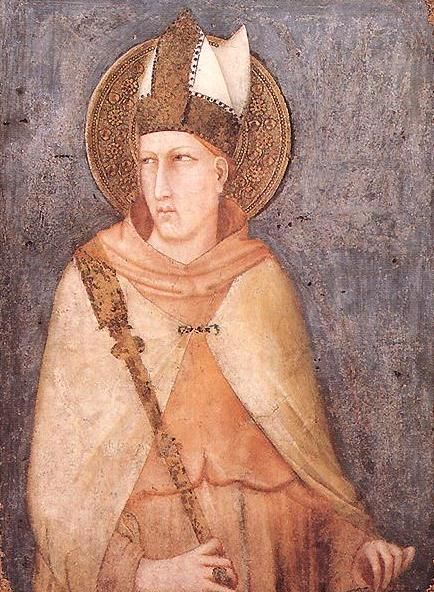
After seven years of captivity, he was released in the year 1295 and returned to Naples, where he took holy orders and was ordained as a priest. He lived in a castle overlooking the deep blue bay, across from Vesuvius with its plume of smoke. He said Mass every day and spent his free time in a garden where he dug, weeded, and tended to his flowers with great diligence. A close friend of his was Jacques d’Euse, a small deformed man who was the son of a cobbler from Cahors. In his youth, he had followed the fortunes of an uncle who had a small trading business in Naples. He settled in that bright and pleasant city, which offered opportunities for needy and ambitious Frenchmen. He was encouraged to study by a Franciscan friar but declined to join the Order. The poor scholar was recommended to the teacher of the king’s children. He won the favor of Louis and gradually rose in status until, in 1316, he became Pope John XXII in Avignon. One of his first acts was to canonize his friend and benefactor, Louis of Naples.
Under the guidance of Richard of Mediavilla, the Franciscan, Louis gained some theological and philosophical knowledge. As he became more attached to the Minorite Order, he surrounded himself with friars in grey habits. He was quickly appointed as the bishop of Toulouse at the age of twenty-two in 1296 and died the following year. He is said to have been a passionate preacher, addressing the people as often as twice on Sundays. His sermons were not without impact.
The interests of the Papal See, along with his alliance with Charles of Naples, compelled Pope Boniface VIII, who was now on the throne of St. Peter, to reconcile, if possible, the conflicting claims of the Houses of Anjou and Aragon. He aimed to put aside the failure of the Holy See's attempts to crush and expel the Spaniards and restore Sicily to the ruthless hands of the French. The Aragonese, despite the most solemn excommunications and repeated grants of the Kingdom of Sicily to the Angevin, as well as the vigorous warfare of the combined Papal and Angevin armies, had stubbornly maintained their claim through descent, the election of the people, and actual possession. The throne of Sicily had passed successively from Peter to Alfonso, from Alfonso to James; from James, it had devolved, in fact, if not through any formal grant or title, to his younger brother Frederick.
During the reign of the peaceful James, a treaty had been established. Two marriages, which Pope Celestine removed the canonical obstacles for, ratified the peace. James of Aragon was married to Bianca, the daughter of Charles, and Robert, the next son of Charles after Louis, was married to Iolante, the sister of James.
The biographer of Saint Louis says that he gave up the crown that could have been his in order to dedicate himself entirely to religion. In 1290, Charles Martel, his older brother, became the king of Hungary through their mother, Mary, who was the sister and heiress of Ladislas IV. Charles the Lame did not die until 1309, so it is not very clear which crown Louis rejected, unless it was the possibility of the crown of Naples, which his younger brother Robert inherited in 1309. However, Louis had already died by then.
Not long after he was appointed Bishop of Toulouse, he was also given the see of Pamiers, which Pope Boniface VIII had just established. He had joined the Order of Saint Francis when he was consecrated Bishop in the Church of Ara Coeli in Rome. In his palace at Toulouse, he adopted the Minorite colors; his bed curtains were grey, as were the coverings of his chairs and stools. He sent all his gold and silver plate and jewelry to his father and used wooden bowls and platters in his household. Even his silver comb, which he reluctantly gave up, was replaced with a fanshell, which was used in the stables for measuring oats for the horses. However, after being advised against it, he softened his strictness and allowed a few silver items to be used at the table.
Every day, he washed the hands and cut up bread for twenty-five poor people. When he found an old man among the beggars who gathered around his hall and was unable to feed himself, he kindly placed food in the man’s mouth. In his bed, he had “two friars minors, and sometimes more.” His clothing was old, dirty, and ragged; one day, when he met a man without clothes, he took off his own garment and gave it to the beggar. He encouraged his clergy not to dress in a flashy manner. “Dirty clothes,” he said, “cover clean souls.”
In 1297, he went to Catalonia to visit his sister, and on his way back to Toulouse, he fell ill with a fever at Tarascon and died there. He was taken to Marseilles, where he was buried. He was fourteen when he was sent as a hostage to Spain, where he spent seven years in captivity. After his release, he was quickly promoted to Orders before the canonical age and was given the bishoprics of Toulouse and Pamiers. He died at the age of twenty-three, two years and ten months after leaving his captivity.
Footnotes
- The Papal legate was a representative of the Pope.
- Campo Franco: a treaty made in 1288 concerning the release of hostages.
- Saint Francis: founder of the Franciscan Order, known for his commitment to poverty and humility.
- Pope John XXII was the first pope to reside in Avignon.
- Pope Celestine was known for his efforts to mediate conflicts in Italy.
- Charles Martel was the king of Hungary through his mother, Mary.
- Pope Boniface VIII established the see of Pamiers.
- Ara Coeli is a church in Rome.
- "Friars minors" refers to members of the Franciscan Order.
Baring-Gould’s own footnotes, in modern English.
Read the original 1870s text
Baring-Gould’s sources: Roman and Gallican Martyrologies. Canonized by Pope John XXII., in 1317. Authority: — A life written by a contemporary, well acquainted with the Saint. Of his childhood he writes, “ This was told me by Mary, her serene Majesty, his mother.”] Charles of Anjou, brother of Louis IX., the Saint, obtained the kingdom of Naples and Sicily, by the gift of Pope Urban IV., who hated and dreaded the Hohenstaufen family, and was reluctant to see the young Conradin, grandson of Frederick II., on the throne, and master of both Germany and Naples, able to hold the Papal States as a nut between the jaws of a cracker. Conradin was only three years old when his father died (a.d. 1250). Charles grasped at the tempting offer. In 1265 he poured a French army into Italy, defeated Manfred, the guardian of Conradin, at Benevento, and established himself on the throne of Naples. Charles of Anjou was succeeded by his son, Charles II., who married Mary of Hungary, and by her had fourteen children. The eldest son was Charles Martel, Prince of Salerno, the second was Louis, the subject of this memoir; the third Robert, King of Sicily; the fourth Philip, Prince of Tarentum; the rest of the sons need not be named. Of his daughters Clementia married Charles of Valois, Bianca became the wife of James, King of Aragon, Eleonora married Frederick, King of Sicily, Maria married the King of Majorca.
Lashed to insurrection by the unexampled barbarities and outrages committed by the French soldiers in Sicily, the people rose as one body, and massacred the insolent and brutal invaders, March 31, a.d. 1282. Charles of Anjou was then at Naples. When he heard of the revolt, of the total loss of Sicily, he sat silent, glaring fiercely around him, gnawing the top of his sceptre; then broke into horrible vows of vengeance: “If he could live a thousand years, he would go on razing the cities, burning the lands, torturing the rebellious slaves. He would leave Sicily a blasted, barren, uninhabited rock, as a warning and an example.’' The Pope, Martin IV., seconded him by hurling a bull of excommunication against the rebels who had dared to rise against a foreign king imposed on them by Papal authority, a king who had murdered in cold blood their beloved and rightful heir, the boy Conradin, and who had filled every corner of Sicily and Naples with blood, outrage, and robbery. A crusade was proclaimed against the insurgents. The people of Palermo replied, “ They had unfolded the banner of S. Peter, in hopes, under its protection, to obtain their liberties; now they unfurled the banner of another Peter, the King of Aragon, they placed the island of Sicily under his protection.1' Peter of Aragon, to whom the Palermitans had offered the kingdom of Sicily, at once embarked an army and landed at Trapani, and hastened to the relief of Messina, then invested by King Charles. The Papal legate [an official representative sent by the pope] who was with the French army demanded to be allowed to enter the city. He was received with the utmost respect, he was implored to accept the dominion of the city in the name of the Church. “ To the Church they would willingly pay their tribute, but never, never again to the French.’' The legate replied by inviting them, “ Let Messina lay herself in the lap of the Church, in her name to be restored to King Charles.” “ To Charles, never !” The people took up the cry, “ To the French never ! so long as we have blood to shed and swords to wield.” They knew too well the mercy of Charles.
Charles of Anjou made a furious assault on the city, but was repelled. Ambassadors from the King of Aragon arrived. Charles received them boiling with rage and baffled pride, sitting on his bed, and, with the gesture constantly ascribed to him, gnawing his sceptre. The letter of the King of Aragon was bold, defiant; it ordered Charles, “Count of Provence and King of Jerusalem,” to depart out of Sicily; and expressed astonishment at his presumption in impeding the passage of the king through his dominions.
From this period, the mind of Charles, never strong, but insolent and cruel in prosperity, sank into a strange prostration; he withdrew to Naples, and appealed to the Pope to hurl his thunders against Peter of Aragon. A new disaster completed the humiliation of Charles. His fleet was discomfited, and his son Charles was taken prisoner. The precious hostage was in the power of his enemies; on him they might wreak vengeance for the death of the young Conradin. His strength failed, and he died the same year at Foggia. The same year saw the death of Peter of Aragon, leaving his Spanish possessions to his elder son Alfonso, and the crown of Sicily to the Infant James.
Edward I. of England, allied with the Houses of Aragon and of Anjou, now mediated to obtain the liberation of Charles the Lame, the son of Charles of Anjou. The King of Aragon would not surrender his captive, still in prison in Catalonia, except at the price of the recognition of the Aragonese tide to the kingdom of Sicily; and Charles, weary of bondage, consented. By the treaty of Campo Franco, drawn up by the Papal notary, Charles pledged himself to arrange a peace satisfactory to the kings of Aragon and of Sicily, to surrender his claims to the latter, and to give up his three sons and sixty Provençal nobles as hostages. He was released (a.d. 1288). Pope Nicholas IV. at once annulled the treaty written by his own notary, and absolved Charles from his solemn oath to observe the conditions of the compact. But the cautious King of Aragon did not allow his captive to escape, till three princes, the sons of Charles, were in his power. One of these was Louis, the subject of this notice.
During his captivity Louis was attacked with a dangerous illness, and thinking himself dying, he vowed, should he be restored to health, to join the Order of S. Francis. A providential escape from being crushed by a horse which fell upon him, after his recovery, confirmed him in his resolution to devote his life to religion.
After seven years of captivity, he was released (a.d. 1295), and returned to Naples, where he took holy orders [ordination; “orders” means the sacrament by which deacons, priests and bishops are ordained] and was ordained priest. He lived in a castle above that deep blue bay, opposite Vesuvius with its streamer of smoke. He said mass every day, and spent his leisure in a garden where he dug and weeded and tended his flowers with great assiduity. A favourite friend was Jacques d’Euse, a little deformed man, a cobbler’s son of Cahors. He had followed in his youth the fortunes of an uncle, who had a small trading capital, at Naples. He settled in that brilliant and pleasant city. It presented openings for needy and ambitious FrenchmenHe was encouraged to study by a Franciscan friar, but refused to enter the Order. The poor scholar was recommended to the instructor of the king’s children. He ingratiated himself into the favour of Louis; from step to step he mounted till, in 1316, he became Pope (as John XXII.) at Avignon. One of his first acts was to canonize his friend and benefactor, Louis of Naples.
Under the tuition of Richard of Mediavilla, the Franciscan, Louis acquired some theological and philosophic learning, and becoming more and more attached to the Minorite Order, he surrounded himself with grey habited friars. He was speedily advanced to the bishopric of Toulouse, at the age of twenty-two, in 1296, and died the following year. He is said to have been a zealous preacher, addressing the people even as much as twice a Sunday. His sermons were not without fruit.
The interests of the Papal See, no less than his alliance with Charles of Naples, bound Pope Boniface VIII., now occupying the throne of S. Peter, to reconcile, if possible, the' conflicting pretensions of the Houses of Anjou and Aragon, and to bury in forgetfulness the failure of the efforts of the Holy See to crush and expel the Spaniard and restore Sicily to the merciless hand of the Frenchman. The Aragonese, notwithstanding the most solemn excommunications, and reiterated grants of the Kingdom of Sicily to the Angevin, the most strenuous warfare of the combined Papal and Angevin armies, had still obstinately maintained their title by descent,, election of the people, and actual possession. The throne of Sicily had successively passed from Peter to Alfonso, from Alfonso to James; from James it had devolved, in fact, if not by any regular grant or title, to his younger brother Frederick.
During the reign of the peaceful James a treaty had been agreed to. Two marriages, to which Pope Coelestine removed the canonical impediments, ratified the peace. James of Aragon was espoused to Bianca, daughter of Charles; and Robert the next son of Charles, after Louis, to Iolante, the sister of James.
The biographer of S. Louis says that he resigned the crown that might have been his, in order to devote himself wholly to religion. In 1290 Charles Martel, his elder brother, succeeded to the crown of Hungary, by right of his mother, Mary, sister and heiress of Ladislas IV. Charles the Lame did not die till 1309, consequently it is not very clear what crown Louis rejected, unless it were the prospect of one, that of Naples, to which his younger brother Robert succeeded in 1309. But Louis was then dead. Not long after his appointment as Bishop of Toulouse, he was given also the see of Pamiers [a bishop’s “see” is his diocese, named from his seat (Latin sedes)], which Boniface VIII. had just erected. He had joined the Order of S. Francis when he was consecrated Bishop, in the Church of Ara Coeli in Rome. In his palace at Toulouse he affected the Minorite colours, his bedcurtains were grey, so were the coverings of his chairs and stools. All his gold and silver plate and jewellery he sent to his father, and used in his household wooden bowls and platters. Even his silver comb he resigned, not without a sigh, and in its place used a fanshell, employed in the stables for measuring the oats for the horses. But having been remonstrated with, he relaxed the severity of his rule, and allowed the table to be laid with a few silver articles. Every day he washed the hands and cut up the bread of twenty-five poor wights, and when he found among the beggars who hung about his hall an old man unable to feed himself, he benignantly placed the food in the man’s mouth. In his bed lay with him “ two friars minors, and sometimes more." His habit was old and dirty and ragged; meeting a man one day without clothes, he pulled off his dress and threw it over the pauper. He urged on his clergy not to appear gay and dapper in dress. “ Dirty clothes,” said he, “ cover clean souls.”
In 1297 he went into Catalonia, to visit his sister, and on his way back to Toulouse was attacked with fever at •S'. Louis.
Tarascon, and died there. He was taken to Marseilles, and there buried. He was aged fourteen when sent a hostage into Spain, and there he spent seven years in captivity. After his release he was rapidly promoted to Orders before the canonical age, and given the bishoprics of Toulouse and Pamiers, and died at the age of twenty-three, two years and ten months after he left his captivity.