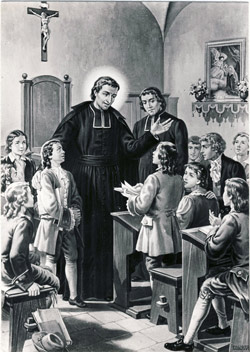
This Saint’s Story
His father, Jean-Baptiste, was a notary, and the family later moved to Iffendic, where Louis spent much of his early childhood. At the age of twelve, he began his education at a Jesuit (member of the Society of Jesus, founded by St. Ignatius of Loyola) institution in Rennes, where he was inspired by a local priest, Abbé Julien Bellier, to develop a profound devotion to the Blessed Virgin Mary.
In 1693, Montfort traveled to Paris to continue his studies at the prestigious Seminary of Saint-Sulpice. However, he encountered financial difficulties and had to live among the poor while attending lectures at the Sorbonne. After a serious illness, he returned to the seminary, where he served as librarian, allowing him to study various works on spirituality, particularly those focusing on Mary. This period solidified his commitment to a life dedicated to serving others.
Ordained a priest in June 1700, Montfort was initially assigned to Nantes but felt a strong calling to preach missions. In 1710, he became a member of the Third Order of Saint Dominic, seeking to establish rosary confraternities. His desire to spread the Gospel led him to undertake a pilgrimage to Rome, where Pope Clement XI recognized his missionary spirit and sent him back to France with the title of Apostolic Missionary. Montfort's preaching gained him a reputation, and he was affectionately referred to as 'the good Father from Montfort.'
Despite facing opposition, including attempts on his life and the destruction of a calvary he built, Montfort remained steadfast in his mission. He founded two religious communities dedicated to education and service: the Company of Mary and the Daughters of Wisdom. His writings, including 'True Devotion to Mary' and 'The Secret of the Rosary,' became influential in Catholic spirituality, emphasizing total consecration to Jesus through Mary.
Montfort's health deteriorated due to his rigorous lifestyle and an incident of poisoning. He died on April 28, 1716, at the age of 43, after delivering a final sermon on the tenderness of Jesus. His burial attracted thousands, and stories of miracles at his tomb quickly spread. He was beatified (declared 'Blessed', the step before sainthood) by Pope Leo XIII in 1888 and canonized (officially declared a saint by the pope) by Pope Pius XII on July 20, 1947, acknowledging his significant impact on the Church.
