St. Linus, Pope

Linus, Pope, reigned about A.D. 64 or 67 to 76 or 79.

Read the essentials →
Feast September 23 · Martyr

St. Linus, Pope

Current feast

September 23
Secondary source · Wikipedia infobox

Traditional feast

September 23
1914 / pre-1969 calendar, per Baring-Gould (1897)

Represents

Martyr

Feast days

Feast: September 23

This Saint’s Story

All the ancient lists of the Roman bishops handed down by St. Irenaeus (bishop of Lyon, d. c. 202, who listed the early popes), Julius Africanus, St. Hippolytus, and Eusebius, and the Liberian catalogue of 354, place his name directly after that of St. Peter. Those lists go back to a catalogue already used when Irenaeus wrote Against Heresies in the time of Pope Eleutherus (about 174–189). Against that testimony the Catholic Encyclopedia does not prefer Tertullian's (North African Christian writer, c. 200) later claim that Clement followed Peter, which Jerome and other Latin writers also repeated. Irenaeus has the stronger historical claim.

Irenaeus identifies Pope Linus with the Linus named by St. Paul in 2 Timothy 4:21, and says that after Peter and Paul had founded and ordered the Church in Rome they handed the episcopal office to Linus, whose successor was Anacletus. Whether that identification rests on an early reliable source, or arose later from the shared name, the Catholic Encyclopedia says we cannot be sure. The papal lists give Linus about twelve years; the Liberian Catalogue adds four months and twelve days, but its dates A.D. 56–67 are wrong. Fourth-century writers who thought Linus headed the Roman Church while the Apostle still lived have, the same source judges, no historical foundation. On Irenaeus's witness, Linus was chosen after the Apostles' death; the year of that death is itself uncertain.

The Liber Pontificalis (the early medieval 'Book of the Popes', not always reliable for the earliest ones) says Linus was a Tuscan and that his father was named Herculanus, but the origin of the claim is unknown. The same book attributes to him a decree that women cover their heads in church; the Catholic Encyclopedia calls it apocryphal (outside the Bible and not accepted as Scripture), lifted from 1 Corinthians 11:5. Its statement that Linus was a martyr is unproved and improbable: between Nero (Roman emperor 54–68, the first to persecute Christians, after the fire of Rome in 64) and Domitian no persecution of the Roman Church is recorded, and Irenaeus singles out only Telesphorus among the early Roman bishops as a glorious martyr. Burial beside St. Peter in the Vatican is also asserted there; it is possible, yet unproven, and a sarcophagus once thought to name Linus almost certainly belonged to another name. An epistle on the martyrdom of Peter and Paul later attributed to Linus is apocryphal. His feast is 23 September.

What he represents

How he teaches us to live

Drawn from themes in the original account

Celebrate this saint’s feast day. Remember him on September 23 with a short prayer, and ask for his help.

From the Catholic Encyclopedia

1913 · 969 words

​Linus, Saint, Pope (about a. d. 64 or 67-76 or 79). All the ancient records of the Roman bishops which have been handed down to us by St. Irenæus, Julius Africanus, St. Hippolytus, Eusebius, also the Liberian catalogue of 354, place the name of Linus directly after that of the Prince of the Apostles, St. Peter. These records are traced back to a list of the Roman bishops which existed in the time of Pope Eleutherus (about 174-189), when Irenæus wrote his book "Adversus hæreses". As opposed to this testimony, we cannot accept as more reliable Tertullian's assertion, which unquestionably places St. Clement (De præscriptione, xxxii) after the Apostle Peter, as was also done later by other Latin scholars (Jerome, "De vir. ill." , xv). The Roman list in Irenæus has undoubtedly greater claims to historical authority. This author claims that Pope Linus is the Linus mentioned by St. Paul in his II Tim., iv, 21. The passage by Irenæus (Adv. hæreses, III, iii, 3) reads: "After the Holy Apostles (Peter and Paul) had founded and set the Church in order (in Rome) they gave over the exercise of the episcopal office to Linus. The same Linus is mentioned by St. Paul in his Epistle to Timothy. His successor was Anacletus". We cannot be positive whether this identification of the pope as being the Linus mentioned in II Tim., iv, 21, goes back to an ancient and reliable source, or originated later on account of the similarity of the name.

Linus's term of office, according to the papal lists ​handed down to us, lasted only twelve years. The Liberian Catalogue shows that it lasted twelve years, four months, and twelve days. The dates given in this catalogue, a. d. 56 until a. d. 67, are incorrect. Perhaps it was on account of these dates that the writers of the fourth century gave their opinion that Linus had held the position of head of the Roman community during the life of the Apostle; e. g., Rufinus in the preface to his translation [the solemn moving of a saint’s relics to a new shrine] of the pseudo-Clementine "Recognitiones". But this hypothesis has no historical foundation. It cannot be doubted that according to the accounts of Irenæus concerning the Roman Church in the second century, Linus was chosen to be head of the community of Christians in Rome, after the death of the Apostle. For this reason his pontificate dates from the year of the death of the Apostles Peter and Paul, which, however, is not known for certain. The "Liber Pontificalis" asserts that Linus's home was in Tuscany, and that his father's name was Herculanus; but we cannot discover the origin of this assertion. According to the same work on the popes, Linus is supposed to have issued a decree "in conformity with the ordinance of St. Peter", that women should have their heads covered in church. Without doubt this decree is apocryphal, and copied by the author of the "Liber Pontificalis" from the first Epistle of St. Paul to the Corinthians (xi, 5) and arbitrarily attributed to the first successor of the Apostle in Rome. The statement made in the same source, that Linus suffered martyrdom, cannot be proved and is improbable. For between Nero and Domitian [Roman emperor 81–96] there is no mention of any persecution of the Roman Church; and Irenæus (1. c, III, iv, 3) from among the early Roman bishops designates only Telesphorus as a glorious martyr.

Finally this book asserts that Linus after his death, was buried in the Vatican beside St. Peter. We do not know whether the author had any decisive reason for this assertion. As St. Peter was certainly buried at the foot of the Vatican Hill, it is quite possible that the earliest bishops of the Roman Church also were interred there. There was nothing in the liturgical tradition of the fourth-century Roman Church to prove this, because it was only at the end of the second century that any special feast of martyrs was instituted, and consequently Linus docs not appear in the fourth-century lists of the feasts of the Roman saints. According to Torrigio ("Le sacre grotte Vaticane", Viterbo, 1618, 53) when the present confession was constructed in St. Peter's (1615), sarcophagi were found, and among them was one which bore the word Linus. The explanation given by Severano of this discovery ("Memorie delle sette chiese di Roma", Rome, 1630, 120) is that probably these sarcophagi contained the remains of the first Roman bishops, and that the one bearing that inscription was Linus's burial place. This assertion was repeated later on by different writers. But from a MS. of Torrigio's we see that on the sarcophagus in question there were other letters beside the word Linus, so that they rather belonged to some other name (such as Aquilinus, Anullinus). The place of the discovery of the tomb is a proof that it could not be the tomb of Linus. (De Rossi, "Inscriptiones christianæ urbis Romæ", II, 236-7). The feast of St. Linus is now celebrated on 23 September. This is also the date given in the "Liber Pontificalis". An epistle on the martyrdom of the Apostles St. Peter and Paul was at a later period attributed to St. Linus, and supposedly was sent by him to the Eastern Churches. It is apocryphal and of later date than the history of the martyrdom of the two Apostles, by some attributed to Marcellus, which is also apocryphal ("Acta Apostolorum apocrypha", ed. Lipsius and Bonnet, I, ed. Leipzig, 1891, XIV sqq., I sqq.).

Read the rest of the article

Lightfoot, The Apostolic Fathers, I; St. Clement of Rome, I (London, 1890), 201 sqq.; Harnack, Geschichte der Altchristlichen Literatur, II: Die Chronologie I (Leipzig, 1897), 70; Acta SS. September, VI, 539 sqq., Liber Pontificalis, ed. Duchesne, I, 121: cf. Introduction, lxix; de Smedt, Dissertationes selectæ in primam ætatem hist. eccl., I, 300 sqq.
Read more

The full original · 261 words

Read Baring-Gould’s full account

Baring-Gould’s sources: Roman Martyrology. The Martyrologium Parvum on Nov. 26, also Usuardus and Wandelbert, Bede, and many ancient Kalendars on Sept. 23. But some also on Oct. 7. By the Greek, Linus with Hermes, Caius, Philologus, and Patrobas on Nov. 5.

I US, a Christian at Rome, known to S. Paul and to S. Timothy, is asserted, unequivocally, by Irenseus to have been the first Bishop of Rome. Eusebius and Theodoret corroborate this statement, and all ancient writers agree that the first Bishop of Rome after the Apostles was named Linus. The date of his appointment, the duration of his episcopate, and the limits to which his episcopal authority extended are points which cannot be regarded as absolutely settled, though they have been discussed at great length. Eusebius and Theodoret state that he became Bishop of Rome after the death of S. Peter.

On the other hand, the words of Irenseus — “ [Peter and Paul] when they founded and built up the Church [of Rome], committed the office of its episcopate to Linus ” — certainly admit, or rather imply, the meaning, that he held that office before the death of S. Peter. The duration of his episcopate is given by Eusebius as a.d. 68 — 80; but there are difficulties in the way of accepting these dates, and it is more probable that Linus terminated his tenure of the see and his life in 67 or 68.

The statement of Ruffinus that Linus and Cletus were bishops in Rome whilst S. Peter was alive has been revived in support of a theory, by no means improbable, that Linus was bishop in Rome, appointed by S. Paul, to Christians of Gentile origin; whilst S. Clement, or Cletus, exercised authority over the Jewish Christians there, and owed his appointment to S. Peter.

More about St. Linus, Pope

Checked against at least two sources, in our own words

Help us add to this saint's story

Everything is read by a person before anything appears. Facts are checked against trusted sources first.

Facts are welcome; a source link helps (optional).With your permission we may share it on this page.

Nine days · Free

Pray the novena
with us.

One short email a day for nine days. The day's prayer, a line from St. Linus's story, and a nudge to keep going.

Also on September 23
T

St. Thecla of Iconium

September 23 · Virgin, Martyr
A

St. Adamnan

September 23 · Abbot
← All 1970 saints in the library
Sources & notes

Feast-day sources

Story sources

Sources

Credits

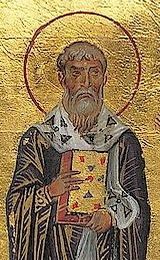
Image: Menologion of Basil II - Patrobulus, Hermas, Linus, Caius, Philologus of 70 disciples (Portrait of Linus).jpg · Authors of Menologion of Basil II (circa 985 AC, Constantinople), Byzantine manuscript illuminators[1]: Pantoleon with G · Public domain, via Wikimedia Commons

Image: Authors of Menologion of Basil II (circa 985 AC, Constantinople), Byzantine manuscript illuminators[1]: Pantoleon with G, Wikimedia Commons (Public domain)

From “Catholic Encyclopedia (1913)/Pope St. Linus,” The Catholic Encyclopedia (New York: Robert Appleton Company, 1907–1914), via Wikisource. Public domain. Matched by name and feast date; text unedited except for our bracketed notes in grey.

From Sabine Baring-Gould, The Lives of the Saints, new edition in 16 vols. (London: John C. Nimmo, 1897–98); text from the Internet Archive scan (OCR, lightly cleaned; errors possible). Public domain in the United States. Reproduced unedited, except for short bracketed notes in grey that we added to explain names and terms (“S.” is the old abbreviation for Saint). Some history and judgments reflect 19th-century scholarship.

Notes

Story retold in our own words from the cited sources.