This Saint’s Story
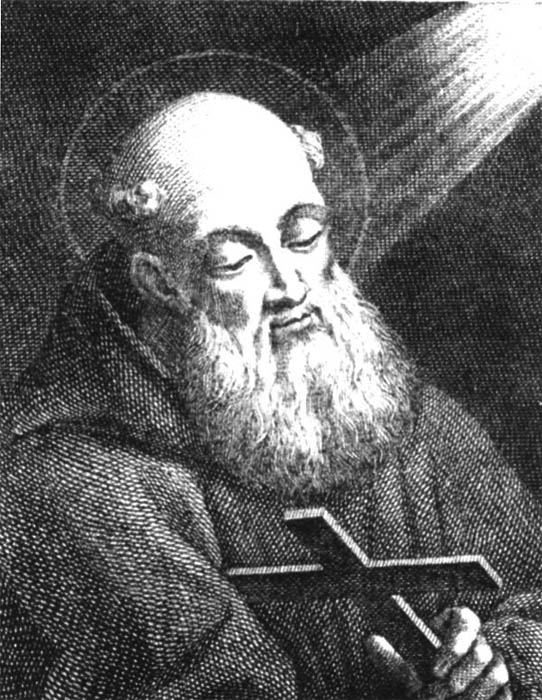
After the early death of his father, he was raised by his uncle, who guided him through his education at a local institution. Displaying a remarkable gift for oratory, he was often chosen to deliver Christmas sermons. At the age of sixteen, he joined the Capuchin (a strict branch of the Franciscan (the order of friars founded by St. Francis of Assisi) friars, founded 1525) Franciscan (the order of friars founded by St. Francis of Assisi) Order in Venice, taking the name Lawrence, and later pursued advanced studies in philosophy and theology at a prominent university. He became a priest when he turned 23.
Lawrence's linguistic abilities were extraordinary; he was fluent in several languages, including Latin, Hebrew, and Greek. This skill proved invaluable when Pope Clement VIII appointed him to preach to the Jewish community in Italy. His deep understanding of Hebrew led many to believe he was a Jew who had converted to Christianity. By the age of 31, he became the major superior of the Capuchin province of Tuscany, where he demonstrated a blend of brilliance and compassion in his leadership.
In 1599, Lawrence began establishing Capuchin monasteries in Germany and Austria, contributing significantly to the Counter-Reformation and helping to convert many Protestants back to Catholicism. His work extended to military service as well; he was appointed the imperial chaplain for the army of Holy Roman Emperor Rudolph II. He led troops during the siege of Székesfehérvár against the Ottoman (the Turkish empire) Turks, armed only with a crucifix, showcasing his deep faith and commitment to his mission.
In 1602, Lawrence was elected the minister general (the head of the whole order) of the Capuchins, a role that allowed him to further expand the Order. He also served as a papal nuncio, traveling to various countries to promote peace. His final mission took him to Lisbon, where he fell ill and passed away on July 22, 1619, his 60th birthday. He was buried at a convent in Villafranca del Bierzo, Spain.
The Church recognized Lawrence's contributions by beatifying him on June 1, 1783, under Pope Pius VI, and canonizing him on December 8, 1881, through Pope Leo XIII. In 1959, he was declared a Doctor of the Church (a title the pope gives to a saint whose teaching is of special value to the whole Church), a title that honors his significant theological contributions.