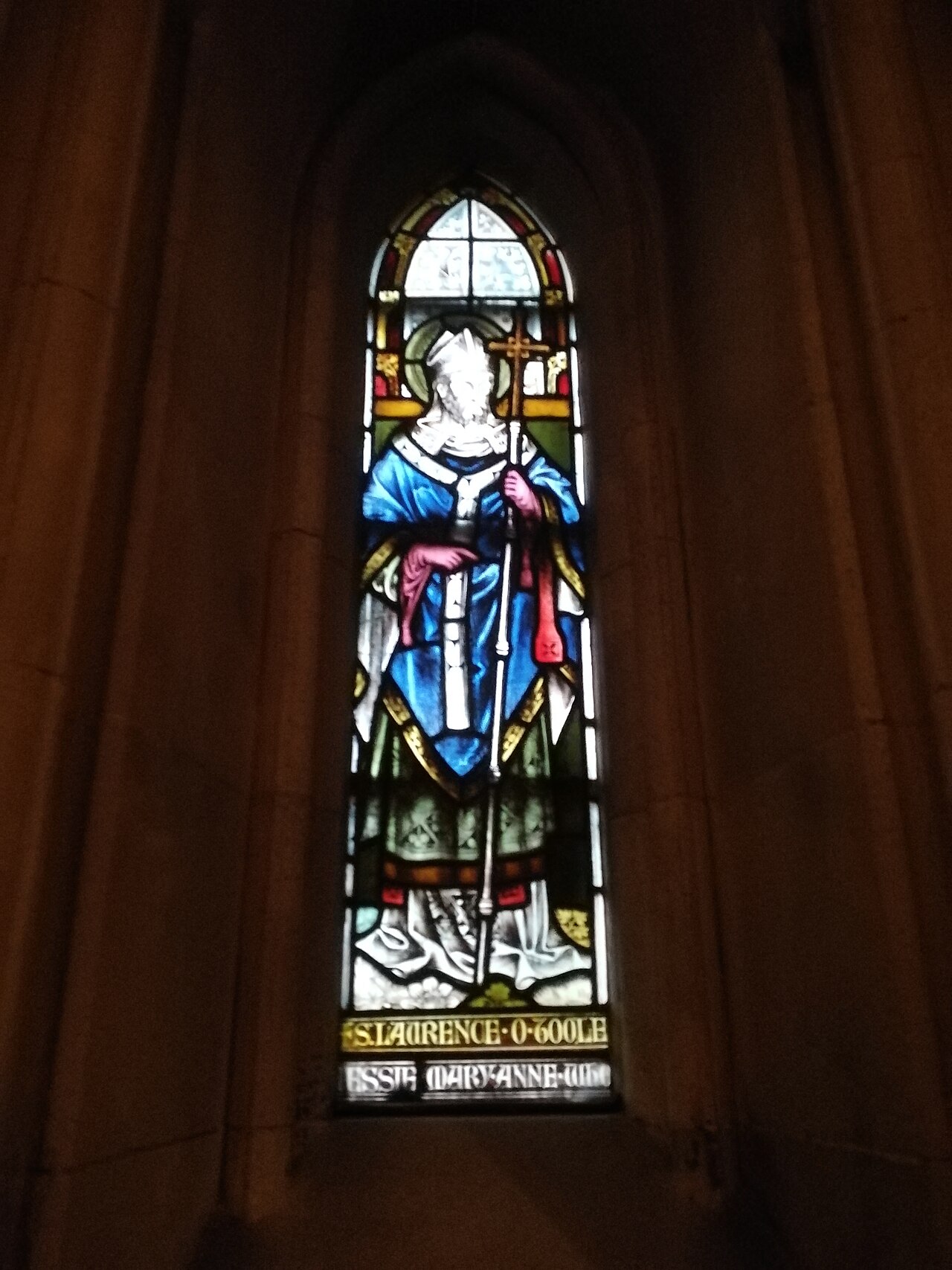
St. Laurence O'Toole of Dublin

Lawrence O'Toole (Lorcan ua Tuathail) was born about 1128.

Read the essentials →
Traditional feast November 14 · Archbishop

St. Laurence O'Toole of Dublin

Feast

Traditional feast: November 14 (Catholic Encyclopedia (1913)/St. Lawrence O'Toole)
Traditional date · cited source, no current calendar entry found

Traditional feast

November 14
1914 / pre-1969 calendar, per Baring-Gould (1897)

Represents

Archbishop

Feast days

Feast: November 14

This Saint’s Story

The Catholic Encyclopedia places his birth in the present County Kildare; Baring-Gould calls him the youngest son of Murtough O'Toole, prince of Imaly in County Wicklow, his mother being of the O'Byrne kindred. At about ten he was given as a hostage to Dermot MacMurrough, King of Leinster. Baring-Gould relates that Dermot treated the boy harshly until Murtough forced his restoration, after which Laurence was trained at Glendalough.

He studied there some thirteen years. Early in 1154, on the death of Abbot Dunlaing, he was chosen abbot of St. Kevin's. Through humility he declined the See of Glendalough in 1160, but after Archbishop Gregory of Dublin died on 8 October 1161 he was elected to that see and consecrated early in 1162 by Gelasius, Primate of Armagh. The Encyclopedia notes that this appointment of a native Irishman, consecrated by the successor of St. Patrick, marked the end of Scandinavian dominance in the Dublin see and of its former obedience to Canterbury.

Lawrence reformed Christ Church by converting its secular canons into Aroasian Austin canons (1163). He wore a hair shirt under his episcopal dress, kept strict austerities, and made an annual forty-day retreat in St. Kevin's cave near Glendalough. Baring-Gould adds that thirty to sixty of the poor were fed daily from his table. At the sieges of Dublin he laboured to protect the people; the Encyclopedia records his deference to Henry II during the king's stay in Dublin and his part in negotiating the Treaty of Windsor for Roderic, King of Connacht.

He attended the Third Lateran Council in 1179 and returned as papal legate for Ireland. Crossing again to plead for Roderic, he was detained about three weeks at Abingdon and then followed Henry into Normandy. Taken ill at the Augustinian (religious who follow the Rule of St. Augustine) abbey of Eu, he was tended by Abbot Osbert and the canons of St. Victor. He died there on 14 November 1180, after learning that Henry had granted his request. The Encyclopedia gives his canonization as 1225 by Honorius III; Baring-Gould gives 1226.

What he represents

How he teaches us to live

Drawn from themes in the original account

Give to people in need. The account records care for the poor.

Celebrate this saint’s feast day. Remember him on November 14 with a short prayer, and ask for his help.

The full story

Baring-Gould’s account retold in modern English

Read the full story · 1,516 words · about 7 min

…chief of Wicklow, and seventeen other lords. Murtough O’Toole heard that Dermot was treating his son badly. He had sent him to a barren bog and given him insufficient food. Murtough seized twelve of Dermot’s soldiers and threatened to put them to death if his son were not restored to him. Dermot, alarmed at the threat, transferred Laurence to the care of the bishop of Glendalough. The bishop kept him for twelve days and then returned him to his father. Murtough took Laurence with him and went to Glendalough. He asked the bishop to determine, by casting lots, which of his sons should be devoted to the ecclesiastical estate. Laurence laughed and asked what was the use of casting lots when he was willing to become a clerk. His father gladly permitted him to remain with the bishop of Glendalough and receive training for the priesthood. He was then twelve years old. Murtough O’Toole was later put to death by Dermot.

When Laurence was twenty-five, he was elected abbot of the monastery of Glendalough. He was generous in his alms, and the riches of the abbey were not enough to satisfy his desire to give, nor the eagerness of the poor to receive. After being abbot for four years, the bishop of Glendalough died, and the office was offered to Laurence, who, however, refused it. Some years later, Gregory, archbishop of Dublin, died, and then Laurence was compelled to accept the archiepiscopal see. Laurence devoted himself to the care of his diocese and was strict in requiring that church offices be regularly and punctually celebrated. He lived a self-denying life, taking only bread and water on Fridays and wearing a hair-shirt next to his skin. From thirty to sixty poor were fed daily by his generosity. Whenever he could, he retired to Glendalough to enjoy the peace of meditation and prayer.

The cruelties and violence of Dermot MacMurrough, king of Leinster, led to him being driven from the country by a coalition of princes and chiefs under Roderic O’Connor, the high king of Ireland. Dermot fled to Henry II of England for help. At the start of his reign, Henry had received a papal bull from Pope Adrian IV granting him the right "to enter the island of Ireland, to subject the people to obedience of laws, to eradicate the seeds of vice, and also to make every house pay the annual tribute of one penny to the blessed Peter." England was ambitious, Rome was in need of money, and the plunder of Ireland would satisfy English ambition and refill the empty coffers of Rome. However, Henry was too busy with his own matters at that time to attempt the invasion of Ireland. The bull had been granted in 1155. It was in 1168 that Dermot fled from Ireland to Bristol and sought Henry's help to regain his kingdom, unaware of the papal decree that had transferred his kingdom and those of his enemies to the crown of England. Henry welcomed Dermot “into the bosom of his grace and benevolence” and invited his nobles to join an expedition to Ireland to right Dermot's wrongs and enrich themselves. For a while, Dermot struggled to gain assistance. After some unsuccessful negotiations with the needy and lawless adventurers who crowded the port of Bristol, he turned to Richard Strongbow, Earl of Pembroke. Strongbow agreed to help him on the condition that he would marry Eva, Dermot's daughter, and succeed him on the throne of Leinster. Strongbow was accompanied by Maurice Fitzgerald and Robert Fitzstephen, sons of Nesta, who had been the mistress of Henry I and was now the wife of Gerald, Lord Carew, governor of Pembroke. We do not need to follow the history of the invasion. Strongbow and his bride went to church in Waterford over the bloody bodies of the dying and the dead, who had been killed by the savage soldiers.

The day before, he marched against Dublin. The inhabitants sent their archbishop, Laurence O’Toole, to negotiate terms with Dermot. While the discussions were ongoing, the English invaded the city and began a brutal massacre of its residents. When the archbishop returned, he heard cries of despair and groans of pain from all around, and it was not easy for him to stop their senseless killing. Dermot MacMurrough died at Ferns in 1171 from a painful illness. Strongbow immediately declared himself king of Leinster through his wife Eva. Everything seemed to be going well for his ambitions when he received an unexpected order from Henry to return to England. He ignored the command, sending an apology and explanations to the king, and stayed in Ireland. Laurence, likely unaware of the papal grant of Ireland and that he was opposing the will of the Vicar of Christ, tried to unite the national leaders and rally the national army against the invaders. His words seemed to have some effect. Strongbow took refuge in Dublin, but soon found himself trapped by an army on land and surrounded by a fleet at sea. Roderic O’Connor led the national forces. Laurence O’Toole was with him, trying to inspire the men with his encouragement and example. The Irish army settled for a blockade, and the besieged soon faced severe food shortages. Strongbow proposed terms of surrender through the archbishop. While these negotiations were happening, Strongbow suddenly broke out of Dublin. The Irish army was completely unprepared for this attack; they fled in panic, and Roderic, who was bathing in the Liffey River, barely escaped. In October 1171, Henry II landed in Ireland with five hundred knights and four thousand men-at-arms to claim the kingdom granted to him by the Holy See and to benefit from the victories of the Earl of Pembroke. The Irish princes, unable to resist him, surrendered without a fight and swore oaths of loyalty.

In 1175, Laurence was at Windsor dealing with matters concerning his Church and witnessed the agreement between Roderic O’Connor and King Henry. At the same time, Henry took his first action of authority by appointing the Irish bishops, naming Augustine, an Irishman, to the vacant see of Waterford. He sent Augustine to the archbishop of Cashel for consecration. Laurence then went to Canterbury, where he was nearly killed by a madman who attacked him with a club and struck him on the head while he was saying mass. Laurence managed to finish the mass, even though his head was bleeding and he was almost dazed. The madman would have been hanged if Laurence had not intervened to save his life.

Strongbow died in Dublin in June 1176. It was crucial for political reasons that his death not be known until someone was available to take his place. His sister, Basilia, wrote to her husband, Raymond Le Gros, in Limerick: “My dear lord, know that the great tooth in my jaw, which used to ache so much, has now fallen out. Therefore, if you care for me or for yourself, you will hurry here as fast as you can.” Raymond understood her message, rushed to Dublin, and then announced Strongbow's death. The deceased earl was buried by S. Laurence in the cathedral of Christ Church in Dublin.

In 1179, S. Laurence O’Toole and five other Irish bishops attended the third Lateran Council in Rome. On their way through England, they were required to take oaths that they would not act in any way harmful to the king or his kingdom. The Pope treated S. Laurence with great kindness and gave him a papal bull, which confirmed the rights of the see of Dublin and its authority over the suffragan sees of Glendalough, Kildare, Ferns, Leighlin, and Ossory. He also appointed him as his legate throughout Ireland.

Upon returning to Ireland, S. Laurence devoted himself passionately not only to the care of his diocese and province but also to the responsibilities of his apostolic legation. In one year, he sent one hundred and forty clergy members convicted of immorality to Rome to seek absolution, indicating that their offenses must have been particularly severe, as he could have absolved ordinary crimes himself. These were new types of scandals in Ireland, brought in by the Norman clergy who came to benefit from the good positions available in Ireland. “Such,” says Dr. Lanigan, “were the missionaries who, according to the wish of Adrian IV, were to establish pure religion and sound ecclesiastical discipline in Ireland.”

S. Laurence continued his extensive charitable work, and during a famine that lasted three years, he provided daily alms to five hundred poor people, in addition to supplying around three hundred more with clothing and other necessities. In 1180, he traveled to England to resolve a dispute between Roderic O’Connor and Henry II. However, Henry refused to meet with him. Consequently, he went to Normandy, waiting for a chance to calm the king's anger. He soon fell ill and died in Eu, crying out in Irish, “O foolish, senseless people! What will you do now? Who will cure your misfortunes? Who will heal you?” Relics are kept in the parish church at Eu.

Footnotes

  1. Murtough O’Toole was later put to death by Dermot.
  2. Laurence was then twelve years old.
  3. He was generous in his alms.
  4. Laurence was compelled to accept the archiepiscopal see.
  5. He lived a self-denying life.
  6. The papal bull was granted in 1155.
  7. Laurence O’Toole was the archbishop of Dublin.
  8. Dermot MacMurrough was a king of Leinster.
  9. Strongbow was a nickname for Richard de Clare, the Earl of Pembroke.
  10. Roderic O’Connor was the last High King of Ireland.
  11. Augustine was the first bishop of Waterford.
  12. The archbishop of Cashel was a senior bishop in Ireland.
  13. Such were the missionaries, who, according to the wish of Adrian IV, were to establish pure religion and sound ecclesiastical discipline in Ireland.

Baring-Gould’s own footnotes, in modern English.

Read the original 1870s text

Baring-Gould’s sources: Roman Martyrology. Canonized by Honorius III in 1226. Authority: — A Life written by a Canon of Eu shortly after his death, in Lorcan OTuathal, or, as he is generally called, Laurence O’Toole, was the youngest son of Muriartach (Murtough) OTuathal, prince of Imaly in the present county of Wicklow. His mother was of the equally great family of the Hy-Brins. Lorcan remained with his parents till he was about ten years old, when he was given as a hostage by his father to Dermot MacMurrough, king of Leinster. He was a brutal prince. In 1135, to please one of his followers, he took the abbess of Kildare from her convent and delivered her over to his pleasure. The people of Kildare rose to rescue her, but without success, for a hundred and fifty of them were killed by Dermot’s soldiers. He put out the eyes of Muirkertach, 1 The date of the synod is generally fixed at 519, so as to allow of Dubricius bring present at it. But the only authority for the two synods of Llandewi-Brefi is Rhyddmarch, and he admits that all records were lost. Some penitential canons passed at it have, however, been preserved, and come to us from Brittany. See Stubbs ind Had dan, “Councils and Eccl. Doc." L p. xx6-x8. 5. Laurence O' Toole.

…chief of Wicklow, and seventeen other lords. Murtough O’Toole heard that Dermot was treating his son badly, that he had sent him to a barren bog, and given him insufficient food. He seized on twelve of Dermot’s soldiers and threatened to put them to death if his son were not restored to him. Dermot, alarmed at the menace, transferred Laurence to the care of the bishop of Glendalough. The bishop kept him twelve days, and then delivered him up to his father. Murtough took Laurence with him and went to Glendalough, and asked the bishop to determine, by casting of lots, which of his sons should be devoted to the ecclesiastical estate. Laurence laughed, and asked what was the use of casting lots when he was willing to become a clerk. His father gladly permitted him to remain with the bishop of Glendalough and receive training for the priesthood. He was then aged twelve. Murtough OToole was afterwards put to death by Dermot.

When Laurence was twenty-five, he was elected abbot of the monastery of Glendalough. He was profuse in his alms, and the riches of the abbey were not sufficient to satisfy his ambition to give, and the readiness of the poor to receive. After having been abbot four years, the bishop of Glendalough died, and the office was offered to Laurence, who, however, refused it Some years later, Gregory, archbishop of Dublin, died, and then Laurence was forced to accept the archiepiscopal see. Laurence devoted himself to the care of his diocese, and was strict in requiring the church offices to be regularly and punctually celebrated. He lived a self-denying life, taking only bread and water on Fridays, and wearing a hair-shirt next his skin. From thirty to sixty poor were fed daily by his bounty. Whenever he was able, he retired to Glendalough, to enjoy the repose of meditation and prayer.

The cruelties and violence of Dermot MacMurrough, king of Leinster, led to his being driven from the country by a league of princes and chiefs under Roderic O’Connor, the head king of Ireland. Dermot fled to Henry II. of England for assistance. At the commencement of his reign Henry had obtained from Pope Adrian IV. a bull granting him the right " to enter the island of Ireland, to subject the people to obedience of laws, to eradicate the seeds of vice, and also to make every house pay the annual tribute of one penny to the blessed Peter.” England was ambitious, Rome was impecunious, and the plunder of Ireland was at once to satisfy English ambition and to replenish the empty coffers of Rome. Henry was, however, just then much too occupied with his own affairs to attempt the invasion of Ireland. The bull had been granted in 1155. It was in 1168 that Dermot fled from Ireland to Bristol, and invoked the aid of Henry to recover his kingdom, little conscious of the deed of gift, whereby his kingdom and those of his enemies had been made over by the Pope to the crown of England. Henry received Dermot “ into the bosom of his grace and benevolence,” and invited his nobles to undertake an expedition to Ireland to redress the wrongs of Dermot, and enrich themselves. For some time Dermot failed in his efforts to obtain assistance. After some fruitless negotiations with the needy and lawless adventurers who thronged the port of Bristol, he applied to Richard Strongbow, Earl of Pembroke. Strongbow agreed to assist him on condition that he should receive the hand of Eva, daughter of Dermot, and should succeed him on the throne of Leinster. Strongbow was accompanied by Maurice Fitzgerald and Robert Fitzstephen, sons of Nesta, mistress of Henry I., and now wife of Gerald, Lord Carew, governor of Pembroke. We need not follow the history of the invasion. Strongbow and his bride passed to church in Waterford over the bleeding bodies of the dying and the dead, who had been massacred by the savage soldiers the S. Laurence O' Toole.

day before. Then he marched against Dublin. The inhabitants commissioned their archbishop, S. Laurence O’Toole, to make terms with Dermot. While the discussion was pending, the English broke into the city and commenced a merciless butchery of its inhabitants. When the archbishop returned, he heard cries of misery, and groans of agony in all quarters, and it was not without difficulty that he succeeded in arresting their wanton slaughter. Dermot MacMurrough died at Ferns in 1.171, of a painful disorder. Strongbow at once proclaimed himself king of Leinster, by right of his wife Eva. All appeared to promise well for the object of his ambition, when he received a sudden summons from Henry to return to England. He disregarded the command, and sending an apology and explanations to the king, remained in Ireland. S. Laurence, probably not aware of the papal grant of Ireland, and that he was opposing the will of the Vicar of Christ, endeavoured to unite the national chiefs and rally the national army against the invaders. His words appeared to have some effect Strongbow threw himself into Dublin; but he soon found himself landlocked by an army, and enclosed at sea by a fleet Roderic O’Connor commanded the national forces. S. Laurence O’Toole was in his camp, and strove to animate the men by his exhortations and example. The Irish army contented themselves with a blockade, and the besieged were soon reduced to extremities from want of food. Strongbow offered terms of capitulation through the archbishop. While these negotiations were in progress, Strongbow suddenly burst out of Dublin. The Irish army was totally unprepared for this sortie; they fled in panic, and Roderic, who was bathing in the Liffey, escaped with difficulty. In October, 1171, Henry II. landed in Ireland, with five hundred knights and four thousand men-at-arms, to take to himself the kingdom granted him by the Holy See, and reap the result of the victories of the Earl of Pembroke. The Irish princes, unable to resist him, submitted without a blow, and took oaths of allegiance.

In 1175, Laurence was at Windsor on affairs concerning his Church, and witnessed the agreement between Roderic O’Connor and King Henry. At the same time Henry exercised the first act of his authority in appointing the Irish bishops, by naming to the vacant see of Waterford [a bishop’s “see” is his diocese, named from his seat (Latin sedes)], one Augustine, an Irishman, whom he sent to the archbishop of Cashel for consecration. Laurence went on to Canterbury, and was there nearly killed by a madman, who ran upon him with a club and beat him on the head whilst he was saying mass. Laurence was able to finish mass, though his head bled, and he was almost stunned. The lunatic would have been hanged, had not S. Laurence interceded for his life.

Strongbow died at Dublin, in June, 1176. It was of the highest political importance that his death should not be known till some one was present to occupy his place. His sister, Basilia, accordingly wrote to her husband, Raymond Le Gros, at Limerick: “ Know you, my dear lord, that the great tooth in my jaw, which was wont to ache so much, is now fallen out; wherefore if you have any love or regard for me, or for yourself, you will not delay to hasten hither with all speed.” Raymond understood her meaning, hasted to Dublin, and then announced the death of Strongbow. The dead earl was buried by S. Laurence in the cathedral of Christ Church at Dublin. In 1179, S. Laurence O’Toole and five other Irish bishops, were at the third Lateran [St. John Lateran, the pope’s cathedral in Rome] Council at Rome. On their way through England they were obliged to take oaths that they would not act in any way prejudicial to the king or his kingdom. The Pope treated S. Laurence with great kindness, and gave him a bull, in which he confirmed the rights of the see of Dublin, S. Laurence O' Toole. 333 and its jurisdiction over the suffragan [a bishop under the authority of an archbishop] sees of Glendalough, Kildare, Ferns, Leighlin, and Ossory. He also appointed him his legate [an official representative sent by the pope] throughout Ireland.

On his return to Ireland S. Laurence applied himself with fervour, not only to the care of his diocese and province, but likewise to the duties of his apostolic legation. He sent in one year a hundred and forty ecclesiastics convicted of immorality to Rome, to obtain absolution there, so that their cases must have been of extreme grossness, as all ordinary crimes could have been absolved by him. These were scandals of a new kind in Ireland, introduced by the Norman clergy, who flocked over to receive the good benefices in Ireland. “ Such,” says Dr. Lanigan, “ were the missionaries, who, according to the wish of Adrian IV., were to establish pure religion and sound ecclesiastical discipline in Ireland.” 1 S. Laurence continued his unbounded charities, and during a famine which lasted for three years, gave daily alms to five hundred poor persons, besides supplying some three hundred more with clothes and other necessaries. In 1180 he went to England to settle a dispute between Roderic O’Connor and Henry II. But Henry refused to see him. He therefore passed over into Normandy, waiting an opportunity for smoothing the wrath of the king. He fell ill almost directly, and died at Eu, crying in Irish, “ O foolish, senseless people ! what are you now to do ? who will cure your misfortunes ? who will heal you ? ” Relics in the parish church at Eu.
From the Catholic Encyclopedia

1913 · 570 words

Lawrence O'Toole (Lorcan ua Tuathail) Saint, onfessor, b. about 1128, in the present Co. Kildare; d. 14 November, 1180, at Eu in Normandy; canonized in 1225 by Honorius III. His father was chief of Hy Murray, and his mother one of the Clan O'Byrne. At the age of ten he was taken as a hostage by Dermot McMurrogh, King of Leinster. In 1140 the boy obtained permission to enter the monastic school of Glendalough; in that valley-sanctuary he studied for thirteen years, conspicuous for his piety and learning. So great was his reputation in the eyes of the community that on the death of Abbot Dunlaing, early in 1154, he was unanimously called to preside over the Abbey of St. Kevin. Dermot, King of Leinster, married Mor, sister of St. Lawrence, and, though his character has been painted in dark colours by the native annalists, he was a great friend to the Church. He founded an Austin nunnery, of the reform of Aroaise, in Dublin, with two dependent cells at Kilculliheen (County Kilkenny) and at Aghade (County Carlow), in 1151. He also founded an abbey for Cistercian [strict Benedictine reform begun at Cîteaux in 1098] monks at Baltinglass, and an abbey for Austin canons at Ferns.

St. Lawrence, through humility, declined the See of Glendalough in 1160, but on the death of Gregory, Archbishop of Dublin (8 October, 1161), he was chosen to the vacant see, and was consecrated in Christ Church cathedral by Gilla Isu (Gelasius), Primate of Armagh, early in the following year. This appointment of a native-born Irishman and his consecration by the successor of St. Patrick marks the passing of Scandinavian supremacy in the Irish capital, and the emancipation from canonical obedience to Canterbury which had obtained under the Danish bishops of Dublin. St. Lawrence soon set himself to effect numerous reforms, commencing by converting the secular canons of Christ Church cathedral into Aroasian canons (1163). Three years later he subscribed to the foundation charter of All Hallows priory, Dublin (founded by King Dermot), for the same order of Austin canons. Not content with the strictest observance of rules, he wore a hair shirt underneath his episcopal dress, and practised the greatest austerity, retiring for an annual retreat of forty days to St. Kevin's cave, near Glendalough. At the second siege of Dublin (1170) St. Lawrence was active in ministration, and he showed his political foresight by paying due deference to Henry II of England, during that monarch's stay in Dublin. In April, 1178, he entertained the papal legate [an official representative sent by the pope], Cardinal Vivian, who presided at the Synod of Dublin. He successfully negotiated the Treaty of Windsor, and secured good terms for Roderic, King of Connacht. He attended the Lateran [St. John Lateran, the pope’s cathedral in Rome] Council in 1179, and returned as legate for Ireland. The holy prelate was not long in Dublin till he deemed it necessary again to visit King Henry II (impelled by a burning charity in the cause of King Roderic), and he crossed to England in September of that year. After three weeks of detention at Abingdon Abbey, St. Lawrence followed the English King to Normandy. Taken ill at the Augustinian [religious following the Rule of St. Augustine] Abbey of Eu, he was tended by Abbot Osbert and the canons of St. Victor; before he breathed his last he had the consolation of learning that King Henry had acceded to his request.

Messingham, Florilegium (Paris, 1624); O'Hanlon, Life of St. Lawrence O'Toole (Dublin, 1857); Healy, Ireland's Ancient Schools and Scholars (4th ed., Dublin, 1902).

Help us add to this saint's story

Everything is read by a person before anything appears. Facts are checked against trusted sources first.

Facts are welcome; a source link helps (optional).With your permission we may share it on this page.

Nine days · Free

Pray the novena
with us.

One short email a day for nine days. The day's prayer, a line from St. Laurence O'Toole of…'s story, and a nudge to keep going.

Also on November 14
S

St. Serapion of Algiers

November 14 · Martyr
S

St. Serapion of…

November 14 · Martyr
H

St. Hypatius

November 14 · Bishop, Martyr
← All 1970 saints in the library
Sources & notes

Feast-day sources

Story sources

Sources

Credits

Image: Christchurch cathedral Dublin - Baptistery stained glass (St Laurence O'Toole).jpg · ManuRoquette · Public domain, via Wikimedia Commons

Image: ManuRoquette, Wikimedia Commons (Public domain)

From “Catholic Encyclopedia (1913)/St. Lawrence O'Toole,” The Catholic Encyclopedia (New York: Robert Appleton Company, 1907–1914), via Wikisource. Public domain. Matched by name and feast date; text unedited except for our bracketed notes in grey.

Retold in plain modern English from Baring-Gould’s public-domain text, sentence by sentence, keeping the same facts and order. Short explanations in parentheses are ours.

From Sabine Baring-Gould, The Lives of the Saints, new edition in 16 vols. (London: John C. Nimmo, 1897–98); text from the Internet Archive scan (OCR, lightly cleaned; errors possible). Public domain in the United States. Reproduced unedited, except for short bracketed notes in grey that we added to explain names and terms (“S.” is the old abbreviation for Saint). Some history and judgments reflect 19th-century scholarship.

Notes

Story retold in our own words from the cited sources.