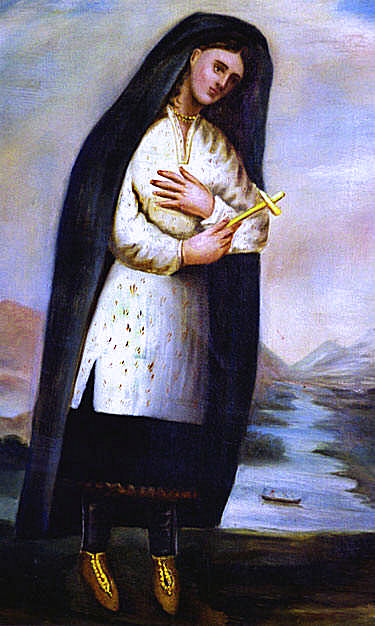
St. Kateri Tekakwitha

Kateri Tekakwitha was born in 1656 in the Mohawk village of Ossernenon, in what is now upstate New York—the same region where three of the North American Martyrs had died. When Tekakwitha was about four, her parents and brother died of smallpox, and she was adopted by her aunts and an uncle who had become chief of the Turtle clan.

Read the essentials →
Feast July 14 · Virgin

St. Kateri Tekakwitha

Current feast

July 14
Verified · Proper calendar for the dioceses of the USA

Traditional feast

July 14
Traditional date (see Catholic Encyclopedia, 1913)

Represents

Virgin

Feast days

Feast: July 14

This Saint’s Story

Her mother was a Christian Algonquin who had been captured and married a Mohawk man; her father was of the Turtle clan. When Kateri was about four, smallpox killed both parents and a brother, scarred Kateri's face, and left the eyes weak. Relatives gave the name Tekakwitha, often explained as “she who bumps into things,” and an uncle who became chief raised her with aunts. Kateri learned the women's work of the village—clothing, baskets, crops—and refused the marriages pressed on her.

Jesuit (member of the Society of Jesus, founded by St. Ignatius of Loyola) missionaries stayed in the uncle's lodge in 1667; Kateri listened but did not yet ask for baptism. About 1675 Father Jacques de Lamberville heard Kateri's desire for the faith, taught her for months, and baptized her on Easter 1676 with the name Kateri (Catherine), after Catherine of Siena. Open practice of Christianity brought harsh treatment at home—mockery, withheld food, stones on the way to chapel. Father Lamberville urged flight. With help from Christian friends Kateri made the long journey north to the mission village of Kahnawake (Caughnawaga) on the St. Lawrence, across from Montreal, arriving in 1677.

There Kateri lived with a Christian woman named Anastasia, made First Communion at Christmas 1677, prayed long hours in the chapel and woods, and on March 25, 1679, took a private vow of chastity. Health had never been strong; Kateri died at Kahnawake on April 17, 1680, about twenty-four years old. Devotion began at once among Native Christians and the French. Pope John Paul II beatified (declared 'Blessed', the step before sainthood) Kateri on June 22, 1980; Pope Benedict XVI canonized (officially declared a saint by the pope) Kateri on October 21, 2012, the first Indigenous saint of North America. The feast is July 14 in the United States and April 17 in Canada.

What she represents

How she teaches us to live

Drawn from themes in the original account

Share your faith, in words and by example. Preaching and conversion are part of this story.

Celebrate this saint’s feast day. Remember her on July 14 with a short prayer, and ask for her help.

Read more

The full original · 481 words

Read the full Catholic Encyclopedia article

Known as the "Lily of the Mohawks", and the "Genevieve of New France" an Indian virgin of the Mohawk tribe, born according to some authorities at the Turtle Castle of Ossernenon, according to others at the village of Gandaouge, in 1656; died at Caughnawaga, Canada, 17 April, 1680. Her mother was a Christian Algonquin who had been captured by the Iroquois and saved from a captive's fate by the father of Tekakwitha, to whom she also bore a son. When Tekakwitha was about four years old, her parents and brother died of small-pox, and the child was adopted by her aunts and a uncle who had become chief of the Turtle clan. Although small-pox had marked her face and seriously impaired her eyesight and her manner was reserved and shrinking, her aunts began when she was yet very young to form marriage projects for her, from which, as she grew older, she shrank with great aversion. In 1667 the Jesuit missionaries Fremin, Bruyas, and Pierron, accompanying the Mohawk deputies who had been to Quebec to conclude peace with the French, spent three days in the lodge of Tekakwitha's uncle. From them she received her first knowledge of Christianity, but although she forthwith eagerly accepted it in her heart she did not at that time ask to be baptized. Some time later the Turtle clan moved to the north bank of the Mohawk River, the "castle" being built above what is now the town of Fonda. Here in the midst of scenes of carnage, debauchery, and idolatrous frency Tekakwitha lived a life of remarkable virtue, at heart not only a Christian but a Christian virgin, for she firmly and often, with great risk to herself, resisted all efforts to induce her to marry. When she was eighteen, Father Jacques de Lamberville arrived to take charge of the mission which included the Turtle clan, and from him, at her earnest request, Tekakwitha received baptism. Thenceforth she practised her religion unflinchingly in the face of almost unbearable opposition, till finally her uncle's lodge ceased to be a place of protection to her and she was assisted by some Christian Indians to escape to Caughnawaga on the St. Laurence. Here she lived in the cabin of Anastasia Tegonhatsihonga, a Christian Indian woman, her extraordinary sanctity impressing not only her own people but the French and the missionaries. Her mortifications were extreme, and Chauchtiere says that she had attained the most perfect union with God in prayer. Upon her death devotion to her began immediately to be manifested by her people. Many pilgrims visit her grave in Caughnawaga where a monument to her memory was erected by the Rev. Clarence Walworth in 1884; and Councils of Baltimore and Quebec have petitioned for her canonization.

[On 22 June 1980, she was beatified by Pope John Paul II; her feast day is celebrated on 14 July. -- Ed.]

More about St. Kateri Tekakwitha

Checked against at least two sources, in our own words

Help us add to this saint's story

Everything is read by a person before anything appears. Facts are checked against trusted sources first.

Facts are welcome; a source link helps (optional).With your permission we may share it on this page.

Nine days · Free

Pray the novena
with us.

One short email a day for nine days. The day's prayer, a line from St. Kateri Tekakwitha's story, and a nudge to keep going.

Also on July 14
P

St. Phocas (July 14)

July 14 · Bishop, Martyr
V

St. Vincent Madelgar

July 14 · Confessor
D

St. Dentlin

July 14 · Confessor
← All 1970 saints in the library
Sources & notes

Feast-day sources

Story sources

Sources

Credits

Image: CatherinaeTekakwithaVirginis1690.jpg · Father Claude Chauchetière, S.J. · Public domain, via Wikimedia Commons

Image: Father Claude Chauchetière, S.J., Wikimedia Commons (Public domain)

From The Catholic Encyclopedia (New York: Robert Appleton Company, 1907–1914), via Wikisource. Public domain in the United States. Reproduced unedited, except for short bracketed notes in grey that we added to explain names and terms (“S.” is the old abbreviation for Saint). Some history and judgments reflect 19th-century scholarship.

Notes

Story retold in our own words from the cited sources.