This Saint’s Story
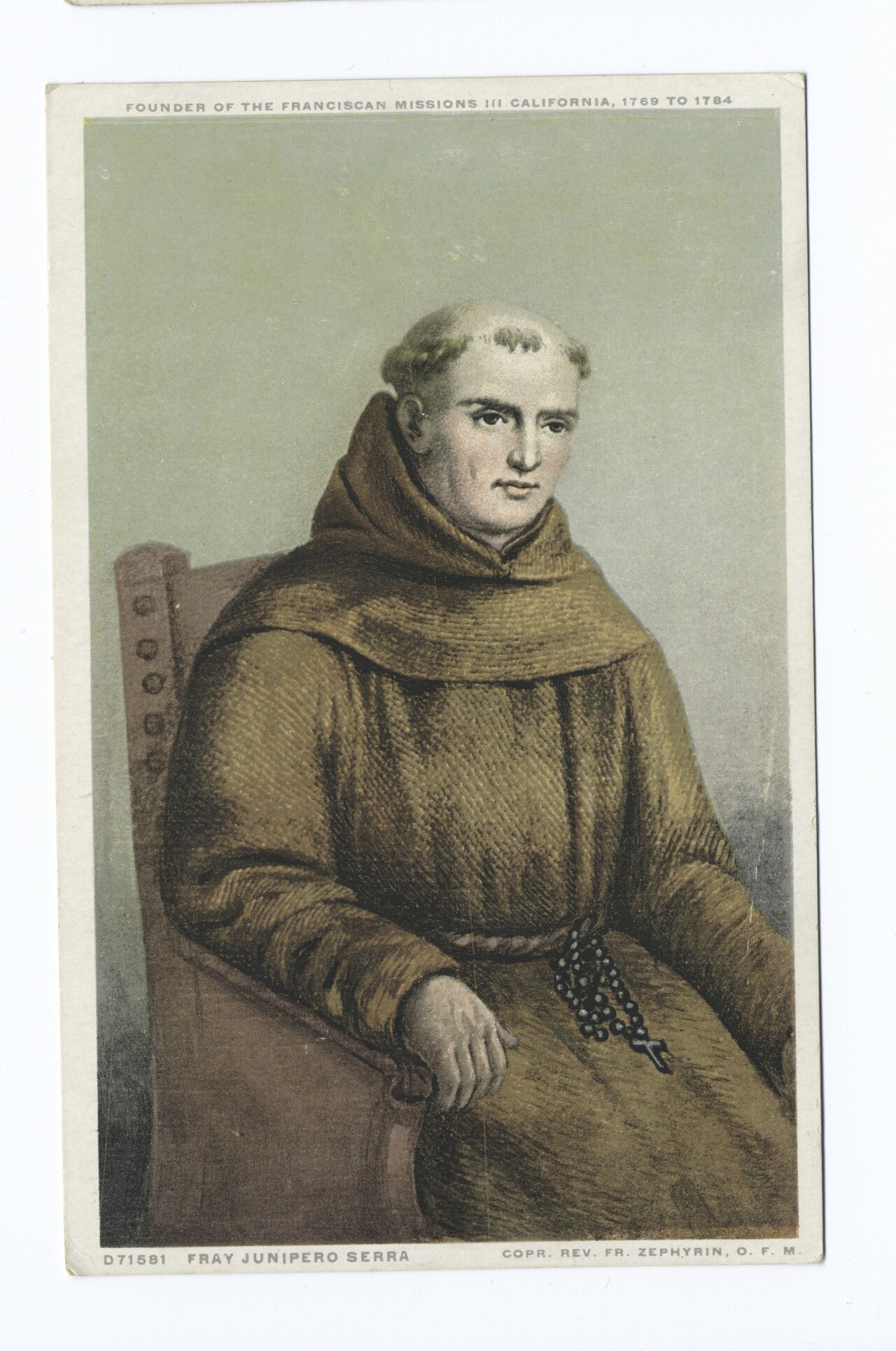
He grew up in a humble family, helping with farm work while showing an early interest in the local Franciscan (the order of friars founded by St. Francis of Assisi) friary. By the age of 16, he was enrolled in a Franciscan school, where he pursued studies in philosophy and theology. Serra entered the Franciscan Order in 1730, taking the name Junípero in honor of a Franciscan saint, and was ordained as a priest in 1737. He later taught philosophy and theology at the Lullian University in Palma, where he was well-regarded for his intellect.
In 1749, at the age of 35, Serra felt a strong calling to missionary work and requested to serve in the Americas. He sailed from Cádiz and arrived in Veracruz, Mexico, where he began his journey on foot to Mexico City, despite suffering from a leg injury that would trouble him for the rest of his life. Serra's dedication to his vocation was evident as he insisted on walking rather than riding, adhering to the Franciscan rule. Once in Mexico City, he joined the College of San Fernando, preparing for his future missionary endeavors.
Serra's first significant missionary work was in the Sierra Gorda region, where he evangelized the Pame people and established missions. His ability to learn local languages and customs allowed him to connect with the indigenous communities. He served there for nine years, during which he built churches and educated the local population in the Christian faith. In 1767, he was appointed to lead the Franciscan missions in Baja California and later moved to Alta California, where he founded several missions, including San Diego and San Francisco.
Throughout his life, Serra faced numerous challenges, including conflicts with civil authorities and the harsh conditions of travel. Despite these obstacles, he remained committed to his mission, advocating for the rights of the indigenous peoples and tirelessly working to spread Christianity. He was known for his extraordinary zeal, often employing dramatic methods to inspire repentance among his congregants. Serra's health deteriorated due to his leg injury and other ailments, yet he continued his missionary work until his death on August 28, 1784, at the Mission San Carlos Borromeo in Carmel.
Junípero Serra was declared Blessed in a ceremony led by Pope John Paul II on September 25, 1988, and later canonized (officially declared a saint by the pope) by Pope Francis on September 23, 2015. His legacy remains complex, as he is celebrated for his missionary work while also facing criticism for the impact of colonization on Native American communities.