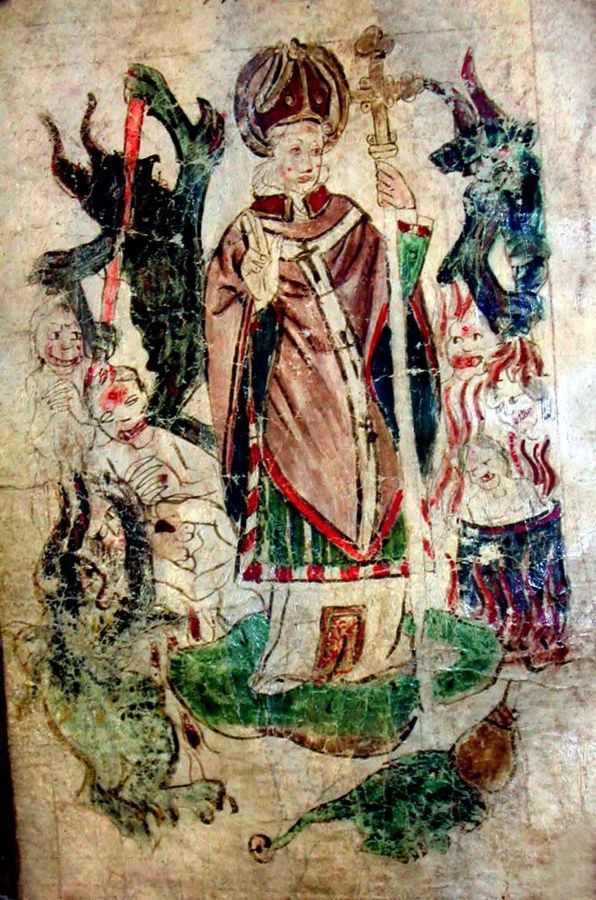
St. John of Bridlington

John, of the Yorkshire family of Twenge (Thwing), was born near Bridlington in 1319, according to the Catholic Encyclopedia.

Read the essentials →
Feast October 21 · Confessor

St. John of Bridlington

Current feast

October 21
Secondary source · Wikipedia infobox

Traditional feast

October 10
1914 / pre-1969 calendar, per Baring-Gould (1897)

Represents

Confessor

Feast days

Feast: October 21
Traditional: October 10

This Saint’s Story

The encyclopedia notes that in Reformation times the same family produced two priest-martyrs and helped establish the Institute of the Blessed Virgin Mary at the Bar Convent in York. Baring-Gould says that as a boy of twelve John vowed himself to chastity.

He completed his studies at Oxford and then entered the priory of St. Mary at Bridlington, a house of Augustinian (religious who follow the Rule of St. Augustine) canons regular. There he held a series of offices; Butler and Baring-Gould name him as precentor, almoner and cellarer. In the end, and against his own wishes, he was elected prior. Butler says he refused the office the first time and was compelled to accept it the second. He remained prior until his death in 1379, and Butler especially remembers his generosity to all in distress.

Even in his lifetime John had a reputation for great holiness and miraculous power. Tradition tells that he once changed water into wine. It also tells of five seamen from Hartlepool who, in danger of shipwreck, called on God in the name of His servant John of Bridlington, and saw the prior appear to them in his canonical habit and bring them safely to shore.

After his death the fame of miracles attributed to his intercession spread quickly. In 1386 Archbishop Neville of York ordered evidence gathered for his canonization, and his body was solemnly translated on 11 March 1404. Pope Boniface IX canonized (officially declared a saint by the pope) him. The fact was long disputed, but the original bull was later found in the Vatican archives, and the encyclopedia calls him the last English saint canonized. Women in difficult childbirth especially invoked him. His shrine was destroyed in 1537 despite the pleas of the people, and only the restored nave of the priory church remains. The canons regular kept his feast on 9 October.
What he represents

How he teaches us to live

Drawn from themes in the original account

Feed your mind with Scripture and good books. Learning and the Scriptures matter in this life.

Build up the community you belong to. Community life is part of this story.

The full story

Baring-Gould’s account retold in modern English

Read the full story · 57 words · about 1 min

…are turned into chips of wood; in the lap of John of Bridlington, they became stones. John studied at Oxford and held the positions of cellarer (the one in charge of the monastery's supplies), precentor (the one responsible for church music), and prior (the head of the monastery) in succession. He ended his life without notable events.

Footnotes

  1. John of Bridlington: a 14th-century English saint known for his piety.
  2. cellarer: the official responsible for the monastery's provisions.
  3. precentor: the official in charge of church music.
  4. prior: the head of a monastery.

Baring-Gould’s own footnotes, in modern English.

Read the original 1870s text

Baring-Gould’s sources: Wilson, in his Anglican Martyrology of 1608. Butler, and the Acta Sanctorum. Authority: — A life by Hugh the Canon.] This saint was born at Thwang, near Bridlington, and from earliest childhood lived to God. At the age of twelve he took a vow of chastity, and on reaching an age of discretion entered the house of Augustinian canons at Bridlington. His life is absolutely devoid of a single incident of interest. The only legend of any beauty in it is an importation. It is the old story of carrying loaves to the poor, and on being detected the loaves are found to be transformed. In most cases they become roses; in the story of S. Nothburga they Oct. jo.] S. Francis Borgia.

…are turned into chips of wood, in the lap of John of Bridlington they became stones. S. John studied at Oxford, and passed through the successive offices of cellarer, precentor, and prior of his monastery, and closed a life without interest

Patron saint of

  • Women in difficult childbirth
    The Catholic Encyclopedia says he was especially invoked by women in cases of difficult confinement.

Short entry · the summary here is 41 words; Baring-Gould’s fuller original text and its sources are below. We have not filled any gap with invented detail.

Help us add to this saint's story

Everything is read by a person before anything appears. Facts are checked against trusted sources first.

Facts are welcome; a source link helps (optional).With your permission we may share it on this page.

Nine days · Free

Pray the novena
with us.

One short email a day for nine days. The day's prayer, a line from St. John of Bridlington's story, and a nudge to keep going.

Also on October 10
P

St. Pinitus

October 10 · Bishop
G

Sts. Gereon and…

October 10 · Martyrs
Sts. Eulampius and Eulampia

Sts. Eulampius and…

October 10 · Martyrs
← All 1970 saints in the library
Sources & notes

Feast-day sources

Story sources

Sources

Credits

Image: British Library Royal 17 B XLIII St John of Bridlington in St Patricks Purgatory.jpg · Wikimedia Commons · Public domain, via Wikimedia Commons

Image: Wikimedia Commons, Wikimedia Commons (Public domain)

Retold in plain modern English from Baring-Gould’s public-domain text, sentence by sentence, keeping the same facts and order. Short explanations in parentheses are ours.

From Sabine Baring-Gould, The Lives of the Saints, new edition in 16 vols. (London: John C. Nimmo, 1897–98); text from the Internet Archive scan (OCR, lightly cleaned; errors possible). Public domain in the United States. Reproduced unedited, except for short bracketed notes in grey that we added to explain names and terms (“S.” is the old abbreviation for Saint). Some history and judgments reflect 19th-century scholarship.

Notes

Story retold in our own words from the cited sources.