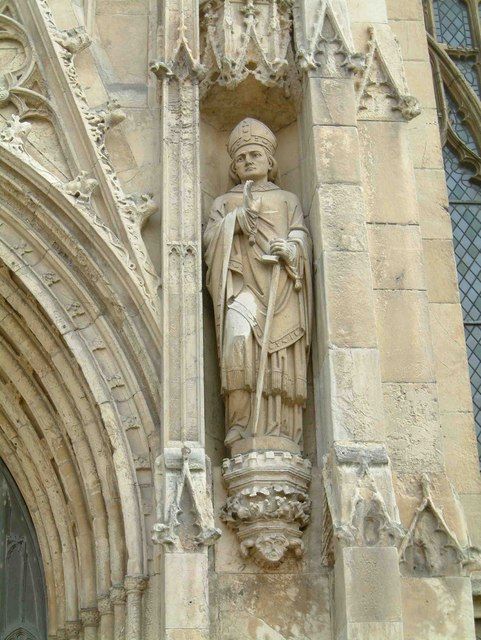
This Saint’s Story
The Catholic Encyclopedia places his birth at Harpham in the East Riding of Yorkshire and his death at Beverley on 7 May 721. In early life he was under Archbishop Theodore at Canterbury, who supervised his education and is reputed to have given him the name John. He became a Benedictine (monks following the Rule of St. Benedict) and for a time lived in St. Hilda’s monastery at Streaneshaleh (Whitby). He won renown as a preacher and teacher of Scripture. On 25 August 687 he was consecrated Bishop of Hexham; he already knew the district, having kept a retreat at Erneshowe (Herneshou) across the Tyne, to which he later returned for Lent when episcopal duties allowed.
Baring-Gould stresses that Bede (the English monk-historian, d. 735) is an excellent witness here: Bede was John’s pupil and was ordained by him. A later life by Folcard of Canterbury (fl. 1066), written at Archbishop Aldred’s request, is too late, in Baring-Gould’s judgment, to keep much that is life-like. John was present at the synod on the Nidd in 705, convened by King Osred of Northumbria over Wilfrid’s case. The encyclopedia also says that in the same year—though it first writes 703—on the death of Bosa, John was translated to York after eighteen years at Hexham, where Wilfrid succeeded him. Of his York years little is known beyond diligent visitation, care for the poor, and close attention to students under his charge. His company is said to have included Bede; Berethune, later Abbot of Beverley; Herebald of Tynemouth; and Wilfrid the Younger, who succeeded John at York.
Having purchased Inderawood, later called Beverley, John founded and endowed a monastery there that became an important ecclesiastical centre even in his lifetime. Baring-Gould and the encyclopedia’s Beverley Minster article describe an Anglo-Saxon double community amid the Forest of Deira; traditions of a still earlier church on the site are marked legendary. After resigning York to Wilfrid the Younger, John retired to Beverley with Abbot Berethune and died there. Benedict IX canonized (officially declared a saint by the pope) him in 1037; Ælfric of York translated the bones into a costly shrine, with a second translation in 1197. Remains were rediscovered in 1664 and again in 1736. Works once ascribed to him are of doubtful authenticity.
