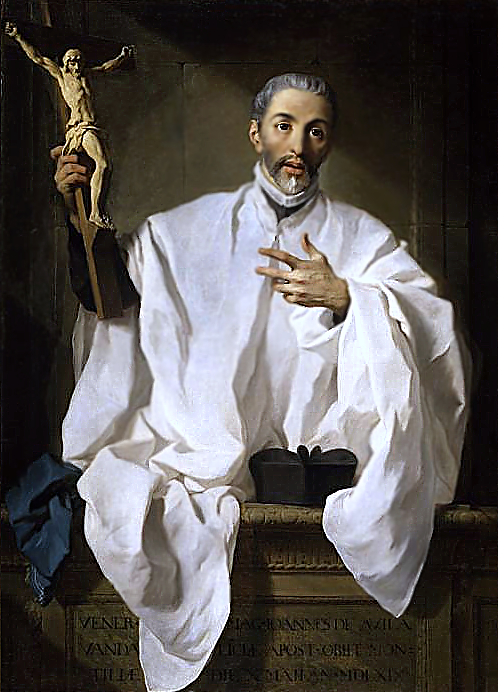
This Saint’s Story
His early education began at the University of Salamanca, where he initially studied law but left without a degree. Following a period of deep spiritual reflection, he resumed his studies in theology and philosophy at the University of Alcalá de Henares, where he earned his bachelor's degree. After becoming a priest in 1526, he offered his first Mass in the church where his parents were laid to rest, marking a significant moment in his life.
With a desire to become a missionary, John planned to travel to Mexico. However, he was persuaded by the Archbishop of Seville to remain in Andalusia, where he began his ministry. His first sermon in 1529 quickly established him as a prominent preacher, attracting large crowds. His calls for reform and criticism of the wealthy led to his arrest by the Inquisition (the Church tribunal that investigated heresy and claims of the supernatural) in 1532, but he was acquitted the following year and continued his work with renewed vigor.
In the years that followed, John became a significant figure in the Diocese of Córdoba, where he established schools and colleges, including the University of Baeza, which was founded in 1538. He dedicated himself to educating young men for the priesthood and promoting spiritual growth among the laity. His writings, particularly the 'Audi, filia', became influential in spiritual literature, reflecting his deep understanding of Christian doctrine and the importance of God's love.
Despite facing health challenges later in life, John remained active in his ministry until his death on May 10, 1569, in Montilla, Spain. He was buried in accordance with his wishes in a church that now serves as a sanctuary in his memory. He is remembered as a preacher and spiritual director whose counsel future saints sought.
John of Ávila was recognized for his contributions to the Church over the centuries. He was declared Venerable by Pope Clement XIII in 1759, beatified (declared 'Blessed', the step before sainthood) by Pope Leo XIII in 1894, and canonized (officially declared a saint by the pope) by Pope Paul VI in 1970. In 2012, he was named a Doctor of the Church (a title the pope gives to a saint whose teaching is of special value to the whole Church) by Pope Benedict XVI, highlighting his profound impact on Christian spirituality and education.
