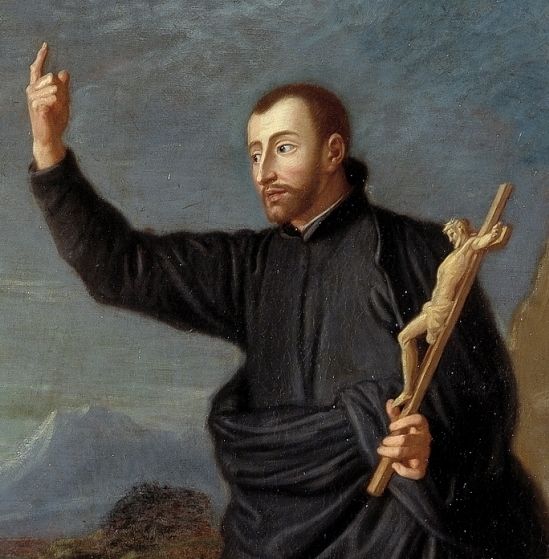
John Francis Regis was ordained a priest in 1630. Shortly after that, the plague broke out in Toulouse, and he devoted himself to caring for the sick with complete selflessness. When family matters required his presence at Fontcouverte, he obtained leave of absence and went to his native place. There, he focused on instructing children, preaching, and hearing confessions. His brothers were very upset with how he dedicated himself to helping the poor, begging for them, and carrying food or fuel on his back to the homes of those in need. On one occasion, he was jeered at by soldiers. His success at Fontcouverte in converting the unrepentant and awakening the indifferent led his superiors to assign him entirely to missionary work. In the summer, he evangelized towns, and in the winter, he worked in villages. His style was extremely simple. An eloquent and well-known preacher who heard him said, “All our oratorical efforts are wasted! The simple words of that man convert souls; our eloquence only entertains.”
Although people from all walks of life came to hear him and to confess to him, he always preferred to address an audience of poor people and to guide the simple and uneducated. His confessional was so crowded that sometimes he did not have time to leave it for meals. “I cannot remember my dinner when I am ministering to these poor wounded souls,” he said once when someone urged him to take a break. He established some houses of refuge for sinful women in Toulouse, supervised by nuns, and later another one in Le Puy. His apostolic career lasted ten years, during which he helped revive religion in Montpellier, Lavonaye, Vivarais, and in Le Puy and all of Velay. Irreligion and moral decay were very prevalent at the time of John Francis Regis.
Sommifcres is the capital of Lavonaye. A mission of Saint John Francis there was so successful that it exceeded his expectations. He wrote a letter to his superior expressing his gratitude to God for the transformation that had occurred. He also founded a confraternity of the Blessed Sacrament there.
In the Vivarais, a province devastated by Calvinism, he worked for three years and achieved a great number of conversions. The churches were rebuilt, converts were made, and Catholics were encouraged to become examples of virtue. Among his conversions, one of the most notable was a wealthy lady of rank in Uzès, who had been a prominent and active supporter of heresy. When she saw the saint and heard him speak, her rebellious will gave way. The Holy Spirit broke down the hard shell that Calvinism had formed over her better and holier feelings, and she willingly placed herself in his hands, eager to be taught the truth as it is in Jesus.
Another of his conversions was the Count of La Mothe, who was so filled with zeal that he invited the saint to Cheylard, which was mostly Calvinist, to work on bringing the lost sheep back to the fold of Christ. There, Regis preached and taught with his usual success. He did not limit his efforts to the town but traveled through the mountains to seek out and convert the peasants who had been trapped by heresy. Often, he lost his way and had to sleep in the forests. His tireless energy and devotion ignited the fire of faith throughout the area.
One day, after leaving the church exhausted from his work, he encountered a group of weary peasants at the gate. "Oh, father! We have walked all night; we have come twelve leagues to hear you, and now we are too late!" "No, my children," said Regis, his eyes filling with tears, "come with me." He returned to the church, preached a moving sermon to them, heard their confessions, offered each one advice, and sent them away rejoicing.
One day, while he was giving a mission at Saint Agrève, a crowd of peasants surrounded him, begging for more instructions. "I cannot, my children. I have promised to hold a mission tomorrow at Saint André. I must go there at once." "Then, father, we will follow you."
Father Clement, a Jesuit from Tournon, was traveling through the mountains. Suddenly, he saw a large group of people approaching along the road in the distance. He stopped and heard a burst of hymns rising from the crowd. The father, quite surprised, asked what was happening. “It is the saint followed by the inhabitants of whole villages who cannot leave him,” was the answer. Father Clement continued on his path to avoid getting caught up in the crowd, but soon found himself caught in another group coming from a different direction. “What is the meaning of this?” he asked. “We are going out to meet the saint.” He hurried on to Saint André, where he planned to spend the night. The small town was buzzing with excitement, and there was a crowd gathered around the church doors. “We are waiting to hear the saint,” they said. Father Clement then thought about how in the past, people followed Jesus from every direction, and he was filled with wonder and joy that such enthusiasm to hear the word of God was being revived in his time.
“Regis, in explaining Christian truths,” said the Count de la Mothe, “spoke with a clarity and simplicity that made his meaning understandable even to the most dull-witted, and with a logical precision that convinced the most stubborn, all while possessing a divine unction that made everyone love him. His holy life gave power to his words. Just seeing him touched hearts.” The last three years of his life were spent on missions throughout the Velay region. In the summer, he preached in Le Puy, the capital; in the winter, when the farmers were not busy with their fields, he visited the villages. So many people came to hear him in Le Puy that seats were reserved three hours before the sermon. His catechism sessions attracted five thousand attendees.
Père Mangeon recounts: “The catechism sessions of Regis were moving and eloquent, delivered with an inspired eloquence rather than a natural or learned one. Père Jean Filleau, the provincial, although he had to leave the next day, insisted on being taken to the church where Regis was conducting his catechism. It was half-past twelve, and I told him I doubted we would find a place. ‘Never mind that,’ he replied, ‘I must once more see that dense crowd of people that so delighted my eyes yesterday.’ We entered the church, and I managed to find a spot for him to stand, but it was not easy. He listened while standing for an hour. He cried, and was so moved that he said to me as we left, ‘If that father were preaching forty leagues from here, I would walk to hear him. That man is full of God and the love of Jesus Christ; I do not know his equal.’”
Regis died on a mission, like a soldier at his post. He was to hold a mission in Louvesc, a small mountain village. He left Le Puy to reach it on December 22, 1640, in fiercely cold, snowy weather, traveling by terrible roads. On his way, he had to spend a night in a barn and was struck with pleurisy. The next day, despite being in great pain and forgetting about his own suffering, as usual, he began his mission. On Christmas Eve and Christmas Day, he did not leave the confessional except to say Mass and preach. The following day, he preached three times, and on his way back to the confessional, he fainted on the church floor. On December 30, he received the last sacraments, and raising his eyes and hands to heaven, he said, “Jesus Christ, my Saviour, I recommend my soul to Thee,” and then he died. Throughout the mountains, a cry arose, “The saint is dead!” His body was laid to rest in Louvesc; it was preserved during the Revolution, and it remains there still.
Footnotes
- Lavonaye (a region in France)
- Vivarais (a historical region in France)
- Le Puy (a city in France)
- Velay (a region in France)
- Saint John Francis is a reference to a Catholic saint.
- Uzès is a town in southern France.
- Cheylard is a town in the Ardèche department of France.
- Saint Agrève is a commune in the Ardèche department of France.
- Saint André is a reference to a place, likely named after Saint Andrew.
- SI John Francis Regis.
- The saint is dead!
Baring-Gould’s own footnotes, in modern English.
Read the original 1870s text
Baring-Gould’s sources: Roman Martyrology. Beatified by Clement XI. in 1716, and canonised by Clement XII. in 1737. Authority A life by the Pfcre Daubenton.] John Francis Regis was born on the 31st of January, in the year 1597, at Font-couverte, in the diocese of Narbonne. He was a grave pious child, with the fear of God ever before his eyes. In 1616, when he was aged nineteen, he entered on his noviciate in the Jesuit College at Toulouse, and his saintliness was manifest to all his fellow students. In 1618 he was sent to Cahors, and in the following year to Toumon, where he was commissioned to preach a mission in the adjacent village of Audance. His success was remarkable, and a general amelioration of morals was the result. There he established for the first time a confraternity of the Blessed Sacrament, and drew up the rules for it himself. In 1625 he was sent to teach literature in the city of Le Puy. In 1628 he was sent to Toulouse to study theology. Every night he was wont to steal softly to the chapel, and fling himself before the Blessed Sacrament in long prayer and rapture of devotion. The superior was told of the conduct of Regis. “Trouble not the communion of that angelic soul with God,” was his answer.
VOL. vi. [June x6 Regis was ordained priest in 1630. Shortly after, the plague broke out in Toulouse, and he devoted himself to the sick with absolute self-forgetfulness. The affairs of his family having required his presence at Font-couverte, he obtained leave of absence, and went to Eis native place. There he occupied himself with instructing the children, preaching, and hearing confessions. His brothers were much offended at the manner in which he placed himself at the service of the poor, begging for them, carrying food or fuel on his back to the hovels of the necessitous, and on one occasion he was hooted at by the soldiers. His success at Fontcouverte in converting the impenitent, and arousing the careless, determined his superiors to destine him entirely to the work of missions. In the summer he evangelized the towns, in the winter the villages. His style was extremely simple. An eloquent and renowned preacher having heard him, said, “ All our oratorical efforts are thrown away ! The simple words of that man convert souls, our eloquence tickles ears.”
Though persons of all ranks crowded to hear him, and to make their confessions to him, he always preferred an audience of poor people, and to become the director of the simple and unlettered. His confessional was so thronged, that sometimes he had not time to leave it for his meals. “ I cannot remember my dinner when I am ministering to these poor wounded souls,” he said once when remonstrated with. He established at Toulouse some houses of refuge for sinful women, under the supervision of nuns; and afterwards another at Le Puy. His apostolic career lasted ten years, during which he had made religion flourish again in Montpellier, the Lavonaye, the Vivarais, and in Le Puy and all Velay. Irreligion and dissolution of morals was very great at S. John Francis Regis.
Sommifcres, the capital of Lavonaye. A mission of S. John Francis there was crowned with fruit so surpassing his expectations that he wrote to his superior a letter expressing his thankfulness to God for the transformation which had taken place. He founded there also a confraternity of the Blessed Sacrament. In the Vivarais, a province devastated by Calvinism, he laboured for three years, and reaped an abundant harvest of souls. The churches were re-built, converts were made, and the Catholics were stimulated to become models of virtue. Amongst his conversions one of the most remarkable was a wealthy lady of rank at Usez, who had been a prominent and active fomentor of heresy. When she saw the saint and heard him speak, her rebellious will yielded, the Holy Spirit broke down the hard crust which Calvinism had formed over all her better and holier feelings, and she placed herself in his hands, meek and zealous, to be taught the truth as it is in Jesus. Another of his conversions was the Count of La Mothe, who was so filled with zeal that he called the saint to Cheylard, which was for the most part Calvinist, to labour for the restoration of the lost sheep to the fold of Christ. There Regis preached and taught with his usual success. He did not confine his efforts to the town, but traversed the mountains to seek out and convert the peasants who had been ensnared by heresy. Often he lost his way, and was obliged to sleep in the forests. His indefatigable energy his devotion, kindled the fire of faith throughout the district. One day he was leaving the church exhausted with his labours, when he found a group of travel- worn peasants at the gate. 44 Oh, father ! we have walked all night, we have come twelve leagues to hear you, and now we are too late ! ” I “No, my children,” said Regis, his eyes filling with tears; “come with me.” He returned to the church, preached to them a moving sermon, heard their confessions, gave each advice, and sent them away rejoicing One day he was giving a mission at S. Agreve. A crowd of peasants surrounded him begging him to give them further instructions. “ I cannot, my children. I have promised to hold a mission to-morrow at S. An dr 6. I must go there at once.” “Then, father, we will follow you.”
Father Clement, a Jesuit of Tournon, was on his journey through the mountains. Suddenly he saw from a height, in the distance, a black swarm of people coming along the road. He halted, and heard a burst of hymnody rise from the crowd. The father, much surprised, asked what all this meant. “ It is the saint followed by the inhabitants of whole villages who cannot leave him,” was the reply. Father Clement pushed on his road so as not to be involved in the crowd, but found himself entangled in another crowd pressing along the road from another direction. “ What is the meaning of this?” “We are going out to meet the saint.” He hastened on to S. Andrd, where he was to sleep the night. The little town was in excitement, there was a crowd about the doors of the church. “We are waiting to hear the saint,” said they. Then Father Clement thought how of old the people followed Jesus from every quarter, and he wondered and rejoiced that such zeal to hear the word of God should be revived in his days. “ Regis, in explaining the Christian verities,” said the Count de la Mothe, “spoke with a lucidity and simplicity which carried his meaning into the understanding of the most stupid, and with a logical clearness which convinced the most obstinate, and withal with a divine •SI John Francis Regis.
unction which made everyone love him. His holy life gave efficacy to his discourses. The mere sight of him touched hearts.” The last three years of his life were spent in missions through the Velay. In the summer he preached in Le Puy, the capital; in the winter, when the peasants were not engaged abroad on their farms, he visited the villages. Such multitudes thronged to hear him at Le Puy, that seats were secured three hours before the sermon. His catechizings were attended by five thousand persons.
The Pere Mangeon relates: “The catechizings of Regis were touching and eloquent, and delivered with an inspired rather than a natural or acquired eloquence. The Pere Jean Filleau, provincial, although he had to leave on the morrow, required to be conducted by me to the church where Regis was giving his catechizings. It was half-past twelve, and I told him that I doubted if we should find room. 4 Never mind that,’ he answered, 1 1 must once more look on that dense throng of people which so gladdened my eyes yesterday.’ We got into the church, and I found a place for him where he could stand, but not without great difficulty. He listened standing for an hour. He cried, and was so touched that he said to me as we came away, 4 If that father were preaching forty leagues from here, I would walk to hear him. That man is full of God and the love of Jesus Christ; I do not know his equal.’ ”
Regis died on a mission, like a soldier at his post. He was to hold a mission at Louvesc, a little mountain village. He left Le Puy to reach it on the 22nd of December, 1640, in fiercely cold, snowy weather, by miserable roads. On his way he had to sleep a night in a barn, and was attacked with pleurisy. He pushed on next day, in great pain, and forgetful of himself, as usual, began his mission. Christmas Eve and Christmas Day he did not leave the confessional except to say mass and preach. On the morrow he preached thrice, and on his way back to the confessional fainted on the church floor. On the 30th of December he received the last sacraments, and raising his eyes and hands to heaven, said, “ Jesus Christ, my Saviour, I recommend my soul to Thee,” and died. Throughout the mountains a wail arose, “ The saint is dead I ” His body was laid at Louvesc; it was saved during the Revolution, and is there still.