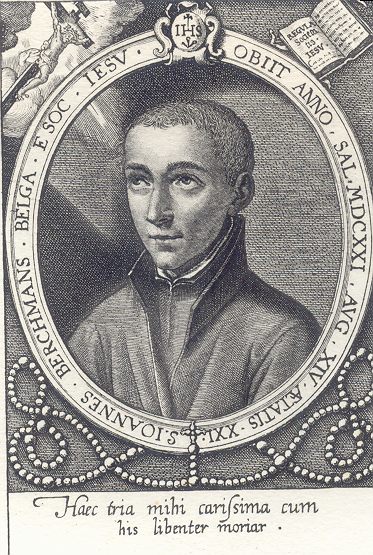
This Saint’s Story
As the eldest of five children, he grew up in a challenging environment marked by religious conflict. His early life was shaped by his mother's long illness, during which he spent many hours by her side, nurturing a compassionate spirit. He attended the local grammar school and worked as a servant to support his studies, even making pilgrimages to a nearby Marian shrine.
In 1615, the Jesuits (the Society of Jesus, founded by St. Ignatius of Loyola) established a college in Mechelen, and Berchmans was among the first students. He quickly joined the Sodality of the Blessed Virgin, demonstrating his commitment to his faith. Despite his father's opposition to his desire to join the Jesuits, Berchmans persevered and entered the novitiate on September 24, 1616. His amiable nature and dedication to his studies made him well-liked among his peers. He aspired to become a chaplain in the army, hoping for the chance to die a martyr's death.
After making his first vows in January 1618, Berchmans moved to Antwerp to study philosophy, but soon transferred to Rome for further education. There, he excelled in his studies and was selected to participate in a philosophical discussion at the Greek College in August 1621. Unfortunately, shortly after this achievement, he fell ill with a fever and dysentery, which ultimately led to his death on August 13, 1621, at just 22 years old.
Following his death, Berchmans was mourned by many, and his remains were displayed for veneration. His heart was returned to Belgium, where it is kept in a church in Leuven. The process for his beatification began shortly after his death, and he was declared Blessed by Pope Pius IX on May 28, 1865. Berchmans was canonized (officially declared a saint by the pope) by Pope Leo XIII on January 15, 1888, and his feast day is celebrated on August 13.
