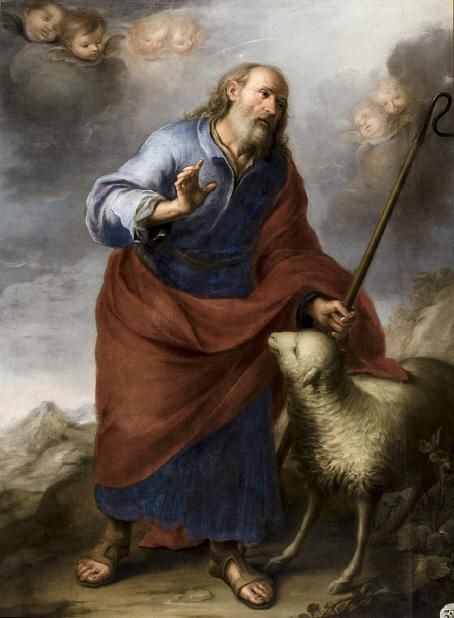
This Saint’s Story
The Gospels do not name Mary's parents. The Catholic Encyclopedia notes St. Peter Damian's warning against idle curiosity about what the Evangelists chose not to relate, yet also records that a very old tradition early hailed Joachim and Anne as the father and mother of the Mother of God.
That tradition seems to rest ultimately on apocryphal (outside the Bible and not accepted as Scripture) writings such as the so-called Gospel of James, the Gospel of the Nativity of Mary, and Pseudo-Matthew. The Catholic Encyclopedia cautions that their rejection from the canon does not mean every detail must be discarded, but legend and borrowed historical data are hard to separate. The lines in which the Gospel of James describes how Joachim and Anne, in their old age, received the reward of their prayers for a child belong to that literature and should be read as tradition, not as Gospel history. Claims that Joachim is the Heli of Luke's genealogy, that he was Joseph's brother, or that he was rich in herds and flocks are, the same source judges, doubtful or drawn from very weak authorities.
Tradition holds that Mary's parents first lived in Galilee and later settled in Jerusalem, where she was born and reared and where they died and were buried. A church known at various times as St. Mary, Holy Probatica, and St. Anne was built in the fourth century, possibly by St. Helena, on the site of their house; their tombs were honoured there until the late ninth century, and the crypt was rediscovered on 18 March 1889. The Greeks honoured Joachim very early, on the day after the Blessed Virgin's birthday. The Latin Church was slower: his feast appeared sometimes on 16 September and sometimes on 9 December; Julius II assigned it to 20 March; it was later suppressed, restored by Gregory XV, fixed by Clement XII on the Sunday after the Assumption, and raised in rank by Leo XIII. In the present General Roman Calendar he is commemorated with St. Anne on 26 July.
