Jerome was born around the year 331. His parents were Catholics from a respectable family and wealthy. He had a brother named Paulinian and a sister, whose name we do not know. Not much is known about his childhood. “Which of us does not remember his infancy?” he writes. “I certainly do, enough to make a grave man like you laugh.... I remember how I used to run in and out of the servants’ chambers when I was little, spending my days in games, until I was dragged away captive from my aunt’s lap to that stern Orbilius.” This old aunt was Castorina, to whom one of his letters was addressed in later years, which still exists. Orbilius was not the name of his master; he refers to his tutor by this name after the famous grammarian from Benevento, whom Horace calls “Plagosus.”
The young Jerome was taught elocution and law to prepare him for a legal career. “Now that I am an old white-haired man,” he writes, “with a bald head, I often dream that I am declaiming in my new toga some minor case before the rhetorician; and when I wake up, I congratulate myself that I am free from the agonies of speechmaking.” He continued his studies in Rome under a certain Donatus. There, he attended the courts to study oratory, and he says it amused him greatly to observe how the lawyers on both sides, becoming heated with their arguments, lost their tempers and began to abuse each other. It was perhaps there that he learned to deal with his opponents in theological debates, which negatively affects his writings. At the same time, he would visit the catacombs and wander through the dark passages, studying the walls filled with cells where the bodies of martyrs and confessors lay.
Besides having Donatus as his grammar teacher, Jerome took lessons in oratory from the rhetorician C. Marius Victorinus, a Christian who wrote a commentary on the Epistles of Saint Paul, and who, for his contributions, was honored with a statue in the Forum of Trajan.
Jerome had not left Rome in 363 when Julian the Apostate was killed. He was not idle during his time there; in addition to studying oratory and grammar, he actively collected a library. However, his moral conduct does not seem to have been exemplary. He often laments that in his youth he fell into sins of the flesh. At that time, he was not baptized. He stated in one place that he had lost the innocence given to him at his birth; a new innocence had been given to him at his second birth, which he had hoped not to lose. Yet even his baptismal garment had been stained, and in one of his letters to Damasus, the Pope, he sadly said that having been baptized by the Spirit and having defiled his robe of innocence, he must look forward to the baptism of fire, in which its stains might be burned away.
From Rome, Saint Jerome went to Treves and to the Rhine, traveling down the Moselle River. At Treves, he copied out two books of Saint Hilary, and this seems to have marked a turning point in his focus towards sacred studies. There, he also met Rufinus, a friendship that was not destined to last a lifetime. He also encountered some Atticoti, or Scots, "a British nation who eat human flesh."
From Treves, he returned south and stayed for some time at Aquileia with his friend Rufinus, from about 370 to 372. There, he formed a friendship with Chromatius, who later became Bishop of Aquileia, as well as with the archdeacon Jovinus, the deacon Eusebius, and Innocent. It was with Innocent that Jerome left Aquileia for the East in 372. They reached Antioch together, where Innocent died, and Jerome fell ill. In 373, while in Antioch, Jerome met Evagrius, the ecclesiastical historian. He had sent a letter, at the request of Innocent, to Evagrius some time before regarding the case of an unfortunate woman who had been tortured by order of the consul at Aquileia on false accusations. One executioner assigned to behead her had struck at her four times; another executioner had struck three times and left her for dead, but, remarkably, the poor woman had revived. In his letter, he expressed his indignation and disgust towards the consul, which had likely forced him to leave Aquileia.
While Jerome was sick in Antioch, his friend Heliodorus came to visit him from Jerusalem and informed him that Rufinus was then in Egypt. Heliodorus was determined to retire into the desert and live as a hermit, wanting Jerome to join him; however, Jerome would not agree to this. He likely felt too ill to endure the strict lifestyle of a hermit. In 374, he was still in Antioch, suffering from poor health and an attack of fever that left him very thin and exhausted.
It was Lent, and even though he was ill, he did not think he could skip the fast. As a result, he became subject to strange hallucinations. He entertained himself in bed by reading Plautus, but mostly he read Cicero, who was his favorite author. One day, while reading, he fell into a fit of unconsciousness and thought he saw himself standing before the throne of God. The Judge asked, “Who are you?” “A Christian,” Jerome answered in his trance. “You lie,” replied the Almighty; “you are a Ciceronian.” Jerome thought he staggered back in fear and fell on his face, filled with shame.
When he regained consciousness, he promised to put aside all his pagan books and decided to focus entirely on the study of theology. In his zeal, he wrote to Theodosius, an abbot in Cilicia, to express his desire to embrace monastic life; he also wrote to Rufinus in Egypt, though that letter expressed his desire more vaguely.
Soon after, his resolve became stronger, and he actually retired into the desert in 374, taking his library with him and writing to his friends for more books to help pass the time, which felt long in his solitude. In his desert cell, he wrote the life of Paul, the first hermit, and sent it to Paul of Concordia, a friend near Aquileia.
The place where he retreated was near Maronia, in Chalcis, a location he described as “burnt up with the heat of the sun.” There, according to his own account, his skin became scorched brown, he slept on the ground, his bones stuck out, and he appeared ragged and miserable. The only people he saw were locals, whose language he barely understood, except at long intervals when he was visited by Evagrius. Troubled by sensual thoughts, he wisely dedicated his mind to the difficult task of learning Hebrew.
In spite of his dream and promise, he continued to study classical writers and later had his monks copy the dialogues of Cicero. He explained Virgil to them in Bethlehem and responded to the accusations of Rufinus, who claimed that all of this was merely a matter of a dream. “He who criticizes me for a dream, I refer to the prophets who teach that dreams are vain and undeserving of faith.” He wanted to keep his mind fully occupied so it wouldn’t wander to unlawful subjects. “What labors did I undertake in learning that alphabet and acquiring those harsh and aspirated words! What difficulties I had to endure! How often I despaired! How often I gave it up, and yet again returned to my task, let my conscience bear witness, which suffered, and that of those who guided me along this path. Yet, thanks be to God! Now I reap sweet fruit from letters off that bitter road.”
It was while Jerome was in his desert that the Meletian schism broke out. In 362, this unfortunate conflict was intensified and prevented from dying out by the reckless actions of Lucifer of Cagliari, who ordained Paulinus. An account of this schism has already been provided, and that sad chapter in the history of the Church need not be repeated here. Antioch had at that time two bishops, both orthodox, and the Catholics were divided into two factions supporting the rival prelates. The Eastern bishops recognized Meletius, while the Roman Church recognized Paulinus. There was also Vitalis, ordained Bishop of Antioch by Apollinaris; but there was, in addition, a fourth claimant—Euzoius, an Arian.
At this time, the East was troubled by questions regarding the term hypostasis; whether it could be applied to the Three Persons of the Trinity. Syrian monks invaded Jerome’s solitude and pressured him to confess the Three Hypostases. He responded that he fully believed in the Three Persons but could not accept Hypostasis to mean anything other than Essence. They insisted that he should accept the phrase as well as the doctrine. In his confusion, he turned to Pope Damasus of Rome for guidance. It was natural for him to do so. Rome was associated with many significant moments of his undisciplined youth and with his subsequent baptism; and her bishops had been notably faithful to the faith, except in the one unfortunate instance for which Liberius had lived to atone. Their leadership had been marked by faithfulness.
“While foxes were in the vineyard,” wrote S. Jerome, “and the seamless robe was torn, he felt compelled to seek nourishment for his soul where the heritage had been kept from corruption.” The kindness of Damasus invited him, even though his grandeur was intimidating. Following “Christ only as Chief,” Jerome claimed to be in communion with the see of Peter. “On this rock, I know, the Church is built; whoever eats the Lamb outside that house is profane. I do not know Vitalis, I disown Meletius, I do not know Paulinus. Whoever does not gather with you, scatters; that is, whoever is not of Christ is of Antichrist.” He implores Damasus, “by the crucified Salvation of the world,” to clarify whether the belief in Three Persons can be expressed by “Three Hypostases,” while also indicating his opinion that no explanations can clear the phrase from the “poison of Tritheism.” This appeal was made around the beginning of 377, and the following year, the response from Damasus arrived, addressed to Paulinus.
About 397, Jerome left his retreat and came to Antioch, where he was ordained a priest by Paulinus. While there, he wrote a dialogue against the Luciferians, led by one Hilary — a stubborn group of narrow-minded individuals who largely replicated the strictness of the Novatians and the Donatists.
Probably in 380, Jerome went to Constantinople, where he had the pleasure of hearing Saint Gregory Nazianzen give sermons and teachings. He stayed there for two or three years, captivated by the eloquence of Saint Gregory, and focused on translating into Latin, continuing the chronicle of Eusebius, and translating the homilies of Origen on Jeremiah and Ezekiel.
From there, in 382, he went to Rome; or perhaps he returned to Antioch in 381 and then sailed to Rome in 382. In that year, a council was held in the Eternal City regarding the Antiochian schism and the heresy of Apollinaris. Jerome likely participated in this council. Damasus formed a high opinion of his learning and abilities and made him his secretary. He consulted Jerome on scriptural matters, which his knowledge of Hebrew allowed him to address with authority. At the Pope's request, he also corrected the Latin version of the New Testament that was commonly used and went on to revise the Psalter based on the Hebrew text. He wrote against Helvidius, who denied the perpetual virginity of the Blessed Virgin Mary, and he also wrote a letter or treatise on virginity to Eustochium, the daughter of Saint Paula.
Jerome had initially been highly regarded by the Roman Christians. However, the roughness and bitterness of his character, his open disdain for the pretentiousness and shortcomings of some clergy, and his success in leading Roman women like Marcella and Paula to the monastic life led to such animosity against him that even his appearance and demeanor provided grounds for slander. Disgusted by the criticism that likely intensified after the death of his patron Damasus, Jerome left Rome in 385 with little self-doubt or humility. He called himself “a fool for wishing to sing the Lord's song in a strange land” and told his female friends that “at Christ’s tribunal the character of every man’s life would appear.” He set sail for Antioch, where he met Paulinus, and then began his journey during the cold of winter to Jerusalem, where he visited the sacred places.
Almost immediately after he left Rome, Paula, the wealthy widow whom he had converted to monastic principles, found Rome unbearable and set out with the intention of catching up with him. She likely succeeded in reaching him in Cyprus, and under his guidance, she was able to visit all the locations mentioned in the Gospel narrative in the Holy Land. From there, they traveled together to Egypt to learn about the lifestyle of the hermits and to gather ideas for establishing similar religious communities in Palestine. After acquiring the information they needed, Jerome and Paula returned to the Holy Land and settled in Bethlehem, where they intended to stay permanently. There, Jerome built a small monastery for himself, and Paula established a convent. In a small and humble cell of his monastic house, this remarkable monk completed the translation and commentary of the Scriptures. He produced the Vulgate, which has made him “the master of Christian prose for all following ages.”
Jerome was fundamentally the advocate of Monachism, and he promoted it at a time when the Roman world was ready to listen. Society was collapsing under its vices, and the empire was facing ruin, blow after blow. Rome, the capital of the world, had become vulnerable to barbarian attacks. During his time in Rome, Jerome had spread the love for monastic life with great zeal and success. At Bethlehem, he continued this mission and attracted many followers from Italy, who, recognizing the futility of worldly ambitions in a crumbling world, joined the monastic ranks. He had little patience for those good Christians who would not abandon everything and come into the desert to join him.
However, his admiration for monastic life did not blind him to the vices and abuses that were already emerging among the monks. No one has denounced or condemned more vigorously than he the false monks, false penitents, and false widows and virgins.
This legitimate severity inspired him with a deeper admiration for the first great founders of monastic life. He collected their traditions and absorbed their spirit while in Egypt. He decided to write the lives of some of the most notable figures, including Paul, Hilarion, and the solitary Malchus, whom he had known and heard about in Syria. He also included the biographies of the distinguished Roman women who, a century later, had revived wonders worthy of the Thebaid (a region in Egypt known for its early Christian monasticism) even within Rome.
Jerome, although he had withdrawn to a solitary life, did not shy away from the arena of theological disputes. Whenever someone disagreed with the doctrine or practices of the Church and expressed their opinions, Jerome unleashed the full force of his condemnation from his cell in Bethlehem. No one was more consistently embroiled in controversy or faced greater personal hostility than this passionate advocate for a life of seclusion. He was involved in a heated and lengthy debate with Augustine regarding whether Peter's weakness and Paul's rebuke at Antioch were genuine or feigned. However, his peace was most disturbed by his bitter and stubborn conflict with Rufinus, a friend from his youth. This dispute was more personal than theological, and one would think that two such men would have recognized it as a serious violation of Christian charity.
In one controversy, the Christian world recognized and celebrated him as its defender. Jovinian and Vigilantius challenged the widespread belief in the sanctity of relics and the greater merit of celibacy. The impact they had on the prevailing sentiment of the time can be gauged by the angry, bitter, contemptuous, and abhorrent language with which Jerome attacked these men. Jovinian, a monk, claimed...
1. Some believed that all sins were equally serious.
2. They also thought that it was impossible for a person to sin after baptism.
3. They claimed that fasting was not beneficial.
4. They argued that being married was just as acceptable to God as choosing to remain celibate; however, Jovinian personally had no intention of getting married.
To these beliefs, Vigilantius added even more controversial ideas. He criticized the respect shown to martyrs and their relics. He questioned the miracles that were said to occur at their tombs. He condemned lighting lamps before them as a pagan superstition. He rejected the practice of invoking saints. He criticized the custom among Christians of selling their possessions and distributing the proceeds indiscriminately for charity. He opposed the entire monastic lifestyle, claiming it interfered with a Christian's duty to their neighbor.
These beliefs did attract followers. Jerome was particularly upset by their influence on some noble women in Rome, who began to turn away from marriage. Even some bishops supported Vigilantius's ideas, arguing that enforced celibacy led to secret immorality and refusing to ordain unmarried deacons. Jerome's writings against these new heretics were filled with indignation, as if he had been unexpectedly challenged in his successful career. His anger was mixed with astonishment that people could hold such strange and bold beliefs.
The length of his response to Jovinian seemed more like an outpouring of his anger and knowledge than a serious argument. However, this treatise was not well received in Rome. Even Jerome's friends, including the zealous Pammachius, were offended by the harshness and coarseness of his initial attack on Jovinian and his dismissive attitude towards marriage. The unfairness of his personal accusations was highlighted by the more moderate statements of Augustine and by Jerome's own admissions.
He was forced, in his defense, to tone down his intensity and reluctantly adopt a gentler tone. Yet, when he learned of the heretic's death, he could not help but express an inappropriate joy, saying, “He has not breathed; he has belched forth his soul over his waterfowl and pork.”
However, his language towards Jovinian was calm, rational, and argumentative compared to his words for Vigilantius, whom he called not vigilant but sleepy. Jerome was involved in a bitter conflict with John, the Bishop of Jerusalem, over the writings of Origen. Jerome admired the great Alexandrian writer and had previously told S. Paula that those who labeled Origen a heretic were a group of “mad dogs.”
His friend Rufinus was now a priest in Jerusalem and was a devoted admirer of Origen. John of Jerusalem also favored Origen's writings, although he did not accept his errors. S. Epiphanius, Bishop of Salamis, who was a fierce opponent of Origenism, was in Jerusalem in 394. He insulted and openly disregarded the authority of John, the bishop. He even went so far as to ordain Jerome’s brother Paulinian as a priest without the diocesan's permission and without informing him of his bold action.
When confronted about this, he justified himself by denouncing John as an Origenist heretic. Jerome, who may have had a grudge against his bishop or was persuaded to dislike him by S. Epiphanius, sided with the Bishop of Salamis. This naturally caused a rift between him and his friend Rufinus. Vigilantius openly questioned Jerome's orthodoxy, leading to suspicions in the West that Jerome was influenced by Origenist errors. This pushed Jerome further to the opposite side.
He translated Epiphanius's letter into Latin and spread it throughout the West, and he wrote a fierce letter to Vigilantius denying any sympathy with Origen. John of Jerusalem then ordered Jerome to leave Bethlehem, and when he refused, John denied his monks permission to enter the church in Jerusalem or the holy manger. In response, S. Epiphanius advised the monks to break communion with their bishop until he renounced Origenism. Jerome and his monks complied.
This miserable and wicked conflict lasted for more than three years. Various attempts were made to resolve the quarrel, but they were all in vain. Archelaus, Count of Egypt, embarrassed that the scandal continued, intervened, but his efforts were rejected. John appealed to Theophilus, Patriarch of Alexandria, who sent the priest Isidore to Jerusalem to try to reconcile the parties, but this also failed. Jerome wrote a lengthy apology to Theophilus, while John of Jerusalem sent him a letter containing a statement of faith and accusations of schismatic behavior and insubordination against Jerome and his monks.
One angry pamphlet led to another, until Jerome himself recognized the misery of such a quarrel. Augustine urged him to end a situation that was chilling and saddening to every true friendship.
His last controversial writings were directed against the Pelagians. Shortly before his death, he wrote to Alypius and Augustine, warmly congratulating them on their successful efforts against that heresy. This is the last of his writings that still exist. He died on September 30, 419, undoubtedly in full Christian peace, although the account of his last moments, which suggested the image of "S. Jerome's last communion," comes from a work that is not credible. S. Prosper in his Chronicle says 420, but the balance of probabilities favors the idea that he died in 419.
The one noticeable flaw in Jerome’s character was a controversial fierceness that his religion could not calm. This fierceness often prevented him from being just or charitable. As a result, many people in modern times tend to overlook his better qualities and the significant contributions he made to the Church through his tireless work in interpreting Scripture.
Saint Jerome was buried at Bethlehem in his cave, and his body remained there until the 13th century. It is said that during that time, his remains were moved to the church of Santa Maria Maggiore in Rome, but no authentic record of this translation exists. A head is located at Nepi, part of his chin is in the altar of the Blessed Virgin in the Vatican, part of his thigh is in the church of Saint Cecilia, and his girdle is in that of Saint Mark. In the Jesuit church, there is an arm.
Also in Santa Maria Maggiore are “his chasuble, stole and maniple, with which he was wont to celebrate in the chapel of the holy manger at Bethlehem.” However, in reality, Saint Jerome, out of mistaken humility, never celebrated Mass, as we know from his own writings. There is a jaw and an entire arm in Florence; the jaw has two teeth and part of the chin attached to it. In Bologna, there is part of a shank, one finger, and a thumb.
Part of his skull was once at Cluny, a finger is in Paris in the church of the Trinitarians, an arm is in Malines, and two bones are in Tournai. At Beaupres near Douai, there is a bone, a finger is in Prague, and a portion of the spine is in the church of Saint Panthaleon in Cologne, with a rib in the Carthusian church there. Other relics are found at Andechs in Bavaria and the abbey of Saint Georgen in Tyrol. The complete head is in the Escorial, and the incorrupt tongue is on the Isle of Samos, among other places.
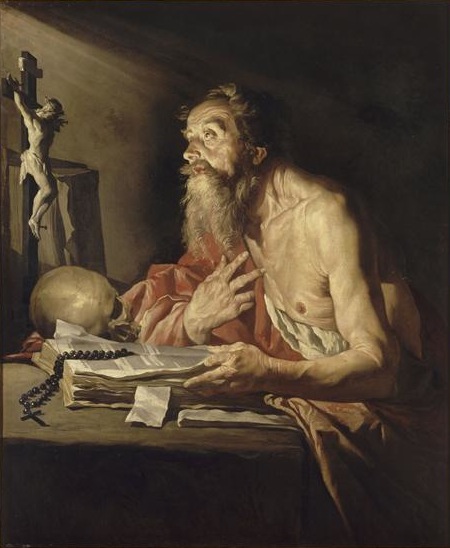
Saint Jerome is depicted in art wearing a cardinal’s hat, even though he was never a cardinal priest in Rome. This may be because he served as secretary to Pope Damasus. He is also shown with a lion, from whose foot he is said to have removed a thorn, although this story has been transferred to him from the life of Saint Gerasimus. He is often represented in a cave, half naked, with a long beard and hair, surrounded by books and a pen, sometimes with spectacles on the table to indicate that he was advanced in age.
Footnotes
- Jerome was born around the year 331.
- This old aunt was Castorina, to whom one of his letters was addressed in later years, which still exists.
- Orbilius was not the name of his master; he refers to his tutor by this name after the famous grammarian from Benevento, whom Horace calls “Plagosus.”
- Besides having Donatus as his grammar teacher, Jerome took lessons in oratory from the rhetorician C. Marius Victorinus, a Christian who wrote a commentary on the Epistles of Saint Paul, and who, for his contributions, was honored with a statue in the Forum of Trajan.
- Jerome expressed that he had everything unclean: and because he was once baptized by the Spirit, he again polluted his robe, needing the purification of the second baptism, that is, he needed fire.
- He does not say that the judge was consul of Aquileia, but it is probable that this was so, and that it was the irritation caused among the magistrates of that city by the publication of the letter, which obliged him to flee Aquileia.
- Epistle 3 to Rufinus.
- Epistle 6 to Julian.
- He who upbraids me with a dream, I refer to the prophets who teach that dreams are vain and undeserving of faith.
- while foxes were in the vineyard, and the seamless robe was rent, he felt moved to seek food for his soul where the heritage had been kept from corruptions.
- by the crucified Salvation of the world.
- Three Hypostases intimating, at the same time, his own opinion that no explanations can clear the phrase from the “poison of Tritheism.”
- See the sarcastic description in Ep. 22, c. 28, of clergy dressed in the extreme of fashion, dainty and elegant as bridegrooms, and wheedling ladies out of articles that suited their tastes.
- Oxanam, Civilisation au Cinquieme Siecle, ii. p. 100.
- Augustine, De Haeres. c. 82; Jerome, Haeres. i. 3.
- Jerome explaining the Scriptures to S. Paula and to Eustochie, her daughter, from a Bible written for Charles the Bald in the Abbey of S. Martin, at Tours.
- Vigilantius, or more accurately, Dormantius.
- Jerome's letter to Vigilantius.
- Epiphanius, Bishop of Salamis, denounced John as an Origenist heretic.
- The account of his last moments is found in De morte Hieronymi, by the pseudo-Eusebius.
- S. Jerome is depicted in a picture by Domenichino in the Vatican.
- The head is located at Nepi.
- Part of his chin is in the altar of the Blessed Virgin in the Vatican.
- Part of his thigh is in the church of Saint Cecilia.
- His girdle is in that of Saint Mark.
- In the Jesuit church, there is an arm.
- His chasuble, stole and maniple are in Santa Maria Maggiore.
- There is a jaw and an entire arm in Florence.
- The jaw has two teeth and part of the chin attached to it.
- In Bologna, there is part of a shank, one finger, and a thumb.
- Part of his skull was once at Cluny.
- A finger is in Paris in the church of the Trinitarians.
- An arm is in Malines.
- Two bones are in Tournai.
- At Beaupres near Douai, there is a bone.
- A finger is in Prague.
- A portion of the spine is in the church of Saint Panthaleon in Cologne.
- A rib is in the Carthusian church there.
- Other relics are found at Andechs in Bavaria and the abbey of Saint Georgen in Tyrol.
- The complete head is in the Escorial.
- The incorrupt tongue is on the Isle of Samos.
Baring-Gould’s own footnotes, in modern English.
Read the original 1870s text
Baring-Gould’s sources: All Latin Martyrologies. Anglican Reformed Kalendar. In the Modern Roman, also May 9, the Translation of S. Jerome from Jerusalem to Rome. By the Greeks and Russians on June 15. Authorities: — His own writings, and those of contemporaries, S. Augustine, S. Innocent I., Sulpicius Severus, S. Prosper, Rufinus, &c.] Hieronymus, or Jerome, as we call him in English, was born at Stridon, on the confines of Dalmatia and Pannonia, a town destroyed by the Goths in the lifetime of the saint.1 The place was rebuilt, and Sdregna, in the heart of stony, barren Istria, on the road between Capo d'Istria and Montena, claims to be the place. The name of Jerome’s father was Eusebius, and his tomb, or what pretends to be his tomb, is shown to this day at Sdregna. But unfortunately for the honour of Istria, S. Jerome plainly states that Stridon was on the borders of Dalmatia and Pannonia, so that we are forbidden to look for it in Istria. It has been thought to be a little place called Stridova, Strigova, or Strigna, between the Mar and Drave, near the point of contact of Croatia, Styria, and Hungary. It is a village consisting at present of some thirty cottages, with a chapel dedicated to S. Jerome, and the house in which he was born is there pointed out, perched on a hill. A miraculous spring issues from the base of the hillock, called the fountain of S. Jerome. Over the door of the house is placed an inscription, “ Hic natus est S. Hieronymus, Ecclesiae doctor.”
S. Jerome [translator of the Bible into Latin (d. 420)] was born about the year 33 1.1 PI is parents were Catholics, of honourable family, and 1 Hieron. De viris illust. c. 135.
9 Prosper in Chron. “ Sub consulibus Basso et Albavio but in 420, lie says, S. Jerome died “Anno aetatis suae nonagesimo-primo,’' which would put his birth at S. Jerome.
wealthy. He had a brother named Paulinian, and a sister, whose name we do not know. Of his childhood not much is known. “Which of us does not remember his infancy?” he writes. “I certainly do, enough to make a grave man like you laugh.... I remember how I used to run in and out of the servants’ chambers, when a little fellow, spending my days in games, till I was dragged away captive from my aunt’s lap to that grim Orbilius.” 1 This old aunt was Castorina, to whom one of his epistles was addressed in after years, which still exists. Orbilius was not the name of his master; he calls his tutor thus after the celebrated Beneventine grammarian, whom Horace calls “ Plagosus.”
The young Jerome was instructed in elocution and law, to prepare him for the legal profession. “ Now that I am an old white-haired man,” he writes, “with bald pate, I often dream that I am declaiming in my new toga some petty cause before the rhetorician; and when I wake up, I congratulate myself that I am free from the agonies of speechmaking.”2 He continued his studies at Rome, under a certain Donatus. There he attended the courts, to study oratory, and, he says, it amused him much to observe how the lawyers on either side, becoming heated with their arguments, lost temper, and took to abusing each other roundly.3 It was perhaps there that he caught the trick of so dealing with his opponents in theological controversies, which disfigures his writings. At the same time he was wont to visit the catacombs, and prowl along the dark avenues, studying the walls honeycombed with cells in which lay the bodies of martyrs and confessors.* 1 Contra Rufin. lib. i. So. * // id. 8 Ii> Epi^t. ad Galat. lib. i. c. a. 4 In Ezech. lib. xii. c. 40.
fSept. 30. Besides having Donatus as his master in grammar, Jerome took lessons in oratory from the rhetorician C. Marius Victorinus, a Christian, who wrote a commentary on the Epistles of S. Paul, and who, for his merits, was given a statue in the forum of Trajan [Roman emperor 98–117].
Jerome had not left Rome in 363, when Julian the Apostate [Roman emperor 361–363 who tried to restore paganism] was killed. He was not idle during his stay there, for, in addition to studying oratory and grammar, he busily collected a library. His moral conduct does not, however, seem to have been exemplary. He repeatedly laments the fact that in his youth he fell into sins of the flesh. At that time he was not baptized. He had lost, he says in one place, the innocence given to him at his nativity; a new innocence had been given him at his second birth, which he had hoped not to be despoiled of. Yet even his baptismal garment he had stained, and in one of his letters to Damasus the Pope, he sadly says that having been baptized by the Spirit, and having defiled his robe of innocence, he must look forward to the baptism of fire, in which its stains might be burnt out.1 From Rome S. Jerome went to Treves [Trier in Germany] and to the Rhine, dropping down the Moselle. At Treves he copied out two books of S. Hilary, and this seems to have marked the turn of his mind to sacred studies. There also he made acquaintance with Rufinus, a friendship which was not, however, destined to last through life. There also he saw some Atticoti, or Scots, “ a British nation who eat human flesh.”
From Treves he returned south, and remained some time at Aquileia with his friend Rufinus, from about 370 to 372. There he contracted friendship with Chromatius, afterwards Bishop of Aquileia, the archdeacon Jovinus, the 1 “ Habeo omnia immunda: et quia semel spiritu baptizatus, rursum tunicam pollui, secundi baptisinatis purgatione, id est, isnis indigeo.” iip. 18. S. Jerome.
deacon Eusebius, and Innocent. It was in company with Innocent that Jerome left Aquileia for the East in 372. They reached Antioch together, and there Innocent died, and Jerome was cast on the bed of sickness. In 373, at Antioch, Jerome made the acquaintance of Evagrius the ecclesiastical historian. He had sent a letter, at the request of Innocent, to Evagrius some time before, on the case of an unfortunate woman who had been tortured by order of the consul at Aquileia,1 on false accusation. One executioner detailed to cut off her head had struck at her four times; another executioner three times, and had left her for dead, but marvellous to relate, the poor creature had revived. In his letter he had poured out his indignation and abhorrence of the consul, and this had probably obliged him to leave Aquileia.
Whilst Jerome lay sick at Antioch, his friend Heliodorus came to see him from Jerusalem, and informed him that Rufinus was then in Egypt.* Heliodorus was bent on retiring into the desert, and embracing an eremitical life, and on taking Jerome with him; but to this Jerome would not consent. He perhaps felt himself too ill to endure the austerities of a hermit’s life.3 In 374 he was still at Antioch, and suffering from bad health, and an attack of fever, which reduced him to a condition of great emaciation and exhaustion.
The season was Lent [the forty days of fasting before Easter], and, although he was ill, he did not consider himself exempt from observing the fast. Thus he was reduced to a condition subject to strange hallucinations. He amused himself on his bed with reading Plautus, but chiefly Cicero, who was his favourite author. Whilst so doing one day, he fell into a fit of unconsciousness, and 1 He does not say that the judge was consul of Aquileia, but it is probable that this was so, and that it was the irritation caused among the magistrates of that city by the publication of the letter, which obliged him to fly Aquileia. s Ep. 3 ad Rufin. 8 Ep. 6, ad Julianum. Ep. xq. thought he saw himself standing before the throne of God. The Judge asked, “Who art thou?" “A Christian," answered Jerome in his trance. “Thou liest,” answered the Almighty; “thou art a Ciceronian." Jerome thought he staggered back in dismay, and sank on his face, covered with confusion.
When he recovered consciousness he promised to cast aside all his heathen books, and resolved to devote his whole attention to the study of divinity.1 In the ardour of his zeal he wrote to Theodosius [name of Roman emperors; Theodosius I (379–395) made Christianity the state religion], an abbot in Cilicia, to announce his desire to embrace the monastic life; and to Rufinus, in Egypt, a letter in which this desire was more vaguely or guardedly expressed.
Shortly after the resolve became more urgent, and he actually retired into the desert, a.d. 374, carrying his library with him, and writing to his friends for more books to assist him in passing the time, which in his solitude dragged somewhat heavily. In his desert cell he wrote the life of Paul, the first hermit, and sent it to Paul of Concordia, a friend, near Aquileia.
The place of his retreat was near Maronia, in Chalcis, a spot which he describes as “ burnt up with the heat of the sun.” There, according to his own account, his skin was scorched brown, he slept on the soil, his bones protruded, he grew ragged and miserable of aspect. The only men he saw were natives, whose tongue he hardly understood, except at long intervals, when he was visited by Evagrius. Being sorely troubled by sensual thoughts, he wisely devoted his mind to the hard task of learning Hebrew, so 1 Ep. 2z ad Eustochium. In spite of his dream and promise he, however, continued his study of classical writers, and afterwards made his monks copy the dialogues of Cicero. He explained Virgil to them at Bethlehem, and answered the accusations of Rufinus that, after all this was only a question of a dream. “ He who upbraids me with a dream, I refer to the prophets who teach that dreams are vain and undeserving of faith/’ Cont. Rufin. i. 30. that it might be kept fully occupied, and not have time for rambling to unlawful subjects. “ What labours did I undertake in learning that alphabet, and acquiring those harsh and aspirated words ! What difficulties I had to undergo ! How often I despaired ! How often I gave it up, and yet again buckled to my task, let my conscience bear witness which suffered, and that of those who led me along this road. Yet, thanks be to God ! now I pluck sweet fruit of letters off that bitter road.”1 It was whilst Jerome was in his desert that the Meletian schism broke out. In 362 this miserable contest was embittered and prevented from dying out by the rash conduct of Lucifer of Cagliari, who ordained Paulinus. An account of this schism has been already given, and that sad page in the history of the Church need not be repeated here.3 Antioch had at the same time two bishops, both orthodox, and the Catholics were broken into two parties adhering to the rival prelates. The Eastern bishops recognised Meletius, the Roman Church Paulinus. There was also Vitalis, ordained Bishop of Antioch by Apollinaris; but there was, moreover, a fourth claimant — Euzoius, an Arian [followers of Arius, who taught that the Son is a created being, not fully God]. The East at this time was distracted with questions as to the term hypostasis; whether it was applicable to the Three Persons of the Trinity. Syrian monks invaded Jerome’s solitude, and importuned him to confess the Three Hypostases. He answered that he fully believed in the Three Persons, but could not take Hypostasis to mean anything but Essence. They insisted that he should accept the phrase as well as the doctrine. In his perplexity he applied to Pope Damasus of Rome. It was natural that he should do so. Rome was associated with many solemn moments of his undisciplined youth, and with his subsequent baptism; and her bishops had been conspicuously true to the faith, except in the one sad instance for which Liberius had lived to atone. Their primacy had been adorned by faithfulness. “ While foxes were in the vineyard,” wrote S. Jerome, “and the seamless robe was rent, he felt moved to seek food for his soul where the heritage had been kept from corruptions.” The kindness of Damasus invited him, though his grandeur was over-awing. Following “ Christ only as Chief,” Jerome professed to be in communion with the see of Peter [a bishop’s “see” is his diocese, named from his seat (Latin sedes)]. “ On this rock, I know, the Church is built; whoso eats the Lamb outside that house is profane. I know not Vitalis, I disown Meletius, I know not Paulinus. Whoso gathers not with thee, scatters; that is, whoso is not of Christ is of Antichrist.” He begs Damasus, “ by the crucified Salvation of the world,” to signify whether the belief in Three Persons may be expressed by “ Three Hypostases intimating, at the same time, his own opinion that no explanations can clear the phrase from the “poison of Tritheism.”1 This appeal was made about the beginning of 377, and in the following year arrived the answer to it by Damasus, addressed to Paulinus.
About 397 S. Jerome left his retreat and came to Antioch, where he was ordained priest by Paulinus. Whilst there he wrote a dialogue against the Luciferians, headed by one Hilary — an impracticable party of narrow bigots, who reproduced, in great measure, the hard austerity of the Novatians and the Donatists.
Probably in 380 S. Jerome went to Constantinople, where he had the gratification of hearing S. Gregory Nazianzen give sermons and instructions. He remained two or three years at Constantinople, arrested by the eloquence of S. Gregory, and occupied in translating into Latin, and con tinuing the chronicle of Eusebius, and in translating the homilies of Origen on Jeremiah and Ezekiel. JEROME IN THE DESERT.
Thence, in 382, he went to Rome; or perhaps he may have returned to Antioch in 381, and sailed thence to Rome ln 3S2. In that year a council was held in the Eternal City about the matter of the Antiochian schism and the ! heresy of Apollinaris. In this council Jerome probably took part. Damasus formed a high opinion of his learning and merits, and constituted him his secretary. He consulted him on scriptural points, which his Hebrew scholarship 1 enabled him to pronounce an opinion upon with authority. He also, at the request of the Pope, corrected the Latin version of the New Testament, then in common use, and then went on to revise the Psalter by the Hebrew. He wrote against Helvidius, who denied the perpetual virginity of the Blessed Virgin Mary, and he also addressed a letter or treatise on virginity to Eustochium, daughter of S. Paula.1 S. Jerome had at first been greatly esteemed by the Roman Christians. But the roughness and bitterness of his nature, his open scorn for the fopperies and meannesses of some of the clergy,2 and his success in drawing Roman ladies like Marcella, and Paula to the monastic life, had involved him in such odium, that even his outward aspect, his “ walk and smile,” furnished occasion for gross calumny. Disgusted by obloquy which doubtless broke forth unrestrained after the death of his patron Damasus, Jerome quitted Rome (a.d. 385) in a mood which had little of selfmistrust or meekness, calling himself “ a fool for wishing to sing the Lord's song in a strange land,” and telling his female friends that “ at Christ’s tribunal the character of every man’s life would appear.”8 He set sail for Antioch, where he saw Paulinus, and thence started during the cold of winter for Jerusalem, where he visited the sacred places. 2 See the sarcastic description in Ep. 22, c. 28, of clergy dressed in the extreme of fashion, dainty and elegant as bridegrooms, and wheedling ladies out of articles that suited their tastes. 8 Ep. 45.
Almost directly after he left Rome, Paula, the wealthy widow whom he had converted to monastic principles, finding Rome no longer endurable, started with the intention of overtaking him. This she probably succeeded in doing at Cyprus, and she was able under his directions to visit with him all the spots consecrated by the Gospel narrative in the Holy Land. Thence they went together to Egypt to study the manner of life of the hermits and obtain hints for the establishment of similar religious societies in Palestine. Having acquired the information they required, Jerome and Paula returned to the Holy Land, and settled at Bethlehem, not to leave it, and there Jerome built for himself a little monastery, and Paula a convent. In a poor and narrow cell of his monastic house, this glorious cenobite accomplished the translation and commentary of the Scriptures. He produced thus that Vulgate which has made him “the master of Christian prose for all following ages.”1 S. Jerome was essentially the preacher of Monachism, and he preached it at a time when the Roman world was ready to lend him its ear. Society was breaking up under j its vices, ruin was falling on the empire, blow on blow. Rome, the capital of the world, had become the prey of barbarians. During his sojourn in Rome, Jerome had i spread the love for monastic life with as much zeal as, success. At Bethlehem he continued this work, and led from the bosom of Italy numerous recruits, who, seeing the vanity of worldly hopes in a world falling to pieces, enrolled themselves in the monastic legions. He had no patience with those good Christians who would not leave all and come into the desert to him.
But his admiration for monastic life did not blind him to the vices and abuses which already appeared among the cenobites. No one has denounced, no one has branded, more 1 Oxanam, Civilisation au Cinquieme Siecle, ii. p. 100. energetically than he the false monks, the false penitents, the false widows and virgins.
This legitimate severity inspired him with the more lively admiration for the first great founders of monastic life, whose traditions he collected, and whose atmosphere he had breathed in Egypt. He undertook to write the lives of some of the most illustrious — of Paul, of Hilarion, of the solitary Malchus, whom he had known and heard in Syria; he added to these the biographies of the illustrious Roman women who, a century later, had renewed even in the bosom of Rome marvels worthy of the Thebaid [the desert region of Upper (southern) Egypt]. S. Jerome, though he had retired to a solitude, had not retreated from the arena of polemical disputes. Wherever any dissentient from the doctrine or practice of the Church ventured to express his opinions, Jerome hurled the thunders of his interdict from his cell at Bethlehem. No one was more perpetually involved in controversy, or opposed with greater rancour of personal hostility, than this earnest advocate of unworldly seclusion. He was engaged in a vehement and lengthy dispute with S. Augustine, on the question whether S. Peter's weakness and S. Paul’s rebuke at Antioch were simulated or real. But his repose was most embittered by his acrimonious and obstinate contest with Rufinus, the friend of his youth, which was rather a personal that a polemic strife, and which, one would have thought, two such men must have seen at once was a grievous breach of Christian charity.
In one controversy, Christendom acknowledged and hailed him as her champion. Jovinian and Vigilantius disturbed the prevalent belief in the sanctity of relics [the bodily remains of a saint, or objects they used, kept with honor], and the superior merit of celibacy. Their effect upon the dominant i sentiment of the times may be estimated by the language of i wrath, bitterness, contempt, and abhorrence with which Jerome assails these men. Jovinian, a monk, asserted, Lives 0/ the Saints.
1. That all sins were equal in heinousness. 2. That it was not possible for man to sin after baptism. 3. That fasting was unprofitable. 4. That a state of marriage was as acceptable with God as a state of voluntary celibacy; though for his own part, Jovinian had no intention of marrying.1 To these doctrines Vigilantius added, if possible, more hated tenets. He condemned the respect paid to martyrs and their relics; he questioned the miracles performed at their tombs; he condemned the lighting of lamps before them as a pagan superstition; he rejected the invocation of saints; he blamed the custom of Christians selling their property to disperse the proceeds promiscuously in charity; he protested against the whole monastic life, as interfering with the duty of a Christian to his neighbour. These doctrines were not without their followers; the resentment of Jerome was embittered by their effect on some of the noble ladies of Rome, who began to fall off to marriage. Even some bishops embraced the doctrines of Vigilantius, and, asserting that enforced celibacy led the way to secret debauchery, refused to ordain unmarried deacons. The tone of Jerome's indignant writings against these new heretics is that of a man suddenly arrested in his triumphant career by some utterly unexpected opposition; his resentment is mingled with a kind of wonder that men should exist who could entertain such strange and daring tenets. The length to which he draws out this answer to Jovinian seems rather the outpouring of his wrath and his learning than a serious argument. But this treatise was not favourably received at Rome, even the friends of Jerome, nay, the zealous Pammachius himself, were offended by the fierceness and coarseness of his first invective against Jovinian, and his contemptuous disparagement of marriage. The injustice of his personal charges is shown, and the 1 S. August. De Haeres. c. 82; S. Hieron. Haeres. i. 3. I. JEROME EXPLAINING THE SCRIPTURES TO S. PAULA AND TO EUSTOCHIE HER DAUGHTER. from a Bible written for Charles the Bald in the Abbey of S. Martin [St. Martin of Tours (d. 397), soldier turned bishop], at Tour3. Sept. 30. charges refuted by the more temperate statements oi Augustine, and by his own admissions. He was obliged, in his apology, to mitigate his vehemence, and fall reluctantly into a milder strain. Yet when he heard of the death of the heretic, he could not refrain himself from the indecent burst of joy — “He has not breathed, he has belched forth his soul over his waterfowl and pork.”1 But his language to Jovinian is sober, dispassionate, and argumentative, in comparison with that to Vigilantius, — not vigilant indeed but sleepy2 — he calls him. S. Jerome was mixed up in a miserable strife with John, Bishop of Jerusalem, about the writings of Origen. S. Jerome was an admirer of the great Alexandrian writer, and had some years before told S. Paula that those who called Origen a heretic were a pack of “ mad dogs.” His friend Rufinus was now a priest at Jerusalem, and was an enthusiastic admirer of Origen. John of Jerusalem also leaned towards Origenism, that is, he admired his writings, though he did not adopt his errors. S. Epiphanius, Bishop of Salamis, an implacable foe to Origenism, was in Jerusalem in 394, and he insultingly and defiantly disregarded the authority and position of John, its bishop. Pie went so far as to ordain Jerome’s brother Paulin ian priest, without permission of the diocesan, and without even informing him of his highhanded intrusion. When called to task for this, he excused himself by denouncing John as an Origenist heretic* and Jerome, who had perhaps some grudge against his bishop, or who was persuaded to dislike him by S. Epiphanius, joined sides with the Bishop of Salamis. This naturally led to an estrangement between himself and his friend Rufinus. Vigilantius openly attacked the orthodoxy of Jerome, and caused suspicion to prevail in the West that he was tainted with Origenist errors. This tended to confirm Jerome in 1 Ad v. Vigilant. 2 “ Vigilantius. seu verius Dormantius." his adhesion to the opposite side. He Latinized the letter of Epiphanius and dispersed it over the West, and wrote a fierce letter to Vigilantius denying all sympathy with Origen. John of Jerusalem then ordered S. Jerome to leave Bethlehem, and when he refused, John denied his monks permission to enter the church at Jerusalem or the holy manger. Thereupon S. Epiphanius recommended the monks to break off communion with their bishop till he had purged himself of Origenism. Jerome and his monks did so. This miserable and wicked strife continued for more than three years. Various attempts were made to patch up the quarrel, but in vain. Archelaus, Count of Egypt, ashamed that the scandal should continue, interfered, but his good offices were rejected. John appealed to Theophilus, Patriarch of Alexandria, who sent the priest Isidore to Jerusalem to effect a reconciliation, but without result. S. Jerome wrote a long apology to Theophilus, and at the same time John of Jerusalem sent him a letter containing a profession of faith, and a charge of schismatical conduct and of insubordination against Jerome and his monks. One angry tract called forth another, till at last Jerome himself became sensible of the wretchedness of such a quarrel, and Augustine entreated him to close a scene which chilled and saddened every true friendship.
His last controversial writings were directed against the Pelagians [followers of Pelagius, who taught people could be good without God’s grace]. Shortly before his death he wrote to Alypius and Augustine, warmly congratulating them on their successful labours against that heresy. This is the last of his extant writings. Pie died on September 30, 419/ doubtless in full Christian peace, although the account of his last moments, which suggested the picture of “S. Jerome's last communion," is found in a work which deserves no credit.2 1 S. Prosper in his Chronicle says 420, but the balance of probabilities is in favcut of his having died in 419.
2 De morte Hieronymi, by the pseudo-Eusebius. THE LAST COMMUNION OF 8. JEROME. After the Picture by Domemchmo m the Vatican S. Jerome.
The one conspicuous blot on Jerome’s character, a controversial fierceness which his religion could not soothe, and which seldom allowed him to be just or charitable, has led many, in modern times, to forget his better qualities, and the great services which he rendered to the Church by his unwearied labours in the field of Scripture interpretation. S. Jerome was buried at Bethlehem in his cave, and his body remained there till the 13th century, when it is said to have been translated to the church of S. Maria Maggiore at Rome, but no authentic record of the translation exists. A head at Nepi, part of the chin in the altar of the Blessed Virgin in the Vatican, part of his thigh in the church of S. Cecilia, his girdle in that of S. Mark, in the Jesuit church his arm. Also in S. Maria Maggiore “his chasuble, stole and maniple, with which he was wont to celebrate in the chapel of the holy manger at Bethlehem,” though, as a matter of fact, S. Jerome, through mistaken humility, never would celebrate, as we know from his own writings. A jaw and entire arm at Florence, the jaw has two teeth and part of the chin attached to it. At Bologna part of shank, one finger, and a thumb. Part of skull anciently at Clugny, a finger at Paris in the church of the Trinitarians, an arm at Malines, two bones at Tournai, at Beaupres near Douai a bone, a finger at Prag, a portion of the spine in the church of S. Panthaleon at Cologne, in the Carthusian [a strict order of hermit-monks founded by St. Bruno in 1084] church there a rib. Other relics at Andechs in Bavaria and the abbey of S. Georgen in Tyrol. The head entire in the Escurial, the tongue incorrupt in the Isle of Samos, &c. S. Jerome is represented in art with a cardinal’s hat, though he never was a cardinal priest at Rome; but perhaps because he acted as secretary to Pope Damasus. Also with a lion, from whose foot he is said to have plucked a thorn, but the story has been transferred to him from the life of S. Gerasimus. Often he is represented in a cave half naked, with long beard and hair, and with books and pen, sometimes with spectacles on the table to signify that he was advanced in age.