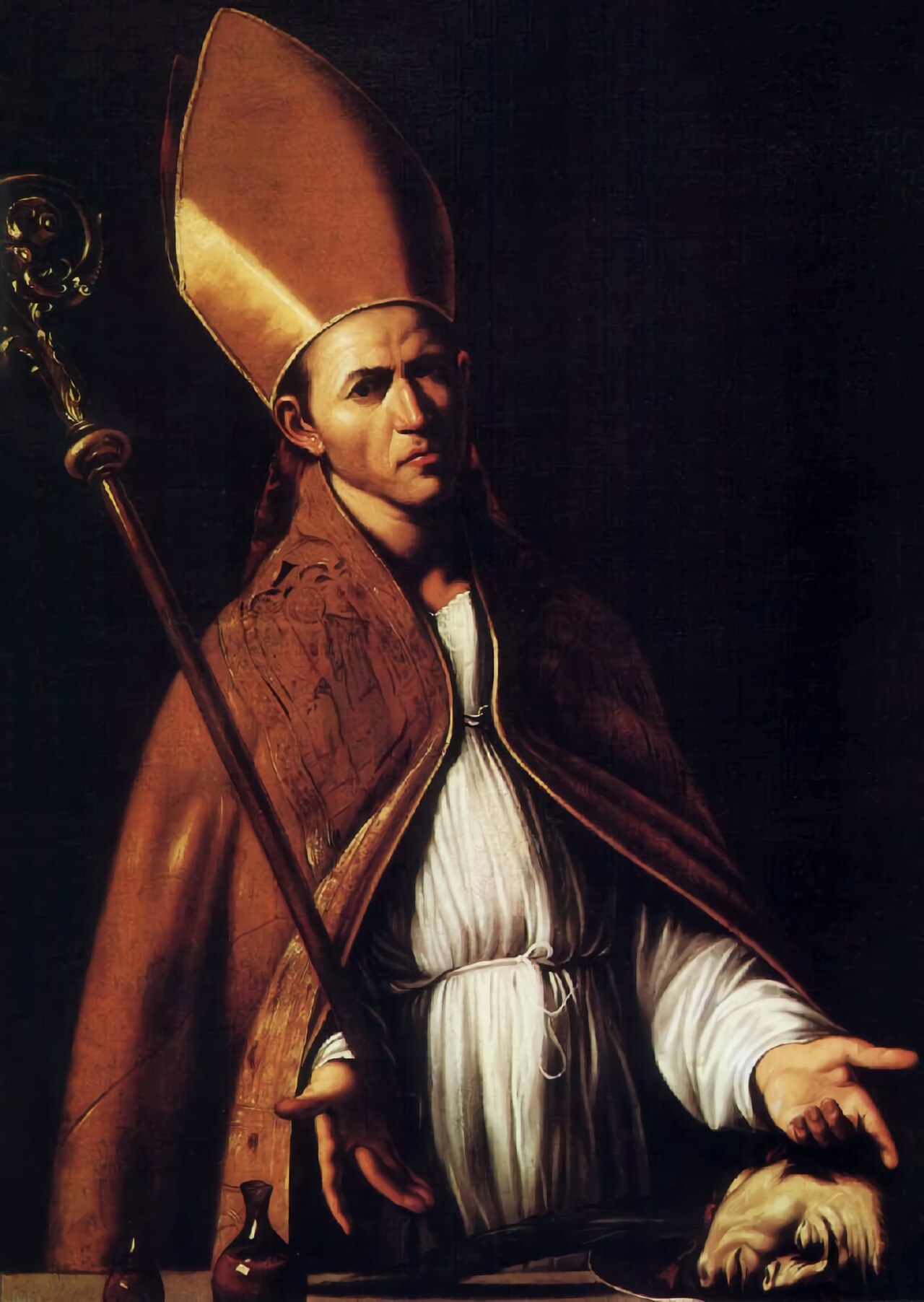
This Saint’s Story
He became a priest at the young age of 15, serving a small Christian community in his hometown. By 20, he was appointed Bishop of Naples, where he formed close friendships with fellow Christians, including Juliana of Nicomedia and Sossius.
During the Great Persecution (Diocletian (Roman emperor 284–305, who launched the last and fiercest persecution of Christians in 303) was Roman emperor 284–305; the 'Great Persecution' of 303–311, when imperial edicts ordered churches and Scriptures destroyed and Christians forced to sacrifice to the Roman gods) initiated by Emperor Diocletian (Roman emperor 284–305, who launched the last and fiercest persecution of Christians in 303), Januarius showed remarkable courage. He hid Christians from arrest and visited Sossius in prison, which ultimately led to his own capture. Along with his companions, he was condemned to die in the Flavian Amphitheater at Pozzuoli, but fearing public unrest, the authorities changed the sentence to beheading, which took place at the Solfatara crater.
Various legends surround his martyrdom. Some say that wild beasts refused to harm him, while others claim he emerged unharmed from a fiery furnace. Regardless of the specifics, his death is believed to have occurred around 305, during a time of intense persecution against Christians.
After his martyrdom, Januarius' relics were moved several times, eventually resting in Naples, where they became a focal point of veneration. His blood, preserved in a glass ampoule, is said to liquefy multiple times each year, a phenomenon that draws thousands of devotees. This event is celebrated on his feast day, September 19, and is a significant part of Neapolitan culture.
The Church formally recognized Januarius as a saint, with his veneration dating back to at least the 5th century. His legacy continues to inspire many, particularly in Naples, where he is the principal patron saint.
