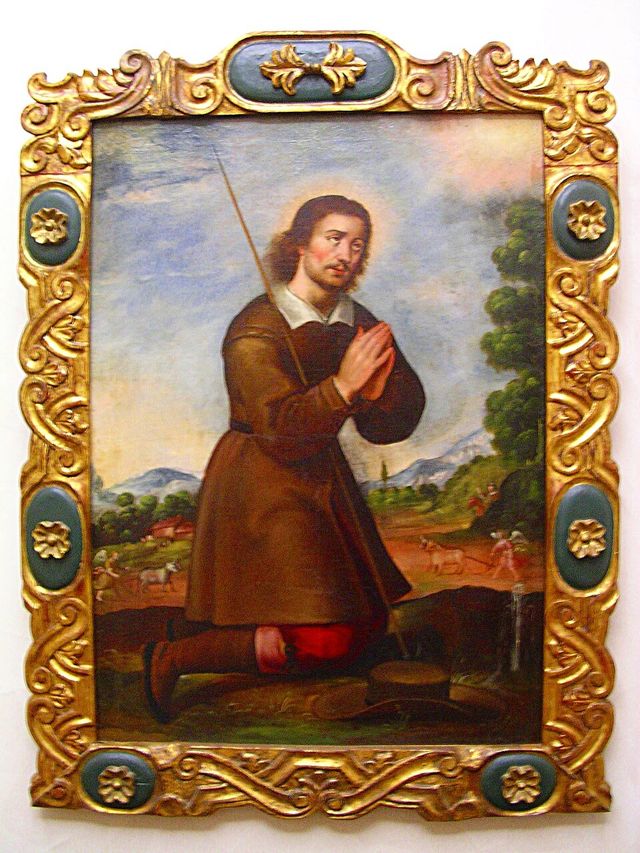
Baring-Gould’s sources: Canonized by Pope Gregory XV. in 1622. Roman and Spanish Mar tyrologies. The Bollandists on May 15. Authority: — His life written in the year 1261, an amplification and continuation of an earlier life. This life was again added to in 1275. The additions are miracles wrought at the tomb or by the intercession of the saint.
The traveller, visiting Madrid on May 15th, would find the city keeping high festival. Church bells ringing, the streets lined with tapestries and coloured curtains, banners streaming, and a procession winding through the streets Normans in 886, and left no successor. Bernard left a son Bernard, the murderer of Solangia, who was Count of Poitiers, and also of Auvergne, after the death of his brother Stephen. He was killed id 886 in a battle against Boso, King of Arles., May io.3 S. Isidore. 147 with military band, and cross and lights and song of clergy.
Why this joyous festival? the traveller would ask; and he would be told that the capital was observing the feast of its patron. And who is the patron of this royal city, the capital of great Spain ? A king, a prelate, a doctor ? No ! only a poor ploughman. God 44 taketh up the simple out of the dust: and lifteth the poor out of the mire; that he may set him with the princes: even with the princes of his The story of this good man is short and very simple.
It is merely that of a devout peasant serving God faithfully in that condition of life to which God had called him. The Church, to show models to all in every condition of life, has enrolled in her sacred calendar the servant girl Veronica of Milan, the shepherd Wendelin, the beggar Cuthman, and the ploughman Isidore, as well as saintly kings, wise prelates, learned doctors and valiant martyrs. Isidore was a day-labourer in the employment of a gentleman of Madrid, engaged on his farm outside the town. He was a hard-working faithful servant, yet he did not escape the voice of slander, and he was accused to his master of coming late to his work in the mornings on account of his going early into Madrid to attend Mass in one of the churches.
His master sent for him and charged him with it. 44 Sir,” said the simple ploughman, 44 it may be true that I am later at my work than some of the other labourers, but I do my utmost to make up for the few minutes snatched for prayer; I pray you compare my work with theirs, and if you find I have defrauded you in the least, gladly will I make amends by paying you out of my private store.” The gentleman was ashamed and said nothing; nevertheless he was not satisfied, and one morning he rose before daybreak to watch for himself and see if Isidore was really late at his work.
He hid himself beside the farm, and saw the steady peasant go to church as the first pale streaks of light appeared in the east, and he returned to his work certainly after the other workmen had gone to theirs. The master saw him enter the field and take the plough, and he left his retreat that he might rate him soundly. But suddenly he stood still. In the field was a second plough, drawn by white oxen, urged on by an angel. He saw it in the slant rays of the rising sun through the thin vapours rising from the dewy soil.
Up the field and then down again went the strange team, cutting a clean furrow and cutting it rapidly. Then the gentleman ran towards the field * but as he opened the gate the vision disappeared, and he saw Isidore bowed upon his plough, and his little son running by the head of the red oxen. Then he went to him and asked him who were his assistants. u Sir ! ” said Isidore in surprise, “ I work alone and know of none save God to whom I look for strength. v Now this Isidore was a man of a very kind heart, and he never omitted doing an act of kindness when the opportunity offered; and though he was poor, and could not give much to the needy, what he did give was given without grudging and with so much sympathy and readiness, that to the recipient it was worth more than the gift of many a rich man.
One pretty instance of this charity is told, to show that it extended to the dumb creation as well as to men. One morning when the snow was sparkling on the ground and the trees and hedges were covered with hoar frost, he set out to the mill with a sack of corn, his wife’s gleanings, that he wished to have ground. Presently he passed a tree on which a number of woodpigeons were sitting, whilst others fluttered over the glistening surface of the snow vainly searching for food. “ Stop,” called Isidore to his boy, who was leading the ass that S. ISIDORE.
Alter Cahier.