St. Ignatius

Ignatius was a convert and disciple of St. John the Evangelist.

Read the essentials →
Feast October 17 · Bishop, Martyr

St. Ignatius

Current feast

October 17
Verified · General Roman Calendar

Traditional feast

February 1
1914 / pre-1969 calendar, per Baring-Gould (1897)

Represents

Bishop
Martyr

Feast days

Feast: October 17
Traditional: February 1

This Saint’s Story

Adapted in modern English from Baring-Gould (1897) · original text below

He succeeded Evodius as bishop of Antioch, probably around the year 70, and the source thinks he may have been consecrated by St. Peter himself. He was called Theophorus, 'God-bearer'. According to his Acts (the written account of a martyr's trial and death), when Trajan (Roman emperor 98–117) asked about the name, he said it was because he bore Christ in his heart. The historian Socrates records a tradition that Ignatius saw angels singing to the Trinity in alternating choirs and brought that way of singing into the Church at Antioch.

In 107 the Emperor Trajan came to Antioch and looked into the state of religion there. Ignatius was brought before him and boldly confessed Christ as God. 'Dost thou mean Him who was crucified?' Trajan sneered. 'The very same,' Ignatius answered, 'Who by His death overcame sin.' Trajan sentenced him to be taken to Rome and thrown to wild beasts.

Guarded by ten harsh soldiers, he sailed to Smyrna. There he met St. Polycarp, who had also known St. John, and bishops came from Ephesus, Tralles and Magnesia to see him. From Smyrna he wrote to their churches, and to the Christians of Rome, begging them not to try to save him. He wanted to meet the beasts. From Troas he wrote to Philadelphia, to Smyrna and to Polycarp, asking him to care for the Church of Antioch. These seven letters survive. His impatient guards then hurried him through Macedonia and across the Adriatic to Rome.

On December 19, the last day of the public games, he was led into the amphitheatre. As he had prayed, the beasts killed him quickly. The Roman Christians gathered the few larger bones that were left, and these were carried to Antioch with great honour, treasured as 'an invaluable treasure'. His relics were later brought back to Rome.

What he represents

How he teaches us to live

Drawn from themes in the original account

Pray a little every day. Prayer is part of this story.

Celebrate this saint’s feast day. Remember him on October 17 with a short prayer, and ask for his help.

The full story

Baring-Gould’s account retold in modern English

Read the full story · 1,117 words · about 5 min

Saint Ignatius was a convert and disciple of John the Evangelist. He was appointed by Peter to succeed Evodius as the bishop of Antioch, and he served in this role for a full forty years. He received the name Theophorus, which means "one who carries God with him." In his Acts, it is said that Trajan asked him why he had the title of God-bearer, and he replied that it was because he carried Christ in his heart.

Socrates, in his "Ecclesiastical History," states, "We must make some allusion to the origin of the custom in the Church of singing hymns antiphonally. Ignatius, the third bishop of Antioch in Syria from the apostle Peter, who also had conversed closely with the apostles themselves, saw a vision of angels singing in alternate chants to the Holy Trinity; after which he introduced this style of singing into the Antiochian Church, from where it was passed down by tradition to all the other churches."

It seems likely that Evodius left the see of Antioch around the year 70. There are traditions that suggest Evodius was martyred, and Josephus mentions a disturbance in Antioch around that time, which led to the deaths of many Jews. There is a challenge in believing that Peter appointed Ignatius as bishop of Antioch if he did not succeed Evodius until the year 70. However, it is likely that later writers confused Ignatius's appointment to the see of Antioch with his consecration to the episcopal office; it is very probable that he received this from the hands of the Prince of the Apostles.

The date of Ignatius's martyrdom can be determined with reasonable certainty as occurring in the year 107. The Acts clearly state that Trajan was in Antioch at that time, and that Sura and Senecio were consuls; these two events align only in the year 107.

Trajan entered Antioch in January. His first concern was to investigate the state of religion there, and the Christians were reported to him as introducing strange gods. Ignatius was brought before him and boldly confessed that Christ is God. "Do you mean Him who was crucified?" asked the emperor scornfully. Ignatius replied, "The very same, Who by His death overcame sin, and enabled those who carry Him in their hearts to trample underfoot all the power of the devils."

Then Trajan ordered that he be taken to Rome and exposed to wild beasts in the amphitheater. This was usually a punishment reserved for Roman citizens, who, if they had committed an offense in the provinces, were sent to the capital for punishment. However, this does not seem to have been the reason in Ignatius's case. The punishment he faced was typically reserved for the lowest criminals, and the heathens may have viewed Christians in this way.

Ecclesiastical history has hardly preserved a more interesting and moving account than that of Ignatius's journey from Antioch to Rome. As we follow the martyr's procession to his final triumph, we forget that we are reading about a prisoner being dragged to his death in chains. He was placed under the guard of ten soldiers, who seem to have treated him harshly. After boarding a ship at Seleucia, they landed for a time at Smyrna. There, he had the pleasure of meeting Polycarp, who was the bishop of that city and, like Ignatius, had known Saint John personally. His arrival also caused a stir throughout all of Asia Minor.

Onesimus, the bishop of Ephesus; Polybius, the bishop of Tralles; and Demas, the bishop of Magnesia, came from their respective cities with a delegation of their clergy to visit the venerable martyr. Ignatius took the opportunity to write from Smyrna to the Churches overseen by these bishops. His letters to the Ephesians, Trallians, and Magnesians still exist today. He also learned of some Ephesians who were going to Rome and who were likely to arrive there more quickly than he would. He wrote a letter to the Church in that city. His main purpose in writing was to prevent any attempts by the Roman Christians to seek a reprieve from the death that awaited him. He expressed not only his willingness but also his eagerness to face the wild beasts in the amphitheater. There may never have been a more perfect example of resignation than what we find in this letter.

From Smyrna, he continued to Troas, where he was met by some neighboring bishops. The bishop of Philadelphia carried a letter he wrote to the Christians in that city. He also wrote from the same place to the Church of Smyrna. The personal affection he had for Polycarp, the bishop of that city, explains why he wrote to him as well, making a dying request that he care for the Church of Antioch. These seven letters, which Ignatius wrote from Smyrna and Troas, still exist today.

It seems that Ignatius had planned to write letters to some other Churches from Troas, but his guards were eager to move on. They set sail again, following the route that S. Paul had taken on his first journey into Greece, and landed at Neapolis. He hurried through Macedonia and then boarded a ship again on the western coast of Epirus. After crossing the Adriatic Sea, he arrived in Rome.

At that time, there was an exhibition of games that lasted several days. It appears that Ignatius's death was meant to be part of the spectacle. The voyage had been rushed for this reason, and on the last day of the games, which was December 19th, the holy martyr was brought into the amphitheater. His death seemed to happen in an instant. In his letter to the Roman Church, he had prayed that the wild beasts would quickly end his life and not refuse to touch him, as had sometimes happened before. His prayer was answered. The Christians of Rome, who felt blessed to have seen the apostolic bishop of Antioch among them, had to gather a few of the larger and harder bones, which were all that the wild beasts had left behind. These bones were taken back to Antioch, and it shows the great reverence for the relics of saints in that early age that the same honors were given to the sacred relics as had been given to the holy martyr himself when he visited different cities. Friends of Ignatius referred to his remains as "an invaluable treasure," and they were buried near one of the gates in the suburbs of Antioch.

The relics of S. Ignatius were later moved back to Rome and are now spread across several churches in the city. However, the head is kept by the Jesuits in Prague.

Footnotes

  1. Socrates, Ecclesiastical History, refers to the origin of antiphonal hymn singing.
  2. Josephus mentions a disturbance in Antioch leading to the deaths of many Jews.
  3. The letters to the Ephesians, Trallians, and Magnesians still exist today.
  4. These seven letters, which Ignatius wrote from Smyrna and Troas, still exist today.
  5. The head of S. Ignatius is in the possession of the Jesuits of Prague.

Baring-Gould’s own footnotes, in modern English.

Read the original 1870s text

Baring-Gould’s sources: S. Ignatius is commemorated variously, on June 10th, Oct. 8th, Nov. 24th, Dec. 14th or 19th; but by the Roman Martyrology his festival is fixed for Feb. 1st. In the Bruges and Treves Martyrologies, his commemoration was placed on Jan. 31st, so as not to interfere with that of S. Bridget on this day. The authorities for his life and passion are his own genuine Epistles, the Acts of his martyrdom, Eusebius, and S. Chrysostom's Homily on S. Ignatius.

SAINT IGNATIUS was a convert and disciple of S. John the Evangelist. He was appointed by S. Peter to succeed Evodius in the see of Antioch [a bishop’s “see” is his diocese, named from his seat (Latin sedes)], and he continued in his bishopric full forty years. He received the name of Theophorus, or one who carries God with him. In his Acts, Trajan [Roman emperor 98–117] is said to have asked him why he had the surname of God-bearing, and he answered, because he bore Christ in his heart. [1]

Socrates, in his "Ecclesiastical History," says, "We must make some allusion to the origin of the custom in the Church of singing hymns antiphonally. Ignatius, third bishop of Antioch in Syria from the apostle Peter, who also had conversed familiarly with the apostles themselves, saw a vision of angels, hymning in alternate chants the Holy Trinity; after which he introduced this mode of singing into the Antiochian Church, whence it was transmitted by tradition to all the other churches." [2]

It seems probable that Evodius vacated the see of Antioch about the year 70. There are traditions that represent Evodius to have been martyred; and Josephus speaks of a disturbance in Antioch about that period, which was the cause of many Jews being put to death. [3] There is a difficulty in supposing S. Peter to have appointed Ignatius bishop of Antioch, if he did not succeed Evodius till the year 70. But it is probable, that later writers have confounded the appointment of Ignatius to the see of Antioch, with his consecration to the episcopal office; and it is highly probable that he received this from the hands of the Prince of the Apostles.

The date of the martyrdom of Ignatius can be fixed with tolerable certainty as occurring in the year 107. The Acts expressly state that Trajan was then at Antioch, and that Sura and Senecio were consuls: two events, which will be found to meet only in the year 107.

Trajan made his entry into Antioch in January; his first concern was to examine into the state of religion there, and the Christians were denounced to him as bringers-in of strange gods. Ignatius was brought before him, and boldly confessed Christ to be God. "Dost thou mean Him who was crucified?" asked the emperor, scornfully. Ignatius answered, "The very same, Who by His death overcame sin, and enabled those who bear Him in their hearts to trample under foot all the power of the devils."

Then Trajan ordered him to be taken to Rome, and exposed to wild beasts in the amphitheatre. It was generally a distinction reserved for Roman citizens, that if they had committed an offence in the provinces, they were sent for punishment to the capital. This, however, does not appear to have been the reason in the case of Ignatius. The punishment to which he was condemned was generally reserved for culprits of the lowest condition; and the Christians were perhaps viewed in this light by the heathen. Ecclesiastical history has scarcely preserved a more interesting and affecting narrative, than that of the journey of Ignatius from Antioch to Rome. In tracing the procession of the martyr to his final triumph, we forget that we are reading of a prisoner who was dragged to his death in chains. He was committed to a guard of ten soldiers, who appear to have treated him with severity; and, after taking ship at Seleucia, they landed for a time at Smyrna. He had here the gratification of meeting with Polycarp, who was bishop of that see, and who, like himself, had enjoyed a personal acquaintance with S. John. His arrival also excited a sensation through the whole of Asia Minor. Onesimus, bishop of Ephesus; Polybius, bishop of Tralles; and Demas, bishop of Magnesia, came from their respective cities, with a deputation of their clergy, to visit the venerable martyr. Ignatius took the opportunity of writing from Smyrna to the Churches over which these bishops presided; and his epistles to the Ephesians, Trallians, and Magnesians, are still extant. Hearing also of some Ephesians, who were going to Rome, and who were likely to arrive there more expeditiously than himself, he addressed a letter to the Church in that city. His principal object in writing was to prevent any attempt which the Roman Christians might have made to procure a reprieve from the death which was awaiting him. He expresses himself not only willing, but anxious, to meet the wild beasts in the amphitheatre; and there never, perhaps, was a more perfect pattern of resignation than that which we find in this letter.

From Smyrna he proceeded to Troas, where he was met by some of the neighbouring bishops, and the bishop of Philadelphia became the bearer of a letter which he wrote to the Christians in that city. He also wrote from the same place to the Church of Smyrna; and the personal regard which he had for Polycarp, the bishop of that see, will explain why he also wrote to him, and made it his dying request that he would attend to the Church of Antioch. These seven epistles, which were written by Ignatius from Smyrna and Troas, are still extant.

It appears that Ignatius had intended to write letters to some other Churches, from Troas; but his guards were impatient to proceed, and once more setting sail, they followed the course which S. Paul had taken upon his first journey into Greece, and landed at Neapolis. Hurrying through Macedonia, he embarked once more on the western coast of Epirus, and crossing the Adriatic, arrived at Rome. There was now an exhibition of games, which lasted some days; and it seems to have been intended that the death of Ignatius should form part of the spectacle. The voyage had been hurried on this account; and on the last day of the games, which was the 19th December, the holy martyr was led into the amphitheatre, and his death seems to have been the work of a moment. In his letter to the Roman Church, he had prayed that the wild beasts might despatch him speedily, and not refuse to touch him, as had sometimes been the case. His prayer was heard; and the Christians of Rome, who had thought themselves blessed to have even seen the apostolic bishop of Antioch among them, had now to pick up a few of the larger and harder bones, which was all that the wild beasts had spared. These were carried to Antioch, and it is evidence of the great reverence at that early age shown to the relics [the bodily remains of a saint, or objects they used, kept with honor] of the saints, that the same honours were paid to the sacred relics as had been paid to the holy martyr himself, when he touched at the different cities. The friends of Ignatius speak of his remains as "an invaluable treasure;" and as such they were deposited near one of the gates in the suburbs of Antioch.

The relics of S. Ignatius were retranslated to Rome, and are dispersed among several of the churches of the city. The head, however, is in the possession of the Jesuits of Prague.
From the homilies

Preached on Scripture

John Chrysostom · Archbishop of Constantinople, c. 347–407
Homily on St. Ignatius

What he’s saying: It is different to lead the Church now compared to the past, much like traveling on a well-used road is easier than forging a new path filled with obstacles.

“For it is not the same thing to administer the Church now as then, just as it is not the same thing to travel along a road well trodden, and prepared, after many wayfarers; and along one about to be cut for the first time, and containing ruts, and stones, and full of wild beasts, and which has never yet, received any traveller.”

More about St. Ignatius

Checked against at least two sources, in our own words

Help us add to this saint's story

Everything is read by a person before anything appears. Facts are checked against trusted sources first.

Facts are welcome; a source link helps (optional).With your permission we may share it on this page.

Nine days · Free

Pray the novena
with us.

One short email a day for nine days. The day's prayer, a line from St. Ignatius's story, and a nudge to keep going.

Also on February 1
P

Sts. Pionius and…

February 1 · Priest, Martyrs
E

St. Ephraem the Syrian

February 1 · Deacon, Confessor
S

St. Severus of Ravenna

February 1 · Bishop, Confessor
← All 1970 saints in the library
Sources & notes

Feast-day sources

Story sources

Sources

Credits

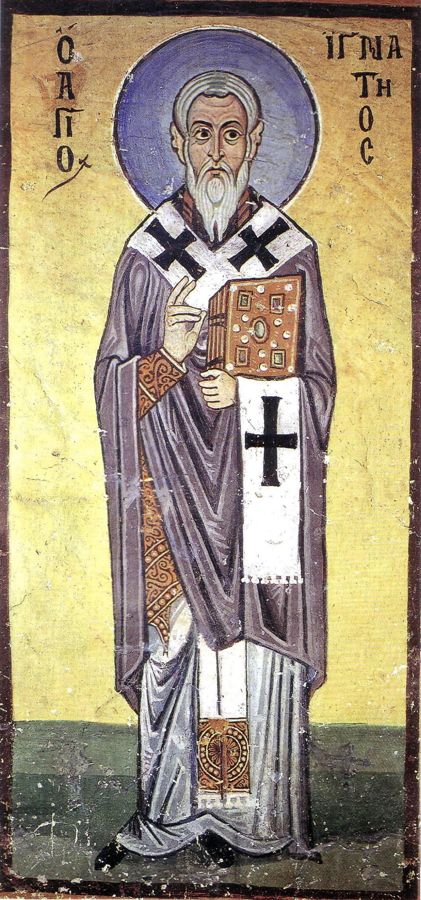
Image: Hosios Loukas (south west chapel, south side) - Ignatios.jpg · Wikimedia Commons · Public domain, via Wikimedia Commons

Image: Wikimedia Commons, Wikimedia Commons (Public domain)

Scripture: Galatians 3:28; John 10:11; 1 Corinthians 15:11; 1 Timothy 5:22
Trans. T. P. Brandram, Nicene and Post-Nicene Fathers, NPNF I, vol. 9 (1889). Public domain. Translation published 1889 (before 1931): public domain in the U.S. Read the full text → · CCEL scan text

Retold in plain modern English from Baring-Gould’s public-domain text, sentence by sentence, keeping the same facts and order. Short explanations in parentheses are ours.

From Sabine Baring-Gould, The Lives of the Saints, new edition in 16 vols. (London: John C. Nimmo, 1897), digitized text from Project Gutenberg. Public domain in the United States. Reproduced unedited, except for short bracketed notes in grey that we added to explain names and terms (“S.” is the old abbreviation for Saint). Some history and judgments reflect 19th-century scholarship.