Nothing whatever is known of this saint.
Read the essentials →February 27
February 27
Virgin
Martyr
Short entry · the summary here is 120 words; Baring-Gould’s fuller original text and its sources are below. We have not filled any gap with invented detail.
Celebrate this saint’s feast day. Remember her on February 27 with a short prayer, and ask for her help.
Nothing is known about this saint. The author of the history of the transfer of her relics to Conflans, near Pontoise, a short distance from Paris, states that her virtues, her merits, and the details of her suffering are completely unknown. The date of her death is also unknown. The relics were moved around the year A.D. 912. As an example of how confusion has arisen in the lives and actions of early martyrs, it is worth mentioning that in the church of Quimper, the morning readings for the feast of Saint Honorina are excerpts from the Acts of Saint Dorothea, which were moved to February 27th to serve in place of the unrecorded Saint Honorina.
Nothing whatever is known of this saint. The author of the history of the translation [the solemn moving of a saint’s relics to a new shrine] of her relics [the bodily remains of a saint, or objects they used, kept with honor] to Conflans, near Pontoise, a short distance from Paris, says that her virtues, her merits, and her mode of passion, are utterly unknown. So also is the date of her death. The relics were translated about the year a.d. 912. As an instance of the manner in which confusion has arisen in the lives and acts of martyrs of an early date, it is deserving of mention that in the church of Quimper, the Matin lections for the feast of S. Honorina are portions of the Acts of S. Dorothea, transferred to Feb. 27th, to do duty for the unrecorded S. Honorina.
Feast: February 27
One short email a day for nine days. The day's prayer, a line from St. Honorina's story, and a nudge to keep going.
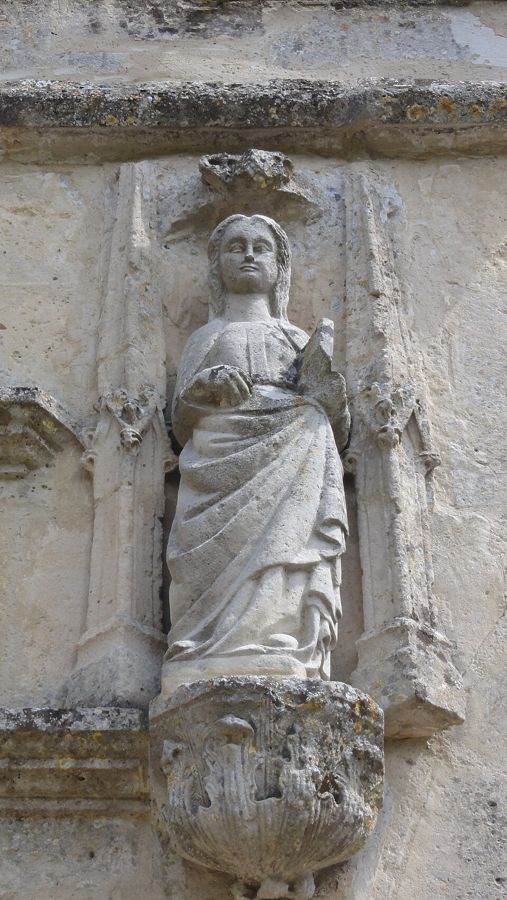
Image: Statue de Sainte-Honorine sur l'église de Corbeil-Cerf.JPG · Carnage 2000 · CC BY-SA 3.0, via Wikimedia Commons
Image: Carnage 2000, Wikimedia Commons (CC BY-SA 3.0)
Retold in plain modern English from Baring-Gould’s public-domain text, sentence by sentence, keeping the same facts and order. Short explanations in parentheses are ours.
From Sabine Baring-Gould, The Lives of the Saints, new edition in 16 vols. (London: John C. Nimmo, 1897), digitized text from Project Gutenberg. Public domain in the United States. Reproduced unedited, except for short bracketed notes in grey that we added to explain names and terms (“S.” is the old abbreviation for Saint). Some history and judgments reflect 19th-century scholarship.