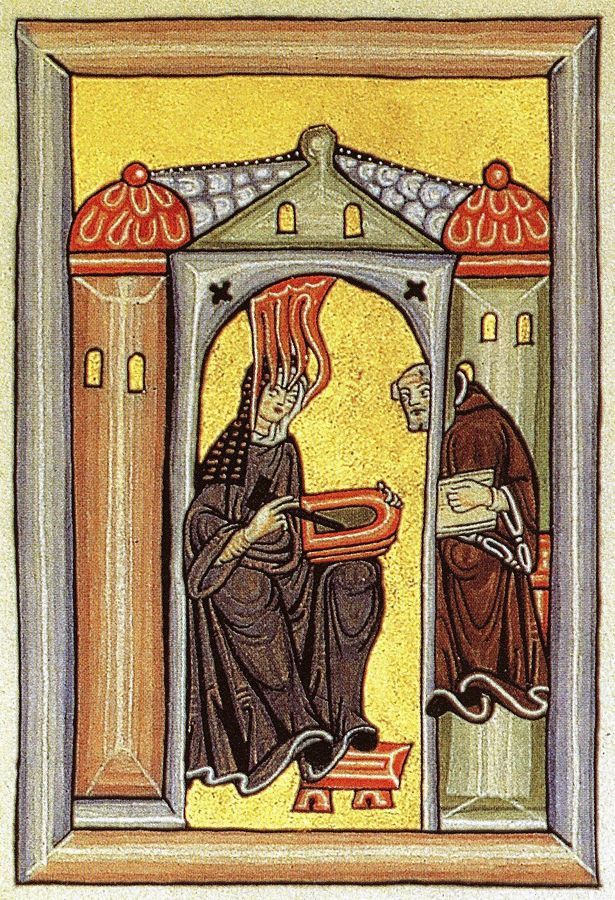
She was born in 1098. Her father was a knight who served Meginhard, Count of Spanheim; his name was Hildebert, and she was born in Bockelheim. At the age of eight, she was placed under the care of Jutta, the Abbess of Saint Disibod, who was a sister of the Count of Spanheim. From the age of six, the child experienced visions, which she described as occurring not externally, but within her soul. These visions continued until she was fifteen, but she did not share them with anyone. After Jutta died in 1136, Hildegard, who was then thirty-eight years old, succeeded her. Her visions had gained so much attention that many women came to seek her guidance. Finding the existing buildings too small, she built a new convent on the Rupertsberg near Bingen in 1147 and moved there with eighteen sisters.
Saint Hildegard was known throughout Europe for her writings. She could not write in Latin herself, but she recorded her visions and messages to various people in a mix of German and Latin. Her secretary, Gottfried, helped organize these writings for her. She openly criticized the vices of society, including those of kings, nobles, bishops, and priests, using harsh language. If a church leader, even a Pope, wrote to her, no matter how humbly, she would respond with a sharp lecture. She spoke uncomfortable truths without sugarcoating them, making everyone feel uneasy. Emperors and bishops sought her attention, but she never succumbed to their charms. Anyone who approached her received a reprimand, which was widely regarded as deserved.
In 1148, Pope Eugenius III was in Treves when he heard everyone discussing the prophecies of the famous abbess of Saint Rupert. He sent Adelbert, the Bishop of Verdun, to investigate her, and he studied her writings himself while in Treves. He even wrote her a letter, to which she responded with a lecture. Around this time, she completed the first part of her work called “Scivias,” a name derived from “nosce vias,” meaning “know the ways (of the Lord),” which reflects her limited knowledge of Latin. The entire work was not finished until 1151.
Saint Hildegard described her gift of visions in this way: “I raise my hands to God, and then I am wafted by Him, like a feather without weight, before the wind, as far as it lists.... Even from my childhood, when my limbs were not full-grown, to now in my seventieth year, my soul has seen visions. My spirit is, as God chooses, borne into the highest firmament, or among all sorts of peoples, and into the furthest lands, far away from my body. And when my inner eye by this means sees the truth, the sights which appear to me vary according to the nature of the vapours and creatures presented to me. These things I see not with my bodily eyes, nor through my understanding or thoughts, but through my spirit, yet with open eyes, and so that they never stir in me an emotion, but I see these sights waking by day or by night alike.”
Bernard, who had great respect for her and valued her influence, urged her repeatedly to use her abilities to inspire enthusiasm for the Crusade that he was preaching. She became passionate, prophesied, and encouraged others, contributing significantly to the humiliation and death of the thousands of Germans who embarked on that most unfortunate and disgraceful of all the Crusades. While Bernard preached along the Rhine River, she climbed the Feldberg, the highest peak of the Rhenish hills, and prayed at its summit, with her arms outstretched, for the success of the undertaking. She held her arms extended for so long that she eventually fainted from exhaustion.
The condition of the Church in Germany was extremely dire. Charlemagne and the Frank Emperors had turned the bishops into electoral princes, granting them vast territories; thus, they were both temporal and spiritual rulers. This situation led to the position of bishop being sought by men of high rank who were completely unqualified for a spiritual office. The bishops were often at war with their neighbors or rising in armed revolt against the Emperors. They maintained lavish entourages, rode in armor at the head of their troops, and exhibited the turbulence and ambition of temporal princes.
One example will suffice. Henry I had been a gentle but weak ruler of the archiepiscopal see of Mainz, where the convent of Hildegard was located. A faction within the chapter, driven by ambition and frustrated by his lack of military prowess, raised some trivial accusations against him and took them to Rome. Archbishop Henry had a friend and confidant, the provost of St. Peter's, named Arnold von Selnhoven, who owed his position to the archbishop's favor. Henry gave Arnold a large sum of money and sent him to Rome to defend his case. Arnold secretly visited Emperor Frederick I, secured his approval for his betrayal, and then hurried to Rome, using the gold Archbishop Henry had given him to bribe those around the Pope to persuade His Holiness to depose Henry and elevate Arnold to the archiepiscopal throne in his place. Two cardinals were sent to Mainz to investigate the case. Henry realized that they had already made up their minds, having been bribed by Arnold. He said to them, “I might appeal from your judgment to the Pope in person; but I appeal to a higher Judge — to Jesus Christ Himself — and I summon you both before His throne to answer for this injustice.” They responded mockingly, “You lead the way, and we will follow.” Both cardinals died suddenly.
before the close of the year. Arnold now returned in triumph to take over the position of his friend and benefactor, whom he had so treacherously replaced. His arrogance knew no bounds. The people of Mainz suffered under his harsh rule, and the insolence with which he treated the nobles in his diocese turned them against him. He waged constant war with all the neighboring princes, especially with Palatine Herman II of the Rhine. The Emperor intervened, and the Archbishop and the Palatine were ordered, as disruptors of the public peace, to carry a dog through the camp. The Archbishop escaped because he was an ecclesiastic, but the Prince Palatine had to submit to the humiliating and ridiculous punishment. This created numerous and relentless enemies for the Archbishop. The people of Mainz, unable to endure his tyranny, plotted a revolt. Saint Hildegard wrote him a letter of warning: “The Living Light says to you, Why are you not strong in fear? You have a kind of zeal, trampling down all that opposes you. But I warn you, cleanse the iniquity from the eye of your soul. Cut off the injustice with which you afflict your people. Turn to the Lord, for your time is at hand.” A friend of the Archbishop, the Abbot of Erbach, also warned him against provoking his subjects beyond their limits. “The Mainzers,” said Arnold, “are dogs that bark, but do not bite.” When Saint Hildegard heard this, she sent word to him, “The dogs are unleashed, and will tear you to pieces.” This prophecy came true. In 1160, the Archbishop was besieged in the Abbey of Saint James, outside Mainz, by a group of citizens. The monastery was broken into, and a butcher killed the Archbishop with his axe. The body was thrown into a ditch, and the market women, as they passed, pelted it with eggs.
It was in view of all this violence that Hildegard expressed her condemnation of the pride and lawlessness of the German bishops. “He who was, and is, and will be, speaks to the shepherds of His Church. He who was sought to shape His creatures in His own image, so that man might obey His will. He who is has brought all creatures into existence, as a sign that all comes from His will. He who will be will uncover all that is hidden and will renew all things. O my sons, says the Lord, you who tend my sheep, why do you not feel shame at the warning voice of your Master? The ignorant creatures fulfill their Master’s commands, but you do not. I have called you, like the sun, to enlighten people, but you are as dark as the black night. Woe to you! You should resemble Mount Zion, where God dwells; instead, you are worthless individuals who do not do what is right, but what pleases your whims, and you follow only your own desires. Instead of being like apostles, you are so mired in worldly laziness that your time is spent waging wars, or with entertainers and singers, or in chasing after trivial matters. You ought to be pillars of the Church, knowledgeable in Scripture, filled with the Spirit; but instead, you ruin the Church by oppressing your subjects to satisfy your greed and ambition. Therefore, the people will rise and turn from you to the lay princes, and will cry to them, 'We can no longer endure these men, who pollute the land with every crime. They are drunkards and pleasure-seekers, who are undermining the foundations of the Church.' Now, when the cries of the people reach the ears of the great Judge, He will unleash His wrath on these despisers of His laws and hand them over to the will of their enemies, who cry, 'How long shall we endure these ravenous wolves?' They should be the healers of our souls, but they do not heal us. They have the power to bind and loose, but they bind us down as if we were wild animals. Their sins rise up and make the Church stink. They do not teach, but tear apart the sheep. Although they are drunkards, adulterers, and fornicators, they judge us harshly. How is it fitting for these shaven heads, with stole and chasuble (a type of vestment), to call for better-equipped and larger armies than we? The priest should not be a soldier, nor should the soldier be a priest. Therefore, we will take from them what they hold against right and decency, and leave them only what is necessary for the welfare of souls.
“At that time, the honor, power, and authority of the German Emperor, which protects the empire, will be diminished by their wrongdoing, because they rule so poorly and carelessly, and do not live as they should. They will continue to demand obedience from their subjects, but not peace and integrity. As a result, many kings, princes, and peoples, who were previously subject to the Roman Empire, will separate from it and no longer submit. Every land, every nation, will choose its own prince and obey him, saying, 'The Empire is a burden and not an honor to us.' And when the Roman Empire is thus broken apart, the power of the papal throne will also be shattered; for when princes and others find no more religion in Rome, they will despise the papal authority and will choose their own priests and bishops, giving them different names, so that only a small part of Germany will remain subject to the Popes—namely, that closest to his seat and diocese. This will happen partly through war, and partly through the efforts of those who encourage the princes to govern their people themselves, and the bishops to manage their subjects more effectively.”
The clear intelligence of St. Hildegard no doubt foresaw that some events, such as the Reformation and the Thirty Years' War, would occur if things were not improved. The departure of most of Germany from the Church three centuries later was caused more by the political situation than by a desire for religious change. German frustration, which had been building for a long time, erupted not so much against the Catholic religion but against the mismanagement of the episcopal electors and princely abbots. The Catholic religion was rejected only because it was associated with the cause of these bishops. There can be no doubt about the terrible mismanagement and the subordination of ecclesiastical authority to that of temporal power. Csesarius of Heisterbach, who lived during the same time as St. Hildegard, quotes with approval the saying of a monk: “I can believe in any miracle and marvel except one — I cannot believe in the possibility of the salvation of a German bishop.”
St. Hildegard wrote to Conrad I., Bishop of Worms, “You sit on the throne of Christ, but you hold a rod of iron for controlling the sheep.” She wrote to the Bishop of Spires, “Rise, O man, wallowing in blackness, rise, and build up the ruins; store up treasures in heaven, so that the black and filthy may blush at your elevation when you rise out of your filth; for your soul scarcely lives because of your evil deeds.” To the Archbishop of Treves, she wrote, “Watch, and restrain yourself with an iron rod; and anoint your wounds so that you may live.” She wrote to Popes Eugenius II, Anastasius IV, and Adrian IV, informing them of the dire state of spiritual affairs in Germany. She also wrote to Emperors Frederick I and Conrad III. There is hardly a notable person throughout the empire to whom she did not send letters. She studied theology and medicine and was consulted on questions of divinity and cases of conscience. Her writings on medical science have attracted the attention of recent scholars.
S. Hildegard was involved in a unique controversy with the choir-bishop of Mainz, who acted in spiritual matters for the archbishop. During the conflict between Emperor Conrad III and Pope Alexander III, there were rival archbishops claiming the position — Cuno, who was supported by the Pope, and Christian, who was nominated by the Emperor. In 1179, peace was established between Conrad and Alexander, and the Pope then confirmed Christian in the position.
Before the Lateran Council of 1179, which marked the end of the schism, a young man died who had been excommunicated by one of the archbishops, likely Christian. He was buried in the cemetery associated with S. Rupert's convent. The choir-bishop and chapter of Mainz immediately wrote to S. Hildegard, ordering her to dig up the body and remove it from consecrated ground. She refused, claiming that she had seen a vision in which Our Lord Himself had forbidden her to do so. Furthermore, she stated that the young man had confessed, been anointed, and received Communion before his death. To prevent any forceful disturbance of the grave, she went to the cemetery and concealed all external signs of where the grave was located.
An interdict was placed against the convent. As a result, she refrained from singing the offices in the chapel and was barred from receiving Holy Communion. This situation continued for more than a month, and she began to feel impatient. She wrote to the ecclesiastical leaders of the see, passionately describing the benefits of choral hymnody and psalmody, which she claimed drove away devils, and subtly suggested that she would not endure the unjust sentence for much longer, as she had heard a voice from heaven urging her to sing.
She traveled to Mainz herself and appeared before the chapter, but she could not obtain any relief. Then she turned to the Archbishop of Cologne, and through his intervention, the interdict was lifted. However, Archbishop Christian, who was then in Italy, learned of the situation and was displeased with the interference of a neighboring archbishop. Perhaps motivated by resentment against Hildegard, who had supported Cuno against him before his recognition by the Pope, he reinstated the interdict.
S. Hildegard then wrote him a lengthy letter, arguing the case of the young man, whom she claimed had certainly been absolved and received Communion from the parish priest of Bingen while on his deathbed. She pointed out the distressing nature of her situation, being deprived of the sacraments and the ability to recite the daily offices. The archbishop accepted her act of submission, believed that she had been punished enough, and lifted the interdict.
Christian was not a man of a religious spirit; he had invaded the see with a group of armed followers in 1165 and expelled Cuno, the rightful archbishop. When he was recognized by the Pope, he took up residence in Italy. Hildegard wrote to him in vain, pleading for him to return to his see and govern it as its bishop. He never returned, instead remaining in Italy, where he was captured and died in captivity in 1183.
Hildegard traveled extensively. She visited Emperor Frederick I at Ingelheim and traveled through parts of Germany, preaching and prophesying to the people. She is known to have been in Treves, Metz, Swabia, Franconia, Paris, and Tours. Hildegard died in 1170 and was buried in her convent church, but this convent was destroyed by the Swedes in 1632, when her relics were removed to Eibingen.
Footnotes
- Saint Disibod: a Christian saint and founder of a monastery in Germany.
- Rupertsberg: a hill near Bingen, Germany, where Hildegard established her convent.
- “Scivias” is derived from “nosce vias,” meaning “know the ways (of the Lord).”
- S. Hildegard refers to Saint Hildegard of Bingen, a prominent abbess and mystic.
- The Living Light says to you, Why are you not strong in fear? You have a kind of zeal, trampling down all that opposes you. But I warn you, cleanse the iniquity from the eye of your soul. Cut off the injustice with which you afflict your people. Turn to the Lord, for your time is at hand.
- The dogs are unleashed, and will tear you to pieces.
- stole and chasuble: a type of vestment worn by priests.
- Csesarius of Heisterbach was a medieval monk and writer known for his stories and teachings.
- St. Hildegard's medical writings have been discussed in various scholarly articles.
- Christian was not a man of a religious spirit.
- He had invaded the see at the head of a body of armed retainers in 1165.
- Hildegard in vain wrote to him, entreating him to return to his see and rule it as its bishop.
- He never revisited it, but remained fighting in Italy, was taken prisoner, and died in captivity in 1183.
Baring-Gould’s own footnotes, in modern English.
Read the original 1870s text
Baring-Gould’s sources: Roman and German Martyrologies. Authorities: — A Life by Theodoric the monk, not the abbot of S. Tron, wbo flourished in 1110; but a contemporary and friend of S. Hildegard, and by her constant attendant and secretary, Godefried. But much more may be learned from her own writings, and something from the chroniclers of the time.] This extraordinary woman, who stands out amidst the miseries and min of temporal and spiritual affairs in the 1 2th century, like the figure of Huldah the prophetess when the kingdom of Judah was tottering to its fall, or like Cassandra in ancient Troy, properly deserves to be studied in connexion with the political and ecclesiastical history of her times, with which she was intimately mixed up, and which she influenced by her prophecies, her warnings, and exhortations. But space forbids us giving her as full an article as she deserves.
She was born in 1098; her father was a knight in attendance on Meginhard, Count of Spanheitn 3 his name was Hildebert, and the place of her birth Bockelheim. At the age of eight she was placed under the charge of Jutta, Abbess of S. Disibod, a sister of the Count of Spanheim. From her sixth year the child was subject to visions, which appeared to her, as she describes, not externally, but within her soul. They continued till she was fifteen, without her venturing to publish them. On the death of Jutta in 1136, Hildegard, then aged thirty-eight, succeeded her. Her visions had attracted so much attention that numerous women came to place themselves under her direction, and finding the buildings too small, she erected a new convent on the Rupertsberg near Bingen, in 1147, and moved into it with eighteen sisters.
S. Hildegard was known throughout Europe by her writings 3 not that she could write in Latin herself, but she dotted down her visions and communications to various people of the town, in a jumble of German and Latin, and her secretary Gottfried put them for her into shape. She denounced the vices of society, of kings, nobles, of bishops and priests in unmeasured terms. If a prelate, even a Pope, wrote to her, however humbly, she sent him a stinging lecture in reply. She told home truths without varnishing them, so plainly as to make every one wince. She was courted by emperors and bishops, but she never yielded to their fascinations. No one approached her without receiving a rap over the knuckles, and, what was more, it was felt to be well deserved. In 1148 Pope Eugenius III. was at Treves [Trier in Germany], when he heard every one talking of the prophecies of the famous abbess of S. Rupert. He sent Adelbert, S. Hildegard, Bishop of Verdun, to examine her, and he studied her writings himself whilst at Treves. He even wrote her a letter, and received in return a lecture. About this time she completed the first part of her work called “ Scivias,” a fantastic name corrupted from “ nosce vias,” — know the ways (of the Lord), — which gives us the measure of her knowledge of Latin. The entire work was not completed till 1151. S. Hildegard thus describes her gift of visions: “ I raise my hands to God, and then I am wafted by Him, like a feather without weight, before the wind, as far as it lists.... Even from my childhood, when my limbs were not full-grown, to now in my seventieth year, my soul has seen visions. My spirit is, as God chooses, borne into the highest firmament, or among all sorts of peoples, and into the furthest lands, far away from my body. And when my inner eye by this means sees the truth, the sights which appear to me vary according to the nature of the vapours and creatures presented to me. These things I see not with my bodily eyes, nor through my understanding or thoughts, but through my spirit, yet with open eyes, and so that they never stir in me an emotion, but I see these sights waking by day or by night alike."
S. Bernard, who had the greatest respect for her, and valued her influence, urged her repeatedly to exert herself to stir up enthusiasm for the Crusade which he preached. She caught the flame, prophesied and exhorted, and contributed not a little towards sending to humiliation and death the thousands of Germans who started on that most unfortunate and disgraceful of all the Crusades. Whilst Bernard preached on the Rhine, she ascended the Feldberg, the highest peak of the Rhenish hills, and prayed on its summit, with outstretched arms, for the success of the ! undertaking. She held her arms so long extended that at last she fainted with exhaustion.
The condition of the Church in Germany was deplorable to the last degree. Charlemagne [king of the Franks, crowned emperor in 800] and the Frank Emperors had made the bishops into electoral princes, with vast territories; they were, therefore, at the same time temporal and spiritual sovereigns. This caused the position of bishop to be sought by men of rank utterly unqualified for filling a spiritual office. The bishops were constantly at war with their neighbours, or rising in armed revolt against the Emperors. They kept splendid retinues, rode in armour at the head of their troops, and had the turbulence and ambition of temporal princes.
An instance must suffice. Henry I. had been a gentle but feeble ruler of the archiepiscopal see of Mainz [a bishop’s “see” is his diocese, named from his seat (Latin sedes)], in which was situated the convent of S. Hildegard. A party in the chapter, moved by ambition and disgusted at his un warlike character, raised some paltry accusations against him, which they carried to Rome. Archbishop Henry had a friend and confidant, the provost of S. Peter's, named Arnold von Selnhoven, who owed his advancement to the favour of the archbishop. Henry gave Arnold a large sum of money, and sent him to Rome to plead his cause. Arnold secretly visited the Emperor Frederick I., secured his sanction to his treachery, and then, hastening to Rome, used the gold Archbishop Henry had given him to bribe those around the Pope to persuade his Holiness to depose Henry, and elevate him (Arnold) to the archiepiscopal throne in his room. Two cardinals were sent to Mainz to investigate the case. Henry saw that they had prejudged it, having been bribed by Arnold. He said to them, “ I might appeal from your judgment to the Pope in person; but 1 appeal to a higher Judge — to Jesus Christ Himself — and I summon you both before His throne to answer for this injustice/' They answered scoffingly, “ You lead the way, and we will follow/1 Both cardinals died suddenly S. Hildegard.
before the close of the year. Arnold now returned in triumph to assume the office of his friend and benefactor, whom he had so treacherously supplanted. His arrogance knew no bounds. The people of Mainz writhed under his harsh rule, and the insolence with which he treated the nobles in his diocese embittered them against him. He waged incessant war with all the neighbouring princes, especially with the Palatine Herman II., of the Rhine. The Emperor interfered, and the Archbishop and the Palatine were ordered, as disturbers of the public peace, to carry a dog through the camp. The Archbishop escaped as being an ecclesiastic, but the Prince Palatine was obliged to submit to the ignominious and ridiculous sentence. This stirred up against the Archbishop numerous and implacable enemies. The people of Mainz, unable to endure his tyranny, plotted revolt. S. Hildegard wrote him a letter of warning: — “ The Living Light saith to thee, Why art thou not strong in fear ? Thou hast a sort of zeal, trampling down all that opposes thee. But I warn thee, cleanse the iniquity from the eye of thy soul. Cut off the injustice wherewith thou affiictest thy people Turn to the Lord, for thy time is at hand.” A friend also of the Archbishop, the Abbot of Erbach, cautioned him against incensing his subjects beyond endurance. “ The Mainzers,” said Arnold, “are dogs that bark, but bite not.” When S. Hildegard heard this, she sent word to him, “ The dogs are slipped, and will tear thee to pieces.” This prophecy came true. In 1160 the Archbishop was besieged in the Abbey of S. James, outside Mainz, by a party of the citizens. The monastery was broken into, and a butcher cut the Archbishop down with his axe. The body was flung into a ditch, and the market women as they passed pelted it with eggs.
It was in sight of all this violence that Hildegard uttered her denunciations of the pride and lawlessness of the German prelates. “ He who was, and is, and will be, speaks to the shepherds of His Church. He who was sought to form His creatures after His own likeness, that man might obey His will. He that is has brought all creatures into being, in token that all proceeds from His will. He that will be will search out all that is hidden, and will renew all things. O my sons, saith the Lord, ye who pasture my sheep, why blush ye not at the warning voice of your Master ? The ignorant creatures fulfil their Master’s commands, but ye do not. I have called you, as the sun, to illumine men, but ye are dark as black night. Woe to you ! Ye should resemble Mount Zion, on which God dwells; but, instead, ye are lostrels who do not that which is right, but that which pleases your fancies, and ye follow but your own lusts. Instead of being like apostles, ye are so sunk in worldly indolence that your time is spent in waging wars, or with buffoons and singers, or in chasing flies. Ye ought to be pillars of the Church, learned in Scripture, filled with the Spirit j but, instead, ye ruin the Church by grinding down your subjects to satisfy your avarice and ambition. Therefore will the people rise, and will turn from you to the lay-princes, and will cry to them, We can no more endure these men, who befoul the land with every crime. They are drunkards and lovers of pleasure, who are sapping the foundations of the Church. Now, when the cries of the people have entered into the ears of the great Judge, then will He execute His wrath on these despisers of His laws, and give them over to the will of their enemies, who cry, How long shall we endure these ravening wolves ? They should be the physicians of our souls, but they heal us not. They are given the power to bind and loose, but they bind us down as if we were wild beasts. Their sins rise up and make the Church to stink. They teach not, but rend the sheep. Although they are drunkards, adulterers, and fornicators, they judge us harshly. How does it become these shaven heads, with stole and chasuble, to call out better harnessed and larger armies than we ? The priest should not be a soldier, nor the soldier a priest. Therefore will we take from them what they hold against right and decency, and only leave them what is necessary for the welfare of souls. “At that time the honour, power, and authority of the German Emperor, whereby the empire is protected, will be lessened by their fault, because they rule so basely and neglectfully, and do not live as heretofore. They will continue to exact from their subjects obedience, but not peaceableness and uprightness. Wherefore many kings, and princes, and peoples, who were before subject to the Roman empire, will separate from it, and submit no longer. Every land, every nation, will choose its own prince, and obey him, saying, The Empire is a burden and not an honour to us. And when the Roman empire is thus broken up, so will also the power of the papal throne be shattered; for when princes and other men find no more religion in Rome, they will despise the papal dignity, and will choose their priests and bishops, giving them other names, so that only a small part of Germany will remain subject to the Popes — namely, that nearest to his seat and diocese. And this will come to pass partly through war, partly through the energy of those who exhort the princes to rule their people themselves, and the bishops to hold their subjects in better order.”
The clear intelligence of S. Hildegard no doubt foresaw that some events such as the Reformation and the Thirty Years’ War must ensue, if matters were not mended. The falling away of the greater part of Germany from the Church three centuries later was caused by the political situation rather than by desire of religious change. German exasperation, which had brooded long, burst into a flame, not against the Catholic religion so much as against the misgovernment of the episcopal electors and princely abbots. The Catholic religion was rejected only because it was entangled with the cause of these bishops. Of the frightful misgovernment and subordination of ecclesiastical character to that of temporal sovereignty there can be no doubt. Csesarius of Heisterbach, who lived in the same age as S. Hildegard, quotes with approval the saying of a monk, “ I can believe in any miracle and marvel except one — I cannot believe in the possibility of the salvation of a German bishop.’7 S. Hildegard wrote to Conrad I., Bishop of Worms, “ Thou sittest in the throne of Christ, but thou holdest a rod of iron for the controlling of the sheep.’7 To the Bishop of Spires, “ Rise, O man, wallowing in blackness, rise, and build up the ruins, lay up store in heaven, that the black and filthy may blush at thy elevation when thou risest out of thy filth; for thy soul scarce lives on account of thy evil deeds.” To the Archbishop of Treves, “ Watch, and restrain thyself with an iron rod; and anoint thy wounds that thou mayest live.” She wrote to Popes Eugenius II., Anastasius IV., and Adrian IV., advising them of the dire state in which spiritual affairs stood in Germany. She wrote to the Emperors Frederick I. and Conrad III. There is scarcely a person of note throughout the empire to whom she did not address letters. She studied theology and medicine; she was consulted on questions of divinity and on cases of conscience. Her writings on medical science have attracted the attention of recent writers.1 Jessen; iiber Ausgaben und Handschriften d. medicinische-historischen Werke der h. Ihldegardis, in Sitzungsberichte der Mathcmat. u. Naturwiss. Classe d. k. Acade* mie der Wiss. zu Wien. 1862. And an article by F. A. Reuss in Annalen des Vereins fur nassauische Alterthumskunde, Wiesbaden, 1859, p. 50-106. S. Hildegard.
S. Hildegard was engaged in a singular controversy with the choir-bishop of Mainz, wnu acted in spiritual affairs for the archbishop. During the quarrel between the Emperor Conrad III. and Pope Alexander III. there were rival archbishops claiming the see — Cuno, supported by the Pope, and Christian, nominated by the Emperor. In 1179 peace was made between Conrad and Alexander, and the Pope then confirmed Christian in the see. Before the Lateran [St. John Lateran, the pope’s cathedral in Rome] Council of 1179, which saw the close of the schism, a certain youth died who had been excommunicated by one of the archbishops, probably Christian. He was buried in the cemetery attached to S. Rupert's convent. The choirbishop and chapter of Mainz at once wrote to S. Hildegard, ordering her to dig up the body and eject it from consecrated ground. She refused, alleging that she had seen a vision in which Our Lord Himself had forbidden her. Moreover, as she said, the young man had confessed, been anointed, and had communicated before his death. And lest force should be used to disturb and throw out the body, she went to the cemetery, and removed all external traces of where the grave was. An interdict was launched against the convent. She abstained therefore from singing the offices in the chapel, and was debarred from receiving the Holy Communion. This went on for more than a month, and she began to be impatient. She wrote to the ecclesiastical directors of the see a glowing account of the advantage of choral hymnody and psalmody, which put devils to flight, and not obscurely hinted that she would not submit much longer to an unjust sentence, for she had heard a voice from heaven enjoining song. She went to Mainz herself, and appeared before the chapter, but could obtain no redress. Then she turned to the Archbishop of Cologne, and by his intervention the interdict was removed. However, Archbishop Christian, then in Italy, heard of the affair, and not pleased at the intermeddling of a neighbouring archbishop, and perhaps moved by rancour against Hildegard, who had supported Cuno against him before his recognition by the Pope, he renewed the interdict S. Hildegard then wrote him a long letter, arguing the case of the young man, who, as she asserted, certainly had been absolved and communicated by the parish priest of Bingen, when he lay on his deathbed, and pointing out the piteousness of her case, deprived of the sacraments and of the recitation of the daily offices. The archbishop accepted her act of submission, thought that she had been punished sufficiently, and removed the interdict. Christian was not a man of a religious spirit 3 he had invaded the see at the head of a body of armed retainers in 1165, and expelled Cuno the rightful archbishop. When he was acknowledged by the Pope, he took up his residence in Italy; Hildegard in vain wrote to him, entreating him to return to his see and rule it as its bishop 3 he never revisited it, but remained fighting in Italy, was taken prisoner, and died in captivity in 1 183.
S. Hildegard travelled about a great deal. She visited the Emperor Frederic I. at Ingelheim, and traversed a portion of Germany preaching and prophesying to the people. She is known to have been at Treves, Metz, in Swabia, Franconia, at Paris and Tours. S. Hildegard died in 1170, and was buried in her convent church 3 but this convent was destroyed by the Swedes in 1632, when her relics [the bodily remains of a saint, or objects they used, kept with honor] wex<? removed to Eibingen, S. Ferreolus.