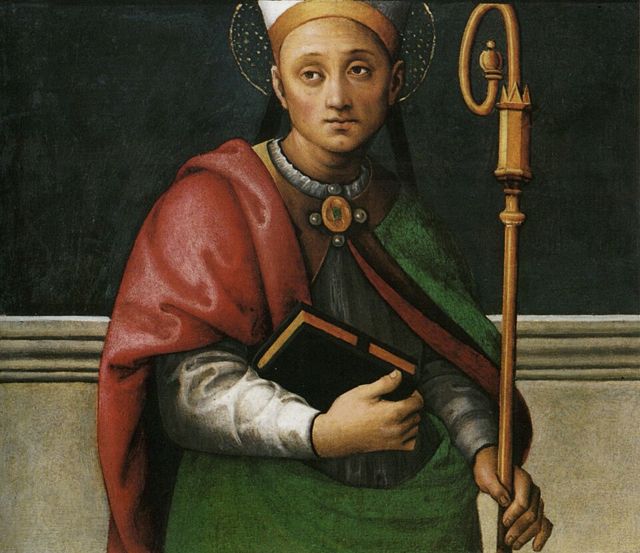
St. Herculanus

Herculanus was bishop of Perugia in central Italy in the sixth century.

Read the essentials →
Feast November 7 · Bishop, Martyr

St. Herculanus

Current feast

November 7 (also listed: March 1)
Secondary source · Wikipedia infobox

Traditional feast

November 7
1914 / pre-1969 calendar, per Baring-Gould (1897)

Represents

Bishop
Martyr

Feast days

Feast: November 7

This Saint’s Story

In our own words, from Wikipedia and Baring-Gould (1897)

What is known of him comes mainly from the Dialogues of Pope Gregory the Great. In 549 the city was besieged by Totila, king of the Ostrogoths. A local story says the bishop tried to trick the besiegers into thinking the city had plenty of food, by having the last sack of grain fed to the last lamb and showing it to them. The ruse failed, and Perugia fell.

Gregory writes that Totila ordered a strip of skin to be cut from the bishop from head to foot before he was killed. The soldier given the task beheaded him first and only then did what he had been ordered. The body was thrown from the walls and buried where it lay, beside a child found dead nearby. Gregory adds that forty days later, when the grave was opened, the head was found joined to the body. Baring-Gould, writing as a critic, doubted that the body found was the bishop's.

Herculanus is the patron of Perugia. His main feast is November 7, with a second feast for the moving of his relics on March 1.

Short entry · the summary here is 34 words; Baring-Gould’s fuller original text and its sources are below. We have not filled any gap with invented detail.

What he represents

How he teaches us to live

Drawn from themes in the original account

Celebrate this saint’s feast day. Remember him on November 7 with a short prayer, and ask for his help.

The full story

Baring-Gould’s account retold in modern English

Read the full story · 33 words · about 1 min

From this, it is clear that either the bishop never lost his head, or, which is much more likely, the body found and now honored at Perugia is not that of the bishop.

Read the original 1870s text

Baring-Gould’s sources: Roman Martyrology. Usuardus, Ado, Notker, &c. The Trans lation of his Relics on March 1. Authority S. Gregory, Dialog, S. Herculanus was bishop of Perugia when that town was besieged by Totila, king of the Goths, in 549; he probably animated his people to defend the city with vigour, for he incurred the vengeance of the king. When the place was taken, the commander of the army sent to Totila, to know what was to be done with the bishop. The king returned answer that a strip of his skin was to be cut off him from his head to his foot, and that then he was to be executed. The Gothic commander, however, decapitated the Saint first on the ramparts, and then cut the thong of skin as required. The body was buried along with that of a little child which was found near it, on the spot where he had fallen. Forty years after, the corpse was dug up, when it was found that the head was attached to it, as though it had never been struck off.

From this it is clear either that the bishop never lost his head, or, what is much more probable, that the body found and now venerated at Perugia, is not that of the bishop.

Help us add to this saint's story

Everything is read by a person before anything appears. Facts are checked against trusted sources first.

Facts are welcome; a source link helps (optional).With your permission we may share it on this page.

Nine days · Free

Pray the novena
with us.

One short email a day for nine days. The day's prayer, a line from St. Herculanus's story, and a nudge to keep going.

Also on November 7
P

St. Prosdochimus

November 7 · Bishop
A

St. Achillas

November 7 · Bishop
W

St. Willibrord of Utrecht

November 7 · Archbishop
← All 1970 saints in the library
Sources & notes

Feast-day sources

Story sources

Sources

Credits

Image: Pietro Perugino cat48h.jpg · Pietro Perugino · Public domain, via Wikimedia Commons

Image: Pietro Perugino, Wikimedia Commons (Public domain)

Retold in plain modern English from Baring-Gould’s public-domain text, sentence by sentence, keeping the same facts and order. Short explanations in parentheses are ours.

From Sabine Baring-Gould, The Lives of the Saints, new edition in 16 vols. (London: John C. Nimmo, 1897–98); text from the Internet Archive scan (OCR, lightly cleaned; errors possible). Public domain in the United States. Reproduced unedited, except for short bracketed notes in grey that we added to explain names and terms (“S.” is the old abbreviation for Saint). Some history and judgments reflect 19th-century scholarship.