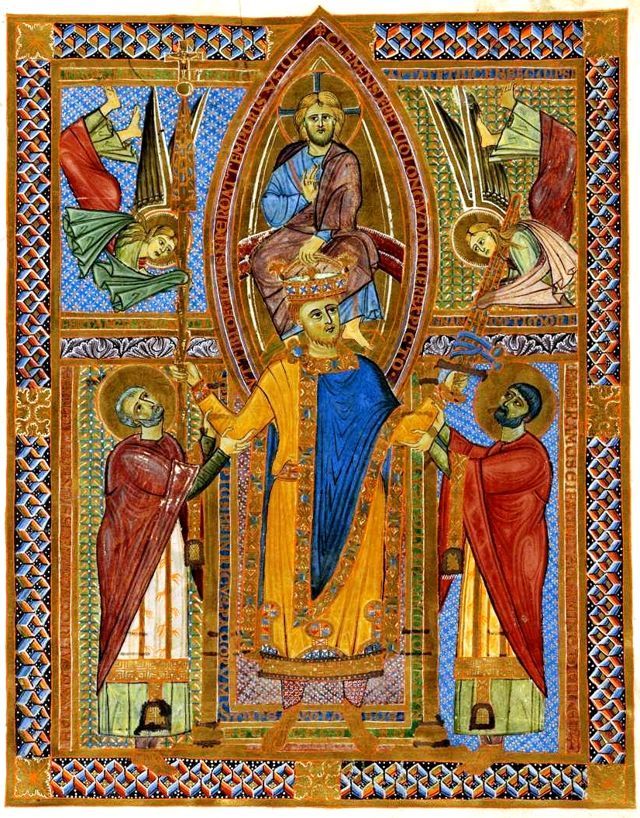
Elected by a council at Werden in Westphalia, Bernard, the duke of Saxony, took the sacred lance from the archbishop of Cologne and placed it in the hands of Henry. Willigis, the archbishop of Mainz, the archbishop of Salzburg, the bishops of Ratisbon, Strasburg, and several nobles joined his cause. Hermann of Swabia gave up his claims, and Henry was crowned at Aix and was recognized by the Saxons, the archbishop of Bremen, S. Benno, the bishop of Hildesheim, and the bishops of Paderborn and Halberstadt. Eckhardt of Meissen lost his life before he could carry out his planned claim. His disrespectful treatment of Sophia and Adeheid, the sisters of Otho III., who actively supported his rival Henry, included forcing his way into their dining room and ruining their meal. This behavior was avenged by the Saxon counts of Nordheim, who attacked him at night in Polde and killed him after a brave defense. Henry's wife, Cunegunda, was then crowned queen at Paderborn. Hermann of Swabia died shortly after and left his possessions to his son, who did not survive him for long. The dukedom of Bavaria, which Henry vacated upon becoming king, was claimed by his cousin, the Markgrave Henry of Schweinfurth, and was also sought by Bruno, the emperor’s brother. Both competitors were refused by Henry, who gave Bavaria to his brother-in-law, Henry, the count of Luxemburg. Disappointed, the rivals conspired against him with Boleslas II. of Bohemia but were defeated by the emperor near Creusen in 1003 and were pardoned.
Almost immediately after his coronation, Henry appointed Meinwerk, his school friend, to be his chaplain. Meinwerk was a man of impeccable morals and some learning. In 1000, the city of Paderborn suffered greatly from a fire. The cathedral and many houses were in ruins. Bishop Riethar appealed to Emperor Otho and to the Pope for help in the restoration efforts. After Otho's death, Riethar visited Henry II., who was then at German Corbei, and urged the king to assist the needy diocese. The king replied that he had nothing to give, at which point Meinwerk, his chaplain, offered one of his estates to his master. Henry readily accepted this offer and gave it to the bishop.
Riethar died in 1009, and when the news reached the king, he decided to appoint his chaplain to the see. He called Meinwerk to him.
“Here is my glove,” said the emperor.
“Not empty, sire,” answered the chaplain.
“No, it contains the bishopric of Paderborn.”
Meinwerk growled, “It is a beggar’s portion. What shall I do with it?”
“Thou art wealthy,” answered Henry, “therefore I gave to thee a poor bride.”
“With thy assistance, sire! She shall be enriched,” said Meinwerk.
And he never missed an opportunity to pressure the emperor with requests for gifts.
After his persistent requests had wrung from him twelve manors, he begged for a thirteenth.
“God forgive thee, bishop!” exclaimed Henry, “for thou plunderest me of everything.”
The emperor was invited by Meinwerk to assist at the dedication of a monastery he had built at Paderborn.
The dedication took place at Christmas.
Upon Henry's arrival, he was dressed in a mantle of lamb’s wool, adorned with marten’s tails, instead of the usual ermine.
The emperor turned red with anger at the insult.
“Sire!” apologized Meinwerk, “the diocese is too poor to provide the proper mantle for your majesty. You are robed in the skins of our poor canons, fleeced by your majesty’s heavy exactions.”
“Well, well, bishop!” said Henry, laughing; “I will restore fourfold. Take now the lordship of Stein.”
After vespers, the emperor sent his drinking cup to Meinwerk through his secretary, so that he might examine and admire it, as it was a rare work of art.
But knowing the kind of man he was dealing with, he strictly forbade his secretary to let the cup out of his hands.
Meinwerk admired and coveted the goblet, snatched it from the hands of the secretary, pushed him out of the room, locked the door in his face, and immediately sent for a silversmith, who worked all evening to transform the drinking cup into a chalice for the altar.
Meinwerk used the vessel at the first mass at midnight, and then said to the emperor, “Reclaim it if thou darest!”
At the offertory of the second mass, sung at daybreak on Christmas morning, the bishop went to the king and asked for the town and lordship of Erwitte, near Lippstadt.
Henry refused.
At the third mass, when the emperor came forward to make his offering, the bishop turned on his heel and refused his oblation.
“I will have Erwitte, and nothing else,” he muttered.
The emperor followed him onto the sanctuary steps.
The scene was becoming undignified and unedifying.
The empress Cunegunda stepped forward and intervened.
The bishop obtained the town he had so persistently demanded.
On the following St. Stephen’s Day, Meinwerk borrowed various expensive pieces of clothing from the emperor to temporarily decorate the altar of the monastery church. Then, from the pulpit, he informed Henry that reclaiming them would jeopardize his salvation. Not satisfied with this, he noticed that Henry had brought with him a beautifully embroidered and jeweled mantle, intended to be worn at imperial diets (formal assemblies). Meinwerk secretly took it, and the emperor next saw it, to his surprise and annoyance, being used as an altar cover.
In retaliation, Henry persuaded one of the canons to scratch a syllable out of the prayer for the dead of the imperial family, changing “de famulis et famulabus” (for the servants) into “de mulis et mulabus” (for the mules and she-mules). The next time the bishop said Mass, he read as it was written, but immediately, upon hearing the laughter of the court, corrected himself. After Mass, the emperor said to him, “Bishop, I want you to pray for my deceased relatives in the future, and not for my mules and she-mules.”
“I will take revenge for this trick,” said the angry bishop. After discovering which canon had erased the syllable, he attacked him with his stick and beat him mercilessly.
Another practical joke of a more serious nature was punished more harshly. The emperor arranged for a piece of paper to fall onto the bishop's plate at a banquet, which read, “Meinwerk, Meinwerk! Set your house in order, for in five days you shall die.” The bishop jumped up from the table in shock, rushed home, made his will, renounced all his worldly possessions, said an emotional farewell to his clergy, wrapped himself in his shroud, and lay down in his coffin, waiting for death.
But death delayed, and instead, a very strong appetite arose, which forced Meinwerk out of his coffin. Still in his grave clothes, he felt compelled to attack some food that was ready at hand. At that moment, the door burst open, and the emperor, Henry, along with his nobles, rushed in, laughing boisterously, and congratulated the bishop on his resurrection. Then Meinwerk realized how he had been tricked, and his anger grew. The following Sunday, the gates of the cathedral were closed against the emperor, and the bishop confronted him on the stairs and excommunicated him. The altar lights were extinguished, divine service was interrupted, and it was only after the emperor had done penance barefoot, wrapped in a linen sheet, with a candle in his hand, that the ban was lifted.
After the death of Otho III, the Italians chose Ardoin, Marquis of Ivrea, as king; however, the Lombards remained loyal to Henry. There were two factions in Rome: the family of Crescentius and the Counts of Tusculum. The latter seemed to have aligned themselves with the new Imperial House that succeeded the House of Saxony. They governed Rome and appointed popes through blatant simony (the practice of buying or selling ecclesiastical privileges). The papacy became a possession of their family, and three popes in succession from this powerful family became the leaders of Christendom. The first of these, Benedict VIII, did not ascend the throne without facing opposition. Gregory, an anti-pope, was established by the rival faction of the Crescentii. Benedict fled to Germany for protection and support from Henry II, who had made significant progress in defeating Ardoin, his rival for the kingdom of Italy. The price of protection was the usual one: the gift of the imperial crown in Rome. The fear of the emperor fell upon the Romans, allowing the pope to return and reclaim his full rights.
When Henry II appeared in Rome in February 1015, all outward opposition had faded, and Henry was crowned by Benedict VIII with the usual splendid ceremony. Henry immediately displayed and exercised all the rights of sovereignty in Italy, minted coins with his own inscription, and administered justice in his own name. The pope was able to recover estates that had been taken from him by the Crescentii, raise an army, and attack and completely destroy a group of Saracens that had landed at Luna. The Saracen queen's headdress was claimed as his share of the spoils by the Vicar of Christ; it was worth 1,000 pounds and was sent by him as a gift to Emperor Henry. The angry Saracen king reportedly sent a bag of chestnuts to the pope with a message: “I will return with as many Saracens to conquer Italy.” The pope replied with a bag of millet, saying, “So many brave men will rise at my bidding to defend their homeland.” In his early life, while out hunting, Henry was thrown from his horse and gored in the thigh by a boar.
But he suffered from other health issues, including colic and kidney stones. The anonymous writer states that, troubled by the latter condition, he went to Monte Cassino to be treated, and there a surgical operation was performed on him with very positive results. In 1006, Henry decided to establish a new bishopric. He fell over a wall while escaping from Ardoin in 1013 and broke his leg. Unsatisfied with such ordinary explanations for the incident, other imaginative writers claim that while S. Henry was hearing Mass in the church of S. Maria Maggiore in Rome, an angel, impressed by his beautiful singing, kissed him and touched the hollow of his thigh, causing the sinew to shrink. The Annalista Saxo states, in the year 1013: "He was long afflicted with colic." The Annals of Hildesheim report: "He was seized by a serious illness." However, the Vita Meinwerci states: "Henry was afflicted by the disease of stones."
He opened the part of the body where the stone lay, and after removing the soft stone, he healed the wound instantly. He placed the stone he had taken out in the hand of the sleeping king. The mention of a surgical instrument shows that this was not a miracle but an ordinary operation performed on the king, who had, without a doubt, been given a strong narcotic because of the pain he would have to endure.
Saint Henry chose Germany and selected Bamberg as the location, perhaps as some atonement for the wrongs done by his ancestors to Adelbert of Babenburg, who had been stripped of his life and lands by them. However, he was hindered in carrying out his plan by the conflicts he had to manage with the brothers of his queen. Her brother Theodoric, who was in holy orders, took over the bishopric of Metz and revolted against the emperor. The bishopric had been given to Adalbert, the son of his brother Adalbert, who was a young boy, and Theodoric of Luxembourg had been appointed his guardian. But Theodoric drove the boy-bishop, his nephew, out of the city and seized the bishopric for himself.
Henry was forced to march against him and bring him to submission. However, he was allowed to keep the bishopric of Metz. Later, in 1018, Adalbert, the queen's brother, drove Megingod out of the archbishopric of Treves and took it for himself. Henry had to bring him to order, depose him, and reinstate Megingod. One reason for Theodoric's revolt was that Henry had proposed to endow the new church of Bamberg he was founding with the dowry of his queen. The boy Adalbert succeeded his uncle as the bishop of Metz in 1047.
However, Theodoric, although allowed to keep the bishopric by the king, wanting to appease him, rebelled again in 1010 and 1011, when the emperor was engaged on the far frontier of Germany in suppressing the Poles and Bohemians. The emperor suffered a defeat in that war on the Bober River. Miseko, the son of Boleslas of Poland, encouraged by this success, attacked Meissen. The castle was set on fire, but the fire was extinguished by the women, who poured mead on the spreading flames. Peace was finally concluded with Poland in 1018, and the rebellious bishop of Metz was forced to submit to the emperor once again.
But before this, in 1012, the cathedral church of Bamberg was dedicated and endowed. It was consecrated by John, patriarch of Aquileja, in the presence of thirty bishops and, according to some, Pope Benedict VIII. To honor his foundation, John had, before this, in 1007, made the new see subject to Rome alone, making it independent of the German archbishoprics. The emperor ordained that the four hereditary officers of the Crown—the marshal, the truchses (a title for a high official), the butler, and the chamberlain—should serve the bishop with the same honors as the emperor. Henry also richly endowed the episcopal sees of Hildesheim, Magdeburg, Strasburg, Meissen, and Merseberg. Having nominated Conrad, duke of Franconia and Swabia, as his successor, Henry died in 1024 and was buried at Bamberg.
It is said that on his deathbed, calling together the surrounding abbots and bishops, and the relatives of Cunegunda, he handed his queen, Cunegunda, to them, saying, "Receive back again your virgin whom you gave to me." Based on this remark and the fact that they had no children, it is said that the loss of Henry to Cunegunda was more like that of a brother to a sister than that of a man to his wife. This opinion is stated as a certainty in the canonization bull by Pope Eugenius III and in that of S. Cunegunda, two hundred years later, by Pope Innocent III. However, it is not improbable that Henry only meant that she was childless, for, as can be seen by a reference to Du Cange, the word "virgo" had that meaning as well as the one usually attributed to it. Alternatively, Henry, speaking in German, probably used the word "Magd," which has the double meaning of the English word "maid," his intention being that the handmaid he had received from the Church he returned to her.
Henry lies buried in the Cathedral of Bamberg, in a richly sculptured marble tomb, but his head is kept separate in a silver-gilt bust, along with that of S. Cunegunda. Bits of his body have been taken at various times and distributed among different churches. A neck joint and one of S. Cunegunda's at Eichstadt, some fragments of bone at Merseburg, some bones in the Escorial (a royal site near Madrid), and a thigh bone at Rome, in the Jesuit College, given in 1641 by the Elector of Bavaria.
Footnotes
- Riethar was the bishop of Paderborn.
- Otho III was a Holy Roman Emperor.
- Boleslas II was a king of Bohemia.
- The Markgrave was a title for a nobleman in charge of a border territory.
- Erwitte is a town near Lippstadt in Germany.
- "de famulis et famulabus" means "for the servants."
- "de mulis et mulabus" means "for the mules and she-mules."
- The papacy became a possession of their family, and three popes in succession from this powerful family became the leaders of Christendom.
- The practice of buying or selling ecclesiastical privileges.
- He was long afflicted with colic.
- He was seized by a serious illness.
- Henry was afflicted by the disease of stones.
- Theodoric of Luxembourg was a bishop who usurped the bishopric of Metz.
- Adalbert of Babenburg was a victim of his ancestors' wrongs.
- Megingod was an archbishop of Treves reinstated by Henry.
- Miseko was the son of Boleslas, a Polish ruler.
- Leo Ostiensis: “Receive back again your virgin whom you gave to me.”
- Auctor Vit* Anon: “Behold, he said, I resign to you your virgin, entrusted to me by Christ our Lord.”
Baring-Gould’s own footnotes, in modern English.
Read the original 1870s text
Baring-Gould’s sources: Roman and German Martyrologies. Canonised on March 14th, a.d. 1x51, by Pope Eugenios III. Authorities: — A Life by Adalbert, deacon of Bamberg, in the middle of the xath cent in Pertz, iv., p. 792. Another Life, by Adalbold, bishop of Maastricht, d. 1027. A fragment "De rebus gestis Henrici imp." in Gretser and the Bollandists. Ditmar of Merseburg (d. xox8), the Annals of Hildesheim (Contin. II., a.d. 994 — 1040), the Saxon Annalist (a.d. 1199), Sigebert of Gembloars (a.d. ixxa), Lambert of Aschaffensburg (d. 1077), Herman the Cripple (d. 1054), Leo of Ostia (d. On the death of Otho III., emperor of Germany, in 1002, probably of small-pox, without issue, the imperial throne was disputed by Henry of Bavaria, Hermann of Swabia, and Eckhardt of Meissen. Henry of Bavaria was born in 972, and was the son of Henry the Wrangler, son of Henry I. of Bavaria, brother of Otho the Great. His mother was Gisela, daughter of Conrad, king of Burgundy. He was therefore descended through both his father and his mother from Charlemagne. He was educated by Wolfgang, bishop of Ratisbon, in his early childhood, and finished his education at Hildesheim, where he made the acquaintance of Meinwerk, whom he afterwards elevated to the bishopric of Paderborn. 1 In the duchy of Bavaria he governed with justice and moderation, giving to the cities charters, and to the churches benefactions; so that he became generally popular. He was thirty-two years old when Otho III. died. Heribert, archbishop of Cologne, received the regalia from the dying emperor, and gave them up to Ezo, count Palatine of the Rhine, who had married Mathilda, daughter of Otho the Great. But Henry was
…elected by a diet at Werden in Westphalia; Bernard, duke of Saxony, wrested the sacred lance from the archbishop of Cologne, and placed it in the hands of Henry. Willigis, archbishop of Mainz, the archbishop of Salzburg, the bishops of Ratisbon [Regensburg in Bavaria], Strasburg, and several nobles joined his standard. Hermann of Swabia resigned his claims, and Henry was crowned at Aix, and was acknowledged by the Saxons, by the archbishop of Bremen, S. Benno, bishop of Hildesheim, and the bishops of Paderborn and Halberstadt Eckhardt of Meissen lost his life before he could carry his projected claim into execution. His indecorous treatment of Sophia and Adeheid, the sisters of Otho III., who actively forwarded the interests of his rival, Henry, in forcing his way into their dining apartment, and destroying their meal, was avenged by the Saxon counts of Nordheim, who attacked him during the night at Polde, and killed him, after a valiant defence. Henryk wife, Cunegunda, was then crowned queen, at Paderborn. Hermann of Swabia died not long after, and left his possessions to his son, who did not long survive him. The dukedom of Bavaria, vacated by Henry, on his accession to the throne, was demanded by his cousin, the Markgrave Henry of Schweinfurth, and was also aspired to by Bruno, the emperor’s brother. Both competitors met with a refusal from Henry, who bestowed Bavaria upon his brother-in-law, Henry, count of Luxemburg, upon which the disappointed rivals entered into a conspiracy against him with Boleslas II., ot Bohemia, but were defeated by the emperor, near Creusen, in 1003, and were pardoned.
Almost immediately on his coronation, Henry appointed Meinwerk, his school-friend, to be his chaplain. He was a man of irreproachable morals, and some [I»ir *s learning. In 1000, the city of Paderborn had suffered severely from a conflagration. The cathedral and the houses were in ashes. Bishop Riethar appealed to the Emperor Otho and to the Pope, to assist him in the work of restoration. On the death of Otho, Riethar visited Henry II., then at German Corbei, and urged the king to relieve the necessities of the afflicted diocese. The king replied that he had nothing to give, whereupon Meinwerk, his chaplain, offered his master one of his estates. Henry readily accepted it, and gave it to the bishop.
Riethar died in 1009, and when the news reached the king, he resolved on conferring the see on his chaplain. He called Meinwerk to him.
“ Here is my glove,” said the emperor. “ Not empty, sire,” answered the chaplain. 44 No, it contains the bishopric of Paderborn.” Meinwerk growled, 44 It is a beggar’s portion. What shall I do with it ?” 44 Thou art wealthy,” answered Henry, 44 therefore gave I to thee a poor bride.” “With thy assistance, sire! she shall be enriched,” said Meinwerk. And he never after omitted an opportunity of besieging the emperor with entreaties for gifts. After his importunities had wrung from him twelve manors, he begged a thirteenth. “ God forgive thee, bishop !” exclaimed Henry, “for thou plunderest me of everything.” The emperor was invited by Meinwerk to assist at the dedication of a monastery he had erected at Paderborn. The dedication took place at Christmas. On the arrival of Henry he was vested in a mantle of lamb’s wool, set with marten’s tails, instead of the usual ermine. The emperor coloured with anger at the affront.
“Sirel” apologised Meinwerk, “the diocese is too poor to provide the proper mantle for your majesty. You are robed in the skins of our poor canons, fleeced by your majesty’s heavy exactions.” “Well, well, bishop!” said Henry laughing; “I will restore fourfold. Take now the lordship of Stein.” After vespers the emperor sent his drinking-cup to Meinwerk by his secretary, that he might examine and admire it, as it was a rare work of art. But knowing the sort of man he had to deal with, he strictly forbad his secretary to allow the cup out of his hands. Meinwerk admired and coveted the goblet, snatched it from the hands of the secretary, thrust him out of the room, locked the door in his face, and sent for a silversmith at once, who worked all the evening to transform the drinking cup into a chalice for the altar. Meinwerk used the vessel at the first mass at midnight, and then said to the emperor, “ Reclaim it if thou darest !” At the offertory of the second mass, sung at daybreak on Christmas morning, the bishop went to the king and asked for the town and lordship of Erwitte, near Lippstadt. Henry refused. At the third mass, when the emperor came forward to make his offering, the bishop turned on his heel and refused his oblation. “ I will have Erwitte, and nothing else,” he muttered. The emperor followed him on the sanctuary steps. The scene was becoming undignified, unedifying. The empress Cunegunda stepped forward and interfered. The bishop obtained the town he had so pertinaciously demanded.
On the following S. Stephen’s Day, Meinwerk borrowed of the emperor various costly pieces of apparel for the temporary adornment of the altar of the monastery church; and then, from the pulpit, informed Henry that to reclaim them would jeopardise his salvation, Not content with this, finding that Henry had brought with him a magnificently embroidered and bejewelled mantle, to be worn at imperial diets, he carried it off* surreptitiously, and the emperor next saw it, to his surprise and vexation, used as an altar cover. In revenge, Henry persuaded one of the canons to scratch a syllable out of the collect for the dead of the imperial family, and by this means to change “ de famulis et famulabus,” into “ de mulis et mulabus.” Next time the bishop said mass, he read as was written, but instantly, hearing the titter of the court, corrected himself. After mass, the emperor said to him, 11 Bishop, I desire you in future to pray for my dead kinsfolk, and not for my mules and she-mules.”
“I will be revenged for this trick,” said the angry prelate, and having discovered the canon who had erased the syllable, he fell on him with his stick, and cudgelled him unmercifully.
Another practical joke of a grimmer description was more severely chastised. The emperor contrived that, at a banquet, a paper should fall on the plate of the bishop, on which was inscribed, “Meinwerk, Meinwerk ! set thine house in order, for in five days thou shalt die.” The bishop started from the table in blank alarm, hastened home, made his will, renounced all his worldly possessions, bade a pathetic farewell to his clergy, wrapped himself in his shroud, and lay down in his coffin awaiting death.
But death tarried, and in its place arose a very hearty appetite, which forced Meinwerk out of his coffin, and, still in his grave-clothes, compelled him to attack some eatables ready at hand. At this juncture the door burst open, and the emperor, S. Henry, followed by his nobles, poured in, with boisterous laughter, and congratulated the bishop on his resurrection. Then Meinwerk discovered how he had been duped, and his wrath waxed high. Next Sunday the gates of the cathedral were closed against the emperor, and the bishop met him on the stairs and excommunicated him. The altar-lights were extinguished, divine service was interrupted, and not till the emperor had done penance with bare feet, in linen sheet, with a taper in his hand, was the ban removed. On the death of Otho III., the Italians had chosen Ardoin, Marquis of Ivrea, as king; but the Lombards [a Germanic people who ruled much of Italy from 568 to 774] adhered to Henry. There were two factions in Rome • the family of Crescentius, and the Counts of Tusculum. The latter seem to have attached themselves to the new Imperial House which succeeded that of Saxony. They governed Rome, and appointed popes by the most open simony. The papacy became an appanage of their family, and three popes in succession from this powerful family became the heads of Christendom. The first of these, Benedict VIII., did not ascend the throne without opposition. Gregory, an anti-pope, was set up by the rival fiction of the Crescentii. Benedict fled for protection and support into Germany, to Henry II., who had now made great progress in the reduction of Ardoin, his rival for the kingdom of Italy. The price of protection was the usual one — the gift of the imperial crown in Rome. The fear of the emperor fell on the Romans, and the pope was able to return and resume his full rights. When Henry II. appeared in Rome, in February, 1015, all outward opposition had died away, and Henry was crowned by Benedict VIII., with the usual splendid ceremonial. Henry at once displayed and exercised all the rights of sovereignty in Italy, coined money with his own superscription, and administered justice in his own name. The pope was able to recover estates, wrested from him by the Crescentii, to levy an army, and to fall on, and cut to pieces to the last man, an armament of Saracens [medieval Christian name for Arab and Muslim peoples], which had landed at Luna. The Saracen queen’s headdress was claimed as his share of the spoils by the Vicar of Christ — it was worth 1000 pounds, and was sent by him as a present to the emperor Henry. The indignant Saracen king, it is said, sent a bag of chestnuts to the pope, with a message, “I will return with as many Saracens to the conquest of Italy.” The pope sent him back a bag of millet. “ So many brave men will rise at my bidding to defend their native land.” In early life Henry, whilst out hunting, was thrown from his horse, and gored in the thigh by a boar; and Lame.
But he laboured from other infirmities, colic, and the stone.* The anonymous writer relates that, troubled with the latter complaint, he went to Monte Cassino to be cured, and there a surgical operation was performed upon him with the happiest results. 8 In 1006, Henry resolved to found a new bishopric in he fell over a wall when escaping from Ardoin, in 1013, and so broke his leg. Unsatisfied with such prosaic explanations of the circumstance, other lively writers assert that whilst S. Henry was hearing mass in the chnrcb of S. Maria Maggiore at Rome, an angel, struck with his admirable chanting, kissed him, and touohed the hollow of his thigh, so that the sinew shrank. ingen item gravissime potitur." So also the Annalista Saxo, ad an. 10x3: — " Diu colica passion? laborans infirmatur." The Annals of Hildesheim say: — "Gravi languors correptus.** But the Vita Meinwerci says: — “ Henricus infirmatus morbo calculi."
M partem illam corporis, ubi calculus jacebat, medieinsli ftrrt, quod in mann tenebat, apernit, et evulso moll iter calculo, hiatum vulnerls snbita sanitate redintegravlt, calculumque quern tulerat, in manu Regis dormientis reposuit." The mention of a surgical instrument shows that this was not a miracle | but an ordinary operation performed on the king, who had, doubtless, been given a strong narcotic, on account of the pain he would be called on to endure. Germany, and selected Bamberg for the spot, perhaps as some expiation for the wrongs done by his ancestors to Adelbert of Babenburg, who had by them been despoiled of his life and lands; but was impeded in the execution of his design by the contests he had to carry on with the brothers of his queen. Her brother Theodoric, in holy orders [ordination; “orders” means the sacrament by which deacons, priests and bishops are ordained], usurped the bishopric of Metz, and revolted against the emperor. The bishopric had been given to Adalbert, son of his brother Adalbert, a young boy, and Theodoric of Luxemburg had been constituted his guardian. But Theodoric drove the boy-bishop, his nephew, out of the city, and seized the bishopric for himself. Henry was constrained to march against him, and reduce him to submission. He was, however, allowed to retain the bishopric of Metz, and Adalbert, the queen's brother, later, in 1018, drove Megingod out of the archbishopric of Treves [Trier in Germany], and possessed himself of it. Henry was obliged to reduce him to order, depose him, and re-instate Megingod. One reason of the revolt of Theodoric was that Henry had proposed to endow the new church of Bamberg he was founding with the dowry of his queen. The boy Adalbert succeeded his uncle on the episcopal chair of Metz, in 1047. But Theodoric, though left in possession of the bishopric by the king, willing to conciliate him, rebelled again in 1010 and ion, when the emperor was engaged at the further frontier of Germany in repressing the Poles and Bohemians. The emperor in that war suffered a defeat on the Bober. Miseko, son of Boleslas of Poland, inspirited by this success, attacked Meissen; the castle was set on fire, but the conflagration was extinguished by the women, who poured mead on the spreading flames. Peace was finally concluded with Poland in 1018, and the turbulent bishop of Metz was obliged again to submit to the emperor.
But before this, in 1012, the cathedral church of Bamberg had been dedicated and endowed; it was consecrated by John, patriarch [the title of the bishops of the great ancient sees: Rome, Constantinople, Alexandria, Antioch, Jerusalem] of Aquileja, in the presence of thirty bishops; and, according to some, of Pope Benedict VIII. To do honour to his foundation, John had, before this, in 1007, subjected the new see to Rome alone, making it independent of the German archbishoprics, and the emperor ordained that the four hereditary officers of the Crown, the marshal, the truchses, the butler, and the chamberlain, should serve the bishop with like honours as the emperor. Henry also endowed richly the episcopal sees of Hildesheim, Magdeburg, Strasburg, Meissen, and Merseberg. Having nominated as his successor Conrad, duke of Franconia and Swabia, Henry died in 1024, and was buried at Bamberg.
It is said that on his death-bed, calling together the surrounding abbots and bishops, and the kinsmen of Cunegunda, he handed his queen, Cunegunda, to them, saying, u Receive back again your virgin whom you gave to me.” 1 On the authority of this remark, and the fact of their having had no children, it is said that the loss of Henry to Cunegunda was rather that of a brother to a sister, than that of a man to his wife; an opinion stated as a certainty in the bull of his canonization by Pope Eugenius III., and in that of S. Cunegunda, two hundred years after, by Pope Innocent III. It is, however, not improbable that Henry only meant that she was 1 Leo Ostiensis: “ Reclpite quam mihi tradidistls virginem restrain.** Auctor Vit* Anon: •* Hanc ecce, inquit, mihi a robls, Immo a Christo consignatam, ipso Christo Domino nostro ct robis resigno rirginem vestram.” B. Ignattus Azevedo.
childless, 1 for, as may be seen by a reference to Du Cange, the word 11 virgo ” had that signification as well as the one usually attributed to it. Or again, Henry, speaking in German, probably used the word Magd, which has the double signification of the English il maid,” his meaning being that the handmaid he had received from the Church he returned to her. Henry lies buried in the Cathedral of Bamberg, in a marble, richly-sculptured tomb; but the head is kept separate in a silver-gilt bust, along with that of S. Cunegunda. Bits of his body have been carried off at various times, and distributed among different churches. A neck joint, and one of S. Cunegunda, at Eichstadt. Some fragments of bone at Merseburg. Some bones in the Escurial, near Madrid; a thigh-bone at Rome, in the Jesuit College, given in 1641, by the Elector of Bavaria.