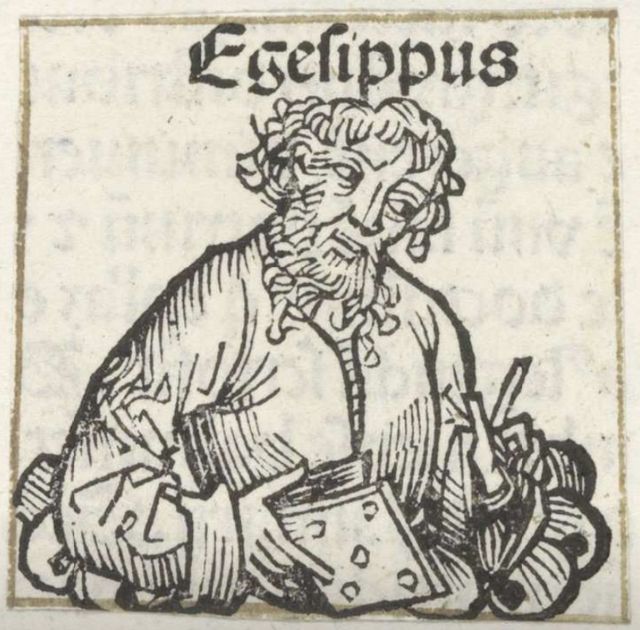
A writer of the second century, known to us almost exclusively from Eusebius, who tells us that he wrote in five books in the simplest style the true tradition of the Apostolic preaching. His work was entitled hypomnemata (Memoirs), and was written against the new heresies of the Gnostics and of Marcion. He appealed principally to tradition as embodied in the teaching which had been handed down in the Churches through the succession of bishops. St. Jerome was wrong in supposing him to have composed a history. He was clearly an orthodox Catholic and not a "Judaeo-Christian", though Eusebius [Eusebius of Caesarea (d. c. 339), the first historian of the Church] says he showed that he was a convert from Judaism, for he quoted from the Hebrew, he was acquainted with the Gospel according to the Hebrews and with a Syriac Gospel, and he also cited unwritten traditions of the Jews. He seems to have belonged to some part of the East, possibly Palestine. He went on a journey to Corinth and Rome, in the course of which he met many bishops, and he heard from all the same doctrine. He says: "And the Church of the Corinthians remained in the true word until Primus was bishop in Corinth; I made their acquaintance in my journey to Rome, and remained with the Corinthians many days, in which we were refreshed with the true word. And when I was in Rome, I made a succession up to Anicetus, whose deacon was Eleutherus. And in each succession and in each city all is according to the ordinances of the law and the Prophets and the Lord" (Euseb., IV, 22).
Many attempts have been made to show that diadochen epoiesamen, "I made for myself a succession," is not clear, and cannot mean, "I made for myself a list of the succession of the bishops of Rome." A conjectural emendation by Halloix and Savile, diatriben epoiesamen, is based on the version by Rufinus (permansi inibi), and has been accepted by Harnack, McGiffert, and Zahn. But the proposed reading makes nonsense: "And being in Rome, I made a stay there till Anicetus." When did he arrive? And what does "till Anicetus" mean? Eusebius cannot have read this, for he says that Hegesippus came to Rome under Anicetus and stayed until Eleutherus. The best scholars have accepted the manuscript text without difficulty, among others Lipsius, Lightfoot, Renan, Duchesne, Weizsaecker, Salmon, Caspari, Funk, Turner, Bardenhewer. In fact diadoche had then a technical meaning, which is precisely found in the next sentence, where "in each succession and in each city", may be paraphrased "in each list of bishops in every city", the argument being that of St. Irenaeus (Adv. Haer., III, 3): "We are able to enumerate those who were made bishops in the Churches by the Apostles, and their successions up till our own time, and they have taught and known nothing resembling the wild dreams of these heretics." The addition of Soter and Eleutherus is intended by the writer to bring his original catalogue up to date.
With great ingenuity Lightfoot has found traces of this list in St. Epiphanius, Haer., XXVII, 6, where that saint of the fourth century carelessly says: Marcellina came to us lately and destroyed many, in the days of Anicetus, Bishop of Rome", and then refers to "the above catalogue", though he has given none. He is clearly quoting a writer who was at Rome in the time of Anicetus and made a list of popes beginning with St. Peter and St. Paul, martyred in the twelfth year of Nero. A list which has some curious agreements with Epiphanius, and extends only to Anicetus, is found in the poem of Pseudo-Tertullian against Marcion; the author has mistaken Marcellina for Marcion. The same list is at the base of the earlier part of the Liberian Catalogue, doubtless from Hippolytus (see under Clement I). It seems fairly certain that the list of Hegesippus was also used by Irenaeus, Africanus, and Eusebius in forming their own. It should be said, however, that not only Harnack and Zahn, but Funk and Bardenhewer, have rejected Lightfoot's view, though on weak grounds. It is probable that Eusebius borrowed his list of the early bishops of Jerusalem from Hegesippus.
Read the rest of the article
Eusebius quotes from Hegesippus a long and apparently legendary account of the death of St. James, "the brother of the Lord", also the story of the election of his successor Symeon, and the summoning of the descendants of St. Jude to Rome by Domitian [Roman emperor 81–96]. A list of heresies against which Hegesippus wrote is also cited. We learn from a note in the Bodleian MS. Barocc. 142 (De Boor in "Texte und Unters.", V, ii, 169) that the names of the two grandsons of St. Jude were given by Hegesippus as Zoker and James. Dr. Lawlor has shown (Hermathena, XI, 26, 1900, p. 10) that all these passages cited by Eusebius were connected in the original, and were in the fifth book of Hegesippus. He has also made it probable (Journal of Theol. Studies, April, 1907, VIII, 436) that Eusebius got from Hegesippus the statement that St. John was exiled to Patmos by Domitian. Hegesippus mentioned the letter of Clement to the Corinthians, apparently in connection with the persecution of Domitian. It is very likely that the dating of heretics according to papal reigns in Irenaeus and Epiphanius — e.g., that Cerdon and Valentius came to Rome under Anicetus, etc. — was derived from Hegesippus, and the same may be true of the assertion that Hermas was the brother of Pope Pius (so the Liberian Catalogue, the poem against Marcion, and the Muratorian fragment). The date of Hegesippus is fixed by the statement that the death and apothesis of Antinous were in his own time (130), that he came to Rome under Anicetus (154-7 to 165-8) and wrote in the time of Eleutherus (174-6 to 189-91). Zahn has shown that the work of Hegesippus was still extant in the sixteenth and seventeenth centuries in three Eastern libraries.
The fragments of Hegesippus, including that published by De Boor (above) and one cited from Stephen Gobaras by Photius (Bibl. 232), have been elaborately commented upon by Zahn, Forschungen zur Gesch. des N.T. Kanons (Leipzig, 1900), VI, 228 sqq., who discusses other traces of Hegesippus. On the papal catalogue see Lightfoot, Clement of Rome (London, 1890), I, 327, etc.; Funk, Kirchengesch. Abhandlungen (Paderborn, 1897), I, 373; Harnak, Chronol., I, 180; Chapman in Revue Bened., XVIII, 410 (1901); XIX, 13 (1902); Flamon in Revue d Hist. eccl., Dec., 1900, 672-8. On the lost manuscripts, etc., see Zahn in Zeitschr. fur Kirchengesch., II (1877-8), 288, and in Theol. Litteraturblatt (1893), 495. For further references and a fuller account see Bardenhewer, Gesch. der altkirchl. Litt., I, 483 sqq.