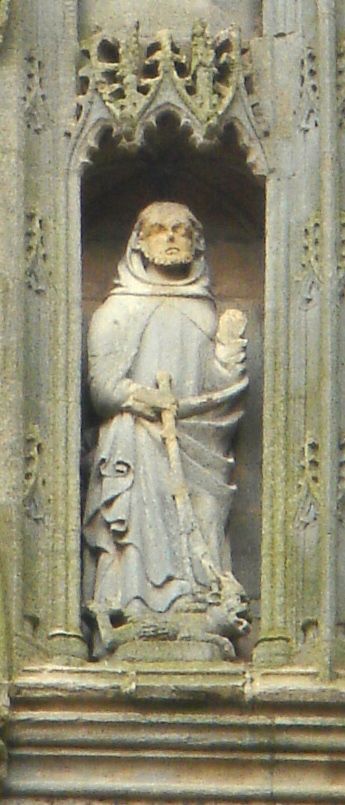
Alfwald was the king of the East Angles, reigning from 713 to 749. At Croyland, Felix had the chance to gather many traditions about Saint Guthlac. He tells us that he also had the advantage of speaking with people who had known Guthlac personally, including Abbot Wilfrid and the priest Beccal, who served him.
During the reign of Ethelred, king of the Mercians, there was a nobleman in Mercia named Penwald. He came from one of the oldest and most distinguished families, known as the Iclings. Penwald was wealthy in worldly matters, and at the height of his wealth, he wanted to take a wife. He chose the fairest maiden from many, who came from a noble family; her name was Tette. They were together until the time that God ordained for her to become pregnant.
After the child was born, on the eighth day, he was brought to the holy water for baptism, and he was named after his family and clan, Guthlac. When the child reached the age when he should begin to speak, he was neither dull nor disobedient to his parents or to those who cared for him, whether they were older or younger. He did not engage in childish mischief, nor did he indulge in the empty talk of common people, nor did he flatter others insincerely or lie. He did not study the various calls of birds, as children often do. Instead, he grew up sharp-minded, cheerful in appearance, pure in character, and innocent in his behavior.
As time passed and he grew stronger into manhood, he began to think about the great deeds of heroes and men from the past. It was as if he had awakened from a dream; his character changed, and he gathered a large group of companions and peers. He took up weapons and sought revenge on his enemies. He burned their city, ravaged their farms, and caused widespread destruction across the land, killing many and taking their possessions. Blessed Guthlac lived this way for about nine years.
Engaged in hostile raids, he returned one night from an expedition. As he rested his tired body and reflected on his actions, he was suddenly filled with a sense of divine awe, and his heart was filled with spiritual love. When he awoke, he thought about the ancient kings who, realizing the miserable end of a sinful life, abandoned this world. In that moment, all his ambitions vanished. Filled with godly fear, he vowed that if God would spare him until the next day, he would become His servant.
When the darkness of night passed, he got up and marked himself with the sign of Christ's cross. He then told his companions to find another leader, declaring that he would henceforth be a servant of Christ. When they heard this, they were greatly astonished and pleaded with him not to follow through on his words. However, he paid no attention to their pleas. God's love burned so intensely within him that he not only disregarded the world but also left his parents' home and wealth, as well as his companions, placing all his hope in Christ.
Afterward, he went to the monastery of Repton, where he received the tonsure (a monastic haircut) from the abbess Elfrida. Once he had taken on the monastic habit, he refused to drink any fermented liquor. This led to resentment from the other monks, but soon they recognized the sincerity of his intentions and the purity of his life, and they all grew to love him. He was tall and trim, pleasant in demeanor, and handsome in appearance. He spoke with mildness and modesty, and he was patient and humble, with divine love always burning brightly in his heart.
After two years in the monastery, he had learned the psalms, canticles, hymns, and prayers according to Church tradition. He then began to yearn for the wilderness and a hermitage. So, he requested permission from the elders to leave. Only one area in Mid-England was desolate enough to attract those seeking to escape the world: the vast fens north of Cambridge. There, as early as the seventh century, hermits settled in marshes that have since been so completely transformed that it is hard to imagine the original landscape.
The fens in the seventh century were probably very similar to the forests at the mouth of the Mississippi River or the swampy shores of the Carolinas. Their vast plain is now, in summer, a sea of golden corn. In winter, it becomes a bleak, black fallow land, divided into squares by stagnant ditches, and interrupted only by unsightly pumping mills and gloomy lines of poplar trees.
In the past, it was a maze of dark, wandering streams, broad lagoons, and marshes that were submerged every spring tide. There were vast beds of reeds, sedge, and ferns, along with large thickets of willow, alder, and grey poplar, which were rooted in the floating peat. This peat was slowly consuming everything, all-devouring yet all-preserving, the forests of fir, oak, ash, poplar, hazel, and yew that had once thrived on that low, rich soil, which geologists say is gradually sinking beneath the sea over time.
Trees that were torn down by floods and storms floated and became lodged in rafts, blocking the waters from returning to the land. Streams, confused in the flatlands, changed their courses, mixing silt and sand with the peat moss. Nature, left to her own devices, descended into wild chaos more and more, until the entire fen became one "Dismal Swamp," where, at the time of the Norman Conquest, Hereward, the "Last of the English," took refuge from the invading tyrants.
This is how Felix described it: "There is in Britain a fen of immense size, which begins from the river Grant (the Cam), not far from the city named Grantchester (near Cambridge). There are immense marshes, now a black pool of water, now foul running channels, and also many islands, reeds, hillocks, and thickets, and with many wide and long windings, it continues up to the North Sea."
The following vivid description of the great Cambridgeshire fens is from Mr. C. Kingsley in "The Hermits." It is provided because the lives of figures like S. Guthlac and S. Botolph cannot be understood without clearly presenting the scenes in which they lived.
For there are islands in the sea that have escaped the destructive flood of peat moss—outcrops of firm and fertile land that, in the early Middle Ages, served as natural parks. These areas were covered with lush grass and majestic trees, teeming with deer, roe, goats, and boars, while the surrounding streams were filled with otters, beavers, birds of every kind, and fish of every variety.
Beautiful in their own way were those lovely islands in the eyes of the monks who were the first settlers in the wilderness. The author of the “History of Ramsey” becomes enthusiastic, and somewhat exaggerated as well, when he describes the beautiful island, which got its name from a solitary ram that had wandered there, either during a severe drought or over the winter ice. Unable to return, it was found feeding among the wild deer, fat beyond what rams usually are. He talks about the majestic ash trees, most of which were cut down in his time to provide large beams for the Church roof. He describes the rich pastures, painted with all kinds of bright flowers in spring. He mentions the “green crown” of reeds and alders that surrounded the island, and the lovely wide lake, now drained, with its “sandy beach” along the forest side. “It is a delight,” he says, “to all who look upon it.”
In a similar tone, William of Malmesbury, writing in the first half of the twelfth century, speaks of Thomey Abbey and its island. “It represents,” he says, “a true paradise; for in pleasure and delight it resembles heaven itself. These marshes are full of trees, whose height, without a knot, rivals the stars. The plain there is as flat as the sea, pleasing the eye with its green grass, and so smooth that there is nothing to trip the foot of anyone running through it. There is no wasteland; for in some areas there are apples, and in others, vines, which either spread on the ground or are raised on poles. There is a friendly competition between Nature and Art, so that what one does not produce, the other supplies. What shall I say about those beautiful buildings, which it is so wonderful to see standing on the ground among those marshes?”
So wrote William of Malmesbury, after the hard work and wisdom of the monks had been at work for more than four centuries to civilize and cultivate the wilderness. Yet even then, there was another side to the picture. Thomey, Ramsey, or Crowland would have seemed, for nine months every year, quite sad to us comfortable people of the nineteenth century. But men lived hard in those days, even the most high-born and luxurious nobles and ladies. They lived under dark skies, in houses that we would consider unfit even for criminals, due to their darkness, drafts, and lack of space. They lived hardly and were easily pleased. They thanked God for the smallest gleam of sunshine and the tiniest patch of green after the terrible and long winters of the Middle Ages.
Those winters must have been quite ugly, with snow and darkness, floods and ice, ague (a fever) and rheumatism. During the dreary winter nights, the whistle of the wind and the wild cries of the waterfowl were transformed into the howls of witches and demons. The delirious fancies caused by marsh-fever made those fiends take hideous shapes before the inner eye and act out fantastic horrors around the fenman’s bed of sedge.
Now, when Saint Guthlac discovered the wilderness, he asked those who lived on the edge of the fen where he might find land that would serve as a home. There was a man named Tatwin, who said that he knew of an island that many men had tried to inhabit, but none had succeeded due to various horrors and fears, and the loneliness of the wide wilderness. When Guthlac heard these words, he immediately told him to show him the place, and he did. He got into a boat, and they rowed through the wild fens until they reached the spot called Crowland, which was so lost in the marsh that few knew of it except Tatwin, who had shown it to him. It was on Saint Bartholomew's Day that Guthlac crashed through the reeds of the morass to the island that would be his home for life.
After he had been there a few days, he was able to see what he needed to settle there. He decided to return to Repton to greet his brethren, as he had left without saying goodbye. So in the morning, he went back to the monastery, where he stayed for ninety nights before returning to the beloved wilderness with two servants. He was twenty-six years old when, endowed with heavenly grace, he first settled in the wilderness.
Soon after he had settled there, he was tormented at night by strange sights and noises. He saw hairy figures leaping about his island and talking in British. His imagination led him to think of them as devils, but there can be no doubt about who they were: some of the old British who had been driven by the Saxon invaders into these wild areas, where they lived among the islets of the vast swamp, unbothered, just as later Saxons took refuge in them from the Normans. These old British resented the presence of the hermit and tried to scare him away, even resorting to violence for that purpose.
His imagination filled these islanders with fantastic terrors, and we read in the life by Felix how they “filled the house with their coming, and poured in on every side, from above, and from beneath, and everywhere.” They had horrible faces, great heads, and long necks, with lean visages. They were filthy and squalid in their beards, had rough ears, crooked noses, fierce eyes, and foul mouths. Their teeth were like horse tusks, and their throats seemed to be filled with fire, producing grating voices. They had crooked legs, large knees, distorted toes, and cried hoarsely. They came with excessive noise and immense horror, making him think that all between heaven and earth resounded with their voices.
They tugged and dragged him out of the cottage, led him to the dark swamp, and threw him into the muddy waters. After that, they brought him into the wild areas of the wilderness, among thick brambles, which tore at his body. Then they took him and beat him with iron whips, and afterward, they carried him on their creaking wings through the cold air.
S. Guthlac found on the island a large burial mound from old British times, which some men had broken into in hopes of finding treasure. On the side of the mound was a hole filled with water. Beside this, Guthlac built his hermitage. He then decided that he would wear neither woolen nor linen garments, but only clothing made of skins; and he continued to do so. Every day he ate barley bread and drank water. One day, the British devils tried to persuade him to give up eating bread except on one day each week. However, Guthlac saw through their clever scheme to rid the islet of his presence and continued to eat his daily portion of barley bread.
The biographer of St. Guthlac goes on to tell how a man named Beccel, who worked as his servant, was shaving the saint one day when he was struck by a great temptation. He thought, why should he not cut St. Guthlac’s throat and take over his cell, so that he could have the honor and glory of sainthood? But St. Guthlac sensed the inner temptation, which is described with the simple honesty of those somewhat primitive times, and he rebuked Beccel, leading him to confess, so that everything turned out well in the end.
But there are gentler and more human touches in that old legend. One can read in it how all the wild birds of the fen came to Saint Guthlac, and he fed them according to their kind. The ravens tormented him by stealing letters, gloves, and other items from his visitors. Then, feeling guilty after his reproofs, they brought the items back or hung them on the reeds.
As Wilfrid, a holy visitor, was sitting and speaking with him in his island, two swallows suddenly flew in. They began to sing joyfully, and then they sat fearlessly on the shoulders of the holy man Guthlac. After that, they lifted up their song again and sat on his chest, arms, and knees. When Wilfrid had watched these birds in wonder for a long time, he asked Guthlac why the wild birds of the wilderness sat so submissively upon him. The holy man Guthlac answered him, “Have you never learned, brother Wilfrid, in Holy Writ, that with someone who has lived according to God's will, the wild beasts and wild birds are tame?”
At last, after fifteen years in the fen, God was pleased to call His servant to Himself. It happened that he was in his chapel at prayer when he fell ill. Beccel came to him and asked what was wrong. Guthlac answered slowly, drawing his breath with difficulty, “The meaning of my illness is this: the spirit must be taken away from this body.” When Beccel heard this, he burst into tears. Then Guthlac comforted him, saying, “My son, do not be grieved, for it is no sorrow for me to go to my Lord and God.”
When Easter arrived after four nights, Guthlac, despite his sickness, performed service to God and sang Mass, for he had been ordained a priest. After he had offered the precious sacrifice, he began to preach to Beccel, and he penetrated him so deeply with his counsel that he had never before or after heard anything like it. When the seventh day of his illness came, Beccel arrived at the sixth hour of the day to visit him. He found Guthlac leaning in the corner of his oratory against the altar. At first, he could not speak to him, for he saw that Saint Guthlac was in pain.
But soon the holy man raised his weary limbs from the wall and said, “My son, now it is very near the time, and you must attend to my last commands. After my soul departs from the body, go to my sister Pegge and tell her that I would not see her in life, so that we might meet in heaven before the face of God. And tell her to place my body in the leaden coffin, to wrap it in the sheet which Ecgburh the abbess sent me, and to lay it in the coffin that the holy virgin gave me.” When he had spoken thus, he leaned his head against the wall and let out a long sigh.
And on the following night, when Beccel began his nightly prayers, it seemed to him that the whole house was surrounded by a great brightness, and the light remained until daybreak. When dawn came the next morning, the man of God stirred a little and raised his weary limbs. Then he said to Beccel, "My son, prepare yourself to go on a journey that I command you; for now is the time for my spirit to leave these aching limbs and depart to endless joy." After saying this, he stretched out his hands toward the altar and strengthened himself with the Body and Blood of Christ. After that, he raised his eyes to heaven, stretched out his arms, and died.
After his death, a church arose on the site sanctified by the life and death of Guthlac, along with a community of monks. Eventually, the lofty wooden abbey of Crowland was built on great piles driven into the marsh, "at the estuary of four rivers." It featured dykes, parks, vineyards, orchards, and rich farmland, from which, in times of famine, the monks of Crowland fed all the people of the neighboring fens. The abbey had a tower with seven bells and became a sanctuary for all who fled from tyranny and slavery.
Those who took refuge in S. Guthlac’s place from cruel lords had to keep peace with each other and earn their living like honest men, safe as long as they did so. For between those four rivers, S. Guthlac and his abbot were the only lords; and neither a summoner, nor the king's sheriff, nor any armed force of knights or earls could enter—“the inheritance of the Lord, the soil of S. Mary and S. Bartholomew, the most holy sanctuary of S. Guthlac and his monks, the minster free from worldly servitude, the special almshouse of most illustrious kings, the sole refuge for anyone in worldly tribulation, the perpetual abode of the saints, the possession of religious men, specially set apart by the common council of the realm; due to the frequent miracles of the holy confessor S. Guthlac, an ever-fruitful garden of camphire in the vineyards of Engedi; and, because of the privileges granted by the kings, a city of grace and safety for all who repent.”
The great and good work started by the monks was continued by others whom they had inspired, such as Richard de Rulos, Lord of Deeping (the deep meadow). He decided to do the same work from the hall of Bourne, which the monks had done from their cloisters. After obtaining permission from the Croyland monks for twenty marks of silver, he drained as much of the common marshes as he could. He shut out the Welland River by building strong dykes, constructed cottages, marked out gardens, and cultivated fields, until “out of slough and bogs accursed he made a garden of pleasure.”
There seems to be one other lasting work that the monks of Crowland accomplished, besides those strong dykes and rich arable lands of the Porsand, which still endure today. Within two generations of the Norman conquest, while the old wooden abbey, which had been destroyed by fire, was being replaced by that noble stone structure whose ruins still stand, the French abbot of Crowland sent French monks to establish a school under the new French donjon (a fortified tower) in the small Roman town of Grante-brigge. This led to S. Guthlac, through his canoe voyage to Crowland Island, becoming the spiritual father of the University of Cambridge in the Old World. Consequently, he is also considered the spiritual father of her noble daughter, the University of Cambridge, in the New World, which was colonized and Christianized by fen-men sailing from Boston deeps 800 years after S. Guthlac's death.
(1) Passages of this article are extracted from the sketch of S. Guthlac in Mr. Kingsley's “The Hermits.”
Footnotes
- Felix had the chance to gather many traditions about Saint Guthlac.
- He also had the advantage of speaking with people who had known Guthlac personally.
- Penwald came from one of the oldest and most distinguished families, known as the Iclings.
- Blessed Guthlac lived this way for about nine years.
- The tonsure is a monastic haircut.
- There is in Britain a fen of immense size, which begins from the river Grant (the Cam), not far from the city named Grantchester (near Cambridge).
- William of Malmesbury was a historian and monk from the 12th century.
- Crowland: a location in the fens of eastern England.
- Saint Bartholomew: one of the twelve apostles of Jesus.
- There can, I think, be no question about this.
- Felix introduces the account by saying that this was at a time when the British, the enemies of the Angle race, were annoying the English in various contests.
- Guthlac, the biographer informs us, understood the language of these accursed spirits speaking British, because he had been previously in exile among them.
- Ecgburh was an abbess, a female leader of a monastery.
- The abbey of Crowland was built on piles in a marshy area.
- The phrase "the estuary of four rivers" refers to the location of Crowland Abbey.
- The term "minster" refers to a church or monastery.
- Passages of this article are extracted from the sketch of S. Guthlac in Mr. Kingsley's “The Hermits.”
Baring-Gould’s own footnotes, in modern English.
Read the original 1870s text
Baring-Gould’s sources: Anglican and Roman Martyrologies, the Monastic Martyrologies of Wyon and Menardus, etc. Authorities: — A life by Felix, commonly called “of Croyland," a contemporary, at least he flourished in the time of Lives 0/ the Saints.
Alfwald, king of the East Angles, who reigned from 713 to 749. At Croyland, Felix had an opportunity of gathering many traditions of S. Guthlac, and he tells us that he had the further advantage of conversations with those who had been his personal acquaintances, among whom were Abbot Wilfrid, and the priest Beccal, who ministered to him.J In the days of Ethelred, king of the Mercians, there was a nobleman of Mercia [the Anglo-Saxon kingdom of the English Midlands], called Penwald; he belonged to the oldest and noblest family, called the Iclings. He was in worldly things wealthy, and when he was wealthiest he desired to take to himself a wife. He chose from the multitude of maidens the one who was fairest, and of the noblest kin; she was called Tette. And they were together until the time that God ordained that the woman became with child. Now after the child was born, on the eighth day, it was brought to the holy laver of baptism, and a name was given him from the appellation of the family and the clan, Guthlac. When the age came that the child should speak in child-fashion, he was no whit dull, nor disobedient to his parents in their commands, nor to those who nurtured him, either elder or younger. Nor was he addicted to boyish levities, nor to the vain talk of vulgar men, nor to unseemly fawning, nor lying flattering. Nor did he study the various cries of fowls, as childish age is often wont But he grew up in sharpness, and was blithe in countenance, and pure and clean in his disposition, and innocent in his ways. After a time, when his strength waxed and he grew up toi manhood, then he thought on the strong deeds of the heroes, and of the men of yore. Thereupon as though he had woke from sleep, his disposition changed, and he collected a great troop of his companions and equals, and himself took weapons. Then wreaked he his grudges on his enemies, and burned their city, and ravaged their farms, and widely through the land made much slaughter, and slew and took from men their goods. It was about nine years that the blessed Guthlac was thus
engaged in hostile raids. But it happened one night when he had come from an expedition, as he rested his weary limbs, and thought over what he had done, he was suddenly inspired with divine awe, and his heart glowed with spiritual love; and when he awoke he thought on the old kings who were of yore, who, thinking of the wretched end of sinful life, forsook this world, and he saw all his ambition vanish on a sudden. And filled with godly fear, he vowed that if God would spare him till the morrow he would be His servant When the darkness of night was gone, he arose and signed himself with the mark of Christ’s rood. Then he bade his companions find another captain, and he told them that he would thenceforth be the servant of Christ. When they heard these words, they were greatly astonished, and begged him not to perform the things he had said. But he cared not for their words. God’s love so burnt within him, that not only did he despise the world, but also he forsook his parents’ home and wealth, and even his companions, and set all his hope on Christ And after that he went to the monastery of Repton, and there received the tonsure [shaving part of the head as a sign of entering the clergy or monastic life], under the abbess Elfrida. And after he had assumed the monastic habit, he would taste no fermented liquor. Therefore the brethren hated him; but soon after, when they perceived the sincerity of his mind, and the cleanness of his life, they all loved him. He was in figure tall, and trim in body, winsome in mood, and goodly of countenance; he was mild and modest in his talk, and he was patient and humble, and ever in his heart divine love was hot and burning. When he had been two years in the monastery, he had learned the psalms, canticles, and hymns, and prayers, after Church order. Then he began to long for the wilderness and a hermitage. So he begged leave of the elders that he might depart One district only in Mid-England was desolate enough to attract those who wished to be free from the world, viz., the great fens north of Cambridge; l and there, accordingly, as early as the seventh century, hermits settled in morasses now so utterly transformed that it is difficult to restore in one’s imagination the original scenery.
The fens in the seventh century were probably very like the forests at the mouth of the Mississippi, or the swampy shores of the Carolinas. Their vast plain is now, in summer, one sea of golden corn; in winter, a black dreary fallow, cut into squares by stagnant dykes, and broken only by unsightly pumping mills and doleful lines of poplar trees. Of old it was a labyrinth of black wandering streams; broad lagoons; morasses submerged every spring-tide;,vast beds of reed and sedge and fern; vast copses of willow, alder, and grey poplar, rooted in the floating peat, which was swallowing up slowly, all-devouring, yet all-preserving, the forests of fir and oak, ash and poplar, hazel and yew, which had once grown on that low, rank soil, sinking slowly (so geologists assure us) beneath the sea from age to age. Trees, torn down by flood and storm, floated and lodged in rafts, damming the waters back upon the land. Streams, bewildered in the flats, changed their channels, mingling silt and sand with the peat moss. Nature, left to herself, ran into wild riot and chaos more and more, till the whole fen became one " Dismal Swamp,” in which, at the time of the Norman Conquest, Hereward, the “ Last of the English, w took refuge from the invading tyrants. 1 This Is the description of it by Felix: " There Is in Britain a fen of immense size, which begins from the river Grant (the Cam), not far from the city named Grantchester (near Cambridge). There are immense marshes, now a black pool of water, now foul running channels, and also many islands, and reeds, and hillocks, and thickets, and with manifold windings wide and long it continues up to the North Sea." The following picturesque sketch of the great Cambridgeshire fens is from the pen of Mr. C. Kingsley, "The Hermits." It is given, as the lives of such as S. Guthlac and S. Botolph cannot be understood without the scenes in which they acted being brought clearly before the eye. April ii.] vS*. Guthlac.
For there are islands in the sea which have escaped the destroying deluge of peat moss, — outcrops of firm and fertile land, which in the early Middle Age were so many natural parks, covered with richest grass and stateliest trees, swarming with deer and roe, goat and boar, as the streams around swarmed with otter and beaver, and with fowl of every feather, and fish of every scale.
Beautiful after their kind were those fair isles in the eyes of the monks who were the first settlers in the wilderness. The author of the “ History of Ramsey” grows enthusiastic, and somewhat bombastic also, as he describes the lovely isle, which got its name from the solitary ram who had wandered thither, either in extreme drought or over the winter ice, and, never able to return, was found feeding among the wild deer, fat beyond the wont of rams. He tells of the stately ashes, most of them cut in his time, to furnish mighty beams for the Church roof; of the rich pastures painted with all gay flowers in spring; of the “green crown” of reed and alder which encircled the isle; of the fair wide mere, now drained, with its “sandy beach” along the forest side; “ a delight,” he says, “ to all who look thereon.”
In like humour William of Malmesbury, writing in the first half of the twelfth century, speaks of Thomey Abbey and its isle. “ It represents,” says he, “ a very paradise; for that in pleasure and delight it resembles heaven itself. These marshes abound in trees, whose length, without a knot, doth emulate the stars. The plain there is as level as the sea, alluring the eye with its green grass, and so smooth that there is nought to trip the foot of him who runs through it Neither is there any waste place; for in some parts are apples, in others vines, which are either spread on the ground, or raised on poles. A mutual strife there is between Nature and Art, so that what one produces not, the other supplies. What shall I say of those fair buildings, which ’tis so wonderful to see the ground among those fens upbear?”
So wrote William of Malmesbury, after the industry and wisdom of the monks, for more than four centuries, had been at work to civilize and cultivate the wilderness. Yet even then there was another side to the picture; and Thomey, Ramsey, or Crowland, would have seemed, for nine months every year, sad places enough to us comfortable folk of the nineteenth century. But men lived hard in those days, even the most high-born and luxurious nobles and ladies; under dark skies, in houses which we should think, from darkness, draught, and want of space, unfit for felons’ cells. Hardly they lived, and easily were they pleased; and thanked God for the least gleam of sunshine, the least patch of green, after the terrible and long winters of the Middle Ages. And ugly enough those winters must have been, what with snow and darkness, flood and ice, ague and rheumatism; while through the dreary winter’s night the whistle of the wind and the wild cries of the waterfowl were translated into the howls of witches and demons; and the delirious fancies of marsh-fever made those fiends take hideous shapes before the inner eye, and act fantastic horrors round the fenman’s bed of sedge. Now when S. Guthlac found out the wilderness, he inquired of those who lived on the edge of the fen where he might find land that would serve him as a home. There was a man named Tatwin, who said that he knew an island which oftimes men had attempted to inhabit, but none had succeeded, on account of manifold horrors and fears, and the loneliness of the wide wilderness. When Guthlac heard these words, he bid him straightway shew him the place, and he did so; he embarked in a boat, and they rowed through the wild fens till they came to the spot called Crow April i*.] Guthlac.
or Croyland, which was so lost in the marsh that few knew of it except Tatwin, who had shewn it him. It was on S. Bartholomew's Day that Guthlac came crashing through the reeds of the morass to the island which was to be thenceforth his home for life.
When he had been there a few days, he was able to see what things he needed for settling there, and he resolved to return to Repton, and salute his brethren, for he had gone away from them without taking leave. So in the morning he went back to the monastery, and there he remained ninety nights, and then returned to the beloved wilderness with two servants. He was six-and-twenty years of age when, endowed with heavenly grace, he first settled in the wilderness.
Soon after he had settled there, he was tormented at nights by strange sights and noises. He saw hairy figures leaping about his island, and talking in British. His imagination caused him to regard them as devils, but there can be no doubt as to who they were, some of the old British who had been driven by the Saxon invaders into these wilds, where they dwelt among the islets of the vast morass, unmolested, as in after years Saxons took refuge in them from the Normans; and these resented the intrusion of the hermit, and endeavoured to scare him away, and even had recourse to violence for that purpose. 1 His imagination invested these islanders with fantastic terrors; and we read in the life by Felix how they “filled the house with their coming, and poured in on every side, from above, and from beneath, and everywhere. They were in countenance horrible, and they had great heads, and a long 1 There can, I think, be no question about this. Felix introduces the account by saying that this was at a time when the British, ** the enemies of the Angle race,** were annoying the English in various contests. Guthlac, the biographer informs us, ** understood the language of these accursed spirits speaking British, because be bad been erewhiie in exile among them/* neck, and a lean visage; they were filthy and squalid in their beards, and they had rough ears, and crooked * nebs/ and fierce eyes, and foul mouths; and their teeth were like horses 1 tusks; and their throats were filled with flame, and they were grating in their voices; they had crooked shanks, and knees big and great behind, and distorted toes, and cried hoarsely with their voices; and they came with immoderate noise and immense horror, that he thought that all between heaven and earth resounded with their voices.... And they tugged and led him out of the cot, and led him to the swart fen, and threw and sunk him in the muddy waters. After that they brought him into the wild places of the wilderness, among the thick beds of brambles, that all his body was torn.... After that they took him and beat him with iron whips, and after that they brought him on their creaking wings between the cold regions of the air.” S. Guthlac found on the island a great “law” or burial mound, of old British times, which some men had broken into in hopes of finding treasure. On the side of the mound was a hole in which water stood. Beside this Guthlac erected his hermitage. Then he resolved that he would use neither woollen nor linen garment, but that he would wear only clothing of skins; and so he continued to do. Every day he ate barley bread and drank water. One day the British devils endeavoured to persuade him to abandon the use of bread except on one day in seven; but Guthlac saw through the ingenious scheme whereby they sought to rid the islet of his presence, and persisted in his daily consumption of barley bread.
The biographer of S. Guthlac goes on to relate how one Beccel, who acted as his servant, was shaving the saint one day, when there fell on him a great temptation. Why should he not cut S. Guthlac’s throat, and instal himself in his cell, that he might have the honour and glory of saintApril it.] Guthlac. 1 71 hood? But S. Guthlac perceived the inward temptation, which is told with the naive honesty of those half-savage times, and rebuked the offender into confession, so that all went well to the end.
But there are gentler and more human touches in that old legend. One may read in it how all the wild birds of the fen came to S. Guthlac, and he fed them after their kind; how the ravens tormented him, stealing letters, gloves, and what not, from his visitors; and then, seized with compunction at his reproofs, brought them back, or hanged them on the reeds; and how, as Wilfrid, a holy visitant, was sitting speaking with him in his island, “ there came suddenly two swallows flying on, and behold they raised up their song rejoicingly; and after that they sat fearlessly on the shoulders of the holy man Guthlac, and then lifted up their song; and afterwards they sat on his bosom, and on his arms and his knees. When Wilfrid had long wondering beheld these birds, he asked him wherefore the wild birds of the wilderness so submissively sat upon him. The holy man Guthlac answered him, ‘Hast thou never learnt, brother Wilfrid, in Holy Writ, that with him who has led his life after God's will, the wild beasts and wild birds are tame?*” At length, after fifteen years in the fen, God was pleased to call His servant to Himself. It happened that he was in his chapel at his prayers, when he was attacked with illness. Beccel came to him and asked what ailed him. Guthlac answered slowly, and drew his breath with difficulty, “ The meaning of my illness is this, that the spirit must be taken away from this body.” When Beccel heard this, his tears burst forth. Then Guthlac comforted him, saying, “ My son, be not thou grieved, for to me it is no sorrow to go to my Lord and God.” When after four nights, Easter arrived, Guthlac in his sickness performed service to God, and sang mass, for he had been ordained ifi — ifi priest, and after he had offered the precious sacrifice, he began to preach to Beccel, “and he penetrated him so deeply with his counsel that he never before or after heard the like.” When the seventh day of his illness came Beccel arrived at the sixth hour of the day to visit him. He found him leaning in the comer of his oratory, against the altar. He could not speak to him at first, for, as he saw, S. Guthlac was in pain. But presently the holy man raised his weary limbs from the wall, and said, “ My son, now it is very near the time, and do thou attend to my last commands. After my soul departs from the body, go to my sister Pegge 1 and tell her that I would not see her in life, that we might meet in heaven, before the face of God; and bid her place my body in the leaden coffin, and wind it in the sheet which Ecgburh the abbess sent me, and lay it in the coffin that holy virgin gave me.” When he had thus spoken, he leaned his head against the wall, and uttered a long drawn sigh.
And on the following night, when Beccel fell to his nightly prayers, it seemed to him that the whole house was encompassed about with a great brightness, and the light remained till day. When it dawned on the morrow, the man of God stirred again a little, and raised up his weary limbs. Then he said to Beccel, u My son, prepare thyself to go on a journey which I bid thee; for now is the time for my spirit to leave these aching limbs and depart to endless joy.” When he had said this, he stretched out his hands to the altar, and strengthened himself with the Body and Blood of Christ And after that he raised his eyes to heaven, and stretched out his arms, and was dead. After his death there arose on the place sanctified by the life and death of Guthlac a church with a community of monks, till at last, founded on great piles driven into the April ii.] 6 *. Guthlac.
morass, arose the lofty wooden abbey of Crowland, “at the estuary of four rivers,” with its dykes, parks, vineyards, orchards, rich plough lands, from which, in time of famine, the monks of Crowland fed all the people of the neighbouring fens, with its tower with seven bells, an abbey which became a place of sanctuary for all who fled from tyranny and slavery.
Those who took refuge in S. Guthlac’s place from cruel lords must keep his peace towards each other, and earn their living like honest men, safe while they so did; for between those four rivers S. Guthlac and his abbot were the only lords; and neither summoner, nor sheriff of the king, nor armed force of knight or earl, could enter — “the inheritance of the Lord, the soil of S. Mary and S. Bartholomew, the most holy sanctuary of S. Guthlac and his monks, the minster free from worldly servitude, the special almshouse of most illustrious kings, the sole refuge of any one in worldly tribulation, the perpetual abode of the saints, the possession of religious men, specially set apart by the common council of the realm; by reason of the frequent miracles of the holy confessor [in old usage, a saint who was not martyred, or who suffered for the faith without being killed] S. Guthlac, an ever-fruitfiil garden of camphire in the vineyards of Engedi; and, by reason of the privileges granted by the kings, a city of grace and safety to all who repent”
The great and good work begun by the monks was carried on by others whom they had pioneered, as by Richard de Rulos, Lord of Deeping (the deep meadow), who resolved to do the same work from the hall of Bourne, which the monks did from their cloisters; and having got permission from the Croyland monks, for twenty marks of silver, to drain as much as he could of the common marshes, shut out the Welland by strong dykes, built cottages, marked out gardens, and tilled fields, till “ out of slough and bogs accursed he made a garden of pleasure,” One other lasting work those monks of Crowland seem to have done, besides those firm dykes and rich com lands of the Porsand, which endure unto this day. For within two generations of the Norman conquest, while the old wooden abbey, destroyed by fire, was being replaced by that noble pile of stone whose ruins are still standing, the French abbot of Crowland sent French monks to open a school under the new French donjon, in the little Roman town of Grante-brigge, whereby — so does all earnest work grow and spread in this world, infinitely and for ever — S. Guthlac, by his canoe voyage into Crowland Island, became the spiritual father of the University of Cambridge in the Old World; and therefore of her noble daughter, the University of Cambridge, in the New World, which fen-men sailing from Boston deeps colonized and Christianized 800 years after S. Guthlac's death. 1 1 Passages of this article are extracted from the sketch of S. Guthlac In Mr. Kingsley's “ The Hermits."