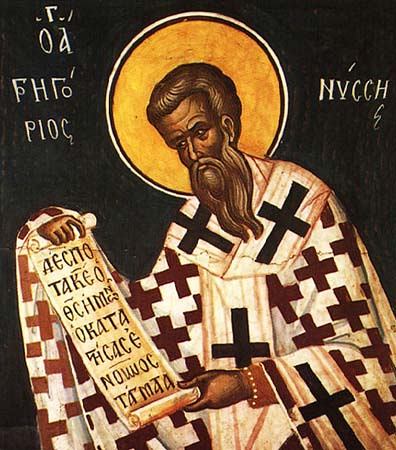
Gregory of Nyssa, Saint, date of birth unknown; d. after 385 or 386. He belongs to the group known as the "Cappadocian Fathers", a title which reveals at once his birthplace in Asia Minor and his intellectual characteristics. Gregory was born of a deeply religious family, not very rich in worldly goods, to which circumstances he probably owed the pious training of his youth. His mother Emmelia was a martyr's daughter; two of his brothers, Basil of Cæsarea and Peter of Sebaste, became bishops like himself; his eldest sister, Macrina, became a model of piety and is honoured as a saint. Another brother, Naucratius, a lawyer, inclined to a life of asceticism, but died too young to realize his desires. A letter of Gregory to his younger brother, Peter, exhibits the feelings of lively gratitude which both cherished for their elder brother Basil, whom Gregory calls "our father and our master". Probably, therefore, the difference in years between them was such as to have enabled Basil to supervise the education of his younger brothers. Basil's training was an antidote to the lessons of the pagan schools, wherein, as we know from a letter of St. Gregory of Nazianzus, Gregory of Nyssa spent some time, very probably in his early youth, for it is certain that while still a youth Gregory exercised the ecclesiastical office of rector. His family, it would seem, had endeavoured to turn his thoughts towards the Church, for when the young man chose a secular career and began the study of rhetoric, Basil remonstrated with him long and earnestly; when he had failed he called on Gregory's friends to influence him against that objectionable secular calling. It was all in vain; moreover, it would seem that the young man married. There exists a letter addressed to him by Gregory of Nazianzus condoling with him on the loss of one Theosebeia, who must have been his wife, and with whom he continued to live, as with a sister, even after he became bishop. This is also evident from his treatise "De virginitate".
Some think that Gregory spent a certain time in retreat before his consecration as bishop, but we have no proof of the fact. His extant letters make no mention of such retirement from the world. Nor are we better informed of the circumstances of his election to the See of Nyssa, a little town on the banks of the Halys, along the road between Cæsarea and Ancyra. According to Gregory of Nazianzus it was Basil who performed the episcopal consecration of his brother, before he himself had taken possession of the See of Sozima; which would place the beginning of Gregory of Nyssa's episcopate about 371. Was this brusque change in Gregory's career the result of a sudden vocation? St. Basil tells us that it was necessary to overcome his brother's repugnance, before he accepted the office of bishop. But this does not help us to an answer, as the episcopal charge in that day was beset with many dangers. Moreover in the fourth century, and even later, it was not uncommon to express dislike of the episcopal honour, and to fly from the prospect of election. The fugitives, however, were usually discovered and brought back, and the consecration took place when a show of resistance had saved the candidate's humility. Whether it was so in Gregory's case, or whether he really did feel his own unfitness, we do not know. In any case, St. Basil seems to have regretted at times the constraint thus put on his brother, now removed from his influence; in his letters he complains of Gregory's naive and clumsy interference with his (Basil's) business. To Basil the synod called in 372 by Gregory at Ancyra seemed the ruin of his own labours. In 375 Gregory seemed to him decidedly incapable of ruling a Church. At the same time he had but faint praise for Gregory's zeal for souls.
On arriving in his see Gregory had to face great difficulties. His sudden elevation may have turned against him some who had hoped for the office themselves. It would appear that one of the courtiers of Emperor Valens had solicited the see either for himself or one of his friends. When Demosthenes, Governor of Pontus [a region on the Black Sea coast of Turkey], convened an assembly of Eastern bishops, a certain Philocares, at one of its sessions, accused Gregory of wasting church property, and of irregularity in his election to the episcopate, whereupon Demosthenes ordered the Bishop of Nyssa to be seized and brought before him. Gregory at first allowed himself to be led away by his captors, then losing heart and discouraged by the cold and brutal treatment he met with, he took an opportunity of escape and reached a place of safety. A Synod of Nyssa (376) deposed him, and he was reduced to wander from town to town, until the death of Valens in 378. The new emperor, Gratian, published an edict of tolerance, and Gregory returned to his see, where he was received with joy. A few months after this (January, 379) his brother Basil died; whereupon an era of activity began for Gregory. In 379 he assisted at the Council of Antioch which had been summoned because of the Meletian schism. Soon after this, it is supposed, he visited Palestine. There is reason for believing that he was sent officially to remedy the disorders of the Church of Arabia. But possibly his journey did not take place till after the Council of Constantinople in 381, convened by Emperor Theodosius [name of Roman emperors; Theodosius I (379–395) made Christianity the state religion] for the welfare of religion in that city. It asserted the faith of Nicæa, and tried to put an end to Arianism [followers of Arius, who taught that the Son is a created being, not fully God] and Pneumatism in the East. This council was not looked on as an important one at the time; even those present at it seldom refer to it in their writings. Gregory himself, though he assisted at the council, mentions it only casually in his funeral oration over Meletius of Antioch, who died during the course of this assembly.
Read the rest of the article
An edict of Theodosius (30 July, 381; Cod. Theod., LXVI, tit. I., L. 3) having appointed certain episcopal sees as centres of Catholic communion in the East, Helladius of Cæsarea, Gregory of Nyssa and Otreius of Melitene were chosen to fill them. At Constantinople Gregory gave evidence on two occasions of his talent as an orator; he delivered the discourse at the enthronization of St. Gregory of Nazianzus, also the aforesaid oration over Meletius of Antioch. It is very probable that Gregory was present at another Council of Constantinople in 383; his "Oratio de deitate Filii et Spiritus Sancti" seems to confirm this. In 385 or 386 he preached the funeral sermon over the imperial Princess Pulcheria, and shortly afterwards over Empress Flaccilla. A little later we meet him again at Constantinople, on which occasion his counsel was sought for the repression of ecclesiastical disorders in Arabia; he then disappears from history, and probably did not long survive this journey. From the above it will be seen that his life is little known to us. It is difficult to outline clearly his personality, while his writings contain too many flights of eloquence to permit final judgment on his real character.
Most of his writings treat of the Sacred Scriptures. He was an ardent admirer of Origen, and applied constantly the latter's principles of hermeneutics. Gregory is ever in quest of allegorical interpretations and mystical meanings hidden away beneath the literal sense of texts. As a rule, however, the "great Cappadocians" tried to eliminate this tendency. His "Treatise on the Work of the Six Days" follows St. Basil's Hexæmeron. Another work, "On the Creation of Man", deals with the work of the Sixth Day, and contains some curious anatomical details; it was translated into Latin by Dionysius Exiguus. His account of Moses as legislator offers much fine-spun allegorizing, and the same is true of his "Explanation of the Titles of the Psalms". In a brief tractate on the witch of Endor he says that the woman did not see Samuel, but only a demon, who put on the figure of the prophet. Besides a homily on the sixth Psalm, he wrote eight homilies on Ecclesiastes, in which he taught that the soul should rise above the senses, and that true peace is only to be found in contempt of worldly greatness. He is also the author of fifteen homilies on the Canticle of Canticles (the union of the soul with its Creator), five very eloquent homilies on the Lord's Prayer, and eight highly rhetorical homilies on the Beatitudes.
In theology Gregory shows himself more original and more at ease. Yet his originality is purely in manner, since he added little that is new. His diction, however, offers many felicitous and pleasing allusions, suggested probably by his mystical turn of mind. These grave studies were taken up by him late in life, hence he follows step by step the teaching of St. Basil and of St. Gregory of Nazianzus. Like them he defends the unity of the Divine nature and the trinity of Persons; where he loses their guidance, our confidence in him tends to decrease. In his teaching on the Eucharist he appears really original; his Christological doctrine, however, is based entirely on Origen and St. Athanasius. The most important of his theological writings is his large "Catechesis", or "Oratio Catechetica", an argumentative defence in forty chapters of Catholic teaching as against Jews, heathens, and heretics. The most extensive of his extant works is his refutation of Eunomius in twelve books, a defence of St. Basil against that heretic, and also of the Nicene Creed against Arianism; this work is of capital importance in the history of the Arian controversy. He also wrote two works against Apollinaris of Laodicea, in refutation of the false doctrines of that writer, viz. that the body of Christ descended from heaven, and that in Christ, the Divine Word acted as the rational soul. Among the works of Gregory are certain "Opuscula" on the Trinity addressed to Ablabius, the tribune Simplicius, and Eustathius of Sebaste. He wrote also against Arius and Sabellius, and against the Macedonians, who denied the divinity of the Holy Spirit; the latter work he never finished. In the "De anima et resurrectione" we have a dialogue between Gregory and his deceased sister, Macrina; it treats of death, resurrection, and our last end. He defends human liberty against the fatalism of the astrologers in a work "On Fate", and in his treatise "On Children", dedicated to Hieros, Prefect of Cappadocia [a region of central Turkey], he undertook to explain why Providence permits the premature death of children.
He wrote also on Christian life and conduct, e.g. "On the meaning of the Christian name or profession", addressed to Harmonius, and "On Perfection and what manner of man the Christian should be", dedicated to the monk Olympius. For the monks, he wrote a work on the Divine purpose in creation. His admirable book "On Virginity", written about 370, was composed to strengthen in all who read it the desire for a life of perfect virtue.
Gregory wrote also many sermons and homilies, some of which we have already mentioned; others of importance are his panegyric on St. Basil, and his sermons on the Divinity of the Son and of the Holy Ghost.
A few of his letters (twenty-six) have survived; two of them offer a peculiar interest owing to the severity of his strictures on contemporary pilgrimages to Jerusalem.
For a discussion of his peculiar doctrine concerning the general restoration (Apocatastasis) to divine favour of all sinful creatures at the end of time, i.e. the temporary nature of the pains of hell, see the articles APOCATASTASIS and MIVART. The theory of interpolation of the writings of Gregory and of Origen, sustained among others by Vincenzi (below), seems, in this respect at least, both useless and gratuitous (Bardenhewer).
The writings of Gregory are best collected in P.G., XLIV-XLVI. There is no critical edition as yet, though one was begun by FORBES and OEHLER (Burntisland, 1855, 61); of another edition planned by Oehler, only one volume appeared (Halle, 1865). The best of the earlier editions is that of FRONTO DUCÆUS (Paris, 1615). Cf. VINCENZI, In Gregorii Nysseni et Origenis scripta et doctrinam nova recensio, etc. (Rome, 1864-69); BAUER, Die Trostreden des Gregorios von Nyssa in ihrem Verhältniss zur antiken Rhetorik (Marburg, 1892); BOUËDRON, Doctrines philosophiques de Saint Grégoire de Nysse (Nantes, 1861); KOCH, Das mystische Schauen beim hl. Gr. v. Nyssa in Theol. Quartalschrift (1898), LXXX, 397-420; DIEKAMP, Die Gotteslehre des hl. Gregor von Nyssa: ein Beitrag zur Dogmengesch. der patristischen Zeit (Münster, 1897); WEISS, Die Erziehungslehre der Kappadozier (Freiburg, 1903); HILT, St. Gregorii episcopi Nysseni doctrina de angelis exposita (Freiburg, 1860); KRAMPF, Der Urzustand des Menschen nach der Lehre des hl. Gregor von Nyssa, eine dogmatisch-patristische Studie (Würzburg, 1889); REICHE, Die kunstlerischen Elemente in der Welt und Lebens-Anschauung des Gregor von Nyssa (Jena, 1897); and on the large Catechesis (logos katechetikos ho megas), generally known as Oratio Catechetica, see SRAWLEY in Journal of Theol. Studies (1902), III, 421-8, also his new edition of the Oratio (Cambridge, 1903). For an English version of several works of Gregory see Library of Nicene and Post-Nicene Fathers, second series (New York, 1893), II, v; and for a German version of some works, HAYD in the Kemptener Bibliothek der Kirchenväter (1874).