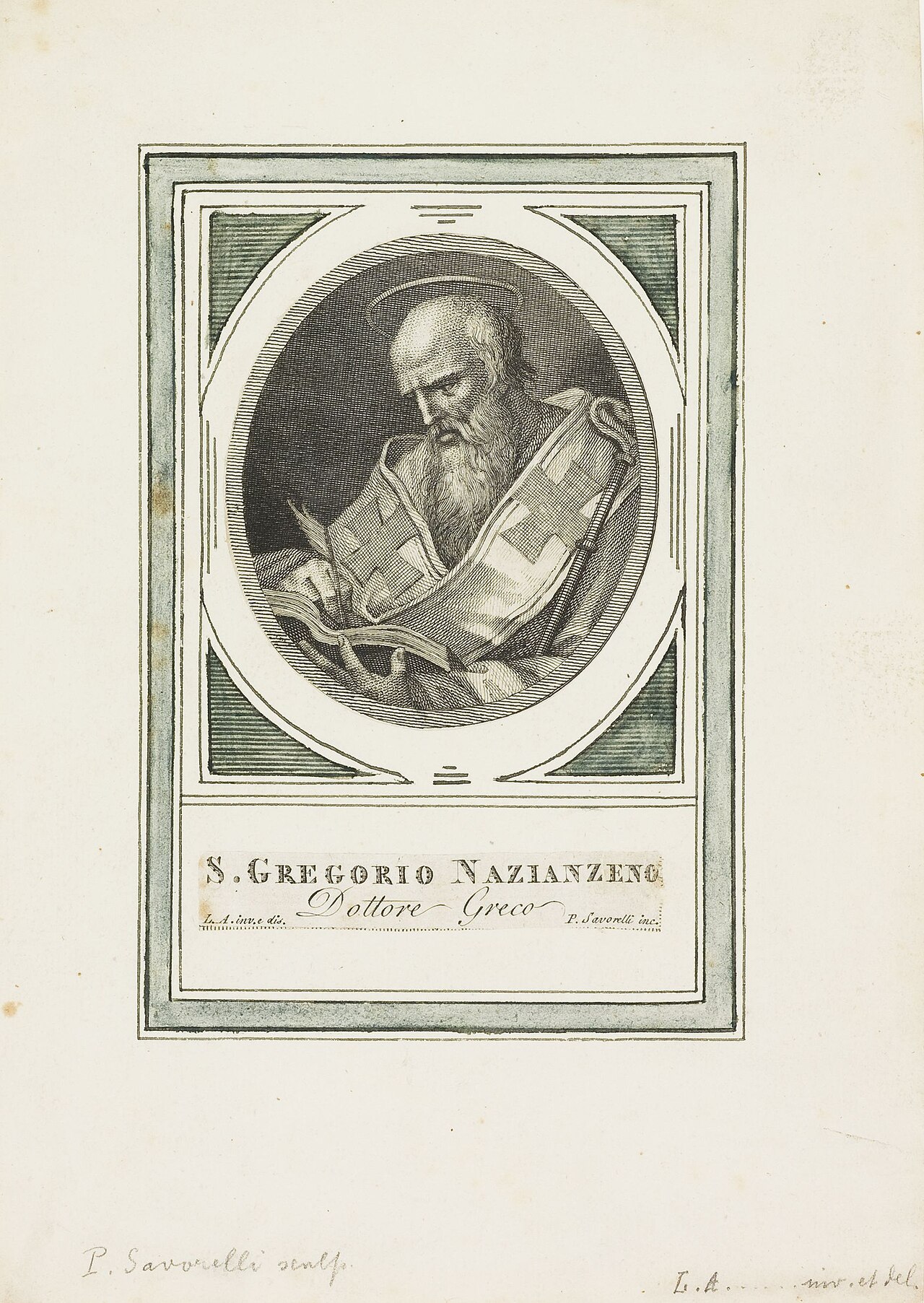
At Athens, he met Saint Basil (June 14th) and, in 355, was also a fellow student with Julian, who later became emperor. In 356, Gregory left Athens and traveled to Constantinople on his way home. There, he found his brother Caesarius working as a physician. Upon arriving at Nazianzus, Gregory was baptized by his father, and in 358, he joined Saint Basil in a secluded area near the river Iris in Pontus, responding to his friend's invitation.
“I believe,” wrote Saint Basil to Gregory, “I have finally found the end of my wanderings. My hopes of uniting with you—my pleasant dream, I should rather say, for the hopes of men have been rightly called waking dreams—have not been fulfilled. God has led me to a place that has often appeared in our imaginations; what we envisioned from afar, I now see before me. A high mountain, covered with dense forest, is watered to the north by fresh and ever-flowing streams. At the foot of the mountain lies a wide plain, made fertile by these streams. The surrounding forest, filled with many types of trees, encloses me like a strong fortress. This wilderness is bordered by two deep ravines; on one side, the river rushes down from the mountains, creating a barrier that is hard to cross, and on the other side, a broad ridge of hills encloses it. My hut is situated at the summit of the mountain, allowing me to overlook the vast plain and the entire course of the Iris, which is far more beautiful and abundant in water than the Strymon near Amphipolis. The river in my wilderness, the fastest I have ever seen, cascades over a jutting cliff and plunges into the deep pool below—an object of delight and admiration for mountain travelers, and valuable to the locals for the many fish it provides.
Should I describe to you the nourishing vapors that rise from the damp earth and the cool breezes from the rushing water? Should I mention the lovely songs of the birds and the abundance of flowers? What captivates me most is the peaceful tranquility of the place; it is only occasionally visited by hunters, for my wilderness supports deer and herds of wild goats, not bears and wolves. How could I trade this spot for any other? Alcmæon, when he discovered the Echinades, would not wander further.”
“In this simple description of the landscape and the life of the forest,” says Humboldt in that beautiful chapter of his Cosmos, where he illustrates how Christianity opened people's eyes to the beauty of creation, “there speak feelings of Saint Gregory Nazianzen.”
more closely connected to those of modern times than anything that Greek or Roman antiquity has left us.” In later years, when the friends had taken on the difficult responsibilities of being bishops, Gregory enjoyed reminding Basil of the happy times when they had worked together in the garden of their hermitage. “Who will bring back to us,” he wrote to his friend, “those days when we worked together from morning until evening? When sometimes we cut wood, sometimes we hewed stone? When we planted and watered our trees, and when we pulled that heavy wagon, the handles of which left marks on our hands for so long?”
But Gregory was not able to enjoy this peaceful life for long. He was called back by his father, who was then over eighty, to help him in leading his congregation. His father forcibly ordained him as a priest during a major festival, probably the Epiphany, in 361. Gregory, filled with sorrow, rushed back to his solitude and sought comfort in the friendship of St. Basil. However, he began to reflect on his actions and, remembering the punishment of Jonah for disobeying God's command, returned to Nazianzus after ten weeks. There, he preached his first sermon on Easter Day. This was followed by another sermon, which served as an apology for his earlier flight, and this sermon still exists and is placed first among his speeches.
He was soon asked to intervene in a matter of particular sensitivity. His father, the bishop, hoping to unite the Sembarians with the Catholics, had signed a compromise. This alarmed the strictest members of the Catholic party, who then refused to communicate with the elder Gregory. The son, with great care, moderation, and at the same time firmness, resolved this emerging schism.
On the occasion of the reunion, he delivered a speech that has been preserved for us. His brother Caesarius died in 369 and was buried at Nazianzus. Saint Gregory preached his funeral oration, as he also did for his sister Gorgonia, who died soon after. In 372, the emperor divided Cappadocia into two provinces, and Tyana became the capital of the second Cappadocia. Anthimus, the bishop of that city, then claimed jurisdiction over this province. Saint Basil, who was the bishop of Caesarea and the metropolitan of Cappadocia, argued that the civil division of the province did not affect his spiritual authority. Basil thought it wise to establish his friend in a new see that he planned to create at Sasima, in order to strengthen the see of Caesarea against Anthimus's aggression. Sasima was a bleak, unhealthy town, full of dust, located at the intersection of three roads. It was noisy due to the constant flow of travelers, disputes with greedy customs officers, and all the chaos and drunkenness typical of a town filled with transient strangers. It was the least suitable place for the timid and sensitive Gregory to call home. Despite Gregory’s objections, Basil forced him to accept consecration. Gregory tried to settle in Sasima, but was driven away by the aggressive Anthimus, who once blocked Basil’s way home with a group of bandits.
Gregory then took up residence at Nazianzus as his father’s assistant. The unfortunate outcome of this situation was that he never again felt completely at ease with Basil, and one of the most beautiful Christian friendships was permanently damaged by a strong will on one side and a lack of understanding on the other.
Gregory the Elder, bishop of Nazianzus, died the following year, in 373, after serving as bishop for forty-five years. Gregory the Younger continued to manage the diocese for a while without taking on the title of bishop. However, in 375, as his health declined, he withdrew to Seleucia, the capital of Isauria, where he remained for five years.
Basil died on January 1, 369, and Gregory wrote twelve short poems in his memory. Eighteen days after Basil’s death, Emperor Gratian appointed Theodosius, the son of a general who had reconquered Britain, as emperor of the East. For nearly thirty-two years, Constantinople had been under the influence of Arianism. It was decided to reclaim it through the ministry of Gregory of Nazianzus, who was then living as a recluse in Seleucia. He reluctantly agreed to dedicate himself to this important task, “Since in God’s providence he was absolutely compelled to be a sufferer.”
He went to Constantinople and stayed in a relative’s house. He was joyfully welcomed by the suffering remnant of Catholics. The congregation was established early in 379, and the house was dedicated as “the Anastasia,” the place where the true faith was to rise again. There, Gregory demonstrated the living energy of the Church as a spiritual body to a population tainted by heresy and irreverence. Daily services were accompanied by powerful preaching. “The worship of the Trinity” was the missionary’s guiding principle.
After earnestly warning his listeners against the miserable levity that, in line with Arianism, was spreading everywhere from the forum to the supper-room, he boldly engaged in discussions on the most serious topics. He delivered the four great discourses on the Nicene faith, which earned him the title of Theologian, meaning the defender of the Divinity of the Word. While proclaiming the Trinity, he was careful to uphold the Unity; he presented the Catholic doctrine as the balanced approach between Sabellian confusion and Tritheistic separation.
However, the Arians accused him of being a Tritheist, inciting mobs to throw stones at him in the streets, and a disgraceful crowd of women, monks, and beggars to desecrate the Anastasia with their insolence. He accepted being a target of public scorn. “They had the churches and the people, he had God and the angels! They had wealth, he had the Faith; they threatened, he prayed; his was but a little flock, but it was protected from the wolves, and some of the wolves might become sheep.” Many conversions occurred; the charm of Gregory’s eloquence, the spiritual beauty of his character, the appealing sweetness combined with his zeal for the truth, and the notable unworldliness contrasting with Arian self-interest, along with his profound reverence, which was so different from Arian frivolity, could not fail to impress even in Constantinople.
His eloquence worked wonders in the bustling and diverse capital. Even the Arians flocked to hear him. Jerome came to Constantinople, listened with delight to Gregory’s sermons, and discussed Scripture passages with him. Peter of Alexandria approved of his work and joined others in wanting to see him regularly established as the bishop of Constantinople. Unfortunately, he soon became involved with the wicked schemes of an unscrupulous and charming adventurer named Maximus, who kept long hair, carried a staff, and wore the white robe of a Cynic philosopher while claiming to be a devoted Christian.
This man, who came to Constantinople intending to secure the bishopric, easily gained the trust of someone as innocent as Gregory. By frequently attending his sermons and professing zeal and orthodoxy, he completely deceived Gregory, who even praised him publicly in church for having suffered for the true religion. This was exactly what Maximus wanted. Attention was drawn to him. Certain Egyptian bishops, sent by Peter, the orthodox bishop of Alexandria, along with seven Alexandrians of low status, secretly enthroned Maximus as the Catholic bishop of Constantinople one night while Gregory was ill.
A number of Egyptian sailors, likely from the grain fleet, participated in the ceremony and raised the usual cheers. The next morning, they were expelled from the church by an outraged crowd and completed the ceremony in the house of a flute player, while also cutting off Maximus’s long hair. He and his supporters had to leave Constantinople, as the Catholics remained steadfastly loyal to Gregory. He fled to the court of Theodosius, but the first action taken by the emperor to strengthen the orthodox party was to reject the intruding bishop.
In early 380, Theodosius, having fallen ill in Thessalonica, was baptized by its bishop, whose orthodoxy he had confirmed. On February 28th, he issued an edict to the people of Constantinople, commanding all his subjects to follow the faith that Peter had delivered to the Romans, which the Pope of Rome and the Patriarch of Alexandria then professed. This faith alone deserved the name of Catholic and recognized the one Godhead of Father, Son, and Spirit, of co-equal majesty in the Holy Trinity.
It was now clear that the power which had long been in the hands of Arians had passed to Catholics. “Let us never be arrogant when times are favorable,” Gregory had already said to the faithful, who had been freed from the persecution of Julian. “Let us never be harsh to those who have wronged us; let us not imitate the actions we have condemned. Let us rejoice that we have escaped from danger and detest everything that leads to revenge. Let us not think of exiles and bans; do not drag anyone before the judge; let not the whip remain in our hands; in short, do nothing like what you have suffered.”
Still, he faced “the scornful reproach of the wealthy.” They mocked his community, which was small and poor. Gregory acknowledged this and asked in righteous indignation whether the sands are more valuable than the stars of heaven, or pebbles more than pearls, simply because they are more numerous. The worldly and wealthy people of Constantinople criticized Gregory. They claimed there was nothing in him except his ability to preach; he was a poor man, from a humble background, lacking dignity and conversational skill. He was out of place in high society, rarely appeared in public, could not make himself likable, nor take his rightful position among the citizens. His gentleness, they said, was merely weakness.
In response to this harsh criticism, Gregory pointed out that at least he had not committed the outrages that characterized the vigorous administration of Arian bishops. However, he felt that his temperament and habits somewhat disqualified him for such a challenging position. He was only persuaded to stay by the passionate pleas of his congregation, including mothers and children, who begged him not to abandon them. After spending a day resisting their loving insistence, Gregory finally yielded to their serious warning, “If you leave, the Faith leaves with you.” He agreed to remain until a more suitable person could be appointed.
On the 24th of November, Theodosius arrived in Constantinople and proposed to Hemophilus, the Arian bishop, that he should agree to the Nicene creed.
He declined to do so and profess faith in the Godhead of Christ, and was immediately ordered to surrender the churches. He called his people together, reminded them of the scripture that instructed them to flee from persecution, and moved their worship to a location outside the city. Until that point, Gregory had only been a Catholic bishop in the city. Theodosius decided to elevate him to be the bishop of the city. Surrounded by armed soldiers, in military splendor, and accompanied by the emperor himself, Gregory, amazed and bewildered, was led to be enthroned in Saint Sophia. All around him, he saw the gloomy and threatening faces of the Arian crowd, and he could hear their muffled murmurs; even the heavens, as the morning was bleak and cloudy, seemed to look down with cold indifference on the scene.
However, as soon as Gregory, along with the emperor, passed the rails that separated the sanctuary from the main area of the church, the sun burst forth in all its brilliance, the clouds cleared, and glorious light streamed in on the gray, bald-headed bishop, who was bowed and trembling with nervousness, as well as on the applauding congregation. Immediately, a shout of acclamation arose demanding the enthronement of Gregory. But his nerves were so shaken by the excitement, and by having seen one man draw a sword against him, that he had to delegate a priest to speak to the people, saying, “For the present our duty is to thank God; other matters may be reserved for another time.” The words were met with the clapping of hands, which was common in that society, where the lively Greek temperament often overshadowed Christian reverence.
Gregory seldom visited the palace and never tried to win the favor of courtiers and chamberlains through flattery and bribes, as Arian prelates did. He was even criticized by his own people for not using his influence on their behalf. He continued on his own path as a humble, unworldly pastor, preaching, praying, visiting the sick, never enriching himself, and winning everyone's hearts with his sincere charity. One day, his sickroom was filled with affectionate supporters who, after thanking God for having lived to see his episcopate, left. A young man, pale and haggard, remained at the foot of the bed in mournful silence and a pleading posture. “Who are you, and what do you want?” asked Gregory. The youth groaned bitterly and wrung his hands. Gregory was moved to tears, and upon learning from another person that this was the man who had sought his life, he said to the weeping penitent, “God be gracious to you; all I ask is that from now on you give yourself to Him!”
On January 10th, 381, Theodosius, through a second edict, forbade heretics, specifically naming the Arians, from holding assemblies within towns; he returned all churches to Catholic bishops; and he assigned the name Catholic to all believers in the undivided essence of the Trinity. Gregory perhaps lacked the firmness and vigor necessary for a prelate of the great metropolis, or perhaps he disapproved of the emperor's high-handed actions, which were so contrary to what he had advised in previous years. Theodosius called the council of Constantinople, and Gregory, overwhelmed by the numerous issues, troubled by challenges to the validity of his own election, and caught up in the disputes arising from the contested election to the see of Antioch, requested and received the reluctant agreement of the bishops and the emperor to resign his position and retire to his cherished solitude. He delivered his famous Farewell at the Council. He recounted his mission and praised God for the success that had accompanied it. Had not the small wrath been followed by great mercy? Had not obstacles been removed from his path? Constantinople was now a center of faith. It had a living and active Catholic Church, a venerable presence.
The clergy, deacons, and readers were well organized; they were a devoted, enthusiastic, and sincere people who were ready to die for the worship of the Trinity. He had done something, at least, “towards the weaving of this crown of glory,” and he could appeal, like Samuel, to their knowledge of his selflessness. However, he was growing old and weak; he could not contend with adversaries who should have been friends. He did not realize that he was expected to take on the dignity of consuls and prefects, and he begged, as a tired soldier, to receive his discharge papers.
Then, in a tone that was more loving and more heartfelt, he said goodbye to the Anastasia, to the cathedral, to the other churches, to the sacred relics, to the episcopal throne, to the bishops and clergy who “ministered at the holy Table, approaching God,” to the “Nazarites,” the widows, orphans, and the poor; to the hospitals, to the crowds who had attended his preaching, to the Emperor and his Court, to the city, and to the East and the West. “They do not lose God who abandon their thrones; rather, they win a throne above. Little children, keep the deposit; remember how I was stoned. The grace of our Lord Jesus Christ be with you all.”
The vacant throne was quickly filled by the election of Nectarius. The people of Constantinople, by choosing this man, and Theodosius by confirming the appointment, showed why they had largely been dissatisfied with Gregory. They did not want a bishop of genius or holiness, but a well-born, dignified, and courteous gentleman. Nectarius seems to have been this, and little more. Gregory withdrew into privacy. His retreat, somewhat disturbed by his interest in the see of Nazianzus, gradually became more complete, until he eventually withdrew into solitude and ended his days in peace, which he sincerely enjoyed after his experiences with the cares and troubles of worldly dignity.
Arianza, his native village, was the place of his seclusion; the gardens, the trees, and the fountains, familiar from his youth, welcomed him in his old age. There he ended his life, after two years spent between the strict austerities of monastic life and the pursuit of poetry, which he continued to write so that pagans would not have sole possession of literary excellence, and also to allow his noble and delicate sadness to flow freely. His graceful, melancholy, and sometimes sublime verses have earned him a place almost as high as his deep understanding of divine matters. The monastic order can proudly claim him as the father of Christian poetry, as well as the theologian who has earned the title of Theologian of the East. His body was moved from Cappadocia to Constantinople in 950, and then, before the fall of Constantinople, to Rome, where it now rests under an altar in the church of the Vatican.
Footnotes
- Alcmæon was a figure in ancient Greek history and mythology.
- Humboldt refers to Alexander von Humboldt, a German naturalist and explorer.
- Gregory Nazianzen, Epistles 9 and 13.
- Anthimus, bishop of Tyana, claimed jurisdiction over the new province.
- Basil was the bishop of Caesarea and the metropolitan of Cappadocia.
- Since in God’s providence he was absolutely compelled to be a sufferer.
- The worship of the Trinity.
- The four great discourses on the Nicene faith.
- The maintainer, that is, of the Divinity of the Word.
- They had the churches and the people, he had God and the angels! They had wealth, he had the Faith; they menaced, he prayed; his was but a little flock, but it was screened from the wolves, and some of the wolves might become sheep.
- Theodosius: Roman Emperor from 379 to 395.
- Hemophilus: Arian bishop of Constantinople.
- Nicene creed: A statement of Christian faith established at the First Council of Nicaea in 325.
- See Saint Meletius, February 12.
- Oration 32 by Saint Gregory Nazianzen.
- Sozomen, vii. 8, says that Theodosius preferred Nectarius to the saintly Gregory.
Baring-Gould’s own footnotes, in modern English.
Read the original 1870s text
Baring-Gould’s sources: By the Greeks on Jan. 25th. Some Latin Martyrologies on Jan. 11th. Maurolycus on Jan. 13th; a Treves Martyrology on March 29th. But Usuardus, Ado, Notker, and Modern Roman Martyrology on May 9th. Authority: — His life written by himself nine years before his death; the Orations and Epistles, also Sozomen, Socrates, Theodoret, &c.] This great saint and doctor of the Church was born in 329, at Arianza, a small village of Nazianzus in Cappadocia, not far from Caesarea. His father, Gregory, was at one time a heathen, but was converted by his Christian wife, Nonna, and was baptized, and then, the same year that Gregory was bom (329), was elected and consecrated bishop of Nazianzus. They had three children, a daughter Gorgonia, Gregory, and the youngest, Caesarius (Feb. 25th), born after he was made bishop. Gregory was intended for the bar, and was sent to study at Csesarea in Palestine, and then to Alexandria. He afterwards sailed for Athens to complete his education, and was nearly wrecked. In his alarm, he vowed to defer his baptism no longer.
At Athens he made the acquaintance of S. Basil (June 14th), and was also, in 355, a fellow pupil with Julian, afterwards emperor. In 356, Gregory left Athens and took Constantinople on his way home. There he found his brother Caesarius practising as a physician. On arriving at Nazianzus, Gregory was baptized by his father, and in 358 joined S. Basil, in a solitude to which he had retreated near the river Iris in Pontus [a region on the Black Sea coast of Turkey], in answer to the call of his friend. “ I believe/7 wrote S. Basil to Gregory, u I have found at last the end of my wanderings; my hopes of uniting myself with thee — my pleasing dream, I should rather say, for the hopes of men have been justly called waking dreams — have remained unfulfilled. God has caused me to find a place, such as has often hovered before fancy of us both; and that which imagination showed us afar off, I now see present before me. A high mountain, clothed with thick forest, is watered towards the north by fresh and everfiowing streams; and at the foot of the mountain extends a wide plain, which is rendered fruitful by these streams. The surrounding forest, in which grow many kinds of trees, shuts me in as in a strong fortress. This wilderness is bounded by two deep ravines; on one side the river, dashing in foam from the mountains, forms a barrier hard to overcome; and the other side is enclosed by a broad ridge of hills. My hut is so placed on the summit of the mountain, that I overlook the extensive plain, and the whole course of the Iris, which is far more beautiful and abundant in water than the Strymon near Amphipolis. The river of my wilderness, which is the most rapid that I have ever seen, breaks over a jutting precipice, and throws itself foaming into the deep pool below- — to the mountain traveller an object on which he gazes with delight and admiration, and valuable to the native for the numerous fish it affords. Shall I describe to thee the fertilizing vapours that rise from the moist earth, and the cool breezes from the broken water? Shall I speak of the lovely singing of the birds, and the profusion of flowers ? What charms me most of all is the undisturbed tranquillity of the spot; it is only visited occasionally by hunters; for my wilderness feeds deer and herds of wild goats, not your bears and wolves. How should I exchange this nook for any other ? Alcmseon, when he had found the Echinades, would not wander further.”1 “In this simple description of the landscape, and of the life of the forest,” says Humboldt, in that beautiful chapter of his Cosmos in which he shows that Christianity opened the eyes of men to see the loveliness of creation, “there speak feelings S, Gregory Nazianzen.
more intimately allied to those of modern times than anything that Greek or Roman antiquity has bequeathed to us.” In after years, when the friends had been called to the painful toils of the episcopate, Gregory loved to recall to Basil the pleasant times when they had cultivated together the garden of their hermitage. “Who shall bring back to us,” he wrote to his friend, “those days when we laboured together from morning till evening? When sometimes we cut wood, sometimes we hewed stone? when we planted and watered our trees, when we drew together that heavy wagon, the galls of which so long remained on our hands ? ” 1 But Gregory was not long to enjoy this peaceful life. He was recalled by his father, then above eighty, to assist him in the government of his flock. He ordained him priest by force, on a great festival, probably the Epiphany, in 361. Gregory, full of grief, flew back to his solitude, and sought relief in the friendship of S. Basil; but there he began to reflect on his conduct, and remembering the punishment of Jonah for disobeying the command of God, after a ten weeks' absence returned to Nazianzus, where he preached his first sermon on Easter Day. This was followed by another, which was an apology for his flight, and which is extant and is placed first among his orations.
He was soon called upon to interfere in a matter of peculiar delicacy. The bishop, his father, hoping to effect an union of the SembArians with the Catholics, had signed; a compromise. This had alarmed the strictest of the Catholic party, who thereupon refused to communicate with the elder Gregory. The son, with great care, moderation, and at the same time firmness, healed this incipient schism; 1Greg. Nazian. Ep. 9 and 13.
and on the occasion of the re-union pronounced an oration which has been preserved to us. His brother Caesarius died in 369 and was buried at Nazianzus. S. Gregory preached his funeral oration, as he did also that of his sister Gorgonia, who died soon after. In 372 Cappadocia [a region of central Turkey] was divided by the emperor into two provinces, and Tyana was made the capital of Cappadocia the second. Anthimus, bishop of that city, thereupon laid claim to jurisdiction over this proviuce. S. Basil, who was bishop of Caesarea and metropolitan [the archbishop who heads a group of dioceses] of Cappadocia, maintained that the civil division of the province in no way affected his spiritual jurisdiction, and Basil thought it advisable to plant his friend in a new see which he determined to found at Sasima, in order to strengthen the see of Caesarea [a bishop’s “see” is his diocese, named from his seat (Latin sedes)] against the aggression of Anthimus. Sasima was a comfortless, unhealthy town, full of dust, at the meeting of three roads, noisy from the constant passage of travellers, the disputes with extortionate custom-house officers, and all the tumult and drunkenness belonging to a town inhabited by loose and passing strangers; of all places the least fitted to be a home for the shrinking and sensitive Gregory. Regardless of Gregory’s objections, Basil compelled him to receive consecration; he attempted to settle at Sasima, but was driven away by the violent Anthimus, who had on one occasion stopped Basil’s way home by a band of freebooters.
Gregory took up his abode at Nazianzus as his father’s coadjutor [an assistant bishop who will succeed the current one]; and the unhappy result of the matter was that he never again felt thoroughly at home with Basil, and one of the most beautiful of Christian friendships was permanently marred by a strong will on one side, and a lack of sympathy on the other.
S. Gregory the elder, bishop of Nazianzus, died the following year, in 373, after an episcopate of forty-five years, and S. Gregory the younger continued for awhile to administer the diocese without assuming the episcopal title. But in 375, his health giving way, he withdrew to Seleucia, the capital of Isauria, where he continued five years. S. Basil died on the 1st of January, 369, and Gregory composed in his memory twelve short poems. Eighteen days after S. Basil’s death, the Emperor Gratian made Theodosius [name of Roman emperors; Theodosius I (379–395) made Christianity the state religion], the son of a general who had reconquered Britain, emperor of the East. Constantinople had been for nearly thirty-two years a domain of Arianism [followers of Arius, who taught that the Son is a created being, not fully God]. It was resolved to reclaim it by the ministry of Gregory of Nazianzus, who was now living as a recluse at Seleucia; and he consented, although with reluctance, to devote himself to this great work, “ Since in God’s providence he was absolutely compelled to be a sufferer.”1 He went accordingly to Constantinople, and lodged in a kinsman’s house. He was welcomed by the suffering remnant of Catholics with exceeding joy. The congregation was formed early in 379, and the house dedicated as “the Anastasia,” the place where the true faith was to rise again. There Gregory exhibited before a population corrupted by heresy and irreverence, the living energy of the Church as a spiritual body. Daily services were accompanied by eloquent preaching. “The worship of the Trinity " was the missionary’s watchword. After earnestly warning his hearers against the miserable levity which, in conformity with the spirit of Arianism, was filling every place from the forum to the supper-room, 2 with fearless disputation on the most awful topics, he delivered the four great discourses on the Nicene faith 3 which secured to him the title of Theologies, the maintainer, that is, of the Divinity of the Word. 4 But while proclaiming the Trinity, he was careful to guard the Unity; he set forth the Catholic doctrine as the middle way between Sabellian confusion and Tritheistic severance. Yet the Arians denounced him as a Tritheist, stirred up mobs to pelt him in the street, and a base crowd of women, monks, and beggars to profane the Anastasia by their wanton insolence. He was content to be a mark for public scorn. “They had the churches and the people, he had God and the angels ! They had wealth, he had the Faith; they menaced, he prayed; his was but a little flock, but it was screened from the wolves, and some of the wolves might become sheep.5' Many such conversions took place; the charm of Gregory’s eloquence, the spiritual beauty of his character, the winning sweetness which was combined with his zeal for the truth, the conspicuous unworldliness which contrasted with Arian self-seeking, the profound reverence so different from Arian flippancy, could not be unimpressive even in Constantinople. His eloquence wrought wonders in the busy and versatile capital. The Arians themselves crowded to hear him. S. Jerome [translator of the Bible into Latin (d. 420)] came to Constantinople, listened with delight to Gregory’s sermons, and conversed with him on passages of Scripture. Peter of Alexandria approved of his work, and united with others in the desire to see him regularly established in the see of Constantinople; but ere long, unhappily, he lent himself to the nefarious schemes of an unprincipled and plausible adventurer named Maximus, who retained the long hair, the staff, and the white dress of a Cynic philosopher, while professing to be a zealous Christian. This man, who came to Constantinople with an intention of securing the bishopric, found it easy to win the confidence of one so childlike as Gregory. By assiduous attendance at his sermons, and profession of zeal and orthodoxy he had so completely imposed on him, that Gregory actually panegyrized him in open church, as having suffered for the true religion. This was precisely what Maximus desired. Attention was attracted to him. Certain Egyptian bishops, deputed by Peter, the orthodox bishop of Alexandria, and seven Alexandrians of low birth, suddenly enthroned Maximus in the night, whilst Gregory was ill, as Catholic bishop of Constantinople. A number of Egyptian mariners, probably belonging to the corn-fleet, had assisted at the ceremony, and raised the customary acclamations. They were driven out of the church next morning by the indignant multitude, and completed the ceremonial in a flute-player's house, cutting off at the same time the Cynic's long hair. He and they were obliged to leave Constantinople, for the Catholics adhered with unshaken fidelity to Gregory • and he fled to the court of Theodosius, but the earliest measure adopted by the emperor to restore strength to the orthodox party, was the rejection of the intrusive prelate. Early in 380, Theodosius, having fallen ill at Thessalonica, received baptism from its bishop, whose orthodoxy he had ascertained; and he then addressed, on February 28th, an edict to the people of Constantinople, commanding all his subjects to observe the faith which S. Peter had delivered to the Romans, and which the Pope of Rome and the Patriarch of Alexandria then professed; that faith which alone deserved the name of Catholic, and which recognized the one Godhead of Father, Son, and Spirit, of co-equal majesty in the Holy Trinity.
It was clear now that the power which had so long been in the hands of Arians was now passed into those of Catholics. “ Let us never be insolent when the times are favourable,” Gregory had already said to the faithful, delivered from the persecution of Julian; “Let us never show ourselves hard to those who have done us wrong 3 let us not imitate the acts which we have blamed. Let us rejoice that we have escaped from the peril, and abhor everything that tends to reprisals. Let us not think of exiles and prescription; drag no one before the judge; let not the whip remain in our hand; in a word, do nothing like that which you have suffered.”1 Still he was subjected to “the scornful reproof of the wealthy.” They jeered at his community. It was small and poor. Gregory admitted the fact, and inquired in righteous indignation, whether the sands are more precious than the stars of heaven, or the pebbles than pearls, because they are more numerous. 2 The worldly and wealthy people of Constantinople objected to Gregory. There was nothing in him, they said, save the preaching faculty; he was quite a poor man, lowborn, country-bred, with no dignity of manner and no power of conversation. He was out of his element in high society, seldom appeared in public, could not make himself agreeable, nor take his proper place among the citizens.3 His gentleness, after all, was nothing but feebleness. To this bitter taunt Gregory replied, 4 that at any rate he had not been guilty of such outrages as had made up the vigorous administration of Arian bishops. Yet he felt that his temperament and habits were to some extent a disqualification for so trying a post; and was only dissuaded from resigning it by the passionate entreaties of his flock, including mothers and children, that he would not forsake them. After a day had been spent in contending against their loving urgency, Gregory yielded to the solemn remonstrance, “If you depart, the Faith departs with you.”5 He consented to remain until a fitter man could be appointed.
On the 24th of November Theodosius came to Constantinople, and proposed to Hemophilus, the Arian bishop, that he should subscribe to the Nicene creed, and thereby 5 Carm. de vitae sua, 76.
re-unite the people. He declined to do so, and profess faith in the Godhead of Christ, and was at once ordered to surrender the churches. He summoned his people, reminded them of the text which prescribed flight from persecution, and transferred their worship to ground outside the city. Till now Gregory had been only a Catholic bishop in the city. Theodosius resolved to exalt him to be the bishop of the city. Environed by the armed legionaries, in military pomp, accompanied by the emperor himself, Gregory, amazed and bewildered, was led to be enthroned in S. Sophia. All around he saw the sullen and menacing faces of the Arian multitude, and his ear caught their suppressed murmurs; even the heavens, for the morning was bleak and cloudy, seemed to look down with cold indifference on the scene. No sooner, however, had Gregory, wflth the emperor, passed the rails which divided the sanctuary from the nave of the church, than the sun burst forth in all his splendour, the clouds dispersed, and the glorious light came streaming in on the gray bald-headed bishop, bowed, trembling with nervousness, and the applauding congregation. At once a shout of acclamation demanded the enthronization of Gregory. But his nerves were so shaken by the excitement, and by having seen one man draw a sword against him, that he was obliged to depute a priest to address the people, “ For the present our duty is to thank God; other matters may be reserved for another time.” The words were received with the clapping of hands so common in that state of society, when the lively Greek temperament was too strong for Christian reverence. Gregory seldom visited the palace, and never exerted himself, after the manner of Arian prelates, by flattery and bribes, to secure the favour of chamberlains and courtiers. He was even blamed by his own people for remissness in using his influence on their behalf. He went on his own way, as a meek, unworldly pastor, preaching, praying, visiting the sick, never enriching himself, winning all hearts by single-hearted charity. One day his sickchamber was thronged by affectionate adherents, who after thanking God that they had lived to see his episcopate, withdrew. A young man, pale and haggard, remained at the foot of the bed, in mournful silence, and in a suppliant attitude. “Who are you, and what do you want?55 asked Gregory. The youth groaned bitterly, and wrung his hands. Gregory was moved to tears, and on learning from another person that this was the man who had sought his life, said to the weeping penitent, “ God be gracious to you; all I ask is, that henceforth you give up yourself to Him ! 55 On Jan. ioth, 381, Theodosius, by a second edict, forbade heretics, the Arians included by name, to hold assemblies within towns; gave back all churches to Catholic bishops; and assigned the Catholic name to all believers in the undivided essence of the Trinity. Gregory perhaps wanted the firmness and vigour necessary for a prelate of the great metropolis, perhaps he disliked the high-handed dealing of the emperor, so much at variance with what he himself had advised in former years. Theodosius summoned the council of Constantinople; and Gregory, embarrassed by the multiplicity of affairs; harassed by objections to the validity of his own election; entangled in the feuds which arose out of the contested election to the see of Antioch,1 entreated, and obtained the reluctant assent of the bishops and the emperor to abdicate his dignity and to retire to his beloved privacy. He delivered in the Council his celebrated Farewell.2 He gave an account of his mission, and glorified God for the success which had attended it. Had not the little wrath been followed by the great mercy? Had not stumbling-blocks been removed from his path? Constantinople was now an “emporium" of the faith. It had a living and working Catholic Church, a venerable pres1 See S. Meletius, Feb. 12. 8 Orat. xxxii. S. Gregory Nazianzen.
bytery, deacons and readers well ordered; a docile, zealous, and true-hearted people, who were ready to die for the worship of the Trinity. Something, at least, he had done “ towards the weaving of this crown of glory: " and he could appeal, like Samuel, to their knowledge of his unselfishness. But he was growing old and weak; he could not wrestle with adversaries who ought to have been friends; he knew not that he had been expected to assume the stateliness of consuls and prefects, and he begged, as a worn-out soldier, to receive the warrant of his discharge. Then, in a tone more loving and more pathetic, he bade farewell to the Anastasia, to the cathedral, to the other churches, to the sacred relics [the bodily remains of a saint, or objects they used, kept with honor], to the episcopal throne, to the bishops and clergy who “ ministered at the holy Table, approaching the approaching God to the “ Nazarites,” the widows, orphans, and poor; the hospitals, the crowds who had attended his preaching, the Emperor and his Court, the city, the East and the West. “They lose not God who abandon their thrones; rather, they win a throne above. Little children, keep the deposit; remember how I was stoned. The grace of our Lord Jesus Christ be with you all.” The vacant throne was speedily filled by the election of Nectarius. The people of Constantinople by choosing this man, and Theodosius by ratifying the appointment, showed why they had been to a great extent dissatisfied with Gregory.1 They did not want a bishop of genius or saintliness, but a well-born, dignified, and courteous gentleman. Nectarius appears to have been this, and little more. Gregory retired into privacy. His retreat, in some degree disturbed by the interest which he took in the see of Nazianzus, gradually became more complete, till at length he withdrew into solitude, and ended his days in that peace, which was not less sincerely enjoyed from his 1 SozomeD, vii. 8, says that Theodosius preferred Nectarius to the saintly Gregory. * experience of the cares and vexations of worldly dignity. Arianza, his native village, was the place of his seclusion; the gardens, the trees, the fountains, familiar to his youth, welcomed his old age. There he ended his life, after two years divided between the hardest austerities of monastic life and the cultivation of poetry, which he continued to pursue, that the pagans might not be left in sole possession of the palm of literature, and also to give a free course to the noble and delicate sadness of his soul. His graceful, melancholy, and sometimes sublime verses, have gained him a place almost as high as his profound knowledge of divine things; and the monastic order may boast of having produced in him the father of Christian poetry, as well as the doctor who has merited the name of Theologian of the East. His body was translated from Cappadocia to Constantinople in 950, and thence, before the fall of Constantinople, to Rome, where it now reposes under an altar in the church of the Vatican.