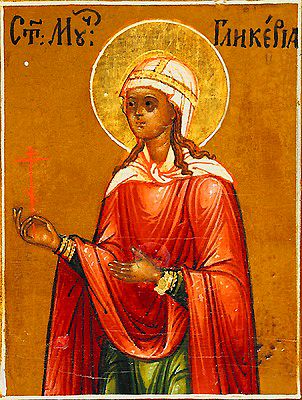
St. Glyceria

Saint Glyceria was a virgin martyr from Trajanopolis in Thrace, who lived during the Roman Empire and is believed to have died around 177.

Read the essentials →
Feast May 13 · Martyr

St. Glyceria

Current feast

May 13
Secondary source · Wikipedia infobox

Traditional feast

May 13
1914 / pre-1969 calendar, per Baring-Gould (1897)

Represents

Martyr

Feast days

Feast: May 13

This Saint’s Story

Written for this site from Wikipedia and Sabine Baring-Gould, The Lives of the Saints (source note)

She faced severe persecution for refusing to worship the Roman gods, particularly a stone statue of Jupiter. When she stood before the statue to pay tribute, it was said to have miraculously shattered.

As a result of her defiance, Glyceria was imprisoned and subjected to harsh torture ordered by the governor Sabinus. Reports indicate that she was cruelly mistreated, including being hung by her hair and beaten. Despite these tortures, she remained resolute in her faith and did not comply with the emperor's demands to sacrifice to idols.

Eventually, she was brought to Heraclea, where she was executed for her beliefs. Tradition holds that she died as a virgin martyr, and her relics were believed to have produced a miraculous oil that flowed from them. This oil was said to have temporarily stopped when a silver basin, previously used for witchcraft, was used to collect it. After the basin was removed, the oil began to flow again.

Glyceria is primarily commemorated in the Eastern Orthodox Church and the Catholic Church, with her feast day celebrated on May 13.

Short entry · the summary here is 48 words; Baring-Gould’s fuller original text and its sources are below. We have not filled any gap with invented detail.

What she represents

How she teaches us to live

Drawn from themes in the original account

Stay faithful when it costs you. Holding firm under pressure is part of this story.

Celebrate this saint’s feast day. Remember her on May 13 with a short prayer, and ask for her help.

Read more

The full original · 48 words

Read Baring-Gould’s full account

Baring-Gould’s sources: Commemorated on this day by the Greeks, especially at Jerusalem, also in the Arabic Egyptian Martyrology, the Menology of the Emperor Basil, the Mensea, and the Modem Roman Martyrology. Authority: — The Greek Acts, not trustworthy.

GLYCERIA was a maiden of Trajanopolis, in Thrace, who refused to obey the edict of the emperor, and sacrifice to the idols. She was cruelly tortured by order of the governor Sabinus, being suspended by her hair and beaten. She was taken to Heraclea, where she was executed.

More about St. Glyceria

Checked against at least two sources, in our own words

Help us add to this saint's story

Everything is read by a person before anything appears. Facts are checked against trusted sources first.

Facts are welcome; a source link helps (optional).With your permission we may share it on this page.

Nine days · Free

Pray the novena
with us.

One short email a day for nine days. The day's prayer, a line from St. Glyceria's story, and a nudge to keep going.

Also on May 13
M

Sts. Martyrs of…

May 13 · Feast
S

St. Servatus of Tongres

May 13 · Bishop
J

St. John the Silentiary

May 13 · Feast
← All 1970 saints in the library
Sources & notes

Feast-day sources

Story sources

Sources

Credits

Image: Saint Glikeriya.jpg · Wikimedia Commons · Public domain, via Wikimedia Commons

Image: Wikimedia Commons, Wikimedia Commons (Public domain)

From Sabine Baring-Gould, The Lives of the Saints, new edition in 16 vols. (London: John C. Nimmo, 1897–98); text from the Internet Archive scan (OCR, lightly cleaned; errors possible). Public domain in the United States. Reproduced unedited, except for short bracketed notes in grey that we added to explain names and terms (“S.” is the old abbreviation for Saint). Some history and judgments reflect 19th-century scholarship.