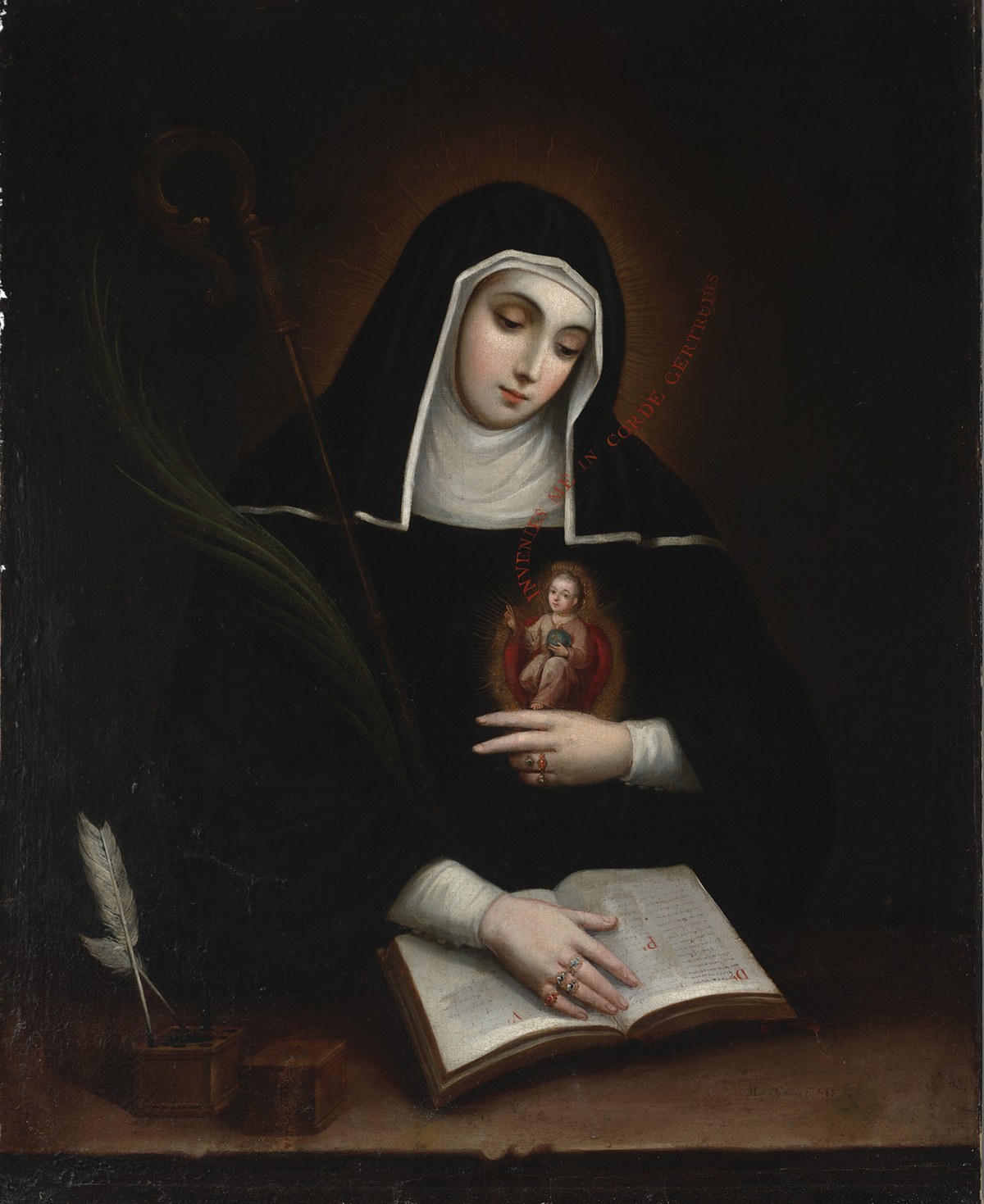
This Saint’s Story
Gertrude of Helfta, known as Gertrude the Great, was a Benedictine (monks following the Rule of St. Benedict) nun and writer at the monastery of St Mary at Helfta, near Eisleben in Saxony. The Catholic Encyclopedia gives her birth as 6 January 1256 and her death at Helfta on 17 November, in 1301 or 1302. She entered the monastery school at the age of five. The abbess was Gertrude of Hackeborn. Gertrude of Helfta was placed in the care of Mechtilde, the abbess's sister, and she joined the community in 1266.
Helfta followed the Rule of St Benedict and also used Cistercian (a strict reform of Benedictine monks begun at Cîteaux in 1098) customs. Gertrude knew Scripture, Augustine, Gregory the Great, and Bernard of Clairvaux. Her chief book is the Herald of Divine Love. She wrote book 2 herself and says she began it on Maundy Thursday 1289. Other nuns wrote books 3 to 5 during her lifetime, partly from her dictation. Book 1 was added near her death. She also wrote the Spiritual Exercises (his month-long program of guided prayer). Later prayer collections mix her words with other people's. The Herald describes a change in 1281, when she was about twenty-five, after which her study turned toward Scripture and theology.
The Herald also describes devotion to the heart of Jesus. Rome approved an office for her in 1606. Her name entered the Roman Martyrology (the Church's official list of saints for each day) in 1677. Pope Benedict XIV gave her the title the Great, to distinguish her from Gertrude of Hackeborn, the abbess. Clement XII set the universal feast on 15 November. The General Roman Calendar now keeps her on 16 November. German-speaking calendars and Hungary keep 17 November, the day given for her death. She is not Gertrude of Hamage, who has a separate page on this site.
This page keeps November 16.
For today: You can keep your studies and still give the hours of prayer the first place. Gertrude's books came out of the daily office and out of a house of nuns who wrote things down. If you belong to a small community, write down the prayers you actually use, and say so when a later collection adds other people's words.
