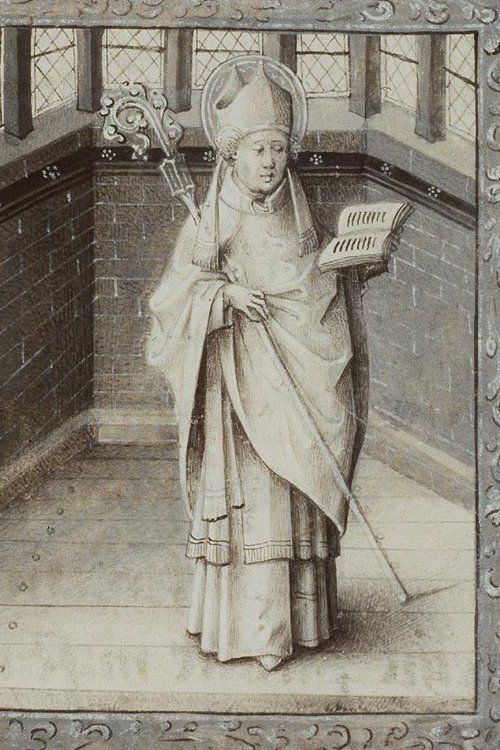
St. Germain of Paris

Germain (Germanus) was born near Autun in Burgundy about 496. St. Germain was the child of Burgundian parents, named Eleutherius and Eusebia.

Read the essentials →
Feast May 28 · Bishop

St. Germain of Paris

Current feast

May 28
Secondary source · Wikipedia infobox

Traditional feast

May 28
1914 / pre-1969 calendar, per Baring-Gould (1897)

Represents

Bishop

Feast days

Feast: May 28

This Saint’s Story

The Catholic Encyclopedia says he studied at Avalon and at Luzy under his cousin Scapilion, a priest, and that at thirty-four he was ordained by St. Agrippinus of Autun and made abbot of Saint-Symphorien near that town. Baring-Gould, following Venantius Fortunatus, names his parents Eleutherius and Eusebia and tells that his grandmother tried to poison him so that his brother Stratidius might inherit; the cups were switched, Stratidius was injured, and his uncle Scopilio took Germain in.

As abbot he gave alms so freely that his monks, fearing he would give everything away, rebelled. Happening to be in Paris in 555 when Bishop Eusebius died, he was kept by King Childebert and, with the consent of clergy and people, consecrated to the vacant see. Under his influence the worldly king reformed his life. Germain attended the Third and Fourth Councils of Paris (557, 573) and the Second Council of Tours (566), and he urged the suppression of remaining pagan customs.

Childebert, campaigning in Spain, spared Saragossa when he learned that the city had placed itself under St. Vincent's protection, and received the martyr's stole. He built a suburban church in Paris to house the relic. Tradition holds that Germain healed the king of a dangerous illness at Celles. The church of St. Vincent was dedicated by Germain on 23 December, the day Childebert died; the Encyclopedia's printed year 588 conflicts with Germain's death in 576 and with the usual date of Childebert's death, 558. The abbey beside that church later took Germain's name as Saint-Germain-des-Prés.

Under later kings his path was harder. He excommunicated King Charibert in 568 for repudiating his wife and living in open immorality. When Sigebert and Chilperic went to war at the urging of Brunehaut and Fredegunde, Germain wrote to Brunehaut begging for peace; Sigebert was assassinated at Vitri in 575. Germain died on 28 May 576, before peace returned. In 754 his relics were moved into the body of St. Vincent's church in the presence of Pepin and the child Charlemagne, and from that time the church was known as Saint-Germain-des-Prés. Baring-Gould notes that the relics were dispersed at the Revolution.

What he represents

How he teaches us to live

Drawn from themes in the original account

Build up the community you belong to. Community life is part of this story.

Celebrate this saint’s feast day. Remember him on May 28 with a short prayer, and ask for his help.

From the Catholic Encyclopedia

1913 · 705 words

Bishop of Paris; born near Autun, Saône-et-Loire, c. 496; died at Paris, 28 May, 576. He studied at Avalon and also at Luzy under the guidance of his cousin Scapilion, a priest. At the age of thirty-four he was ordained by St. Agrippinus of Autun and became Abbot of Saint-Symphorien near that town. His characteristic virtue, love for the poor, manifested itself so strongly in his alms-giving, that his monks, fearing he would give away everything, rebelled. As he happened to be in Paris, in 555, when Bishop Eusebius died, Childebert kept him, and with the unanimous consent of the clergy and people he was consecrated to the vacant see. Under his influence the king, who had been very worldly was reformed and led a Christian life. In his new state the bishop continued to practise the virtues and austerities of his monastic life and laboured hard to diminish the evils caused by the incessant wars and the licence of the nobles. He attended the Third and Fourth Councils of Paris (557, 573) and also the Second Council of Tours (566). He persuaded the king to stamp out the pagan practices still existing in Gaul [roughly modern France and Belgium] and to forbid the excess that accompanied the celebration of most Christian festivals. Shortly after 540 Childebert making war in Spain, besieged Saragossa. The inhabitants had placed themselves under the protection of St. Vincent, martyr. Childebert learning this, spared the city and in return the bishop presented him with the saint's stole. When he came back to Paris, the king caused a church to be erected in the suburbs in honour of the martyr to receive the relic. According to the story, Childebert fell dangerously ill about this time, at his palace of Celles, but was miraculously healed by Germain, as is attested in the king's letters-patent bestowing the lands of Celles on the church of Paris, in return for the favour he had received. In 588 St. Vincent's church was completed and dedicated by Germain, 23 December, the very day Childebert died. Close by the church a monastery was erected. Its abbots had both spiritual and temporal jurisdiction over the suburbs of St. Germain till about the year 1670. The church was frequently plundered and set on fire by the Normans in the ninth century. It was rebuilt in 1014 and dedicated in 1163 by Pope Alexander III. Childebert was succeeded by Clotaire, whose reign was short. At his death (561) the monarchy was divided among his four sons, Charibert becoming King of Paris. He was a vicious, worthless creature, and Germain was forced to excommunicate him in 568 for his immorality. Charibert died in 570. As his brothers quarrelled over his possessions the bishop encountered great difficulties. He laboured to establish peace, but with little success. Sigebert and Chilperic, instigated by their wives, Brunehaut and the infamous murderess Fredegunde, went to war, and Chilperic being defeated, Paris fell into Sigebert's hands. Germain wrote to Brunehaut (his letter is preserved) asking her to use her influence to prevent further war. Sigebert was obdurate. Despite Germain's warning he set out to attack Chilperic at Tournai, whither he had fled, but Fredegunde caused him to be assassinated on the way at Vitri in 575. Germain himself died the following year before peace was restored. His remains were interred in St. Symphorien's chapel in the vestibule of St. Vincent's church, but in 754 his relics [the bodily remains of a saint, or objects they used, kept with honor] were solemnly removed into the body of the church, in the presence of Pepin and his son, Charlemagne [king of the Franks, crowned emperor in 800], then a child of seven. From that time the church became known as that of St. Germain-des-Prés. In addition to the letter mentioned above we have a treatise on the ancient Gallican liturgy, attributed to Germain, which has been published by Martene in his "Thesauruis Novus Anecdotorum". St. Germain's feast is kept on 28 May.

BUTLER, Lives of the Saints, II, 296-8; BENNETT in Dict. Christ. Biog., s. v. (18); GUÉRIN, Vie des Saints (Paris, 1880), VI, 264-71; Acta SS., May, VI, 774-8; MABILLON, Acta SS. O.S.B. (1668-72), I, 234-45; DUPLESSY, Histoire de St. Germain (Paris, 1831); FRAICINET, Not. biog. sur St. Germain-des-Prés (Agen, 1881); Anal. Bolland. (1883), II, 69; BOUILLART, Hist. de l'abbaye de St. Germain (Paris, 1724).

Read more

The full original · 327 words

Read Baring-Gould’s full account

Baring-Gould’s sources: Roman and Gallican Martyrologies. Authority: — Life by Venantius Fortunatus, a contemporary.

S. Germain was the child of Burgundian parents, named Eleutherius and Eusebia. His mother endeavoured to destroy her unborn child, but ineffectually, injuring her own constitution without hurting him. His grandmother also bore the poor boy, after he was born, the same malice, and wishing his brother Stratidius to enjoy the whole of the parental inheritance, gave a servant a poisoned cup for Germain, and a cup of wine for Stratidius, telling her which cup was intended for each child, but the servant, not knowing that mischief was intended, carelessly changed the cups, and Stratidius, though he did not die of the effects, was severely injured by the poison.

It was not safe for Germain to remain in his father’s house, therefore his uncle Scopilio, at Luzy near Autun, took charge of him. He was a very pious man, and from him Germain derived his first religious impressions, Germain was educated in the abbey of S. Symphorian at Autun, and was created abbot of the monastery, by S. Nectarius, the bishop. He was ordained priest by S. Agrippinus of Autun. The fame of his virtue reaching the ears of King Childebert, he was ordered to come to Paris, where he became abbot of the monastery of S. Vincent, afterwards called after himself, S. Germain-des-Prés.

Four years after, he was appointed to the episcopal throne of Paris, on the death of Eusebius. Childebert, at his request, built the church of S. Germain l’Auxerrois on the further side of the Seine. The saint showed great courage in opposing the king and nobles for their violence and dissolute manners; he even excommunicated king Charibert, who had repudiated his legitimate wife Ingoberga, that he might marry a woman named Marcoveva, at the same time that he was living in concubinage with her sister. S. Germain died on May 28th, in the year 576.

His body was laid in the abbey of S. Vincent, but his relics [the bodily remains of a saint, or objects they used, kept with honor] were dispersed at the Revolution.

Patron saint of

  • Paris Catholic Encyclopedia / history
    He was its bishop; the abbey and quarter of Saint-Germain-des-Prés took his name.

More about St. Germain of Paris

Checked against at least two sources, in our own words

Help us add to this saint's story

Everything is read by a person before anything appears. Facts are checked against trusted sources first.

Facts are welcome; a source link helps (optional).With your permission we may share it on this page.

Nine days · Free

Pray the novena
with us.

One short email a day for nine days. The day's prayer, a line from St. Germain of Paris's story, and a nudge to keep going.

Also on May 28
H

St. Heliconis

May 28 · Martyr
C

St. Caraunus

May 28 · Martyr
T

St. Theodulus the Stylite

May 28 · Hermit
← All 1970 saints in the library
Sources & notes

Feast-day sources

Story sources

Sources

Credits

Image: Saintgermanusofparis.jpg · Book of Hours, c. 1450-1460. Jean le Tavernier (illuminator). · Public domain, via Wikimedia Commons

Image: Book of Hours, c. 1450-1460. Jean le Tavernier (illuminator)., Wikimedia Commons (Public domain)

From “Catholic Encyclopedia (1913)/St. Germain (2),” The Catholic Encyclopedia (New York: Robert Appleton Company, 1907–1914), via Wikisource. Public domain. Matched by name and feast date; text unedited except for our bracketed notes in grey.

From Sabine Baring-Gould, The Lives of the Saints, new edition in 16 vols. (London: John C. Nimmo, 1897–98); text from the Internet Archive scan (OCR, lightly cleaned; errors possible). Public domain in the United States. Reproduced unedited, except for short bracketed notes in grey that we added to explain names and terms (“S.” is the old abbreviation for Saint). Some history and judgments reflect 19th-century scholarship.

Notes

Story retold in our own words from the cited sources.