…served his mind calm and serene until the moment when his spirit departed.” This martyr, whose name Eusebius does not provide, is generally believed to be Saint George. If this is correct, this is nearly all we know for certain about him. However, he was undoubtedly popular as a saint from a very early age. The earliest accounts of his life are in Greek and date back to the 6th century; these accounts are fanciful. In addition to these, there are some Latin accounts that claim to be written by Pasikr&s, the servant of the martyr. But these are also not genuine.
The essence of the Greek accounts is as follows: George was born to Christian parents in Cappadocia. His father died as a martyr, and his mother, along with her child, sought refuge in Palestine. He joined the army at a young age and showed great courage and endurance. At the age of twenty, he lost his mother, and her death left him with a large fortune. He then went to the court of Diocletian, where he hoped to gain advancement. When the persecution began, he gave his money to the poor and publicly declared himself a Christian before the emperor.
After being ordered to make a sacrifice, he refused and was sentenced to death. According to the story, following this, he endured a series of tortures, from which he miraculously recovered day after day. This pattern of suffering is a common theme in many Greek apocryphal accounts of martyrdom. On the first day, he was stabbed with spears and taken to prison; one of the spears broke like straw when it touched him. He was then bound by his feet and hands to posts, and a heavy stone was placed upon him.
As the Bollandists point out, Usuardus included this account in his Martyrology under the name of John of Nicomedia on September 5th, and Baronius accepted it without question from Usuardus into the Modern Roman Martyrology. Papebroeck suggests that it is most likely this unnamed martyr by Eusebius was the great Saint George, who died around 303 AD; however, as will be seen later, this date does not align with that in the Chronicon Paschale, which states 285 AD.
The second day, he was tied to a wheel equipped with blades and swords. Diocletian believed him to be dead; however, an angel appeared, and S. George greeted him in a military manner, which made the persecutor realize that the saint was still alive. When he was taken off the wheel, it was found that all his wounds had healed. S. George was then thrown into a pit of quicklime, but this did not kill him. The day after that, the emperor ordered his limbs to be broken, but he was found on his knees, completely unharmed. He was then forced to run in red-hot iron shoes. That night and the following day, he spent in prayer, and on the sixth day, he appeared before Diocletian, walking and uninjured. He was then whipped with leather thongs until his flesh was torn from his back, but he was fine the next day. On the seventh day, he drank two cups, one of which was meant to drive him mad and the other to poison him, yet he felt no ill effects. According to the story, he then performed some miracles, raised a dead man to life, and restored an ox that had been killed—miracles that led to many conversions. That night, S. George dreamed that the Savior placed a golden crown on his head and told him to prepare for Paradise. He immediately called to the servant who claims to write these memoirs and instructed him, after his death, to take his body and will to Palestine. On the eighth day, the saint, by the sign of the cross, forced the devil inhabiting the statue of Apollo to admit that he was a fallen angel; then all the statues of the gods fell before him. This miracle converted the empress Alexandra, and Diocletian was so furious at the truth that he condemned her to immediate death. She was then executed, along with Apollo, Isaac, and Croates, who had converted with her.
The empress is commemorated in the Greek Church on April 21st. Baronius found this absurd and did not include her name in the Roman Martyrology, only listing her servants, Apollo, Isaac, and Croates. Two days later, S. George received his crown. The Latin Acts can be summarized as follows: The devil urged Dacian, the emperor of the Persians, to persecute the Church. At this time, George of Cappadocia, a native of Melitena, lived. Melitena is also where he was martyred. He lived there with a holy widow. He endured numerous tortures, such as the rack, iron pincers, fire, a wheel with spikes, shoes nailed to his feet; he was placed in an iron box lined with sharp nails and thrown down a cliff; he was beaten with sledgehammers, a pillar was laid on him, and a heavy stone was dropped on his head; he was stretched on a red-hot iron bed, melted lead was poured over him; he was thrown into a well, pierced with forty long nails, locked in a bronze bull over a fire, and thrown again into a well with a stone tied around his neck. Each time he returned from a torment, he was restored to full strength. His tortures lasted seven years. His steadfastness and miracles converted 40,900 men and the empress Alexandra. Dacian then ordered the execution of S. George and the empress; as they died, a whirlwind of fire consumed and carried off the persecutor.
In Europe, the story of S. George became popularized in a completely different form, just as far removed from the truth as the Greek version. Jacques de Voragine tells the story this way: George, a tribune, was born in Cappadocia and came to Libya, to a town called Silene, near which there was a pond infested by a monster that had repeatedly driven back armed forces trying to kill it. The monster even approached the city walls and poisoned all who were nearby with its breath. To avoid such visits, he was
Will it be believed that Pere Giry and Abbe Guerin, in their "Little Bollandists," present this string of impossibilities as true history, without any caution, only omitting the most revolting absurdities? Yet Pope Gelasius rejected the Acts of S. George as the work of heretics.
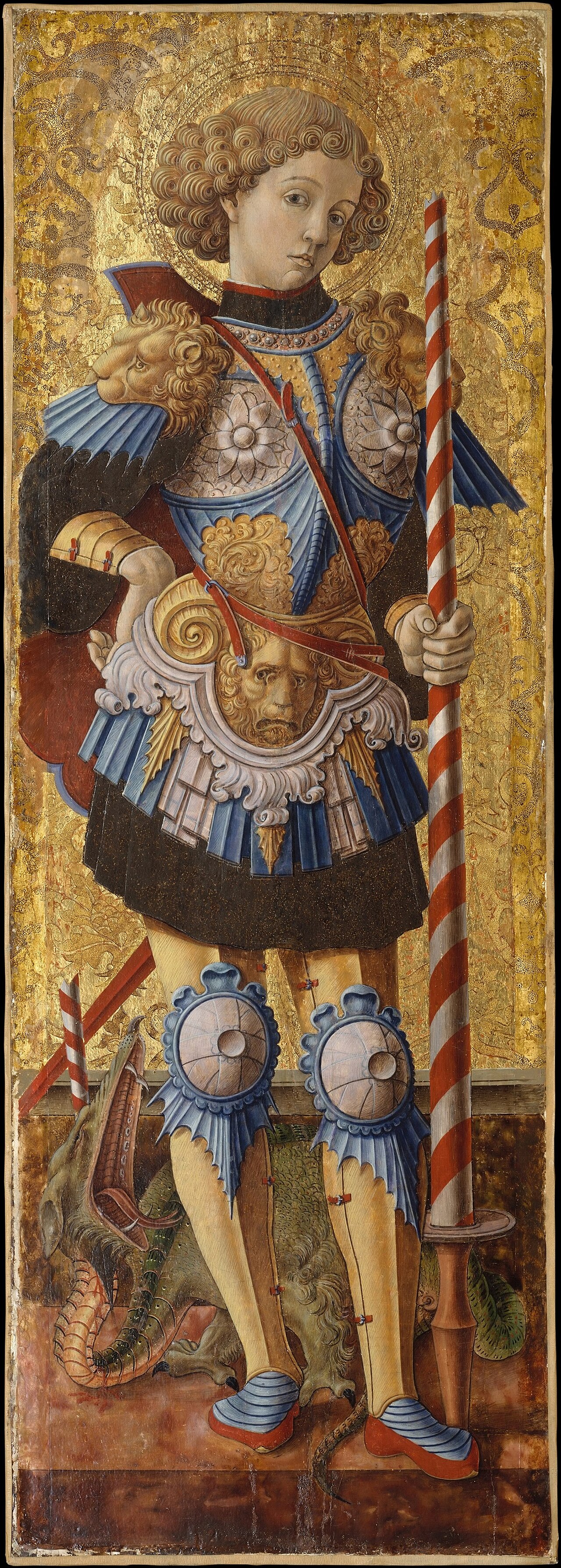
Each day, two sheep were provided to satisfy his hunger. When the sheep available to the citizens ran out, their sons and daughters were offered to the dragon. One day, the lot fell on the princess. The king dressed his daughter in royal robes and sent her out to face the dragon. Saint George was riding by and, seeing the maiden in tears and the monster rising from the marsh to devour her, he approached, spear in hand, to confront the beast, commending himself to God. He pierced the dragon and then instructed the princess to tie a girdle around it and not to be afraid. Once this was done, the monster followed her like a tame dog. When they brought it into the town, the people fled in fear, but George called them back, telling them to set aside their fear. Then the king and all his people, twenty thousand men, not counting women and children, were baptized, and George struck off the head of the monster.
Other versions of the story suggest that the princess was locked in a castle, and everyone inside was dying of thirst. The only water could be obtained from a fountain at the base of a hill, which was guarded by the dragon, and Saint George rescued them from it. This story was accepted by the uncritical clerks of the Middle Ages and made its way into the Church's Office-books, Missals, and Breviaries, from which it was removed by Pope Clement VII. Saint George was simply recognized as a martyr, reigning with Christ. But although the legend itself may be fictional, Saint George himself is a historical figure.
It is one of those peculiar phenomena familiar to all readers of history that successfully disproving an error does not settle the question for the future. The history of Saint George the Martyr is a case in point. Calvin was the first to express his belief that Saint George was a myth, a mere creation of someone's imagination. The learned Peter Heylyn refuted his argument against the historical reality of the champion of chivalry. Again, the historian Gibbon carelessly identified him with the infamous George of Cappadocia, the Arian bishop of Alexandria. Since this identification is widely believed to be indisputable, it is necessary to tell the story of this Arian George and demonstrate how completely unfounded the attempt is to convert a heretic into the patron saint of England.
This George, according to a contemporary source, Ammianus Marcellinus, was born in a fuller's mill at Epiphania, in Cilicia. His first job was as a supplier of bacon to the army in Constantinople, where, according to Saint Athanasius, he was making significant profits, not in the most honest way. When he was discovered, he fled to Cappadocia, where he began his scheming. He adopted Arianism to better ingratiate himself with the party in power at court. Being seen as useful and unscrupulous, he gained friends who helped overlook and pardon his previous misdeeds. Out of a love for or the show of learning, he amassed a valuable library. The favor of the ruling faction elevated George of Cilicia to the position of archbishop of Saint Athanasius. His entrance as the new archbishop was like that of a barbarian conqueror, and every moment of his reign was marked by cruelty and greed. The Catholics of Alexandria and Egypt were left at the mercy of a tyrant, naturally and educationally suited to be a persecutor, but he oppressed all the various inhabitants of his vast diocese with equal severity. As primate of Egypt, he displayed pomp and arrogance in his high position, yet still revealed the vices of his low character.
The merchants of Alexandria were made poor by the unfair and nearly universal control he gained over nitre, salt, paper, funerals, and other goods, and the spiritual leader of a large community stooped to the despicable acts of an informer. The pagans stirred his greedy devotion, and the wealthy temples of Alexandria were either looted or disrespected by the arrogant bishop, who shouted in a loud and threatening voice, “How long will these tombs be allowed to stand?”
The messenger who announced the rise of the apostate Julian in Alexandria also proclaimed the downfall of the archbishop. George, along with two of his obedient ministers, Count Diodorus and Dracontius, the master of the mint, were shamefully dragged to the public prison. After twenty-four days, the prison was broken open by the fury of the pagan crowd, and George, Diodorus, and Dracontius were torn to pieces by them, with their bodies thrown into the sea. Gibbon states, “The meritorious death of the archbishop erased the memory of his life. The rival of Athanasius was beloved and revered by the Arians, and the apparent conversion of those sectarians brought his worship into the heart of the Catholic Church. The detested outsider, hiding every detail of time and place, took on the guise of a martyr, a saint, and a Christian hero, and the infamous George of Cappadocia has been transformed into the famous St. George of England, the patron of arms, chivalry, and the Order of the Garter.” Such is the slander that we aim to refute.
The date of the killing of George the Arian bishop was 361. The Chronicon Paschale, or Alexandrine Chronicle, states: “285th Olympiad. Consuls, Mamertinus and Nevitta.” This chronicle was compiled by three different authors. The first author brought it down to AD 354, the second to 639—though the years 601 and 609 are lost; the third continued it to 1048. Julian, upon learning of the death of Emperor Constantius, openly revealed his own apostasy and impiety, and sent out an edict against Christianity throughout the entire world, ordering all idols to be restored. As a result, the Gentile Greeks in the East were stirred up, and in Alexandria, which is in Egypt, they seized George, the bishop of that city, murdered him, and insulted his corpse.
Mamertinus and Nevitta were consuls in 362, while the 285th Olympiad was in 361. However, if the murder occurred on the last day of 361, the difference in dates can be easily explained. The same Chronicon Paschale mentions the martyrdom of St. George in the 266th Olympiad, stating: “266th Olympiad. Consuls, Carinus for the second time, and Numerianus. In the year 255 of the Ascension of our Lord into heaven, a persecution of the Christians took place, and many suffered martyrdom, among whom was the Holy George.”
We find from the “Fasti Consulares” by Almeloveen that in 284, Carinus and Numerian were consuls before the kalends of May. The 266th Olympiad corresponds with A.D. 285, so we must add 255 years after Christ's Ascension to the thirty-four years of His era, which would make it A.D. 289. However, it is evident that the author of this Chronicon follows those chronologists who place the birth of Christ four years earlier; consequently, A.D. 289 ought to be A.D. 285. But there is further proof. At Shaka, the ancient Saccaea in Palestine, there existed the ruins of a church with a dated Greek inscription, copied by Burckhardt, which states: "A church of the holy victorious martyr George, and of the holy ones with him, was built from the foundations with offerings of Bishop Tiberinus."
But the care of George and Sergius erected the sanctuary and the addition to the temple in the year 363; this date ought to be 367. This date, however, is not that of the founding and dedication of the church, but of the sanctuary (hierateion) and the addition (prostheke) erected by George and Sergius; consequently, the original building must have been much older. Another ruined church at Ezra in Syria, originally a heathen temple, also has a dated Greek inscription from the year 346, in which Saint George is named and called a “Holy Martyr.” Consequently, this inscription was put up during the lifetime of George, the Arian bishop of Alexandria, who lived fifteen years longer, until A.D. 362.
George Codinus, in the 15th century, wrote his book “On the Antiquities of Constantinople.” This book is a compilation and contains the chronicle of Hesychius Milesius, written in 518. In this chronicle, we are told that Constantine the Great dedicated a church to Saint George the martyr in Constantinople around 330, which is about forty-two years before the death of the Arian George. The Greek Mensea confirms this, and indeed November 3rd is observed in the Greek Church as the feast of the dedication of this church by Constantine. It is almost absurd to suppose that, considering the horror of Arian teaching held by the Catholics, the opponent of Saint Athanasius, a man detested for his crimes, should have become popular as a saint, and that Saint Gregory the Great (died 506) should have included his festival in the sacramentary, with collects for his day. However, enough evidence has been produced to undermine the view of Gibbon, eagerly adopted by Dr. Stanley, which is a parody of history and an insult to religion.
Royal Society of Literature, volume 1, page 303 and volume 7, page x, contains an article on Saint George by Mr. Hogg. In art, Saint George is depicted as a knight, riding a horse and piercing the dragon with his lance. It is nearly impossible to list all the places that claim to have relics of this saint.
Footnotes
- As the Bollandists point out, Usuardus inserted this account in his Martyrology under the name of John of Nicomedia on September 5th, and Baronius adopted it without question from Usuardus into the Modern Roman Martyrology.
- Papebroeck shows that it is most probable that this martyr, unnamed by Eusebius, was the great Saint George, AD 303; but on the other hand, as will be seen presently, this date will not agree with that in the Chronicon Paschale, 285.
- In my “Curious Myths of the Middle Ages,” I have traced both the Eastern and Western forms of the legend of Saint George to their original sources.
- The Chronicon Paschale was compiled by three authors.
- The 285th Olympiad corresponds to the year 361.
- The 266th Olympiad corresponds to the year 255 of the Ascension.
- This date will not agree with that of the nameless Nicomedian martyr of Eusebius, which is 303.
- This date ought to be 367.
- This inscription was put up during the lifetime of George the Arian bishop of Alexandria, who lived fifteen years longer, to A.D. 362.
- Royal Society of Literature, volume 1, page 303 and volume 7, page x, contains an article on Saint George by Mr. Hogg.
Baring-Gould’s own footnotes, in modern English.
Read the original 1870s text
Baring-Gould’s sources: Every Martyrology, Greek and Latin. Few saints have received such universal recognition as S. George. His name is in the Sacramentary of S. Gregory. The Acts, Latin and Greek, are apocryphal. Pope S. Gelasius, in the council of Rome, A.D. 494, numbered these Acts among the Apocrypha, together with those of SS. Cyriac and Julitta. The Latin Acts dose with the remarkably barefaced lie, "I Pasecras, servant of my lord George, who was present through the seven years of his passion.... have written in order all that was done to my lord George. God, the Lord of heaven and earth, who will judge the quick and the dead, knows that I have neither added to nor subtracted anything from his passion; but have written what he suffered.” This is quoted by S. Andrew of Crete, (d. 767), and it must therefore have existed in his time, and been recognized in spite of the protest of S. Gelasius. The Bollandists suppose that the Acts we now have are not those accounted as the work of heretics by S. Gelasius, but are the fabrication of some Sidlian monks, in the 10th century; and they base their opinions on the fact that there is no heresy in them. But S. Gelasius may well have seen then, what is abundantly evident to comparative mythologists now, that these Acts are simply an adaptation of a heathen myth of a solar god to a Christian saint. All that can be relied on is mentioned in the following article.] Eusebius, the father of ecclesiastical history, says, (Hist Eccl. viii. 5), “ Immediately on the promulgation of the edict (of Diocletian), a certain man of no mean origin, but highly esteemed for his temporal dignities, as soon as the decree was published against the Churches in Nicomedia, stimulated by a divine zeal, and excited by an ardent faith, took it as it was openly placed and posted up for public inspection, and tore it to shreds as a most profane and wicked act This, too, was done when the two Caesars were in the city, the first of whom was the eldest and chief of all, and the other held the fourth grade of the imperial dignity after him. But this man, as the first that was distinguished there in this manner, after enduring what was likely to follow an act so daring, pre(April sj.
…served his mind calm and serene until the moment when his spirit fled,” 1 This martyr, whose name Eusebius does not give, has been generally supposed to be S. George, and if so, this is nearly all we know authentic concerning him. But popular as a saint he unquestionably was, from a very early age. The earliest Acts are in Greek, and belong to the 6th century; they are fabulous. Besides these, are some Latin Acts, pretending to be the composition of Pasikr&s, the servant of the martyr. But these are also apocryphal. The substance of the Greek Acts is to this effect: — George was born of Christian parents in Cappadocia [a region of central Turkey]. His father suffered a martyr’s death, and the mother with her child took refuge in Palestine. He early entered the army, and behaved with great courage and endurance. At the age of twenty he was bereaved of his mother, and by her death came in for a large fortune. He then went to the court of Diocletian [Roman emperor 284–305, who began the ‘Great Persecution’ of Christians in 303], where he hoped to find advancement On the breaking out of the persecution, he distributed his money among the poor, and declared himself; before the emperor, to be a Christian. Having been ordered to sacrifice, he refused, and was condemned to death. Here follows a numerous succession of tortures, from which he miraculously recovers, day after day, a succession which accompanies with wearisome monotony nearly all the Greek apocryphal acts of martyrdom. The first day he was thrust with spears to prison; one of the spears when it touched him snapped like straw. He was then fastened by feet and hands to posts, and a heavy stone was laid upon 1 As the Bollandists [Jesuit scholars who since the 1600s have critically studied the lives of the saints] point out, Usuardus [a 9th-century monk of Paris who compiled a list of saints for each day] inserted this account in his Martyrology, under the name of John of Nicomedia, on Sept, fth, and Baronius [Cardinal Baronius (d. 1607), church historian who edited the Roman Martyrology] adopted it without question from Usuardus into the Modern Roman Martyrology. Papebroeck shows that it is most probable that this martyr, unnamed by Eusebius, was the great S. George, a.d 303; but on the other hand, as will be seen presently, this date will not agree with that in the Chronicon Paschale, 285. & George.
his breast The second day he was bound to a wheel set with blades and swords. Diocletian believes him to be dead; but an angel appearing, S. George saluted him in military fashion, whereby the persecutor ascertained that the saint was still living. On removing him from the wheel, it was discovered that all his wounds were healed. S. George was then cast into a pit of quick-lime, which, however, did not cause his death. On the next day but one, the emperor sent to have his limbs broken, and he was discovered on his knees perfectly whole. He was next made to run in red-hot iron shoes. The following night and day he spent in prayer, and on the sixth day he appeared before Diocletian walking and unhurt He was then scourged with thongs of hide till his flesh came off his back, but he was well on the next day. On the seventh day he drank two cups, whereof the one was prepared to make him mad, the other to poison him, without his experiencing any ill effects. He then performed some miracles, raised a dead man to life, and restored to life an ox which had been killed; — miracles which resulted in numerous conversions. That night S. George dreamed that the Saviour laid a golden crown on his head, and bade him prepare for Paradise. S. George at once called to him the servant who pretends to write these memoirs, and commanded him, after his death, to take his body and will to Palestine. On the eighth day, the saint, by the sign of the cross, forced the devil inhabiting the statue of Apollo to declare that he was a fallen angel; then all the statues of the gods fell before him. This miracle converted the empress Alexandra; and Diocletian was so exasperated against the truth, that he condemned her to instant death. She was then executed, with Apollo, Isaac, and Croates, who were converted with her. 1 1 The empress Is commemorated in the Greek Church on April axst ! Baronius saw the absurdity of this, and did not insert her name in the Roman Martyrolo-jv, but only those ol her servants, Apollo, Isaac, and Croates. Two days after S. George received his crown. The Latin Acts may be summed up as follows: — The devil urges Dacian, emperor of the Persians, to persecute the Church. At this time lived George of Cappadocia, a native of Melitena. Melitena is also the scene of his martyrdom. Here he lived with a holy widow. He was subjected to numerous tortures, such as the rack, iron pincers, fire, a sword-spiked wheel, shoes nailed to his feet; he was put into an iron box, set within with sharp nails, and flung down a precipice; he was beaten with sledge hammers, a pillar was laid on him, a heavy stone dashed on to his head; he was stretched on a red-hot iron bed, melted lead was poured over him; he was cast into a well, transfixed with forty long nails, shut into a brazen bull over a fire, and cast again into a well with a stone round his neck. Each time he returned from a torment, he was restored to full vigour. His tortures lasted seven years / His constancy and miracles were the means of converting 40,900 men, and the empress Alexandra. Dacian then ordered the execution of S. George and the empress; and as they died, a whirlwind of fire consumed and carried off* the persecutor. 1 In Europe, the story of S. George became popularised under a totally different form, one just as far removed from the truth as the Greek version. Jacques de Voragine tells the story thus: — George, a tribune, was born in Cappadocia, and came to Libya, to the town called Silene, near which was a pond infested by a monster, which had many times driven back an armed host that had come to destroy him. He even approached the walls of the city, and with his exhalations poisoned all who were near. To avoid such visits, he was 1 Will it be believed that the Pere Giry, and the Abbe Guerin, in their ** Little Bollandlsts ** give this string of impossibilities as true history, without a word of caution, only suppressing the most revolting absurdities. Yet pope Gelasius rejects the Acts of S< George as the composition of heretics. April aj.] S. George.
furnished each day with two sheep, to satisfy his voracity. When the sheep at the disposal of the citizens were exhausted, their sons and daughters were cast to the dragon. The lot fell one day on the princess. The king covered his child with royal robes and sent her forth to meet the dragon. S. George was riding by, and seeing the maiden in tears, and the monster rising from the marsh to devour her, advanced, spear in hand, to meet the monster, commending himself to God. He transfixed the dragon, and then bade the princess pass the girdle round it, and fear nothing. When this was done, the monster followed like a docile hound. When they had brought it into the town, the people fled before it; but George recalled them, bidding them put aside all fear. Then the king and all his people, twenty thousand men, without counting women and children, were baptized, and George smote off the head of the monster. Other versions of the story are to the effect that the princess was shut up in a castle, and that all within were perishing for want of water, which could only be obtained from a fountain at the base of a hill, and this was guarded by the dragon, from which S. George delivered them. This story was accepted by the uncritical clerks of the Middle Ages, and found its way into the Office [the Divine Office, the Church’s daily cycle of prayer from the Psalms]-books of the Church, the Missals and Breviaries, whence it was cut out by Pope Clement VII., and S. George was simply acknowledged as a martyr, reigning with Christ. 1 But though the legend itself may be fable, S. George himself is a fact It is one of those singular phenomena which are familiar to all readers of history, that the successful refutation of an error as a false statement, by no means sets the question at rest for the future. The history of S. George the Martyr 1 In my “Curious Myths of the Middle Ages,” I hare followed out both the hastem and Western forms of the legend of S. George to their original sources. is a case in point Calvin was the first to declare his conviction that S. George was a myth, a mere creation of some one's imagination. The learned Peter Heylyn demolished his argument against the historical reality of the existence of the champion of chivalry. Again, the historian Gibbon flippandy identified him with the infamous Geoige of Cappadocia, the Arian [followers of Arius, who taught that the Son is a created being, not fully God] bishop of Alexandria, and as this identification is very popularly believed to be incontestable, it is necessary here to tell the story of this Arian George, and to show how utterly groundless is the attempt to convert a heretic into the patron saint of England. This George, according to a contemporary authority, Ammianus Marcellinus, was born in a fuller's mill at Epiphania, in Cilicia; his first occupation was that of purveyor of bacon to the army, at Constantinople, where, according to the testimony of S. Athanasius [bishop of Alexandria (d. 373), great defender of the Nicene faith], he was making great profits, not in the most honest way; being found out, he fled to Cappadocia; here he commenced his intrigues. He adopted the profession of Arianism, the better to ingratiate himself with the party then in power at court; being found a useful, and at the same time an unscrupulous man, he gained friends, who got his former malpractices overlooked and pardoned. From the love, or the ostentation of learning, he collected a valuable library; and the choice of the prevailing faction promoted George of Cilicia to the throne of S. Athanasius. The entrance of the new archbishop was that of a barbarian conqueror, and each moment of his reign was polluted by cruelty and avarice. The Catholics of Alexandria and Egypt were abandoned to a tyrant, qualified by nature and education to exercise the office of persecutor; but he oppressed with an impartial hand the various inhabitants of his extensive diocese. As primate [the leading bishop of a country] of Egypt, he assumed pomp and insolence in his lofty station, but still betrayed the vices of his base
and servile extraction. The merchants of Alexandria were impoverished by the unjust, and almost universal, monopoly which he acquired of nitre, salt, paper, funerals, &c., and the spiritual father of a great people condescended to practice the vile acts of an informer. The pagans excited his devout avarice; and the rich temples of Alexandria were either pillaged or insulted by the haughty prelate, who exclaimed, in a loud and threatening tone, “ How long will these sepulchres be permitted to stand?” The messenger who proclaimed at Alexandria the accession of the apostate Julian, announced the downfall of the archbishop. George, with two of his obsequious ministers, Count Diodorus and Dracontius, master of the mint, were ignominiously dragged to the public prison. At the end of twenty-four days, the prison was forced open by the rage of the heathen multitude, and George, Diodorus, and Dracontius were torn to pieces by them, and their bodies cast into the sea. Gibbon says, “The meritorious death of the archbishop obliterated the memory of his life. The rival of Athanasius was dear and sacred to the Arians, and the seeming conversion of those sectaries introduced his worship into the bosom of the Catholic Church. The odious stranger, disguising every circumstance of time and place, assumed the mask of a martyr, a saint, and a Christian hero, and the infamous George of Cappadocia has been transformed into the renowned S. George of England, the patron of arms, of chivalry, and of the garter.” 1 Such is the slander which we undertake to refute. The date of the slaying of George the Arian prelate was 361. The Chronicon Paschale, or Alexandrine Chronicle, 8 says: — “285 th Olympiad. Consuls, Mamertinus and Nevitta. 1 Compiled by three hands. The first carried it down to a.d. 3541 the second to I 639 — the years 601, 609, are however lost; the third to 104a. 308 Lives 0/ the Saints. lAprn** Julian, learning the death of the Emperor Constantius, making manifest his own apostasy and impiety, and despatching an edict against Christianity throughout the whole world, ordered all idols to be restored. Whereupon the Gentile Greeks in the East, being excited, immediately in Alexandria, which is in Egypt, having seized George, the bishop of that city, murdered him, and profanely insulted his corpse.”
FI. Mamertinus and FL Nevitta were consuls in 362, while the 285th Olympiad was in 361. But if the murder took place on the last day of 361, the difference of date is easily accounted for. Now this same Chronicon Pashale mentions the martyrdom of S. George in the 266th Olympiad, in these words: — “ 266th Olympiad. Consuls, Carinus for the second time, and Numerianus. In the year 255 of the Ascension of our Lord into heaven, a persecution of the Christians took place, and many suffered martyrdom, among whom also the Holy George was martyred.”
We find from the “ Fasti Consulares,” of Almeloveen, that in 284, Carinus and Numerian were consuls before the kalends of May. The 266th Olympiad corresponds with a.d. 285, so 255 years after Christ's Ascension must be added the thirty-four years of his era, which would make a.d. 289. But it is evident that the author of this Chronicon follows those Chronologists who place the birth of Christ four years earlier, consequently a.d. 289 ought to be a. d. But there is further proof. At Shaka, the ancient Saccaea, in Palestine, there existed the ruins of a church with a dated Greek inscription, copied by Burckhardt, to this effect — il A church of the holy victorious martyr George, and of 1 This date will not agree with that of the nameless Nicomedian martyr of Eusebius, which is 303.
April *3.] 5 *. George. the holy ones with him, was built from the foundations with offerings of bishop Tiberinus. But the care of George and Sergius (erected) the sanctuary and the addition to the temple..... in the year 363, great.. This date ought to be 367. This date, however, is not that of the founding and dedication of the church, but of the sanctuary (hierateion) and the addition (prostheke) erected by George and Sergius; consequently the original building must have been much more ancient Another ruined church at Ezra in Syria, originally a heathen temple, has also an inscription, dated in Greek, of the year 346, in which Saint George is named, and called a “Holy Martyr.” 1 Consequently this inscription was put up during the lifetime of George the Arian bishop of Alexandria, who lived fifteen years longer, to a.d. 362. George Codinus in the 15th century wrote his book “On the Antiquities of Constantinople.” This book is a compilation, and contains the chronicle of Hesychius Milesius, written in 518. In this we are told that Constantine the Great dedicated a church to S. George the martyr, in Constantinople, about 330, and therefore some forty-two years before the death of the Arian George. The Greek Mensea confirms this, and indeed Nov. 3rd is observed in the Greek Church as the feast of the dedication of this church by Constantine. It is almost absurd to suppose that, considering the horror of Arian teaching entertained by the Catholics, the opponent of S. Athanasius, a man odious for his crimes, should have become popular as a saint, and that S. Gregory the Great (d. 506) should have inserted his festival in the sacramentary, with collects for his day. But evidence enough has been produced to ruin the view of Gibbon, eagerly adopted by Dr. Stanley, which is a parody of history, and an insult to religion.
transactions Royal Snc. Lit., yol. *i., p. 303 j and vii., p. x, an art. onS. George by Mr. Hogg. In Art S. George appears armed as a knight, mounted on a horse transfixing the dragon with his lance. It is almost impossible to enumerate all the places which boast of possessing relics [the bodily remains of a saint, or objects they used, kept with honor] of this saint