St. Fulgentius

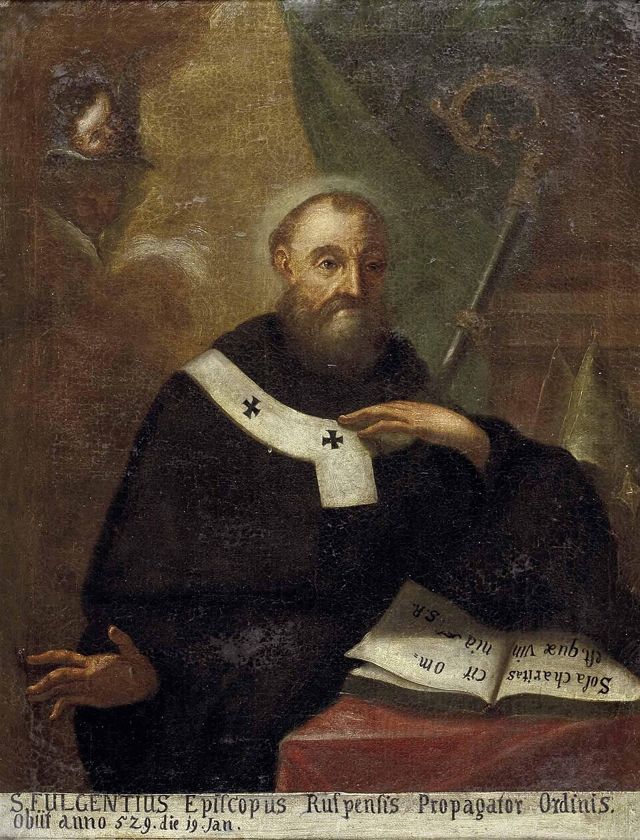
Fulgentius, born in 468 at Telepte in Byzacene, belonged to a senatorial family of Carthage despoiled by the Vandal invasion.

Read the essentials →
Feast January 1 · Bishop, Confessor

St. Fulgentius

Current feast

January 1 (also listed: January 3)
Secondary source · Wikipedia infobox

Traditional feast

January 1
1914 / pre-1969 calendar, per Baring-Gould (1914)

Represents

Bishop
Confessor

Feast days

Feast: January 1

This Saint’s Story

His father Claudius soon died, and his mother Mariana raised him with care, teaching him Greek letters before Latin so that he might speak among Africans with a true accent. He memorized Homer and was well trained in Latin literature. Favoured by the provincial authorities, he became procurator of the fiscus, but reading St. Augustine's Enarrationes on Psalm 36 moved him to enter a monastery founded by the exiled Bishop Faustus. His mother clamoured at the door for her son; he gave no sign. He made his goods over to her for his younger brother and practised such abstinence that he fell ill, yet he did not give it up.

When Faustus fled renewed persecution, Fulgentius joined his friend Felix as co-abbot. After raids and further trials, including a scourging by an Arian (followers of Arius's teaching that the Son is a created being, not fully God) priest at Sicca Veneria, he was ordained priest. In 508, though he had hidden from preferment, the seaport of Ruspe elected him bishop against his will. He kept monastic habits: one poor tunic for winter and summer, no fine chasuble, sandals or bare feet, and a monastery beside him under Felix. King Thrasamund soon exiled some sixty Catholic bishops to Sardinia. There Fulgentius wrote for the group, and about 515 the king summoned him to Carthage to answer ten Arian objections. His replies, still extant, pleased the king, but Arian bishops secured his exile again. He prophesied a speedy return and liberty for the African Church.

Thrasamund died in 523; Hilderic restored the bishops. Fulgentius's journey home was a triumphal progress. He insisted that Felix remain sole superior of the monastery, exempted it from the local bishop's jurisdiction, and gave himself to the care of his diocese: plain clothes for the clergy, gardens worked by their own hands, fasting on Wednesdays and Fridays. A year before his death he withdrew to the island of Circe for prayer, then returned when his people complained. In his last sickness he said ceaselessly, "O Lord, give me patience here, and forgiveness hereafter." He died on 1 January 533, in the twenty-fifth year of his episcopate. The Catholic Encyclopedia ranks him among the principal theologians of the sixth century and states no patronage.

What he represents

How he teaches us to live

Drawn from themes in the original account

Build up the community you belong to. Community life is part of this story.

Stay faithful when it costs you. Holding firm under pressure is part of this story.

Pray a little every day. Prayer is part of this story.

The full story

Baring-Gould’s account retold in modern English

Read the full story · 2,675 words · about 12 min

Fulgentius came from a respected senatorial family in Carthage, which had lost its status due to the invasion of the Vandals in Northern Africa. His father, Claudius, had been unfairly stripped of his house in Carthage, which was given to an Arian priest. He then retired to an estate he owned in Telepte, a city in the province of Byzacene. Here, about thirty years after the barbarians had separated Africa from the Roman Empire, Fulgentius was born in the year 468. Shortly after this, his father passed away, and the responsibility of raising the child fell entirely on his mother, Mariana. It has often been noted that great men have great mothers. Mariana was a woman of exceptional intelligence and piety. She carefully taught her son to speak Greek fluently and with good pronunciation, and she made him memorize Homer, Menander, and other renowned poets of antiquity. At the same time, she did not neglect his religious education, and the young man grew up to be obedient and humble. She entrusted him early on with the management of the household, the servants, and the estate; his wisdom in these matters quickly earned him a good reputation, and he was appointed procurator of the province.

However, it wasn't long before he grew tired of worldly affairs, and his love for God led him down a different path. He found great joy in religious reading and devoted more time to prayer. He often visited monasteries and was amazed to see that the monks showed no signs of fatigue, even though they were deprived of all the comforts and pleasures that the world offers. Then, under the pretext that his official duties required him to take occasional breaks, he withdrew from business at intervals to focus on prayer and meditation, and he reduced the amount of food he was served. Eventually, inspired by a sermon from Saint Augustine on the thirty-sixth Psalm, he decided to embrace a religious life.

At that time, there was a bishop named Faustus, who, along with other orthodox bishops, had been expelled from their sees by Huneric, the Arian king. Faustus had established a monastery in Byzacene. Fulgentius went to him and requested to be admitted into the monastery. However, the bishop turned him away, saying, "Why, my son, do you seek to deceive the servants of God? You will only be a monk when you have learned to despise luxurious food and fine clothing. Live as a layman with less comfort, and then I will believe in your calling." But the young man grasped the bishop's hand, kissed it, and said, "He who gave me this desire is powerful enough to help me fulfill it. Allow me to follow in your footsteps, my father!" After much hesitation, Faustus allowed the young man to stay, saying, "Perhaps my fears are unfounded. You must be tested for some days."

The news that Fulgentius had become a monk spread widely. His mother, overwhelmed with grief, ran to the monastery, crying out, "Faustus! Restore my son to me, and return the governor to the people. The Church always protects widows; why then do you rob me, a desolate widow, of my child?" Faustus tried in vain to calm her. She wanted to see her son, but he refused to allow it. Fulgentius, from inside, could hear his mother's cries. This was a severe temptation for him, as he loved her dearly.

Shortly after, he transferred his estate to his mother, to be managed by her for the benefit of his brother Claudius when he reached an appropriate age. He practiced strict self-discipline regarding his appetite, completely abstaining from oil and anything tasty, and his fasting led to a serious illness. However, he recovered, and his body adjusted to his life of abstinence.

When persecution broke out again, Faustus had to leave his monastery, and Fulgentius, following his advice, sought refuge in another monastery governed by Abbot Felix, who had been his friend in the world and became his brother in faith. Felix was delighted to see his friend again and insisted on elevating him to be co-abbot with himself. Fulgentius resisted for a long time, but it was in vain; the monks were led by these two abbots living in holy harmony. Felix took care of the discipline and the physical needs of the brothers, while Fulgentius taught them about divine love. Thus, they shared authority for six years without any conflicts, each always willing to comply with the other's wishes.

In the year 499, the country was being ravaged by the Numidians, and the two abbots were forced to flee to Sicca Veneria, a city in the proconsular province of Africa. Here, they were captured by orders of an Arian priest and commanded to be whipped. Felix, seeing the executioners first seize Fulgentius, exclaimed, "Spare my brother, who is not strong enough to endure your blows, lest he die from them, and strike me instead." After Felix was whipped, Fulgentius was beaten next. His pupil says, "Blessed Fulgentius, a man of delicate body and noble birth, could hardly endure the pain of the repeated blows. As he later told us, hoping to calm the priest's violence or distract him for a moment so he could recover a little, he cried out, 'I will say something if I am allowed.'" The priest ordered the blows to stop, expecting to hear a recantation. But Fulgentius, with great eloquence, began to recount his travels. After the priest listened for a while and realized this was all he would hear, he commanded the executioners to continue beating Fulgentius. After that, the two abbots, naked and bruised, were driven away. Before being brought before the Arian priest, Felix had thrown away a few coins he had; and his captors, not noticing this, after they were released, he and Fulgentius returned to the spot and recovered all of them. The Arian bishop, whose relatives were familiar with Fulgentius's family, was very annoyed by the priest's actions and severely reprimanded him. He also urged Fulgentius to take legal action against him, but the confessor declined, partly because a Christian should never seek revenge, and partly because he did not want to plead before a bishop who denied the divinity of the Lord Jesus Christ. Fulgentius, deciding to visit the deserts of Egypt, known for the holiness of the hermits who lived there, boarded a ship for Alexandria. However, the vessel stopped in Sicily, where S. Eulalius, the abbot at Syracuse, dissuaded him from his plan, assuring him that "a treacherous division had separated this country from the communion of S. Peter. All these monks, whose remarkable abstinence is widely known, do not share the Sacrament of the Altar with you," meaning that Egypt was full of heretics. Fulgentius visited Rome in the latter part of the year 500, during the entry of Theodoric. "Oh," he said, "how beautiful must the heavenly Jerusalem be, if earthly Rome is so glorious." Shortly after, Fulgentius returned home and built himself a cell on the seashore, where he spent his time in prayer, reading, writing, and making mats and umbrellas from palm leaves.

At this time, the Vandal heretic, King Thrasimund, had forbidden the consecration of Catholic bishops. As a result, many dioceses were left without pastors, and the faithful faced great distress. Faustus, the bishop, had ordained Fulgentius as a priest upon his return to Byzacene, and now many places were requesting him to be their bishop. Fulgentius, fearing this responsibility, hid himself. However, in a time of such trial and difficulty, the Lord needed him, and He called him to shepherd His flock in a remarkable way.

There was a city named Ruspe that was then without a bishop. An influential deacon there, named Felix, whose brother was a friend of the procurator, wanted the position for himself. However, the people disapproved of his ambition and unanimously chose Fulgentius, whom they only knew by reputation. After the primate Victor, the bishop of Carthage, consented for the neighboring bishops to consecrate him, several people from Ruspe went to Fulgentius's cell and forcibly compelled him to agree to be ordained. Thus, he could say, in the words of the prophet, "A people whom I have not known shall serve me."

The deacon, Felix, taking advantage of the illegality of the situation, decided to block S. Fulgentius's entrance by force and occupied the road he presumed the bishop would take to enter Ruspe. However, the people found another way to meet him and brought him into the Cathedral, where he was installed, while Felix was still waiting for him on the road. Fulgentius then celebrated the Divine Mysteries with great solemnity and communicated with all the people. When Felix, the deacon, heard this, he was embarrassed and refrained from further opposition. Fulgentius welcomed him with great kindness and charity, and later ordained him as a priest.

As bishop, S. Fulgentius lived like a monk. He ate the coarsest food and wore the plainest clothing, not putting on the orarium, which was customary for bishops. He refused to wear a brightly colored cloak (casula) and instead wore a very plain one, with a blackish or milk-colored habit (pallium) underneath it, which he girded around himself. Regardless of the weather, he wore this habit alone in the monastery, and when he slept, he never loosened his girdle. "In the tunic in which he slept, in that did he sacrifice; he may be said, in time of sacrifice, to have changed his heart rather than his habit."

His great love for a life of solitude led him to build a monastery near his home in Ruspe. He intended to place it under the direction of his old friend, Abbot Felix. However, before the building could be completed, King Thrasimund ordered the banishment of the Catholic bishops to Sardinia. As a result, Saint Fulgentius and other bishops, a total of sixty, were exiled. During their banishment, they received yearly provisions and money from the generosity of Symmachus, Bishop of Rome. A letter from this Pope to them still exists, in which he encourages and comforts them.

During his time in exile, Saint Fulgentius wrote several treatises to strengthen the faith of the orthodox Christians in Africa. King Thrasimund, wanting to see him, summoned him and arranged for him to stay in Carthage. The king prepared a list of ten objections to the Catholic faith and asked Fulgentius to respond to them. The Saint promptly complied, and his answers had such an impact that when the king sent him new objections, he ordered that the responses be read only to him. Fulgentius then wrote a rebuttal against Arianism, which we have under the title "Three Books to King Thrasimund." The king was pleased with this work and allowed him to remain in Carthage.

However, after repeated complaints from the Arian bishops about the success of his preaching, which they claimed threatened to convert the entire city to the faith in the Consubstantial, he was sent back to Sardinia in 520. He was taken on board a ship one stormy night to avoid the knowledge of the people, but the wind was against them, and the vessel returned to port by morning. When the news spread that the bishop was about to leave, the people gathered to say goodbye. He was able to go to a church, celebrate Mass, and communicate with all the faithful. As he prepared to board again when the wind changed, he said to a Catholic he saw weeping, "Do not grieve; I will return soon, and the true faith of Christ will flourish again in this land, with full freedom to profess it; but do not reveal this secret to anyone."

The event confirmed the truth of his prediction. Thrasimund died in 523 and was succeeded by Hilderic, who ordered the restoration of the orthodox bishops to their sees and granted freedom of worship to the Catholics.

The ship that brought the bishops back to Carthage was welcomed with great joy. A pupil of the bishop, who witnessed the scene, describes it this way: "The devotion of the Carthaginian citizens, eager to see the blessed Fulgentius again, was such that everyone looked forward to him, the one they had seen struggle so bravely before them. The crowd standing on the shore was silent in anticipation as the other bishops disembarked before him, searching with their eyes and thoughts only for him whom they had known so well, eagerly awaiting him from the ship. When his face appeared, a loud cheer erupted, with everyone trying to be the first to greet him, the first to bow their heads to him as he gave his blessing, the first to touch the tips of his fingers as he walked by, or even just to catch a glimpse of him from a distance. Praises of God echoed from every mouth. Then the people, moving both ahead of and behind the procession of the blessed confessors, made their way to the Church of S. Agileus. However, there was such a crowd, especially around Fulgentius, whom they honored above all, that the Christians had to form a protective circle around him to allow him to continue on his path. Furthermore, the Lord, wishing to test the charity of the faithful, miraculously sent down a heavy shower of rain as they moved. But the heavy downpour did not deter anyone; it seemed to be a generous blessing from heaven, and it strengthened their faith so much that they spread their cloaks above blessed Fulgentius, creating a new kind of shelter over him out of their great love. As evening approached, the group of bishops presented themselves before Boniface, the bishop of Carthage, who is remembered for his piety, and together they praised and glorified God. Then the blessed Fulgentius walked through the streets of Carthage, visiting his friends and blessing them; he rejoiced with those who were joyful and wept with those who were sorrowful. After fulfilling all their wishes, he bid farewell to his brothers and left Carthage, finding people on all the roads coming to meet him with lanterns, candles, tree branches, and great joy, praising the ineffable God, who had wonderfully made the blessed Fulgentius pleasing in the sight of all. He was welcomed in all the churches as if he were their bishop, and thus the people throughout Byzacene rejoiced as one over his return."

Arrived at Ruspe, Saint Fulgentius diligently worked to correct what was wrong, restore what had fallen down, and strengthen what was weak in his diocese. The persecution had lasted seventy years, so many abuses had crept in, the faith of many was weak, and ignorance was widespread. He carried out his reformation with such gentleness that he won, sooner or later, the hearts of even the most vicious.

In a council held at Junque in 524, a certain bishop named Quodvultdeus disputed the precedence with the Bishop of Ruspe, who made no reply but took the first place assigned to him by the council. However, Saint Fulgentius publicly requested, at the gathering of another council, that he be allowed to yield the precedence to Quodvultdeus.

About a year before his death, the bishop retired from all business to prepare his soul for its departure to a little island named Circinia. However, the needs of his flock called him back to Ruspe for a short time.

He endured the violent pains of his last illness with great resignation, praying continuously, "Lord, grant me patience now, and afterwards pardon." He gathered his clergy around him and asked them to forgive him if he had shown too much severity at any time or had offended them in any way. Then, committing his soul into the hands of God as a merciful Creator, he fell asleep in the evening of January 1st, A.D. 533, at the age of sixty-five.

Relics are at Bourges, in France, where May 16 is observed as the feast of his translation in the year 714.

Footnotes

  1. Faustus was a bishop expelled by Huneric, the Arian king.
  2. The thirty-sixth Psalm is a biblical text referenced by Saint Augustine.
  3. Faustus: a monk and the abbot of the monastery where Fulgentius was.
  4. Felix: the Abbot of the monastery where Fulgentius took refuge.
  5. Theodoric was a king of the Ostrogoths who ruled Italy.
  6. casula: a type of cloak worn by clergy.
  7. pallium: a type of garment worn by bishops.
  8. Arianism: a belief that denies the full divinity of Jesus Christ.
  9. Relics are at Bourges, in France, where May 16 is observed as the feast of his translation in the year 714.

Baring-Gould’s own footnotes, in modern English.

Read the original 1870s text

Baring-Gould’s sources: Roman Martyrology and nearly all the Latin Martyrologies. His life was written by one of his disciples, and addressed to his successor, Felicianus. Many of his writings are extant.

Fulgentius belonged to an honourable senatorial family of Carthage, which had, however, lost its position with the invasion of the Vandals into Northern Africa. His father, Claudius, who had been unjustly deprived of his house in Carthage, to give it to the Arian [followers of Arius, who taught that the Son is a created being, not fully God] priest, retired to an estate belonging to him at Telepte, a city of the province of Byzacene. And here, about thirty years after the barbarians had dismembered Africa from the Roman empire, in the year 468, was born Fulgentius. Shortly after this his father died, and the education of the child devolved wholly on his mother, Mariana. It has been often observed that great men have had great mothers. Mariana was a woman of singular intelligence and piety. She carefully taught her son to speak Greek with ease and good accent, and made him learn by heart Homer, Menander, and other famous poets of antiquity. At the same time, she did not neglect his religious education, and the youth grew up obedient and modest. She early committed to him the government of the house, and servants, and estate; and his prudence in these matters made his reputation early, and he was appointed procurator of the province.

But it was not long before he grew weary of the world; and the love of God drew him on into other paths. He found great delight in religious reading, and gave more time to prayer. He was in the habit of frequenting monasteries, and he much wondered to see in the monks no signs of weariness, though they were deprived of all the relaxations and pleasures which the world provides. Then, under the excuse that his labours of office required that he should take occasional repose, he retired at intervals from business, and devoted himself to prayer and meditation, and reduced the abundance of food with which he was served. At length, moved by a sermon of S. Augustine on the thirty-sixth Psalm, he resolved on embracing the religious life.

There was at that time a certain bishop, Faustus by name, who had been driven, together with other orthodox bishops, from their sees, by Huneric, the Arian king. Faustus had erected a monastery in Byzacene. To him Fulgentius betook himself, and asked to be admitted into the monastery. But the Bishop repelled him saying, "Why, my son, dost thou seek to deceive the servants of God? Then wilt thou be a monk when thou hast learned to despise luxurious food and sumptuous array. Live as a layman less delicately, and then I shall believe in thy vocation." But the young man caught the hand of him who urged him to depart, and, kissing it said, "He who gave the desire is mighty to enable me to fulfil it. Suffer me to tread in thy footsteps, my father!" Then, with much hesitation, Faustus suffered the youth to remain, saying, "Perhaps my fears are unfounded. Thou must be proved some days."

The news that Fulgentius had become a monk spread far and wide. His mother, in transports of grief, ran to the monastery, crying out, "Faustus! restore to me my son, and to the people their governor. The Church always protects widows; why then dost thou rob me, a desolate widow, of my child?" Faustus in vain endeavoured to calm her. She desired to see her son, but he refused to give permission. Fulgentius, from within, could hear his mother's cries. This was to him a severe temptation, for he loved her dearly.

Shortly after, he made over his estate to his mother, to be discretionally disposed of, by her, in favour of his brother Claudius, when he should arrive at a proper age. He practised severe mortification of his appetite, totally abstaining from oil and everything savoury, and his fasting produced a severe illness, from which, however, he recovered, and his constitution adapted itself to his life of abstinence.

Persecution again breaking out, Faustus was obliged to leave his monastery, and Fulgentius, at his advice, took refuge in another, which was governed by the Abbot Felix, who had been his friend in the world, and who became now his brother in religion. Felix rejoiced to see his friend once more, and he insisted on exalting him to be abbot along with himself. Fulgentius long refused, but in vain; and the monks were ruled by these two abbots living in holy charity, Felix attending to the discipline and the bodily necessities of the brethren, Fulgentius instructing them in the divine love. Thus they divided the authority between them for six years, and no contradictions took place between them; each being always ready to comply with the will of the other.

In the year 499, the country being ravaged by the Numidians, the two abbots were obliged to fly to Sicca Veneria, a city of the proconsular province of Africa. Here they were seized by orders of an Arian priest, and commanded to be scourged. Felix, seeing the executioners seize first on Fulgentius, exclaimed, "Spare my brother, who is not sufficiently strong to endure your blows, lest he die under them, and strike me instead." Felix having been scourged, Fulgentius was next beaten. His pupil says, "Blessed Fulgentius, a man of delicate body, and of noble birth, was scarce able to endure the pain of the repeated blows, and, as he afterwards told us, hoping to soothe the violence of the priest, or distract it awhile, that he might recover himself a little, he cried out, 'I will say something if I am permitted.'" The priest ordered the blows to cease, expecting to hear a recantation. But Fulgentius, with much eloquence, began a narration of his travels; and after the priest had listened awhile, finding this was all he was about to hear, he commanded the executioners to continue their beating of Fulgentius. After that, the two abbots, naked and bruised, were driven away. Before being brought before the Arian priest, Felix had thrown away a few coins he possessed; and his captors, not observing this, after they were released, he and Fulgentius returned to the spot and recovered them all again. The Arian bishop, whose relations were acquainted with the family of Fulgentius, was much annoyed at this proceeding of the priest, and severely reprimanded him. He also urged Fulgentius to bring an action against him, but the confessor [in old usage, a saint who was not martyred, or who suffered for the faith without being killed] declined, partly because a Christian should never seek revenge, partly also because he was unwilling to plead before a bishop who denied the divinity of the Lord Jesus Christ. Fulgentius, resolving to visit the deserts of Egypt, renowned for the sanctity of the solitaries who dwelt there, went on board a ship for Alexandria, but the vessel touching at Sicily, S. Eulalius, abbot at Syracuse, diverted him from his intention, assuring him that "a perfidious dissension had severed this country from the communion of S. Peter. All these monks, whose marvellous abstinence is noised abroad, have not got with you the Sacrament of the Altar in common;" meaning that Egypt was full of heretics. Fulgentius visited Rome in the latter part of the year 500, during the entry of Theodoric. "Oh," said he, "how beautiful must the heavenly Jerusalem be, if earthly Rome be so glorious." A short time after, Fulgentius returned home, and built himself a cell on the sea-shore, where he spent his time in prayer, reading and writing, and in making mats and umbrellas of palm leaves.

At this time the Vandal heretic, King Thrasimund, having forbidden the consecration of Catholic bishops, many sees were destitute of pastors, and the faithful were reduced to great distress. Faustus, the bishop, had ordained Fulgentius priest, on his return to Byzacene, and now, many places demanded him as their bishop. Fulgentius, fearing this responsibility, hid himself; but in a time of such trial and difficulty the Lord had need of him, and He called him to shepherd His flock in a marvellous manner. There was a city named Ruspe, then destitute of a bishop, for an influential deacon therein, named Felix, whose brother was a friend of the procurator, desired the office for himself. But the people, disapproving his ambition, made choice unanimously of Fulgentius, of whom they knew only by report; and upon the primate [the leading bishop of a country] Victor, bishop of Carthage, giving his consent that the neighbouring bishops should consecrate him, several people of Ruspe betook themselves to the cell of Fulgentius, and by force compelled him to consent to be ordained. Thus, he might say, in the words of the prophet, "A people whom I have not known shall serve me."

The deacon, Felix, taking advantage of the illegality of the proceeding, determined to oppose the entrance of S. Fulgentius by force, and occupied the road by which he presumed the bishop would enter Ruspe. By some means the people went out to meet him another way, and brought him into the Cathedral, where he was installed, whilst the deacon, Felix, was still awaiting his arrival in the road. Then he celebrated the Divine Mysteries, with great solemnity, and communicated all the people. And when Felix, the deacon, heard this, he was abashed, and refrained from further opposition. Fulgentius received him with great sweetness and charity, and afterwards ordained him priest.

As bishop, S. Fulgentius lived like a monk; he fed on the coarsest food, and dressed himself in the plainest garb, not wearing the orarium, which it was customary for bishops to put upon them. He would not wear a cloak ( casula ) of gay colour, but one very plain, and beneath it a blackish, or milk-coloured habit ( pallium [a woolen band the pope gives to archbishops as a sign of their authority] ), girded about him. Whatever might be the weather, in the monastery he wore this habit alone, and when he slept, he never loosed his girdle. "In the tunic in which he slept, in that did he sacrifice; he may be said, in time of sacrifice, to have changed his heart rather than his habit." [15]

His great love for a recluse life induced him to build a monastery near his house at Ruspe, which he designed to place under the direction of his old friend, the Abbot Felix. But before the building could be completed, King Thrasimund ordered the banishment of the Catholic bishops to Sardinia. Accordingly, S. Fulgentius and other prelates, sixty in all, were carried into exile, and during their banishment they were provided yearly with provisions and money by the liberality of Symmachus, Bishop of Rome. A letter of this Pope to them is still extant, in which he encourages them, and comforts them. S. Fulgentius, during his retirement, composed several treatises for the confirmation of the faith of the orthodox in Africa. King Thrasimund, desirous of seeing him, sent for him, and appointed him lodgings in Carthage. The king drew up a set of ten objections to the Catholic faith, and required Fulgentius to answer them. The Saint immediately complied with his request, and his answer had such effect, that the king, when he sent him new objections, ordered that the answers should be read to himself alone. He then addressed to Thrasimund a confutation of Arianism, which we have under the title of "Three Books to King Thrasimund." The prince was pleased with the work, and granted him permission to reside at Carthage; till, upon repeated complaints from the Arian bishops, of the success of his preaching, which threatened, they said, the total conversion of the city to the faith in the Consubstantial, he was sent back to Sardinia, in 520. He was sent on board one stormy night, that he might be taken away without the knowledge of the people, but the wind being contrary, the vessel was driven into port again in the morning, and the news having spread that the bishop was about to be taken from them, the people crowded to say farewell, and he was enabled to go to a church, celebrate, and communicate all the faithful. Being ready to go on board when the wind shifted, he said to a Catholic, whom he saw weeping, "Grieve not, I shall shortly return, and the true faith of Christ will flourish again in this realm, with full liberty to profess it; but divulge not this secret to any."

The event confirmed the truth of the prediction. Thrasimund died in 523, and was succeeded by Hilderic, who gave orders for the restoration of the orthodox bishops to their sees, and that liberty of worship should be accorded to the Catholics.

The ship which brought back the bishops to Carthage was received with great demonstrations of joy. The pupil of the bishop, and eye-witness of the scene, thus describes it:—"Such was the devotion of the Carthaginian citizens, desiring to see the blessed Fulgentius again, that all the people ardently looked for him whom they had seen wrestle so manfully before them. The multitude, which stood upon the shore, was silent in expectation as the other bishops disembarked before him, seeking with eyes and thoughts only him whom they had familiarly known, and eagerly expecting him from the ship. And when his face appeared, there broke forth a huge clamour, all striving who should first salute him, who should first bow his head to him giving the benediction, who should deserve to touch the tips of his fingers as he walked, who might even catch a glimpse of him, standing afar off. From every tongue resounded the praise of God. Then the people, going before and following after the procession of the blessed confessors, moved to the Church of S. Agileus. But there was such a throng of people, especially around Fulgentius, whom they especially honoured, that a ring had to be formed about him by the holy precaution of the Christians, to allow him to advance upon his way. Moreover, the Lord, desiring to prove the charity of the faithful, marvellously poured upon them, as they moved, a heavy shower of rain. But the heavy down-pour deterred none of them, but seemed to be the abundant benediction of heaven descending on them, and it so increased their faith, that they spread their cloaks above blessed Fulgentius, and composed of their great love a new sort of tabernacle over him. And the evening approaching, the company of prelates presented themselves before Boniface, the bishop (of Carthage) of pious memory, and all together praised and glorified God. Then the blessed Fulgentius traversed the streets of Carthage, visiting his friends and blessing them; he rejoiced with them that did rejoice, and wept with them that did weep; and so, having satisfied all their wishes, he bade farewell to his brethren, and went forth out of Carthage, finding on all the roads people coming to meet him in the way with lanterns, and candles, and boughs of trees, and great joy, giving praises to the ineffable God, who had wondrously made the blessed Fulgentius well pleasing in the sight of all men. He was received in all the churches as if he were their bishop, and thus the people throughout Byzacene rejoiced as one man over his return."

Arrived at Ruspe, S. Fulgentius diligently laboured to correct what was evil, and restore what was fallen down, and strengthen what was feeble in his diocese. The persecution had lasted seventy years, so that many abuses had crept in, and the faith of many was feeble, and ignorance prevailed. He carried out his reformation with such gentleness, that he won, sooner or later, the hearts of the most vicious.

In a council, held at Junque, in 524, a certain bishop, named Quodvultdeus, disputed the precedency with the Bishop of Ruspe, who made no reply, but took the first place accorded him by the council. However, S. Fulgentius publicly desired, at the convention of another council, that he might be allowed to yield the precedence to Quodvultdeus.

About a year before his death, the bishop retired from all business, to prepare his soul for its exit, to a little island named Circinia. The necessities of his flock recalled him, however, to Ruspe for a little while.

He bore the violent pains of his last illness with great resignation, praying incessantly, "Lord grant me patience now, and afterwards pardon." He called his clergy about him, and asked them to forgive him if he had shewn too great severity at any time, or had offended them in any way, and then, committing his soul into the hand of God as a merciful Creator, he fell asleep in the evening of January 1st, A.D. 533, in his sixty-fifth year.

Relics, at Bourges, in France, where May 16 is observed as the feast of his translation, in the year 714.
Help us add to this saint's story

Everything is read by a person before anything appears. Facts are checked against trusted sources first.

Facts are welcome; a source link helps (optional).With your permission we may share it on this page.

Nine days · Free

Pray the novena
with us.

One short email a day for nine days. The day's prayer, a line from St. Fulgentius's story, and a nudge to keep going.

Also on January 1
C

The Circumcision of Our…

January 1 · Feast
C

St. Concord

January 1 · Priest, Martyr
E

Sts. Elvan and Mydwyn

January 1 · Feast
← All 1970 saints in the library
Sources & notes

Feast-day sources

Story sources

Sources

Credits

Image: Fulgentius von Ruspe 17Jh.jpg · Wikimedia Commons · Public domain, via Wikimedia Commons

Image: Wikimedia Commons, Wikimedia Commons (Public domain)

Retold in plain modern English from Baring-Gould’s public-domain text, sentence by sentence, keeping the same facts and order. Short explanations in parentheses are ours.

From Sabine Baring-Gould, The Lives of the Saints, new and revised edition (Edinburgh: John Grant, 1914; first edition 1872). Public domain in the United States. Reproduced unedited, except for short bracketed notes in grey that we added to explain names and terms (“S.” is the old abbreviation for Saint). Some history and judgments reflect 19th-century scholarship.

Notes

Story retold in our own words from the cited sources.