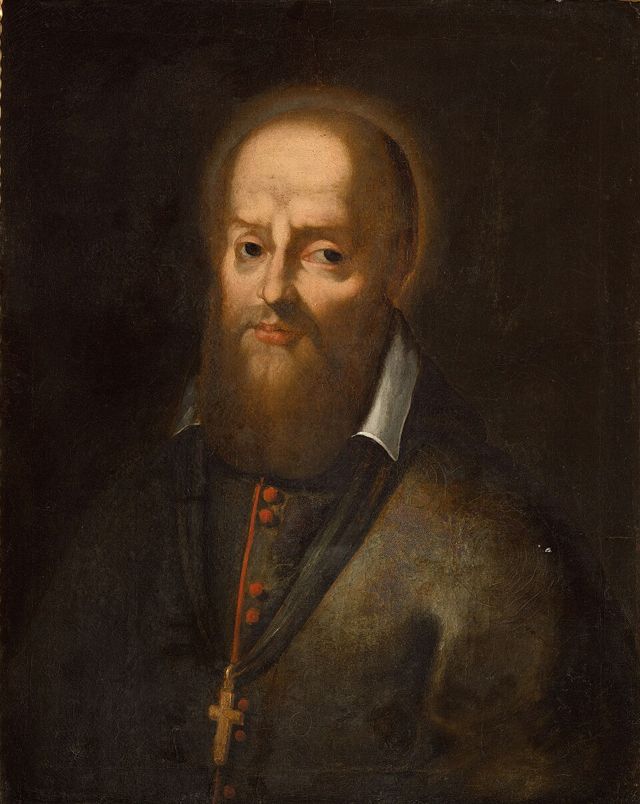
Francis of Sales was the eldest son of one of the main nobles of Savoy—John, Lord of Sales, of Boisy, of Balleyson, and of Ville-Roget, usually referred to by the second of these titles. His mother, Frances, was the daughter of the Lord of La Thuille and of Vallieres, and she came from equally noble lineage. He had many brothers and sisters, among whom Louis, Lord of La Thuille, was the father of Charles Augustus, the devout biographer of the Saint. Francis was born on August 21, 1567.
He was sent in early childhood to the college of Annecy, where he was educated in all the skills that were considered essential for a young noble at that time. He spent five years at the college of Annecy. At the age of eleven, he asked his father for permission to take the tonsure, having already decided at that young age to pursue an ecclesiastical life. M. de Boisy did not want this, as he hoped that his eldest son would succeed him as the head of the family and make a name for himself in politics. However, using a kind of management that experienced men often prefer over forceful measures, he allowed Francis to follow his wishes. The old lord understood that taking the tonsure did not permanently commit his son to becoming a clergyman, and he relied on the changes that often occur in a young man's mind to diminish this inclination.
In 1580, he was sent to continue his studies at the University of Paris. While in Paris, one of the most critical events of his life occurred: a terrible temptation to despair that came on suddenly and lasted for a considerable time. However, he was released from it in a remarkable way. He was about seventeen years old when the idea took hold of him that he was not in a state of grace and that God’s face was turned away from him. In his deep mental distress, he prayed, "Lord, if I may not see You hereafter, yet, oh grant that I may never blaspheme You!" He seemed to suffer the very anguish of hell, yet without losing his love for God.
During the six weeks that this shadow hung over him, he could hardly eat or sleep. He wasted away to a skeleton, and his friends became very concerned for his health. Finally, this heavy burden disappeared as suddenly as it had come. One day, he entered the church of Saint Etienne des Grés and knelt down before an image of the Blessed Virgin. His attention was drawn to a tablet on the wall that bore the famous prayer of Saint Bernard, known as the Memorare. He recited it with great emotion and begged that, through the intercession of Mary, it might please God to restore his peace of mind. He also made a vow of perpetual chastity. The dark thoughts that had plagued his soul for many weeks now vanished, and the sun of God’s favor shone upon him and warmed him once more. He left the church with a sweet and profound calmness of mind that he never lost again. Considering what he would become later in life, the guide and comforter of many souls, it was necessary for him to have experienced the deepest depths of human agony to develop his tender and overflowing sympathy.
After spending five years in Paris, he was sent to complete his education at the University of Padua. He stayed there until he was twenty-four years old, when, in 1591, he earned his degree as a doctor of laws. Soon after returning home, his father sent him to Chambéry to take the position of senator in the court. The young Francis took this opportunity to discuss with the Bishop the best steps to take in order to gain his family's consent to pursue a religious life, which he had long desired. The Bishop advised him to wait a little before revealing this intention. In the meantime, he obtained a bull from Rome that authorized Francis's appointment to the deanery of the cathedral, knowing that achieving this position would help soften his family's feelings toward his plans.
However, Francis's hopes seemed destined to be completely thwarted by his father's intense anxiety. His father wanted him to accept the position offered to him and also to marry a rich, kind, and beautiful girl, the daughter of one of their oldest friends. But Francis, to the surprise and despair of his parents, refused both offers. Not long after, as the suspense became unbearable for him and his calling grew stronger each day, he decided to reveal his true intentions to his father and mother. He took his cousin, Louis of Sales, with him and pleaded for their consent to become a priest.
M. de Boisy was stunned by his son's proposal, which completely took him by surprise, and he initially flatly refused his consent. However, after struggling against Francis's determination for a long time, he eventually yielded to the pleas of his wife. She warned him that opposing such a strong vocation would mean denying his son the chance to follow God's call. With his father's consent and blessing, Francis quickly returned to the Bishop of Geneva, from whom he received minor orders on June 8, 1593. The Bishop, who held Francis in high regard, told him that he expected him to preach the following Thursday, which was the Feast of Corpus Christi.
When the morning arrived, Francis was suddenly overcome with panic and threw himself onto his bed as the bells rang for service. However, overcoming his shyness, he got up and went to the cathedral, where he preached about the Real Presence in the Holy Eucharist. His sermon flowed from a heart that had long loved and adored that Presence. The Bishop was deeply moved by this discourse, and three prominent Calvinist gentlemen, who had come out of mere curiosity to hear the new preacher, were convinced and shortly thereafter were received into the Church of God.
On December 18th of the same year, Francis was elevated to the order of priests. His ecstatic devotion during this event astonished those who were present.
At this time, the Bishop received a request from the Duke of Savoy to send missionaries into the Chablais. This area is part of Savoy, located south of Lake Geneva, which had been forced into heresy by the canton of Berne in Switzerland. The situation was as follows. During the wars between the canton of Berne, which supported the rebellious city of Geneva against Duke Charles III of Savoy, who was engaged in war with Francis I, King of France, the troops from Berne invaded the province of Chablais and took it from him. Not satisfied with this takeover, the senate of Berne decided to undermine the Catholic faith in this region. To achieve this, they divided the conquered province into townships, with the main one established at Thonon, on the shores of the lake.
There were two large churches in the town, those of Saint Hippolytus and Saint Augustine. The authorities of Berne expelled the Catholic clergy and sent two aggressive reformers, Farel and Lambertet, to preach during Lent in 1536. Their goal was to persuade the people to reject many of the truths that the Church had taught them. They succeeded to some extent, but when Lambertet began to preach in the pulpit of the church of Saint Hippolytus, chaos broke out. He was completely denied a hearing, and one of the citizens forced him to come down from the pulpit.
To punish this disturbance, the government of Berne sent six commissioners who, on June 4th, destroyed and defaced the sacred images, burned the crosses, prohibited the practice of the Catholic religion, and expelled all the priests and religious figures. They also issued an edict forbidding any Catholic rites, imposing a fine of ten florins for each violation. In a few years, Catholicism was effectively banished from the region. Fifty-seven years passed, and due to the strict suppression of Catholicism, the people had grown up in heresy or complete disbelief.
Now, Chablais had been returned to the Duke of Savoy, and he wrote to the Bishop of Geneva, asking him to send a holy priest to Thonon to begin the work of guiding the people out of the darkness of error and into the clear light of the Gospel of Christ. The Bishop sent a virtuous priest, but the following year, the castle of Thonon was betrayed and destroyed by the troops from Berne. The poor priest, fearing for his life and completely discouraged about making any conversions among the Protestants, left his position and returned to report his failure to the Bishop in Annecy. However, the Duke was not discouraged by this situation. He rebuilt and fortified the castle of Allinges, located not far from Thonon, stationed a garrison there, and wrote again to the Bishop, pleading for more workers in the neglected spiritual vineyard.
The Bishop called a meeting of the Cathedral Chapter and gave a heartfelt speech about the Duke's letter, which he first read to the group. A deep and chilling silence followed the Bishop's appeal, but everyone turned to look at the young dean, whose face appeared radiant with joy and emotion. He stood up and said simply and sincerely, "My Lord, if you believe I am capable and worthy of this mission, I will undertake it with joy. At your word, I will let down my net!" The Bishop gratefully accepted this generous offer and prepared to do everything he could to help Francis succeed.
The scene in the castle of Sales was very different when the tragic news became known. M. de Boisy rushed to Annecy and overwhelmed Francis with pleas and accusations. "Did you not know that I must be about my Father's business?" was the Saint's reply. Then, throwing himself at his father's feet, he begged for his consent and blessing. M. de Boisy responded, "As for agreeing to this crazy undertaking, I cannot do it. There is no use in asking me." With that, the poor old man left the palace and returned in tears to his castle, where he was comforted, but not consoled, by the stronger faith of his wife.
On September 9th, 1594, Francis, accompanied by his cousin Louis, began his evangelical mission. They needed to pass by the castle of Sales, where Francis faced a new struggle with his family. "The Château of Sales," writes a contemporary of our Saint, "was at that time one of the most beautiful in Savoy, situated at the foot of Mount Ferreo, and surrounded by lovely gardens and shrubberies. A fountain in the center and a lake on one side added to its charms." Despite this beauty, Francis seems to have left without a thought or even a regret. During their visit, the cousins decided to spend a couple of days in retreat. On the evening of the second day, Francis went to say goodbye to his mother. Her behavior throughout had been admirable. After this painful farewell, Francis returned to the chapel, where, as a child, he had often knelt with his tender mother before the altar and repeated his childhood prayers evening after evening. There, he completed and offered the noble sacrifice of his entire future life to God. His natural sorrow was calmed in the Sacred Presence, and Francis spent the rest of the night in prayer for the success of his mission. The next morning, the cousins set off at dawn, avoiding any further goodbyes, and without servants or provisions, as his father had specifically forbidden any assistance, hoping to discourage them from their venture. Thus, in poverty, Saint Francis left his ancestral home. Nine years later, writing to the Pope, he stated, "On arriving in the Chablais, nothing but heart-breaking sights met our eyes. Out of sixty-five parishes, excepting a few officers of the Duke's garrisons, there were scarcely fifty Catholics. The churches were desecrated or destroyed, and the cross everywhere broken down."
It would be impossible to convey the anger of the Protestants of Thonon when they learned about the mission of the two cousins. The news spread quickly to Geneva, where a public meeting was immediately held to declare that anyone was free to kill the two Papists who had dared to undertake the mission. Some of the Protestants present even went so far as to swear that they themselves would be the ones to assassinate them.
M. de Boisy was alarmed when he heard that his son's life was in danger, so he sent his old and loyal servant, George Roland, with strict orders to bring Francis back. However, the Saint was not to be swayed. He did persuade his cousin, Louis, to return for a short time to ease the worries of his family, while he himself stayed to continue his important work. Louis complied, but soon came back, and the two dedicated missionaries worked tirelessly together to spread the Gospel. Francis traveled on foot among the villages, with only his stick, his breviary, and his Bible as companions, while Louis was sent to other parts of the province.
One night, on December 12th, while on an expedition, night fell suddenly. The ground was covered with snow, and he found himself alone in a large forest filled with wolves. Afraid of being eaten, he climbed up into a tree to spend the night. To prevent himself from falling asleep and dropping from the branch, he tied himself to the trunk with his leather belt. The next morning, some peasants from a nearby village found him there, nearly frozen and unable to move. They took him to their home, gently rubbed his numb limbs, and helped him regain warmth and consciousness. Their kindness was rewarded, as the Saint took the opportunity to talk to them about their eternal salvation. His gentle and loving voice and manner had a greater impact than his words, and the zeal he displayed in facing various dangers and hardships to bring back a few lost sheep to the fold spoke more powerfully to their hearts than a thousand sermons. These poor peasants were moved and touched, and Francis counted them among his first converts.
M. de Boisy sent George Roland back to Francis at the beginning of the year 1595. We owe much of the details of the most interesting personal adventures that happened to the Saint to the records of this faithful servant, who never left him from that moment on. However, God Himself intervened on several occasions to protect His servant from dangers that even George Roland was unaware of. There was one bigoted Protestant who, in a fit of fanatical rage, swore that he would kill Francis and take his head to Geneva. This man was later converted and testified under oath that he had attempted to ambush the Saint three times to fulfill his plan. Each time, his gun misfired, and he had assigned various others to kill him, but on each occasion, God made His apostle invisible. The instigator of this wicked plot was eventually moved by the remarkable way in which providence protected Francis from harm; he renounced his heresy and later became one of the Saint's most devoted followers.
At the beginning of the year 1595, Francis started a brief, clear, and simple explanation of Catholic doctrine, written on loose sheets for distribution among Protestants, along with answers to the main objections raised against the Faith. Everyone read and discussed these pamphlets, and the Protestants were extremely surprised at how all their favorite arguments were disproven. Some among them were equally astonished to find that their prejudices against the Catholic faith melted away in the light of God's truth.
The winter, which is always harsh in Savoy, was particularly severe this year. The roads were completely covered in ice, and Francis had to put iron clamps on his shoes to avoid slipping. He suffered greatly from painful chilblains, and his heels became so bad that blood stained the snow as he walked, seeping through his stockings and gaiters. One night, he arrived at a village with his cousin, Louis, only to find that all the doors were closed to them. They knocked and pleaded for admission in vain; the villagers, who had been biased against them, refused to offer them shelter. They ended up crawling into the village oven, which was still warm, and there they slept.
On July 17th, he preached a wonderful sermon at Thonon about the mediation of Jesus Christ. He showed his listeners that the Catholic Church, far from rejecting this doctrine as the Protestants claimed, based her entire system on it. The Calvinist ministers were furious about the impact of the sermon and held a public meeting where they decided to accuse him of sorcery and magic. They even bribed a man to testify that he had seen Francis communicating with devils at a witch's festival.
As he was walking through a wood at dusk right after this, two men attacked him with swords, shouting terrible curses. Francis faced them with such calmness that they were overwhelmed. They fell at his feet and begged for his forgiveness, claiming they were following orders from the Protestant clergy. The Saint forgave and blessed them, then continued on his way without further trouble.
The Calvinists, angrier than ever, hired a group of assassins who secretly came to the house where he was staying in the dead of night. Francis had not yet gone to bed. He was watching and praying in his room when he heard the sound of armed men in the street and their whispered conversation at the door. He quietly slipped into a hidden chamber, cleverly concealed by a panel in the wall that had been prepared for emergencies like this. The assassins searched the house from top to bottom but could not find him.
What promoted the Catholic faith far more than his sermons was his daily life of unwavering charity. Madame de Boisy eventually helped her husband to see and appreciate the beauty and reality of the mission their son was engaged in. This brought great relief to Francis, and from that time on, both parents worked together to support their son's apostolic efforts as much as they could. They provided shelter in the castle of Sales for converts who had to flee to escape the wrath of the heretics. It is impossible to overstate the tender care with which Madame de Boisy attended to their physical and spiritual needs.
Meanwhile, the Saint continued his pastoral work without interruption. Since he could not publicly carry the Blessed Sacrament through the streets of Thonon to the sick, he would take a Host in a small silver pyx shaped like a triangle, suspended by three little silver chains around his neck, and carry our Lord on his breast. Then, wrapping himself in a large cloak, he would walk very solemnly, looking down at the ground, without speaking to anyone or lifting his hat. This was the signal he had given to the faithful, who, upon seeing him pass in this manner, would leave their tasks and quietly follow him at a distance to avoid drawing hostile attention.
It brought him immense joy to carry the Blessed Sacrament in this way; his flock often noted that his face shone with the fire of his love during these moments. Since prudence still prevented the public celebration of the Mass in Thonon, Saint Francis would celebrate it in the small village of Marin, on the other side of the Drance River, in the old church of Saint Stephen.
On one occasion, he went to preach in an old parish church near Allinges. It was Saint Stephen's Day, 1595, and he called the inhabitants as usual by ringing a bell. However, due to very bad weather, only seven people came. Someone told him that it was not worth preaching to such a small audience. He replied, "One soul is as precious to me as a thousand." He then began a very eloquent discourse on the Invocation of Saints, explaining the doctrine and clearly refuting the Protestant objections.
Among his seven listeners was a magistrate from Thonon who had recently joined the Church. However, he had been troubled by the ministers, who had succeeded in shaking his weak faith. After the sermon, he fell at the feet of Saint Francis and exclaimed, "You have saved my soul this day!" He then stated that he had been thinking of abandoning his new Catholic faith the following Thursday. He explained that after hearing the bell ring and seeing only half a dozen poor peasants respond and come to the church, he thought that if Saint Francis were to preach, it would show that he loved souls. But if he did not preach, then he would be convinced that he sought applause.
He continued by saying that the effort Saint Francis made to explain the doctrine of the Communion of Saints to those half-dozen peasants had resolved his difficulties and convinced him of the grand and unutterable truth of the Catholic Church, of which he would always remain a member. Gradually, the work progressed. Francis was given three energetic assistants. For some time, the progress was very slow, but the great mass of the people was like an avalanche, slowly undermined, ready to fall in a body at the foot of the Cross.
It would go beyond our limits to detail the steps by which Saint Francis advanced the cause. Let us focus on the culmination of his efforts. In 1597, he celebrated the "Forty Hours" Exposition of the Blessed Sacrament in Thonon. The churches of Saint Augustine and Saint Hippolytus had been returned to the Catholics, and the Bishop arrived to consecrate them again and to administer the Sacraments of Confirmation and Ordination for the first time in sixty-three years. A huge crowd gathered from all directions. After the Blessed Sacrament was carried in procession through the town, it was placed in an oratory built for this purpose. Soon, a group of three hundred people from Bellevaux arrived, all asking to be admitted into the Church. The residents of Saint Cergue came next, bringing with them a cross that they had hidden between two walls during the Calvinist persecution, and this cross remains in the hamlet to this day. Some of these poor people arrived barefoot, carrying other symbols of the Passion of our Lord, such as the spear, the nails, and the crown of thorns. Then came the people of Bonneville, along with the nobility of the Chablais. One part of the procession arrived later than the others, and that was from the village of Ternier. They had been attacked by the fanatics from Geneva on their way. During the "Forty Hours" of Adoration, prayers, meditations, catechizing, and sermons followed one after another without interruption. The personal affection that all the people felt for Saint Francis, along with his tender and moving exhortations, gave an extra boost to the devotion of the spectators. Entire villages took the opportunity to return to the faith of their ancestors; and when the Exposition was over, the Bishop and Saint Francis had several difficult days receiving countless abjurations and administering the rites of conditional baptism and confirmation.
On September 30th, the Duke of Savoy visited Thonon, and the Chablais ceased to be Protestant. Few heretics remained, and the Duke ordered them to cross the lake to the land of Vaud, just as the Calvinists had previously expelled those who would not accept the end of their religion. The spiritual conquest achieved by Francis is commonly believed to have amounted to 72,000 souls.
In 1599, Saint Francis was appointed coadjutor bishop of Geneva. The ongoing disputes between France and Savoy were finally resolved by a treaty made in Lyons, in which the latter government ceded the province of Gex to the former. This province is located to the north of Lake Geneva and contains thirty-seven parishes with about 30,000 inhabitants. Saint Francis visited Paris in 1602 and persuaded Henry IV to restore the practice of the Catholic religion throughout Gex, wherever there were enough Catholics; the king only required that this be done gradually to avoid alarming the Protestants.
Francis now returned to Savoy, where the declining health of the elderly Bishop of Geneva made it necessary for him to be present. Some time before the bishop's death, he had the comfort of celebrating the jubilee at Thonon, which marked the conclusion of the history of the conversion of the Chablais region. Hundreds of thousands of pilgrims from all walks of life, in groups led by crosses and banners, came from the surrounding areas, filling the Alpine valleys with their devout songs as they thanked God for bringing them out of darkness into the glorious freedom of the children of God. More than a hundred confessors were continuously available at the confessional, and a total of 62,000 communions were received in the church of Thonon. On December 8, 1702, Francis was consecrated as bishop and appointed to the see of Geneva in the parish church of Thonon.
The first task that Francis undertook after settling in Annecy, the residence of the Bishops of Geneva after their expulsion by the Calvinists from the city of Geneva, was to establish a confraternity of Christian Doctrine and to focus on catechetical instruction as his main priority. He personally taught the classes every Sunday. There could not have been a more captivating sight than to see him seated in front of the altar, teaching the children, with the girls on one side and the boys on the other. Twice a year, he organized a festival for the children and led them through the city in a procession, singing Litanies. His kindness had such a profound effect on them that he never left without the children rushing out from every nook and cranny of the streets to ask for his blessing or to kiss his robe. When some friends complained about the crowds of children who followed him, he gently replied, "Let them come; they are my own dear little people."
In 1603, while he was preaching a series of sermons during Lent in Dijon at the invitation of the local officials, he met Jane Frances of Chantal. Together, they later founded the Order of the Visitation. In 1605 and 1606, he conducted a general visitation of his entire diocese, enduring great fatigue and often facing danger while traveling through the Alpine regions, which made up most of his diocese. He preached, taught the faith, and heard confessions everywhere he went.
In 1618, Francis was chosen by the Duke of Savoy to accompany a delegation to Paris to negotiate the marriage of the Duke's son to the daughter of Henry IV and sister of Louis XIII. The negotiations lasted nearly a year, during which Francis received constant invitations to preach, which he accepted almost daily. The people never grew tired of listening to him. The secret of his influence lay in the remarkable charm of divine grace that radiated from him. The churches were so packed that on more than one occasion, a ladder had to be brought for him to enter through a window, as the doors were completely blocked. People rushed to see him or to touch his robe as he walked through the streets. Cardinal de Retz, the Bishop of Paris, was eager to have him as his assistant and offered him a generous pension, full control of his diocese, and the appointment of his brother, John Francis, to succeed him in Geneva if he would agree to come; but all of this was in vain.
Gradually, the entire territory of Gex became Catholic, and Francis had the joy of continually establishing new parishes that had embraced the Gospel of Christ. Towards the end of 1622, he was invited to meet the Duke of Savoy in Avignon, where he was to see Louis XIII. Francis had a feeling that this journey would be his last, but he felt it was not right to decline the invitation from his sovereign. Therefore, he prepared himself with complete calmness, as if he would not return. He made his will and gave instructions for his funeral, which he wished to be simple. On November 8th, he said goodbye to his friends and set off the next day.
In Lyons, a minor incident occurred that is worth mentioning as an example of his kind and gentle nature. As he was about to board the boat, the ferryman refused to let him on without his passport. When his attendants became upset about the delay, the bishop said, "Let him be; he knows the duties of a boatman; we have forgotten those of a traveler." He had to wait an hour for the passport in a bitterly cold wind. When they finally boarded, he went and sat next to the boatman, saying, "I wish to make friends with this good man and to talk to him a little about our Blessed Lord."
At Avignon, he kept himself apart from all the grandeur that the reunion of two courts in that splendid age displayed so lavishly. Instead, he spent his time in prayer and in discussions with religious individuals. On his way home, he stayed in Lyons, where he was very ill. Nevertheless, he celebrated his midnight Mass on Christmas morning and preached with great fervor that day. He then heard confessions and celebrated his third Mass shortly before noon, after which he broke his fast.
After that, he gave the habit to two novices, preached again, received several visitors, and attended to Queen Marie de Medicis, who was set to leave Lyons the next day. Yet, he was actually a dying man when he managed to fit such astonishing efforts into one day. The next day, on the Feast of Saint Stephen, he said his last farewell to the nuns of the Visitation, the order he had founded. The following morning, he confessed, celebrated Mass, and gave Holy Communion to the nuns. The Superioress noticed how much he had changed in appearance.
Outside the church, he was held up talking to some noblemen. It was cold and foggy, and he felt a chill. By the time he got home, he was extremely fatigued and ill; however, he sat down to write letters and received several visitors. After they left, his servant came in and began to tell him about a sermon he had heard, in which the preacher urged the Queen to love her servants. Francis asked, "And you, do you love me?" The good servant could not speak for crying, seeing how gravely ill he looked. The saint continued, "And I, too, love you well; but let us love God above all." As he spoke these words, he sank back in a fit.
The next day, the doctors resorted to all the methods used in the brutal surgery of the time, including blisters on the head, the application of a hot iron to the back of the neck, and a red-hot ball pressed on the crown until it burned to the bone. After these procedures, he gradually declined, and while his lips moved in prayer, unable to form words, those present knelt and recited the "Recommendation for a departing soul," during which his gentle spirit departed to its rest.
After being embalmed, his body was taken to Annecy and now rests in the Church of the Visitation.
Footnotes
- Memorare: a well-known prayer asking for the intercession of the Blessed Virgin Mary.
- M. de Boisy refers to Monsieur de Boisy, a title of respect in French.
- Farel and Lambertet were reformers sent to preach in Chablais.
- The Duke of Savoy was a ruler in the region of Savoy.
- The castle of Allinges is near Thonon.
- The Château of Sales was a beautiful castle in Savoy.
- Chablais is a region in the Alps, now part of France and Switzerland.
- M. de Boisy was a supporter of Francis.
- George Roland was a loyal companion of Francis.
- Madame de Boisy was a noblewoman who supported her son's mission.
- The Drance River is a river in the region of Thonon, France.
- Saint Stephen's Day is celebrated on December 26.
- The Communion of Saints refers to the Christian belief in the spiritual union of all members of the Christian community.
- The spiritual conquest achieved by Francis is commonly believed to have amounted to 72,000 souls.
- Cardinal de Retz was a prominent figure in the Church and politics of France.
- The following life is summarized from Mr. Ormsby's "Life of Saint Francis of Sales," and "The Mission of Saint Francis of Sales in the Chablais" by Lady Herbert. See also Addenda at the end of this volume.
- Saint Serena, martyr, at Metz, A.D. 303.
- Saint Sabina or Savina, virgin, in the Milanese, beginning of the 4th century.
- Saint Barsas, bishop of Edessa, circa A.D. 371.
- Saint Felix, Pope, A.D. 530.
- Saint Aldegund, virgin, at Maubeuge in France, circa A.D. 680.
- Saint Adelelm, abbot, in Burgos, circa A.D. 1100.
- Saint Hyacintha, virgin, at Viterbo, A.D. 1640.
Baring-Gould’s own footnotes, in modern English.
Read the original 1870s text
Baring-Gould’s sources: Roman Martyrology. Beatified, a.d. 1661, canonized, a.d. 1665. Jan. 29th, is the day of the translation of his body to Annecy; he died on Holy Innocents' Day. Authorities: authentic lives by his nephew, Charles Augustus de Sales, also by F. Goulu, general of the Feuillans, also by Henry de Maupas du Tour, Bishop of Puys, and afterward of Evreux; also by Madame de Bussi-Rabutin, nun of the Visitation; also anecdotes of him collected by his friend Camus, Bishop of Belley; and finally, his own writings. [133]
S. Francis of Sales was the eldest son of one of the principal nobles of Savoy,—John, Lord of Sales, of Boisy, of Balleyson, and of Ville-Roget, usually styled by the second of these titles. His mother Frances, daughter of the Lord of La Thuille and of Vallieres, came of no less noble stock. He had many brothers and sisters, of whom Louis, Lord of La Thuille, was the father of Charles Augustus, the pious biographer of the Saint. Francis was born, Aug. 21st, 1567.
He was sent in early childhood to the college of Annecy, where he was trained in all the accomplishments which in those days were considered essential to the rank of a young noble. He was five years at the college of Annecy. At the age of eleven, he entreated permission of his father to take the tonsure [shaving part of the head as a sign of entering the clergy or monastic life], having at that early age decided to adopt the ecclesiastical life. M. de Boisy by no means desired this, for his ambition was, that his eldest son should succeed him as the head of the family, and distinguish himself in political life; but, with that sort of management which men of great experience often prefer to violent measures, he permitted him to do as he pleased. The old lord knew that the tonsure did not bind his son finally to become an ecclesiastic; and he depended on the changes to which a young man's mind is subject, to dissipate this predilection.
In 1580, he was sent to pursue his studies in the University of Paris. At Paris one of the most critical events of his life took place, a terrible temptation to despair, which came on suddenly, and lasted for a considerable time, but from which he was released in a wonderful manner. He was about the age of seventeen, when the idea took possession of his mind, that he was not in a state of grace, and that the face of God was turned away from him. In his agony of mental distress he prayed, "Lord if I may not see Thee hereafter, yet, oh grant, that I may never blaspheme Thee!" He seems, if it were possible, to have suffered the very anguish of hell, without the loss of the love of God. During the six weeks this shadow lay upon him, he could hardly eat or sleep, he wasted to a skeleton and his friends became greatly alarmed for his health. At length, this great cross disappeared as suddenly as it came. He one day entered the church of S. Etienne des Grés and knelt down before an image of the Blessed Virgin. His eye was caught by a tablet on the wall, on which was inscribed the famous prayer of S. Bernard, called the Memorare . He repeated it with great emotion; and implored that, through the intercession of Mary, it might please God to restore his peace of mind. He also made a vow of perpetual chastity. The dark thoughts which had brooded over his soul for many weeks now sped away, and the sun of God's favour shone on it and warmed it once more. He came out of the church in that sweet and profound calmness of mind which he never afterwards lost. Considering what he was to become in after life, the guide and comforter of such a multitude of souls, it was necessary, in order to give him his tender overflowing sympathy, that he should have sounded the most unusual depths of human agony.
After having spent five years at Paris, he was sent to finish his education at the university of Padua, and there he remained till he was twenty-four years of age, when, in 1591, he took his degree of doctor of laws. Soon after his return home, his father sent him to Chambéry, to take the office of senator in the court, and the young Francis took the opportunity of conferring with the Bishop on the steps which it would be most advisable for him to take, in order to ensure the consent of his family to his embracing the ecclesiastical state, on which his heart had long been set. The Bishop advised him to wait a little, before declaring this intention; and, in the mean time he obtained a bull from Rome authorizing the appointment of Francis to the deanery of the cathedral, knowing that the attainment of this dignity would soften the feelings of the family towards the purposed steps. The hopes of Francis, however, seemed destined to be frustrated altogether by the extreme anxiety of his father, both that he should accept the post offered him, and also that he should marry a rich, amiable, and beautiful girl, the daughter of one of their oldest friends. But Francis, to the surprise and despair of his parents, refused both offers. Not long after, the suspense becoming intolerable to him, and his vocation day by day stronger, he resolved to reveal the cause to his father and mother, and taking with him his cousin, Louis of Sales, he implored their consent to his becoming a priest. M. de Boisy was stupified at his son's proposal, which took him completely by surprise, and at first flatly refused his consent. But after combating the resolution of Francis for a long time, he yielded to the entreaties of his wife, who warned him that, should he oppose so decided a vocation, it would be refusing him permission to follow the voice of God. Armed with his father's consent and blessing, Francis lost no time in hastening back to the Bishop of Geneva, from whom he received minor orders [the lower ranks below deacon, such as reader and acolyte, abolished in 1972] on June 8th, 1593. The Bishop, who had the highest opinion of his power, told him that he expected him to preach on the following Thursday, which was the Feast of Corpus Christi. When the morning came, Francis was seized with a sudden panic, and he cast himself on his bed when the bells were ringing for service. But, overcoming his bashfulness, he rose and went to the cathedral, where he preached on the Real Presence in the Holy Eucharist, a sermon which flowed from a heart which had long loved and adored that Presence. The Bishop was much moved by this discourse, and three leading Calvinist gentlemen who had come out of sheer curiosity to hear the new preacher were convinced, and shortly after were received into the Church of God.
On the 18th December of the same year, Francis was promoted to priests' orders, on which occasion his ecstatic devotion amazed the assistants.
At this time the Bishop received an appeal from the Duke of Savoy to send missionaries into the Chablais. This is a portion of Savoy to the south of the lake of Geneva, which had been forced into heresy by the canton of Berne in Switzerland. The circumstances were as follows. During the wars between the canton of Berne, supporting insurgent Geneva against the Duke of Savoy, Charles III, who was thus engaged in war with Francis I., King of France, the troops of Berne had invaded the province of Chablais, and has wrested it from him. Not content with this usurpation, the senate of Berne determined to undermine the Catholic religion in this canton, and for this purpose divided the conquered province into townships, of which the principal was fixed at Thonon, on the borders of the lake. There were two large churches in the town, those of S. Hippolytus, and S. Augustine. The authorities of Berne drove out the Catholic clergy, and sent two violent reformers, Farel and Lambertet to preach during Lent [the forty days of fasting before Easter] in 1536, and try to prevail on the people to disbelieve the majority of those truths which the Church had taught them. This they accordingly did, but when Lambertet began to preach in the pulpit of the church of S. Hippolytus, a scene of confusion ensued; he was absolutely refused a hearing, and one of the citizens forced him to come down from the pulpit. The government of Berne, to punish this tumult, sent six commissioners, who, on the 4th of June, destroyed and defaced the sacred images, burnt the crosses, forbade the exercise of the Catholic religion, and drove away all the priests and religious; and by edict forbade the exercise of any Catholic rite under a penalty of ten florins for each offence. In a few years, to all intents and purposes, Catholicism was banished from the land. Fifty-seven years had passed, and by means of rigid suppression of Catholicism, the people had grown up in heresy or total unbelief. Now, the Chablais was returned to the Duke of Savoy, and he wrote to the Bishop of Geneva, entreating him to send some holy priest to Thonon to inaugurate the work of leading the people out of the darkness of error into the clear light of the Gospel of Christ. The Bishop sent a virtuous priest, but the following year the castle of Thonon was betrayed and destroyed by the Bernese troops, and the poor priest, fearing for his life, and utterly despairing of effecting any conversions among the Protestants, quitted his post, and returned to report his failure to the Bishop at Annecy. But the Duke, no way disheartened by this state of things, rebuilt and fortified the castle of Allinges not far from Thonon, placed it in a garrison, and wrote again to the Bishop, imploring for fresh workers in the neglected spiritual vineyard.
The Bishop summoned a meeting of the Cathedral Chapter, and made a moving discourse before them on the subject of the Duke's letter, which he first read to the assembly. A profound and chilling silence followed the Bishop's appeal, but all turned to look at the young dean, whose face seemed radiant with joy and emotion. He rose, and said simply and earnestly, "My Lord, if you think me capable and worthy of this mission, I undertake it with joy. At thy word will I let down my net!" The Bishop gratefully accepted the generous offer, and prepared to do all for Francis that lay in his power to ensure his success.
Far different, however, was the scene in the castle of Sales, when the fatal news became known. M. de Boisy flew to Annecy, and overwhelmed Francis with entreaties and reproaches. "Wist ye not that I must be about my Father's business," was the reply of the Saint; then throwing himself at his father's feet, he besought his consent and his blessing. M. de Boisy replied, "As to consenting to this mad undertaking, I cannot do it. It is of no use asking me;" and so saying, the poor old man left the palace, and returned in tears to his castle, there to be soothed, but not consoled, by the stronger faith of his wife.
On Sept. 9th, 1594, Francis, accompanied by his cousin, Louis, started on his evangelical mission. It was necessary to pass by the castle of Sales, when Frances had a fresh battle to fight with his family. "The Château of Sales," writes a contemporary of our Saint, "was at that time one of the most beautiful in Savoy, situated at the foot of mount Ferreo, and surrounded with lovely gardens and shrubberies. A fountain in the centre, and a lake on one side, added to its charms." Yet all this Francis seems to have left without a thought or even a regret. During their visit, the cousins determined to spend a couple of days in retreat. The evening of the second day, Francis went to take leave of his mother. Her conduct throughout had been admirable. This terrible parting over, Francis went back to the chapel, where, as a child, he had so often knelt with that tender mother before the altar and repeated, evening after evening, his childish prayers, and there the noble sacrifice of his whole future life to God was consummated and accepted. His natural sorrow quenched in the Sacred Presence, Francis spent the rest of the night in prayer, for the success of his mission; and the next morning the cousins started at break of day, avoiding all further leave-takings; and without either servants or provisions; his father having expressly forbidden any assistance being given to them, hoping thereby to disgust them of their enterprise. So, in poverty, S. Francis left his ancestral home. Nine years afterwards, writing to the Pope, he says, "On arriving in the Chablais, nothing but heart-breaking sights met our eyes. Out of sixty-five parishes, excepting a few officers of the Duke's garrisons, there were scarcely fifty Catholics. The churches were desecrated or destroyed, and the cross everywhere broken down."
It would be impossible to give an idea of the fury of the Protestants of Thonon when they heard of the mission of the two cousins. The news flew to Geneva, where a public meeting was instantly held to declare that any one was at liberty to take the lives of the two Papists who had dared to undertake the mission; some of the Protestants present went so far as to swear that they themselves would be their assassins. M. de Boisy was alarmed when news reached him that the life of his son was menaced, and he sent his old and faithful servant, George Roland, with positive orders to bring Francis back; but the Saint was not to be moved; he, however, persuaded his cousin, Louis, to go back for a short while, in order to calm the anxiety of his family, whilst he himself remained to prosecute his great work. Louis obeyed, but soon returned, and the two earnest missioners laboured indefatigably together to advance the Gospel. Francis went on foot among the villages, his stick, his breviary, and his Bible being his sole companions; Louis being sent into other parts of the province.
One night, on the 12th December, being on an expedition of this kind, night came on suddenly; the earth was covered with snow, and he found himself alone in a large wood infested with wolves. Afraid of being devoured, he climbed up into a tree to pass the night; and then, lest he should fall asleep and drop from the branch, he tied himself with his leathern girdle to the stem. The next morning some peasants from a neighbouring village found him there, nearly frozen with cold, and unable to move. They carried him to their home, gently chafed his numbed limbs, and brought him back to warmth and consciousness. Their charity was not without its reward, for the Saint profited by the occasion to speak to them on things concerning their eternal salvation. His gentle, loving voice and manner effected even more than his words, and the zeal he had shown in braving every kind of peril and suffering for the sake of bringing back a few stray sheep to the fold, spoke more forcibly to their hearts than a thousand sermons. These poor peasants were moved and touched, and S. Francis numbered them among his first converts. M. de Boisy sent George Roland back to Francis at the beginning of the year 1595, and to the records of this faithful servant, who from that hour never left him, we are mainly indebted for the details of the most interesting personal adventures which befell the Saint. But God Himself interposed on several occasions to save His servant from dangers of which even George Roland knew nothing. There was one bigoted Protestant, who in the height of fanatical fury, swore that he would murder Francis and carry his head to Geneva. This man was afterwards converted, and declared on oath that he had thrice waylaid the Saint to accomplish his purpose, and that each time his gun missed fire, and that he had posted various other persons to kill him, but on each occasion God had rendered His apostle invisible. The instigator of this diabolical design was at last touched by the wonderful way in which providence shielded Francis from harm; he abjured his heresy, and became afterwards one of the Saint's most devoted followers.
At the beginning of the year 1595, Francis began a short, clear, and simple exposition of Catholic doctrine, written on loose sheets for distribution among Protestants, with an answer to the principal objections raised against the Faith. Every one read and discussed these fly-leaves—and the Protestants were beyond measure surprised at the way in which all their favourite arguments were disproved, while some among them were equally startled at finding how their prejudices regarding the Catholic faith melted away before the sunshine of God's truth.
The winter, always severe in Savoy, was this year one of unusual rigour. The roads were one sheet of ice, and Francis was obliged to put iron clamps on his shoes, in order to prevent himself from slipping. As he suffered terribly from broken chilblains, his heels became in such a state that the blood stained the snow as he walked along, penetrating through his stockings and gaiters. One night he arrived, with his cousin, Louis, at a village where all the doors were closed against him. In vain they knocked and entreated for admission; the inhabitants, who had been prejudiced against them, refused to give them shelter; they crept into the village oven, which was still warm, and there slept.
On the 17th July, he preached a wonderful sermon at Thonon on the mediation of Jesus Christ. He showed his hearers that the Catholic Church, so far from destroying this doctrine, as the Protestant asserted, based her whole system upon it. The Calvinist ministers were exasperated at the effect of the sermon, and held a public meeting, in which it was resolved to charge him with sorcery and magic. They even suborned a man to swear that he had seen Francis in communication with devils at a witch's festival. As he was walking through a wood at dusk immediately after this, two men rushed upon him with swords, uttering horrid imprecations. Francis met them with such composure, that they were overcome, and casting themselves at his feet, implored his pardon, alleging as their excuse the orders they had received from the Protestant clergy. The Saint forgave and blessed them, and pursued his road, unmolested. The Calvinists, more furious than ever, hired a body of assassins who came secretly, in the dead of the night to the house in which he lodged. Francis had not yet gone to bed. He was watching and praying in his room, when he heard the tramp of armed men in the street, and their whispered consultation at the door. He quietly slipped into a secret chamber, cleverly concealed by a panel in the wall which had been provided in case of any such emergency, and the assassins hunted through the house from garret to cellar without being able to find him. What promoted the Catholic faith far more than his sermons, was his daily life of never-failing charity. Madame de Boisy at last brought her husband to see and feel the beauty and reality of the mission in which their son was engaged. This was an untold relief to Francis; and from that time, father and mother worked together in forwarding to the utmost of their power the apostolic labours of their son. They gave shelter in the castle of Sales to such of the converts as were compelled to resort to flight in order to escape the fury of the heretics; and it is impossible to exaggerate the tender zeal with which Madame de Boisy looked after their temporal and spiritual wants. The Saint, in the meanwhile, continued without intermission his pastoral work. As he could not carry the Blessed Sacrament publicly through the streets of Thonon to the sick, he used to take a Host in a little silver pyx in the shape of a triangle, suspended by three little silver chains round his neck, and thus bear our Lord on his breast. Then wrapping himself up in a large cloak, he would walk along very gravely, looking on the ground, without speaking to any one, or raising his hat. This was the sign he had given to the faithful, who no sooner saw him passing in that manner than they left their occupations and silently followed, though at a little distance, so as not to excite hostile observation. It was an intense joy to him to carry the Blessed Sacrament in that way: his flock often remarked that his face on such occasions positively shone with the fire of his love. As prudence still forbade the public sacrifice of the Mass in Thonon, S. Francis used to celebrate it in the little village of Marin, on the other side of the river Drance, in the old church of S. Stephen.
On one occasion he went to preach in an old parish church near Allinges; it was S. Stephen's Day, 1595, and he summoned the inhabitants as usual by ringing a bell, but, as it was very bad weather, only seven people came. Some one said to him that it was not worth while his preaching to so small an audience. He replied, "One soul is as precious to me as a thousand;" and he began a most eloquent discourse on the Invocation of Saints, of which he explained the doctrine, and refuted the Protestant objections with great clearness. Among his seven hearers was a magistrate of Thonon who had lately joined the Church, but had been beset by the ministers, who had succeeded in shaking his feeble faith. After the sermon, he threw himself at the feet of S. Francis and exclaimed, "You have saved my soul this day!" He then declared that he had meditated abjuring his new Catholicism next Thursday; that having heard the bell ring, and seen only half-a-dozen poor peasants obey the summons, and come to the church, he had thought that, if S. Francis were to preach, it would be a proof that he loved souls, but if he did not preach, then he would be convinced that he sought applause. He went on to say that the pains taken by S. Francis to explain to those half-dozen peasants the doctrine of the Communion of Saints, had cleared away his difficulties, and had convinced him of the grand and unutterable truth of the Catholic Church, of which he would ever remain a member. Little by little the work advanced; Francis was given three energetic assistants; for some time the progress was very small, but the great mass of the people were like an avalanche, slowly undermined, to fall in a body at the foot of the Cross.
It would exceed our limits to detail the steps by which S. Francis advanced the cause. Let us turn to the crowning of his labour. In 1597, he celebrated the "Forty Hours" Exposition of the Blessed Sacrament at Thonon. The churches of S. Augustine and S. Hippolytus had been given up to the Catholics, and the Bishop arrived to consecrate them anew, and to administer the Sacraments of Confirmation and Ordination for the first time for sixty-three years. An enormous crowd assembled from all quarters. After the Blessed Sacrament had been carried in procession through the town, it was placed in an oratory erected for the purpose. Very soon a crowd came up, consisting of three hundred people, inhabitants of Bellevaux, all begging to be admitted into the Church. The inhabitants of S. Cergue arrived next, bearing with them a cross which had been concealed by them between two walls during the Calvinist persecution, and which cross remains in the hamlet to this day. Some of these poor people arrived barefoot bearing other emblems of the Passion of our Lord, the spear, the nails, the crown of thorns. Then came the people of Bonneville, with the nobility of the Chablais. One portion of the procession arrived later than the rest, and that was from the village of Ternier. They had been attacked by the fanatics of Geneva on their way. During the "Forty Hours" of Adoration, prayers, meditations, catechizings, and sermons succeeded each other without intermission. The personal love which all the people felt for S. Francis, together with his tender and touching exhortations, gave an additional impulse to the devotion of the spectators. Whole villages took the opportunity of returning to the faith of their fathers; and when the Exposition was over, the Bishop and S. Francis had several hard days' work in receiving such numberless abjurations and administering to them the rites of conditional baptism and confirmation.
On September 30th, the Duke of Savoy visited Thonon, and the Chablais ceased to be Protestant. Few heretics now remained, and the Duke ordered them to cross the lake to the land of Vaud, as the Calvinists before had expelled those who would not submit to the abolition of their religion. The spiritual conquest achieved by Francis has been commonly reckoned to have amounted to 72,000 souls.
In 1599, S. Francis was appointed coadjutor [an assistant bishop who will succeed the current one] bishop of Geneva. The continual disputes between France and Savoy were at length adjusted by a treaty contracted at Lyons, by which the latter government yielded to the former the province of Gex to the north of the lake of Geneva, containing thirty-seven parishes, with about 30,000 inhabitants. S. Francis visited Paris in 1602, and persuaded Henry IV. to re-establish the exercise of the Catholic religion throughout Gex, wherever there were a sufficient number of Catholics; only the king stipulated that this should be done gradually, so as to avoid giving alarm to the Protestants.
Francis now returned to Savoy, where the failing health of the aged Bishop of Geneva made it necessary for him to be present. Some time previous to his death, he had the consolation of celebrating the jubilee at Thonon, by which the history of the conversion of the Chablais was wound up. Hundreds of thousands of pilgrims of all ranks, in companies preceded by cross and banner, poured from all the country round, making the Alpine valleys resound with their pious chants, as they thanked God for having brought them out of darkness into the glorious liberty of the children of God. More than a hundred confessors were engaged continually at the tribunal of penance; and altogether 62,000 communions were made in the church of Thonon. On Dec. 8th, 1702, Francis was consecrated bishop, and appointed to the see of Geneva [a bishop’s “see” is his diocese, named from his seat (Latin sedes)], in the parish church of Thonon.
The first business which Francis undertook after he was settled at Annecy, the seat of the Bishops of Geneva, after their expulsion by the Calvinists from the city of Geneva, was to establish a confraternity of Christian Doctrine, and to make catechetical instruction his strongest point. He heard the classes himself every Sunday. A more interesting sight there could not be than to behold him, seated in front of the altar, teaching the little ones, the girls on one side, and the boys on the other. Twice in the year he made a festival for the children, and went through the city with them processionally, singing Litanies. The influence of his kindness over them was so great, that he never came forth, without the children running out from every nook and corner of the streets to ask his blessing or kiss his robe. When some friends complained of the troops of them who followed him, he said gently, "Suffer them to come, they are my own dear little people."
In 1603, when he was preaching the Lent course of sermons at Dijon, by invitation of the magistrates, he made the acquaintance of Jane Frances of Chantal, in combination with whom he afterwards founded the Order of the Visitation. In 1605 and 1606, he made a general visitation of his whole diocese, undergoing great fatigue, and often danger, in traversing the Alpine districts, which formed the greatest part of it, and everywhere preaching, catechizing, and hearing confessions. In 1618, Francis was chosen by the Duke of Savoy to accompany an embassy to Paris to negotiate the marriage of his son with the daughter of Henry IV., and sister of Louis XIII. The negotiations of the embassy lasted for nearly a year, during which Francis received incessant invitations to preach, which he did almost daily; the people never tiring of listening to him. The secret of his power lay in the exquisite charm of divine grace which radiated from him. The churches were so crowded, that it more than once happened that a ladder had to be brought for the preacher to enter by the window, the doors being completely blocked up. People ran to gaze at him, or to touch his robe as he passed in the streets. Cardinal de Retz, Bishop of Paris, had set his heart on having him as his coadjutor, and offered him a rich pension, the entire control of his diocese, and the appointment of his brother, John Francis, to succeed him at Geneva, if he would consent to come; but all was in vain.
By degrees the whole of the territory of Gex was catholicized, and Francis had the felicity of continually organizing fresh parishes which had submitted to the Gospel of Christ. Towards the close of 1622, he was invited to attend the Duke of Savoy at Avignon, where he was to meet Louis XIII. Francis had a presentiment that this journey would be his last; but he did not think it right to decline the invitation of his sovereign. Accordingly he made preparation, with the utmost calmness, as if to return no more. He made his will, and gave directions concerning his funeral, which he desired should be modest. On November 8th he bade farewell to his friends and started next day. At Lyons a trifling incident happened, which is worth relating, as an example of his sweet and gentle demeanour. As he was going on board the boat, the ferryman refused to receive him without his passport. When his attendants were angry at the delay, the bishop remarked, "Let him alone, he knows the duties of a boatman; we have forgotten that of a traveller." He had to wait an hour for the passport in a bitterly cold wind. When at last they got on board, he went and sat by the boatman, observing, "I wish to make friends with this good man, and to talk to him a little of our Blessed Lord."
At Avignon he held aloof from all the magnificence which the reunion of two courts in that splendid age so lavishly displayed, and spent his time in prayer, and in conference with religious persons. On his way home he remained at Lyons, very ill. Nevertheless he said his midnight Mass on Christmas morning and preached on the day with great fervour. He then heard confessions, and said his third Mass shortly before noon, after which he broke his fast. Then he gave the habit to two novices, preached, received a number of visitors, and waited on the Queen Marie de Medicis, who was to leave Lyons next day. Yet he was actually a dying man when he thus crowded such astonishing exertions into one day. Next day, the Feast of S. Stephen, he bade his last farewell to the nuns of the Visitation, the order he had founded. On the following morning he confessed, said Mass, and gave the Holy Communion to the nuns. The Superioress noticed his altered looks. Outside the church he was detained talking to some noblemen. It was cold and foggy, and he felt a chill. By the time he got home he was excessively fatigued and ill; but he sat down to write letters, and received several visitors. On their departure his servant came in, and began to tell him about a sermon he had heard, in which the preacher exhorted the Queen to love her servants. Francis said, "And you, do you love me?" The good servant could not speak for weeping, seeing how deadly ill he looked. The saint continued: "And I, too, love you well; but let us love God above all," As he said these words he sank back in a fit. Next day the physicians resorted to all the expedients used in the barbarous surgery of the age, blisters on the head, the application of a hot iron to the nape of the neck, and a red-hot ball pressed on the crown till it burnt to the bone. He gradually sank after these operations, and his lips moving in prayer, when unable to utter words, those in attendance knelt and recited the "Recommendation for a departing soul," during which his gentle spirit departed to its rest.
The body, after having been embalmed, was removed to Annecy, and reposes in the Church of the Visitation.
FOOTNOTES:
[133] The following life is epitomized from Mr. Ormsby's "Life of S. Francis of Sales," and "The Mission of S. Francis of Sales in the Chablais" by Lady Herbert. See also Addenda at end of this volume.
S. Serena , M., at Metz , a.d. 303. S. Sabina or Savina , W., in the Milanese, beginning 4th cent. S. Barsas , B.C., of Edessa, circ. a.d. 371. S. Felix , Pope , a.d. 530. S. Aldegund , V., at Maubeuge in France, circ. a.d. 680. S. Adelelm , Ab., Burgos, circ. a.d. 1100. S. Hyacintha , V., at Viterbo , a.d. 1640.