St. Fidelis of Sigmaringen

Fidelis of Sigmaringen was born in 1577 at Sigmaringen, where his father, Johannes Rey, was burgomaster; he died at Sevis on 24 April 1622.

Read the essentials →
Feast April 24 · Martyr

St. Fidelis of Sigmaringen

Current feast

April 24
Verified · General Roman Calendar

Traditional feast

April 24
1914 / pre-1969 calendar, per Baring-Gould (1897)

Represents

Martyr

Feast days

Feast: April 24

This Saint’s Story

On his father's side he was of Flemish ancestry. He studied at Freiburg, and in 1604 became tutor to Wilhelm von Stotzingen, travelling with him in France and Italy; Wilhelm later testified to the severe mortifications his tutor practised on those journeys. In 1611 Fidelis took the doctorate in canon and civil law at Freiburg and began to practise as an advocate, but open corruption in the courts led him to leave the law for the Church. Ordained the next year, he entered the Capuchin (a strict branch of the Franciscan friars, founded 1525) Franciscans (the order of friars founded by St. Francis of Assisi) at Freiburg and took the name Fidelis. After theology at Constance he was guardian at Rheinfelden, Freiburg, and Feldkirch, and gained a name as a preacher.

He worked to convert those who had left the Catholic Faith by preaching and by anonymous pamphlets against Calvinism and Zwinglianism, now lost. Still guardian at Feldkirch in 1621, he was sent on a Capuchin mission into the Grisons, where most had gone over to Calvinism. Before setting out he was charged by the papal nuncio to reform the Benedictine (monks following the Rule of St. Benedict) monastery at Pfafers. He told a fellow friar that since entering the order he had prayed never to fall into mortal sin and to die for the Faith. At Mayenfeld from Advent onward he preached and catechized, often in several places the same day, and at Zizers won the public conversion of Rudolph de Salis, after which many others followed.

Heretic preachers stirred the people against him, saying his mission was political. After Easter 1622 Propaganda named him superior of the Grisons mission. He preached a farewell sermon at Feldkirch as if foreseeing martyrdom. On 24 April, after Mass at Grusch, he went to Sevis and began to preach; a tumult broke out, and outside a crowd offered him life if he would apostatize. He answered that he had come to root out heresy, not to embrace it, and was struck down. The Catholic Encyclopedia calls him the first martyr of Propaganda. His body was taken to Feldkirch; his head and left arm were placed in the cathedral at Coire. He was beatified (declared 'Blessed', the step before sainthood) in 1729 and canonized (officially declared a saint by the pope) in 1745. His feast is 24 April.

Short entry · the summary here is 31 words; Baring-Gould’s fuller original text and its sources are below. We have not filled any gap with invented detail.

What he represents

How he teaches us to live

Drawn from themes in the original account

Celebrate this saint’s feast day. Remember him on April 24 with a short prayer, and ask for his help.

The full story

Baring-Gould’s account retold in modern English

Read the full story · 31 words · about 1 min

The murderers had cut off the head and arm of the saint. These were recovered and placed in the cathedral of Chur. His body was moved to Weltkirche on April 1.

Footnotes

  1. Weltkirche (a church in Switzerland).

Baring-Gould’s own footnotes, in modern English.

Read the original 1870s text

Baring-Gould’s sources: Roman Martyrology. Beatified by Benedict XIII., in 1729, and canonized by Benedict XIV., in 1745.] S. Fidelis was bom in 1577, at Sigmaringen, a little town in the principality of Hohenzollem. His father Johann Rey, and his mother Genoveva von Rosenberg, were of noble birth and good Catholics. He studied in the university of Freiburg, in Breisgau, and became a lawyer at Colmar, in Alsace. But his heart was drawn to God, and he longed to devote himself to the salvation of the poor souls who had been led by Haller of Bern, Zwingle of Zurich, and CEcolampadius of Basle, into doubt and disbelief in some of the great verities of the Christian religion. Accordingly, Fidelis resigned his profession, and joined the Capuchin friars, in Freiburg, in 1612. He speedily became conspicuous through his zeal, fervour and piety. He was ordained priest, and sent to Weltkirchen, as superior of the Capuchin convent there, and he was successful in converting many Calvinists to the Gospel ol Christ A pestilence having broken out in the garrison, which extended to the inhabitants of Weltkirchen, Fidelis devoted himself to the sick with entire 6elf-forgetfulness. His reputation became so great that the congregation of the Propaganda, established by Gregory XV., having asked of the provincial of the Capuchins zealous missionaries to combat the heresies which were spreading over, and corrupting the faith and morals of Switzerland, he was chosen to head a mission in the Grisons. His success was astonishing, so mightily grew the Word of God and prevailed, and the Zwinglian preachers taking the alarm, resolved on his murder. On the 24th of April, 1621, he went from Grusch to Seewis, where he exhorted the Catholics to stand constant in the faith once for all delivered to the saints. During his discourse, a Zwinglian shot at him with his musket, but missed him. His people implored him to place himself in safety; he replied that he was ready to shed his blood for Christ The same day he started to return to Grusch, and fell into the hands of a party of Zwinglians, headed by one of their preachers, who were lying in wait for him. They endeavoured to force him to admit their false doctrines. He replied that he had come to refute their errors, and not to embrace them. Then one of the party shot him, and he fell on his knees. “Lord Jesus,” said he raising his eyes and hands to heaven; “ Have mercy on me; and do thou Mary, Mother of God, succour me !” Another of the Protestants fired at him, and the ball struck him; then he fell forward, and the rest finished him with their long knives. Thus he died, at the age of forty-five; and like S. Stephen, the protomartyr, by his death gained the soul of his persecutor, for the minister who had stood by consenting to his death, renounced his heresy, and was received into the fold of the Catholic Church.

The murderers had hacked off the head and arm of the saint. These were recovered, and placed in the cathedral of Chur; his body was translated to Weltkirchea I April 35.

From the Catholic Encyclopedia

1913 · 1064 words

Born in 1577, at Sigmaringen, Prussia, of which town his father Johannes Rey was burgomaster; died at Sevis, 24 April, 1622. On the paternal side he was of Flemish ancestry. He pursued his studies at the University of Freiburg in the Breisgau, and in 1604 became tutor to Wilhelm von Stotzingen, with whom he travelled in France and Italy. In the process for Fidelis's canonization Wilhelm von Stotzingen bore witness to the severe mortifications his tutor practised on these journeys. In 1611 he returned to Freiburg to take the doctorate in canon and civil law, and at once began to practise as an advocate. But the open corruption which found place in the law courts determined him to relinquish that profession and to enter the Church. He was ordained priest the following year, and immediately afterwards was received into the Order of Friars Minor of the Capuchin Reform at Freiburg, taking the name of Fidelis. He has left an interesting memorial of his novitiate and of his spiritual development at that time in a book of spiritual exercises which he wrote for himself. This work was re-edited by Father Michael Hetzenauer, O.F.M. Cap., and republished in 1893 at Stuttgart under the title: "S. Fidelis a Sigmaringen exercitia seraphicae devotionis". From the novitiate he was sent to Constance to finish his studies in theology under Father John Baptist, a Polish friar of great repute for learning and holiness. At the conclusion of his theological studies Fidelis was appointed guardian first of the community at Rheinfelden, and afterwards at Freiburg and Feldkirch. As a preacher his burning zeal earned for him a great reputation.

From the beginning of his apostolic career he was untiring in his efforts to convert heretics nor did he confine his efforts in this direction to the pulpit, but also used his pen. He wrote many pamphlets against Calvinism and Zwinglianism though he would never put his name to his writings. Unfortunately these publications have long been lost. Fidelis was still guardian of the community at Feldkirch when in 1621 he was appointed to undertake a mission in the country of the Grisons with the purpose of bringing back that district to the Catholic Faith. The people there had almost all gone over to Calvinism, owing partly to the ignorance of the priests and their lack of zeal. In 1614 the Bishop of Coire had requested the Capuchins to undertake missions amongst the heretics in his diocese, but it was not until 1621 that the general of the order was able to send friars there. In that year Father Ignatius of sergamo was commissioned with several other friars to place himself at the disposal of this bishop for missionary work, and a similar commission was given to Fidelis who however still remained guardian of Feldkirche. Before setting out on this mission Fidelis was appointed by authority of the papal nuncio to reform the Benedictine [monks following the Rule of St. Benedict] monastery at Pfafers. He entered upon his new labours in the true apostolic spirit. Since he first entered the order he had constantly prayed, as he confided to a fellow-friar, for two favours: one, that he might never fall into mortat sin; the other, that he might die for the Faith. In this Spirit he now set out, ready to give his life in preaching the Faith. He took with him his crucifix, Bible, Breviary, and the book of the rule of his order; for the rest, he went in absolute poverty, trusting to Divine Providence for his daily sustenance. He arrived in Mayenfeld in time for Advent and began at once preaching and catechizing; often preaching in several places the same day. His coming aroused strong opposition and he was frequently threatened and insulted. He not only preached in the Catholic churches and in the public streets, but occasionally in the conventicles of the heretics. At Zizers one of the principal centres of his activity, he held conferences with the magistrates and chief townsmen, often far into the night. They resulted in the conversion of Rudolph de Salis, the most influential man in the town, whose public recantation was followed by many conversions.

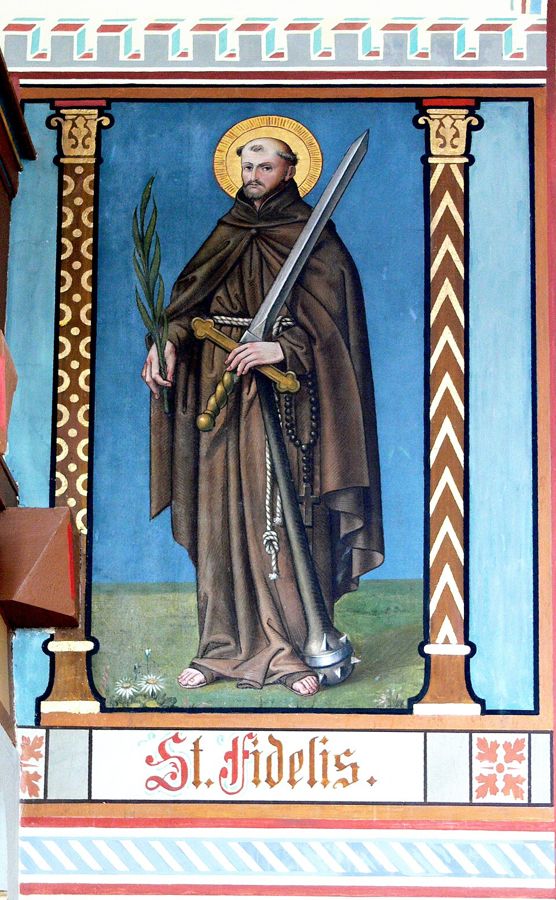
Throught the winter Fidelis laboured indefatigably and with such success that the heretic preachers were seriously alarmed and set themselves to inflame the people against him by representing that his mission was political rather than religious and that he was preparing the way for the subjugation of the country by the Austrians. During the Lent [the forty days of fasting before Easter] of 1622 he preached with especial fervour. At Easter he returned to Feldkirch to attend a chapter of the order and settle some affairs of his community. By this time the Congregation of the Propaganda had been established in Rome, and Fidelis was formally constituted by the Congregation, superior of the mission in the Grisons. He had, however, a presentiment that his laborers would shortly be brought to a close by a martyr's death. Preaching a farewell sermon at Feldkirch he said as much. On re-entering the country of the Grisons he was met everywhere with the cry: "Death to the Capuchins!" On 24 April, being then at Grusch, he made his confession and afterwards celebrated Mass and preached. Then he set out for Sevis. On the way his companions noticed that he was particularly cheerful. At Sevis he entered the church and began to preach, but was interrupted by a sudden tumult both within and without the church. Several Austrian soldiers who were guarding the doors of the church were killed and Fidelis himself was struck. A Calvinist present offered to lead him to a place of security. Fidelis thanked the man but said his life was in the hands of God. Outside the church he was surrounded by a crowd led by the preachers who offered to save his life if he would apostatize. Fidelis replied: "I came to extirpate heresy, not to embrace it", whereupon he was struck down. He was the first martyr of the Congregation of Propaganda. His body was afterwards taken to Feldkirch and buried in the church of his order, except his head and left arm, which were placed in the cathedral at Coire. He was beatified in 1729, and canonized in 1745. St. Fidelis is usually represented in art with a crucifix and with a wound in the head; his emblem is a bludgeon. His feast is kept on 24 April.
Help us add to this saint's story

Everything is read by a person before anything appears. Facts are checked against trusted sources first.

Facts are welcome; a source link helps (optional).With your permission we may share it on this page.

Nine days · Free

Pray the novena
with us.

One short email a day for nine days. The day's prayer, a line from St. Fidelis of…'s story, and a nudge to keep going.

Also on April 24
M

St. Mellitus

April 24 · Feast
E

St. Elizabeth Hesselblad

April 24 · Religious, Founder
← All 1970 saints in the library
Sources & notes

Feast-day sources

Story sources

Sources

Credits

Image: Pfärrenbach Wandmalerei Fidelis von Sigmaringen.jpg · Photo: Andreas Praefcke · Public domain, via Wikimedia Commons

Image: Photo: Andreas Praefcke, Wikimedia Commons (Public domain)

From “Catholic Encyclopedia (1913)/St. Fidelis of Sigmaringen,” The Catholic Encyclopedia (New York: Robert Appleton Company, 1907–1914), via Wikisource. Public domain. Matched by name and feast date; text unedited except for our bracketed notes in grey.

Retold in plain modern English from Baring-Gould’s public-domain text, sentence by sentence, keeping the same facts and order. Short explanations in parentheses are ours.

From Sabine Baring-Gould, The Lives of the Saints, new edition in 16 vols. (London: John C. Nimmo, 1897–98); text from the Internet Archive scan (OCR, lightly cleaned; errors possible). Public domain in the United States. Reproduced unedited, except for short bracketed notes in grey that we added to explain names and terms (“S.” is the old abbreviation for Saint). Some history and judgments reflect 19th-century scholarship.

Notes

Story retold in our own words from the cited sources.