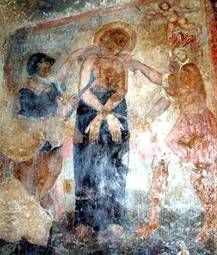
During the persecution of Diocletian, there was a convent of fifty virgins in Sibapte, Syria. One of them, Febronia, was eighteen years old and the niece of the abbess, Bryene. She was remarkably beautiful and graceful, and the older sisters seemed to regard her with a sense of reverence because of her extraordinary physical beauty and purity of soul. Raised among the sisters from infancy, she read the Holy Scriptures, fasted, prayed, and sang psalms with them. Febronia became filled with heavenly thoughts, and her understanding of divine matters was greatly admired.
Women from the outside world came to hear her interpret Scripture in the convent. However, to prevent distractions and protect her from the gaze of the public, Bryene placed a curtain between Febronia and the visiting ladies, so they could not see her face. One day, a young pagan woman, grieving for her husband whom she had married only seven months before, came to the convent. She had found no comfort in her parents' religion. Falling at Bryene's feet, she begged to see and speak with Febronia, hoping to hear words that might soothe her troubled spirit.
The abbess hesitated but was eventually moved by the young woman's tears. She agreed and allowed her to meet the young nun. They spent the night reading the Gospel and discussing Christian teachings. They embraced and wept together, and when the widow left the convent, she had converted to Christianity.
"Who was that traveling nun who wept as if she had never heard the holy Scriptures explained before?" Febronia asked. "It was Hieria," answered the nun Thomais. "Hieria, the widow of a senator."
“Ah!” said Febronia, “why didn’t you tell me her rank? I spoke to her as if she were my sister.” The noble widow truly became the sister and friend of the nun. She stayed with her during a serious illness that kept Febronia confined to the narrow plank of wood on which she rested. Febronia was recovering when Selenus, the minister of imperial cruelty, arrived at Sabapte, tasked with enforcing the decrees against the Christians. He was accompanied by his nephews, Lysimachus and Primus. The former was suspected by the emperor of having a tendency towards Christianity because his mother had been a Christian. Therefore, Selenus thought it wise to carry out the decrees with exceptional zeal and cruelty. He also involved his nephew Lysimachus in the hearings and sentencing of the Christians to eliminate any suspicion in the emperor's mind. Primus, a young man related to Lysimachus through his mother, shared Lysimachus's disgust for Selenus's cruelty. However, the two young men could only warn the Christians to escape before their uncle visited any town.
As soon as the bishop and clergy of Sibapte learned that the governor was about to visit, they scattered and hid themselves. The nuns, in great distress, approached their abbess and begged for permission to flee for their lives. Bryene told them not to worry, as the danger was only a threat and had not yet reached them. She was torn with anxiety because Febronia was not strong enough to be moved, and she did not want to leave her behind. The sisters consulted one another and chose a nun named iEtheria as their spokesperson. They made a second appeal and complained, “We know the real reason you don’t want us to escape is your concern for Febronia. But are we really better off than the bishop and clergy, who have already secured their safety? Remember that there are dangers that threaten us worse than death and torture, and we should have fled before the clergy did. Let us take Febronia with us and carry her away.” However, Febronia could not be moved, and the abbess had to dismiss the nuns. All of them left the convent except for Thomais, the writer of this history, Procla, a nun who cared for Febronia, and the abbess Bryene.
Almost immediately after, news arrived of the governor's arrival. Febronia heard Bryene sobbing. She looked at Thomais and asked, “I pray you, mother, why is the Great Mistress (for this was the title of the abbess) crying so bitterly?”
“My child,” answered the old nun, “she is worried about you. We are old and unattractive, and all that can happen to us is death; but you are young and beautiful, and there are dangers we fear for you that you know nothing about. We need not say more to you, dear child, than to advise you to be very careful about accepting any offers from the governor, no matter how innocent they may seem — comfort, wealth, happiness — there is a danger hidden beneath them that you cannot imagine.”
The night passed with anxious conversation and mutual encouragement. The next morning, Selenus sent soldiers to the convent, who broke open the door and would have killed Bryene, had not Febronia jumped up from the bench where she lay and thrown herself at the soldiers' feet, begging them to kill her instead of her old aunt.
Primus arrived at this moment, scolded the soldiers for their violence, and ordered them to leave the house. Then, turning to Bryene, he asked her why they had not escaped from the place. “You had plenty of warning; and even now I will withdraw the soldiers. Take the opportunity and flee.” Primus then left, and perhaps his advice would have been followed, had not Selenus prevented it by almost immediately sending the soldiers back to the convent with orders that Febronia should be captured and brought before him.
The next day, Selenus took his place on the tribunal, accompanied by his nephew, whom he forced to attend. Bryene and Thomais also appeared, each holding the hand of the young girl, and begging to be tried and condemned alongside her. “They are old and ugly, dismiss them,” said Selenus, and the two nuns were separated from their charge. Bryene, unable to bear the sight of her beloved niece's suffering, returned to the convent and asked that word be sent to her about how the contest was proceeding. “Mother,” said Febronia, “I trust in God that as I have always been obedient to you in the monastery, so I may be faithful to your exhortation here before all the people. Go then and pray for me, but first give me your blessing.” Then Bryene raised her hands to heaven and cried, “Lord Jesus Christ, who appeared to your handmaiden Thecia in her agony to comfort her, stand by this lowly one in her great contest.” After saying this, she fell on Febronia's neck, and they kissed, wept, and clung to one another until they were separated by the soldiers.
Meanwhile, Hieria had heard about Febronia's arrest, and wild with grief, she rushed to the place of judgment to witness the death of her friend and guide. She found the large area of the court crowded with people, mostly women, who were agitated, indignant, and muttering. There was a space where the accused stood before the tribunal, and on one side were various instruments of torture, along with a great stake driven into the ground, equipped with rings and ropes. On the judgment seat were Selenus and Lysimachus. Selenus turned to his nephew and said, “You begin the examination.”
The young man struggled to control his emotions and began, “Tell me, young maiden, what is your condition?” “I am a servant,” answered Febronia.
“Whose servant?” asked Lysimachus. “I am the servant of Christ,” she replied. “And may I ask your name, maiden?”
“The good mother always calls me Febronia.” Then Selenus interrupted, “We will not get anywhere if we continue like this; let’s get to the point. Febronia, I swear by the gods that I do not wish to harm you. Here is a brave young man, my nephew; take him as your husband and forget your false religion. I had other plans for him, but that does not matter. I have never seen a sweeter face than yours, and I am ready to accept you as my niece. I am a man of few words; accept my offer, or by the living gods, I will make you regret your refusal.”
Then Febronia replied, “I have a Bridegroom in the heavens, eternal, with all celestial glory as His dower.” Selenus shouted, “Strip the girl, soldiers.” They obeyed. They only covered her with a tattered cloak. Calm and showing no signs of being disturbed, Febronia endured the humiliation. “How now! Impudent hussy!” mocked Selenus; “where is your maiden modesty, that you do not blush or struggle?”
“God Almighty knows, O Judge, that until this day I do not remember ever having seen a man, for I was taken when I was just two years old into the convent of my aunt, and there I spent my life, seeing only the good sisters. Do I seem lost to shame? No! But I am stripped like a wrestler in the games to strive for victory. I do not fear you.”
“Stretch her face downward over a slow fire, binding her hands and feet to four stakes, and then scourge her,” said Selenus. It was done, and the red blood trickled over her white skin with every stroke of the lash, hissing in the red-hot charcoal. The crowd could not bear to watch, and they all pleaded with the judge to have mercy on the girl and spare her. But their pleas only made him angrier, and he ordered the blows to be increased. Thomais could not take it any longer; she fainted at the feet of Hieria, who cried out, “Febronia! My sister! Thomais is dying.” The poor sufferer turned her head and asked the soldiers to throw some water on her face, and she begged to be allowed to speak to Hieria. But the judge intervened to deny this request and ordered Febronia to be taken away and attached to the rack. “Well, girl, how do you like this first taste of justice?” “Learn from the way I have endured it that my resolution is unbreakable,” answered Febronia.
On the rack, her sides were torn with iron combs. She prayed continuously, “O Lord, make haste to help me, do not leave me, do not leave me in this hour of anguish!” “Cut out her tongue,” ordered the judge. Febronia was taken down from the rack and tied to the post in the center of the arena. But when the crowd saw what the executioner was about to do, their excitement and anger became so threatening that the judge thought it wise not to carry out his order. Instead, he instructed the surgeon present to extract her teeth. After he had removed seventeen, Selenus told him to stop. “Cut off her breast,” he commanded. This horrific order caused an uproar. The physician hesitated. But Selenus was clearly enraged. “Coward, go on, cut!” he shouted, and the surgeon, with a swift motion of the razor, sliced off her right breast. Febronia cried out as she felt the cold steel cut into her, “My Lord! My God! see what I suffer, and receive my soul into Your hands.” These were the last words she spoke. “Cut off the other breast, and set fire to the wound,” said Selenus. He was obeyed. The crowd swayed and trembled with anger, and with a roar they shouted in condemnation, “Cursed be Diocletian and all his gods!” Then Hieria and Thomais sent a girl running to the convent to Bryene to tell her everything. The old abbess threw herself on the ground sobbing, “Febronia, my child!” Then, raising her arms and straining her eyes to heaven, she cried, “Lord, regard Your humble handmaiden, Febronia, and may my aged eyes see the work accomplished, the battle fought, and my child numbered among the martyrs.”
In the meantime, Selenus had ordered the cords that bound Febronia to the stake to be removed. Then she collapsed onto the sand, and her long hair flowed over and covered her bleeding body.
Primus said quietly to Lysimachus, “The poor young girl is dead.” “She has died to bring light and conviction to many hearts, perhaps to mine,” said Lysimachus aloud. “Would that it had been in my power to save her. Now let her finish her struggle and enter into her rest.”
Then Hieria burst into the arena, wild with anger and grief before the judge, and screamed as she shook her hands at him, “Oh, monster of cruelty, shame on you, shame! You, born of a woman, have forgotten your duty to honor womanhood, and have insulted and outraged your mother in the person of this poor girl. God, the Judge above all judges, will act swiftly against you, and root you out of the land of the living.”
June 30. Saint Febronia.
Selenus, stung by these words, frustrated by the obvious disgust of the crowd, and realizing that he had incited his nephews to defy his authority, shouted to the soldiers to bind the widow and torture her.
At this moment, some local authorities intervened and warned the judge that he was going too far. Hieria was well-connected and popular, and if she were tortured, half the city would rush into the court and demand to be tried and martyred as well, “for they will all confess Christ.”
Selenus reluctantly ordered the release of Hieria, who was eagerly preparing to be tortured, and directed his anger toward Febronia, who was now unconscious. He ordered that her hands, then her feet, and finally her head be cut off. When all was done, he rose from his seat, turned to Lysimachus, and saw that his face was covered in tears. He quickly left for supper, angry with himself, his nephews, and the crowd. Lysimachus would neither speak nor eat and went to his room, ignoring his uncle's commands.
In a fit of rage, Selenus jumped up from the table and paced the room, fuming. He tripped and fell headfirst against a pillar. The impact caused his death, as he never spoke again and was dead by the next day. Lysimachus then ordered that Febronia's body be taken with all reverence to the house of Bryene. Almost the entire city gathered to see the body of the beautiful young girl who had suffered so bravely. The bishop and clergy returned, and Lysimachus and Primus, standing by the mangled body, vowed to renounce the gods of Diocletian and to worship God and believe in the faith of the martyr Febronia. They were both baptized, and when Constantine became emperor, they both retired into solitude and embraced the religious life.
Footnotes
- Hieria was the widow of a senator.
- The Great Mistress refers to the abbess.
- Febronia: a Christian martyr known for her steadfast faith.
- Selenus: a judge who persecuted Christians.
- Hieria: a companion of Febronia.
- Thomais: a friend of Febronia who fainted during the torture.
- Selenus was a judge involved in the execution.
- Diocletian was a Roman emperor known for his persecution of Christians.
Baring-Gould’s own footnotes, in modern English.
Read the original 1870s text
Baring-Gould’s sources: Modern Roman Marty rology and later Latin Martyrologists. Greek Men ea and Menology on 15th or 24th June. On the latter day also the Coptic and Abyssinian H agio logics. Authority Ad account of the Life and Passion of Febronia by a nun of the same convent, and an eye-witness ot her martyrdom, named Thomais. T he account is so fresh and full of natural touches, so circumstantial, that its authenticity can hardly be doub:ed. The only reason for hesitation in accepting it, is that in the reign of Diocletian we should not have expected monastic life to have been as fully developed as it is here represented. However, there are othei, indicant ns of such having been the case from an early period, and as the Church had enjoyed peace for some time, it is by no means improbable that such institutions were flourishing in the Eas, when the persecution u* Diocletian broke out.) Of all the histories of virgin martyrdom, there is scarcely one more touching and beautiful than that of Febronia, as A tfi there is none described more fully than hers by a friend and witness of the sufferings.
During the persecution of Diocletian [Roman emperor 284–305, who began the ‘Great Persecution’ of Christians in 303], there was at Sibapte in Syria, a convent of fifty virgins. One of them, Febronia, aged eighteen, was a niece of the abbess, Bryene. She was wondrously fair of face and graceful of form, and the old sisters seem to have regarded her with a reverential awe on account of her marvellous loveliness of body and purity of soul. Nourished from infancy among the sisters, reading the Holy Scriptures, fasting, praying, chanting psalms with them, Febronia became full of heavenly thoughts, and her understanding in divine things was much wondered at Women of the world came to hear her interpret Scripture in the convent; but so as not to distract the thoughts of her charge and expose her to the vulgar gaze, Bryene drew a curtain between her and the ladies who visited her, so that they never saw her face. And one day there came a young heathen woman, in the first grief at the loss of her husband, to whom she had been married seven months. She had found no consolation in the religion of her parents, and falling at the feet of Bryene, besought her to suffer her to see and converse with Febronia, that perhaps she might from her lips hear words which would be balm to her wounded spirit The abbess hesitated, but moved at last by the tears of the young woman, she consented, and admitted her to the presence of the young nun. They passed the night in reading the Gospel and conferring upon Christian doctrine. Embracing each other, they wept together, and the widow left the convent converted to the faith of Christianity. 44 Who then,” asked Febronia, 44 was that travelling nun, who wept as if she had never heard the holy Scriptures explained before T “It was Hieria,” answered the nun Thomais. “Hieria the widow of a senator.”
“Ah!” said Febronia, “why did you not tell me her rank ? I spoke to her as to a sister.” The noble widow became in truth the sister and friend of the nun, she remained with her during a serious illness, which confined Febronia to the narrow plank of wood on which she took her repose. She was convalescent when Selenus, the minister of imperial cruelty, arrived at Sabapte, charged with the execution of the decrees against the Christians. He was accompanied by his nephews, Lysimachus and Primus, the former of whom was suspected by the emperor of having a leaning towards Christianity, his mother having been a Christian, and therefore Selenus deemed it expedient to execute the decrees with extraordinary zeal and cruelty, and to associate his nephew Lysimachus with him in the hearing and sentencing of the Christians, so as to dispel the suspicion in the imperial mind. Primus, a youth akin to Lysimachus on his mother's side, shared the disgust felt by Lysimachus for the cruelty of Selenus, but all the two young men could do was to send warning to the Christians to escape, before their uncle visited any town. As soon as the bishop and clergy of Sibapte heard that the governor was about to visit that place, they dispersed, and secreted themselves The nuns in great agitation waited on their abbess, and entreated permission to escape for their lives. Bryene bade them be without alarm, as the danger only threatened, and was not yet at their doors. She was distracted by anxiety, as Febronia was not strong enough to be removed, and she was unwilling to leave her. The sisters took counsel together, and electing one named iEtheria as their spokewoman, made a second remonstrance, and complained, “We know the real objection to our escaping is your solicitude for Febronia; but are we so much better than the bishop and clergy, who have already placed themselves in security? Remember that there are dangers which threaten us worse than death and torture, and therefore we ought to have taken flight before the clergy escaped. Let us take Febronia with us, and carry her away.” Febronia however could not be moved, and the abbess was obliged to dismiss the nuns, who all deserted the convent, except Thomais, the writer of the history, and Procla, a nun who attended on Febronia, and the abbess Bryene.
Almost immediately after, news arrived of the entrance of the governor. Febronia heard Bryene sobbing. She looked to Thomais, and asked, 11 1 pray you, mother, what is the Great Mistress (for this was the title of the abbess) crying so bitterly for?”
“My child,” answered the old nun, “she is anxious at heart about you. We are old and ugly, and all that can befall us is death; but you are young and fair, and there are things we fear for you of which you know nothing. We need not say more to you, dear child, than bid you be very careful how you accept any offers of the governor, however innocent they may seem — ease, riches, happiness — a danger is hidden beneath them you little dream of.” The night passed in anxious conversation and mutual encouragement. Next morning Selenus sent soldiers to the convent, who broke open the door, and would have cut down Bryene, had not Febronia started from the bench on which she lay, and casting herself at the feet of the soldiers, implored them to kill her rather than her old aunt. Primus arrived at this juncture, rebuked the soldiers for their violence, and bade them leave the house. Then turning to Bryene, asked her why they had not escaped from the place. “ You had plenty of warning; and even now I will withdraw the soldiers. Take the chance, and fly.” Primus then withdrew, and perhaps his advice would v£ Febronia.
have been followed, had not Selenus prevented it, by almost immediately sending the soldiers back to the convent with order that Febronia should be secured and brought before him.
Next day Selenus ascended the tribunal, accompanied by his nephew, whom he forced to attend. Bryene and Thomais also appeared, each holding a hand of the young girl, and begging to be tried and condemned with her. “ They are old and ugly, dismiss them,” said Selenus; and the two nuns were separated from their charge. Bryene, unable to endure the sight of her beloved niece's sufferings, returned to the convent, and begged that word might be sent her how the contest proceeded. “ Mother," said Febronia; “ I trust in God that as I have been ever obedient to thee in the monastery, so I may be faithful to thy exhortation here before all the people. Go then and pray for me, but first give me thy benediction." Then Bryene stretched her hands to heaven and cned, “ Lord Jesus Christ, who didst appear to thy hand-maiden Thecia in her agony to comfort her, stand by this lowly one in her great contest,” So saying she fell on the neck of Febronia, and they kissed and wept and clung to one another, till parted by the soldiers. Hieria, in the mean time, had heard of the arrest of Febronia, and wild with grief she rushed to the place of judgment to witness the death of her friend and guide. She found the great area of the court crowded with people, mostly women, agitated, indignant and muttering. There was a space where stood the accused before the tribunal, and at one side were various instruments of torture, and a great stake driven into the soil furnished with rings and ropes. On the judgment seat were Selenus and Lysimachus. Selenus turned to his nephew and said, “ Do you begin the examination.”
The young man with difficulty controlled his emotion, and began, “Tell me, young maiden, what is thy condition ?” “I am a servant,” answered Febronia.
“Whose servant ?” asked Lysimachus. “ I am the servant of Christ” “ And tell me thy name, I pray thee.” “lama humble Christian,” answered Febronia. “ May I ask thee thy name, maiden ?”
“ The good mother always calls me Febronia.” Then Selenus broke in: “ We shall not have done if we proceed in this fashion; to the point at once. Febronia, I swear by the gods that I have no wish to hurt thee. Here is a gallant young man, my nephew; take him as thy husband, and forget thy false religion. I had other views for him, but that matters not, never have I seen a sweeter face than thine, and I am ready to accept thee as a niece. I am a man of few words, accept my offer, or by the living gods, I shall make thee rue the refusal.” Then Febronia answered, “ I have a Bridegroom in the heavens, eternal, with all celestial glory as his dower.” Selenus burst forth with, “Strip the girl, soldiers.” He was obeyed. They only clothed her with a tattered cloak. Calm, without a sign of being discomposed, Febronia bore the outrage. “ How now ! impudent hussey !” scoffed Selenus; “ where is your maiden modesty, that you blush not, nor struggle ?”
“God Almighty knows, O Judge, that till this day I never remember to have seen a man, for I was taken when a babe of two years old into the convent of my aunt, and there I spent my life, seeing only the good sisters. Do I seem lost to shame ? Nay ! but I am stripped as a wrestler in the games to strive for victory. I fear thee not” “ Stretch her face downward over a slow 6*. Febronia.
fire, binding her hands and feet to four stakes and then scourge her,” said Selenus. It was done, and the red blood trickled over her white skin at every stroke of the lash, and hissed in the red-hot charcoal The multitude could not bear the sight, and with one voice entreated the judge to pity the girl and spare her. But their intercession only exasperated him to greater fury, and he ordered the blows to be redoubled. Thomais could endure no more, she fell fainting at the feet of Hieria, who uttered a cry of 44 Febronia 1 my sister ! Thomais is dying.” The poor sufferer turned her head, and asked the soldiers to throw some water over her face, and begged to be allowed to speak to Hieria. But the judge interfered to forbid this indulgence, and ordered Febronia to be taken off, and attached to the rack. 44 Well, girl * how like you this first taste of justice?” 44 Learn from the manner in which I have borne it, that my resolution is invincible,” answered Febronia.
On the rack her sides were torn with iron combs. She prayed incessantly, 44 O Lord, make haste to help me, leave me not, leave me not in this hour of anguish !” “Cut out her tongue,” ordered the judge. Febronia was detached from the rack and tied up to the post in the centre of the arena. But when the multitude saw what the executioner was about to do, the excitement and indignation became so menacing, that the judge thought it prudent not to insist on the execution of his order. Instead of which he bade the surgeon in attendance extract her teeth. When he had drawn seventeen, Selenus bade him desist 44 Cut off her breas s.” This atrocious order caused an uproar. The physician hesitated. But Selenus was fairly roused. 44 Coward, go on, cut !” he shouted, and the surgeon with a sweep of the razor sliced off her right breast Febronia cried as she felt the cold steel gash her, TJune *5.
“ My Lord ! My God ! see what I suffer, and receive my soul into Thy hands.” These were the last words she spoke. 44 Cut off the other breast, and put fire to the wound,” said Selenus. He was obeyed. The mob swayed and quivered with indignation, and with a roar broke forth in execration, 44 Cursed be Diocletian and all his gods 1” Then Hieria and Thomais sent a girl running to the convent to Bryene to tell her all And the old abbess flung herself on the ground sobbing, 44 Bra 1 bra ! bra ! Febronia, my child !” then raising her arms and straining eyes to heaven she cried, 44 Lord, regard thy humble handmaiden, Febronia, and may my aged eyes see the work accomplished, the battle fought, and my child numbered with the martyrs.
In the meantime Selenus had ordered the cords to be removed which bound Febronia to the stake. Then she fell in a heap on the sand, and her long hair flowed over, and clothed her bleeding body.
Primus said under his breath to Lysimachus, 44 The poor young girl is dead.” 44 She has died to bring light and conviction to many hearis, perhaps to mine,” said Lysimachus aloud. 44 Would that it had been in my power to have saved her. Now let her finish her conflict and enter into her rest”
Then Hieria bursting into the arena stood wild with indignation and anguish before the judge, and shrieked as she shook her hands at him, 44 Oh, monster of cruelty, shame on thee, shame 1 Thou born of a woman hast forgotten thy obligation to honour womanhood, and hast insulted and outraged thy mother in the person of this poor girl. God the Judge above judges will make a swift work with thee, and cut it short, and root thee out of the land of the living.”
June a$.j S. Febronia. Selenus, stung with these words, exasperated with the ill-concealed abhorrence of the mob, and finding that he had fairly roused his nephews into defiance of his authority, shouted to the soldiers to bind the widow, and rack her.
But at this point some of the authorities of the town interfered, and warned the judge that he was proceeding to dangerous lengths. Hieria was well-connected, popular, and if she were tortured, half the city would rush into court, and insist on being tried and martyred also, “for they will all confess Christ.”
Selenus reluctantly gave orders for the release of Hieria, who was enthusiastically preparing to ascend the rack; and directed the current of his rage on Febronia, now unconscious. He ordered first her hands, then her feet, and finally her head to be struck off, and when all was finished, rose from his seat, turned to Lysimachus, and saw that his face was bathed in tears. He hastily withdrew to supper, angry with himself, his nephews, and the mob. Lysimachus would neither speak nor eat, and withdrew to his chamber, deaf to the commands of his uncle. Selenus in a paroxysm of rage sprang from table, and paced the room storming. His foot tripped, and he fell head foremost against a pillar. The blow caused his death, for he never spoke again, and next day was dead. Lysimachus then gave orders that the body of Febronia should be taken with ail reverence in the house of Bryene. Almost the whole city crowded to see the body of the fair young girl who had suffered so heroically; the bishop and clergy returned, and Lysimachus and Primus, standing by the mangled body, vowed to renounce the gods of Diocletian, and to worship the God and believe the faith of the martyr Febronia. They were both baptized, and when Constantine became emperor, both retired into solitude, nnd embraced the religious life.