St. Faith

Faith was born at Agen in Aquitain.

Read the essentials →
Feast October 6 · Virgin, Martyr

St. Faith

Current feast

October 6
Secondary source · Wikipedia infobox

Traditional feast

October 6
1914 / pre-1969 calendar, per Baring-Gould (1897)

Represents

Virgin
Martyr

Feast days

Feast: October 6

This Saint’s Story

Adapted in modern English from Alban Butler's Lives of the Saints · Baring-Gould original below · little is known

Brought before Dacian, she said her name was Faith and that she served Christ.

When told to sacrifice to Diana she called the pagan gods devils, and Dacian had her chained to a brazen bed over a fire fed with oil. Butler says the onlookers cried out in pity. The text on this page gives about 287.

Short entry · the summary here is 54 words; Baring-Gould’s fuller original text and its sources are below. We have not filled any gap with invented detail.

What she represents

How she teaches us to live

Drawn from themes in the original account

Celebrate this saint’s feast day. Remember her on October 6 with a short prayer, and ask for her help.

The full story

Baring-Gould’s account retold in modern English

Read the full story · 55 words · about 1 min

The arm of Saint Faith was historically displayed at Glastonbury. The crypt of Saint Paul’s Cathedral in London is dedicated to Saint Faith and was once adorned with some of her relics. Her head is displayed at Agen.

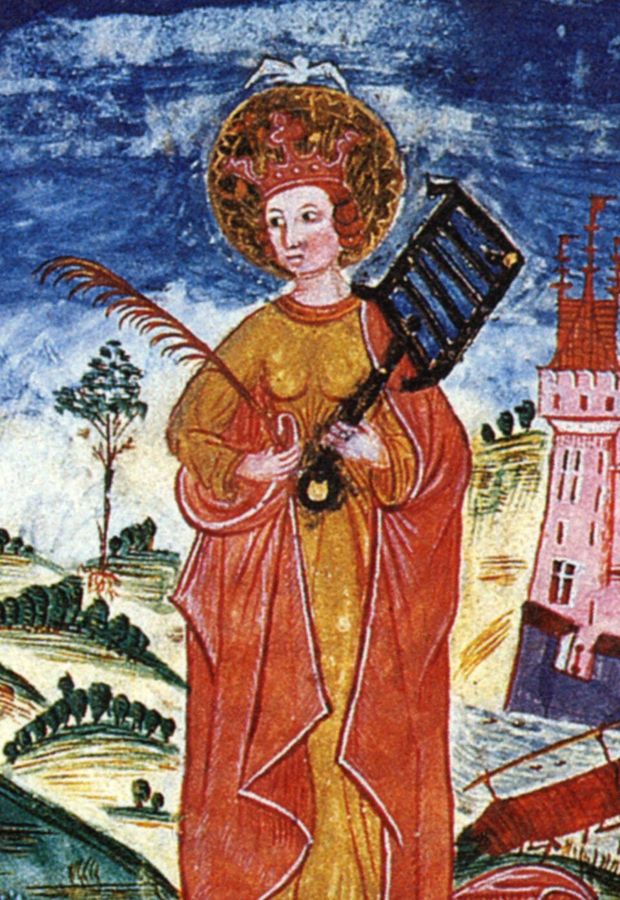
In art, Saint Faith is depicted as a young woman holding a palm branch and a grate.

Read the original 1870s text

Baring-Gould’s sources: Roman Martyrology. Sarum, York, Hereford, and Anglican Reformed Kalendars; some copies of the Martyrology of Jerome, Usuar dus, Wandelbert, Notker, Ado, &c. Authority The Acts, not trustworthy. The Acts of SS. Caprais and Faith vary in several particulars from those of S. Faith alone. All versions of the Acts are too late to be relied upon.] ACIANUS, governor of Spain under Diocletian and Maximian, was at one time at Agen, in Aquitania, and hearing that a certain noble damsel, named Faith, living in Agen, was a Christian, he summoned her before his tribunal and ordered her to renounce the faith of the Crucified. “ From a child,” answered the maiden, “ I have served the Lord Jesus Christ with all my heart, and have confessed his name.” Dacian produced the ordinary arguments, tried persuasion and threats in vain, and then sentenced her to be stretched over a fire on a brazen grate with her hands and feet tied to four posts. She endured the agony with great fortitude. The executioners raked up the coals under her and poured on fat, and the blaze rushing up enveloped her. According to one version of the Acts, a heavy fall of snow veiled her body as it lay on the burning bed, and the shower only ceased when she was dead. Many other Christians, moved by her heroism, surrendered themselves and were executed with the sword.

The arm of S. Faith was anciently shown at Glastonbury. The crypt of S. Paul’s Cathedral, London, is dedicated to S. Faith, and was at one time enriched with some of her relics [the bodily remains of a saint, or objects they used, kept with honor]. Her head is shown at Agen.

In art S. Faith is represented as a maiden with a palmbranch and a grate.
Help us add to this saint's story

Everything is read by a person before anything appears. Facts are checked against trusted sources first.

Facts are welcome; a source link helps (optional).With your permission we may share it on this page.

Nine days · Free

Pray the novena
with us.

One short email a day for nine days. The day's prayer, a line from St. Faith's story, and a nudge to keep going.

Also on October 6
C

St. Cumine

October 6 · Abbot
Y

St. Ywi

October 6 · Feast
N

St. Nicetas (October 6)

October 6 · Confessor
← All 1970 saints in the library
Sources & notes

Feast-day sources

Story sources

Sources

Credits

Image: Santa Fe (cropped).jpg · unknown (12th c entury · Public domain, via Wikimedia Commons

Image: unknown (12th c entury, Wikimedia Commons (Public domain)

Retold in plain modern English from Baring-Gould’s public-domain text, sentence by sentence, keeping the same facts and order. Short explanations in parentheses are ours.

From Sabine Baring-Gould, The Lives of the Saints, new edition in 16 vols. (London: John C. Nimmo, 1897–98); text from the Internet Archive scan (OCR, lightly cleaned; errors possible). Public domain in the United States. Reproduced unedited, except for short bracketed notes in grey that we added to explain names and terms (“S.” is the old abbreviation for Saint). Some history and judgments reflect 19th-century scholarship.