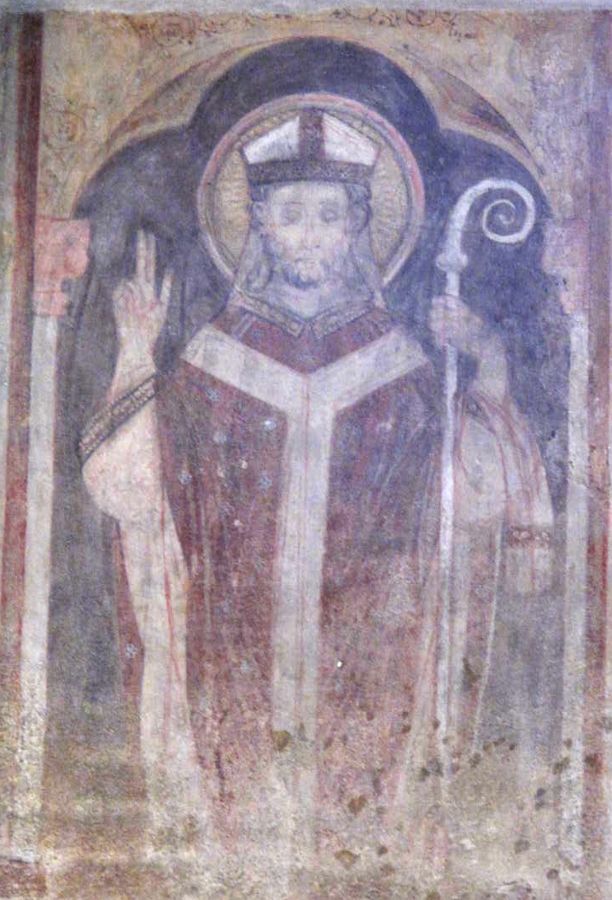
St. Eustorgius of Milan

Eustorgius I was born around 275 AD and became the Bishop of Milan in 343, following the death of Protasius.

Read the essentials →
Feast September 18 · Bishop

St. Eustorgius of Milan

Current feast

September 18
Secondary source · Wikipedia infobox

Traditional feast

September 18
1914 / pre-1969 calendar, per Baring-Gould (1897)

Represents

Bishop

Feast days

Feast: September 18

This Saint’s Story

Written for this site from Wikipedia and Sabine Baring-Gould, The Lives of the Saints (source note)

He hailed from a noble Greek family and played a significant role in the early Church during a challenging period marked by the rise of Arianism (followers of Arius's teaching that the Son is a created being, not fully God), a belief that questioned the full divinity of Christ.

To secure his position as bishop, Eustorgius journeyed to Constantinople to seek the Emperor's confirmation. During this visit, he received a precious gift: the remains of the Three Magi, which he later transported back to Milan, underscoring his commitment to the Christian faith.

Eustorgius was proactive in church leadership, organizing synods in 345-346 and 347-348. He also initiated the building of several churches and basilicas in Milan, enhancing the city's religious landscape. His dedication to the faith earned him praise from notable figures like Saint Athanasius, who recognized his steadfastness against Arianism.

His contributions are commemorated in the Ambrosian Rite, and he is honored with multiple churches named after him, with the Basilica of Sant'Eustorgio being the most prominent. Tradition holds that he was buried in this basilica, where his remains are still venerated.
Short entry · the summary here is 53 words; Baring-Gould’s fuller original text and its sources are below. We have not filled any gap with invented detail.

What he represents

How he teaches us to live

Drawn from themes in the original account

Practise small acts of self-denial. Fasting and penance are part of this story. Skipping a snack or setting your phone aside for an hour is a start.

Celebrate this saint’s feast day. Remember him on September 18 with a short prayer, and ask for his help.

Read more

The full original · 53 words

Read Baring-Gould’s full account

Baring-Gould’s sources: Roman and Milanese Martyrologies.

In the list which S. Athanasius [bishop of Alexandria (d. 373), great defender of the Nicene faith] gives of the great Catholic prelates of his age who stood fast in the faith, who quitted themselves like men, and would not yield to Arianism [followers of Arius, who taught that the Son is a created being, not fully God], though supported by the Emperor, occurs the name of Eustorgins of Milan, and S. Ambrose [bishop of Milan (d. 397)] speaks of him as a confessor [in old usage, a saint who was not martyred, or who suffered for the faith without being killed].

Help us add to this saint's story

Everything is read by a person before anything appears. Facts are checked against trusted sources first.

Facts are welcome; a source link helps (optional).With your permission we may share it on this page.

Nine days · Free

Pray the novena
with us.

One short email a day for nine days. The day's prayer, a line from St. Eustorgius of Milan's story, and a nudge to keep going.

Also on September 18
F

St. Ferreolus

September 18 · Martyr
M

St. Methodius

September 18 · Bishop, Martyr
St. Joseph of Cupertino

St. Joseph of Cupertino

September 18 · Confessor
← All 1970 saints in the library
Sources & notes

Feast-day sources

Story sources

Sources

Credits

Image: Sant Eustorgio di Milano.jpg · A ntv · CC BY-SA 3.0, via Wikimedia Commons

Image: A ntv, Wikimedia Commons (CC BY-SA 3.0)

From Sabine Baring-Gould, The Lives of the Saints, new edition in 16 vols. (London: John C. Nimmo, 1897–98); text from the Internet Archive scan (OCR, lightly cleaned; errors possible). Public domain in the United States. Reproduced unedited, except for short bracketed notes in grey that we added to explain names and terms (“S.” is the old abbreviation for Saint). Some history and judgments reflect 19th-century scholarship.