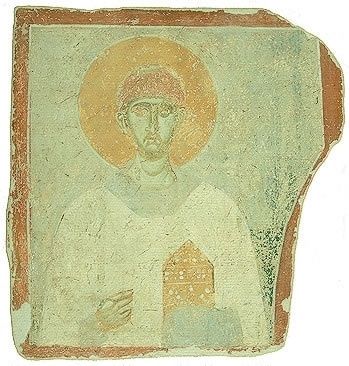
And again, “If anyone wants to follow me, let him deny himself, take up his cross, and follow me.” The judge asked what that meant. The martyr answered, “It is the law of my Lord, which has been delivered to me.” Calvisianus asked, “By whom?” Euplius answered, “By Jesus Christ, the Son of the living God.” Calvisianus then declared, “Since his confession shows his disobedience, let him be handed over to the executioners and examined on the rack.” This was done immediately. While they were torturing him, Calvisianus asked him whether he still stood by his previous statement. Euplius, making the sign of the cross on his forehead with the hand he had free, said, “What I said before, I now declare again: that I am a Christian and read the holy Scriptures.” Calvisianus ordered him to be hoisted on the rack and tortured more cruelly. The martyr said, while enduring torture, “I thank you, O Lord Jesus Christ, that I suffer for your sake: save me, I beseech you.” Calvisianus said, “Lay aside your folly; worship our gods, and you will be set free.” Euplius answered, “I worship Jesus Christ; I detest the devils. Do what you wish; add new torments; for I am a Christian. I have long desired to be in the condition in which I now am.”
After the executioners had tormented him for a long time, Calvisianus ordered them to stop and said, “Wretch, worship the gods; honor Mars, Apollo, and Aesculapius.” Euplius replied, “I worship the Father, Son, and Holy Spirit. I honor the Holy Trinity, besides whom there is no God.” Calvisianus said, “Sacrifice, if you want to be freed.” Euplius answered, “I sacrifice myself now to Jesus Christ my God. All your efforts to persuade me are in vain. I am a Christian.” Then Calvisianus ordered for his torments to be increased.
While the executioners were doing their utmost to torture him, Euplius prayed, “I thank you, my God; Jesus Christ, help me. It is for your name’s sake that I endure these agonies.” He repeated this several times. When his strength failed him, his lips were still seen to move, as the martyr continued to pray silently when he could not speak.
Then Calvisianus went behind the curtain and dictated the sentence of death. Coming out with the tablet in his hand, he read, “Euplius, a Christian, who despises the edicts of the emperors, blasphemes the gods, and does not repent, is condemned to death by the sword. Lead him away.” Then the Gospel was hung around his neck, and the herald went before him as he was taken to execution, shouting, “Euplius, a Christian, the enemy of the gods and of the emperors.”
But Euplius, filled with joy, cried out repeatedly, “Thanks be to Christ, my God.” When he arrived at the execution site, he gave thanks again and offered his throat to the executioner, who then beheaded him. The Christians took his body, embalmed it with spices, and buried it.
Footnotes
- Aesculapius: the Roman god of medicine and healing.
Baring-Gould’s own footnotes, in modern English.
Read the original 1870s text
Baring-Gould’s sources: Roman Martyrology. By the Greeks on Aug. n. The Acts exist in their original form, and are thoroughly trustworthy. "| In Sicily, in the year 304, under the ninth consulate of Diocletian and the eighth of Maximian, on the 12th of August, in the city of Catana, Euplius, a deacon, was brought to the governor’s audience-chamber, and attending on the outside of the curtain, cried out, “ I am a Christian, and shall rejoice to die for the name of Jesus Christ.’' The governor, Calvisianus, who was of consular dignity, heard him, and ordered that he who had made that outcry should be brought in and presented before him. Euplius went in with the book of the Gospel in his hand. One of Calvisianus’s friends, named Maximus, said, “You ought not to keep such writings, contrary to the edicts of the emperors.” Calvisianus said to Euplius, “ Where had you those writings? did you bring them from your own honse ?” Euplius replied, “ That he had no house, but that he was seized with the book about him.” The judge bid him read something in it. The martyr opened it, and read the following verses, “ Blessed are they that are persecuted for righteousness’ sake; for theirs is the kingdom of Heaven.”1 6". Euplius.
And again, “ If any man will come after me, let him deny himself, and take up his cross and follow me.”1 The judge asked what that meant. The martyr answered, “ It is the law of my Lord, which hath been delivered to me.” Calvisianus said, “By whom?” Euplius answered, “ By Jesus Christ, the Son of the iiving God.” Calvisianus then pronounced, “ Since his confession makes his disobedience manifest, let him be delivered up to the executioners, and examined on the rack.” This was immediately done. Whilst they were tormenting him, Calvisianus asked him whether he persisted in his former declaration. Euplius, making the sign of the cross on his forehead with the hand that he had at liberty, said, “ What I formerly said I now declare again, that I am a Christian, and read the holy Scriptures.” Calvisianus ordered him to be hoisted on the rack, and more cruelly tormented. The martyr said, whilst undergoing torture, “ I thank thee, O Lord Jesus Christ, that I suffer for thy sake: save me, I beseech thee.” Calvisianus said, “ Lay aside thy folly; adore our gods, and thou shalt be set at liberty.” Euplius answered, “ I adore Jesus Christ; I detest the devils. Do what you please; add new torments; for I am a Christian. I have long desired to be in the condition in which I now am.”
After the executioners had tormented him a long time, Calvisianus bade them desist, and said: “ Wretch, adore the gods; worship Mars, Apollo, and HSsculapius.” Euplius replied, “ I adore the Father, Son, and Holy Ghost. I worship the Holy Trinity, beside whom there is no God.” Calvisianus said, “Sacrifice, if you would be delivered.” Euplius answered, “I sacrifice myself now to Jesus Christ my God. All your efforts to move me are to no purpose. I am a Christian.” Then Calvisianus gave orders for increasing his torments.
Whilst the executioners were exerting their utmost in torturing him, Euplius prayed thus: “ I thank thee, my God; Jesus Christ, succour me. It is for thy name’s sake that I endure these agonies.’' This he repeated several times. When his strength failed him, his lips were seen still to move, the martyr continuing to pray inaudibly when he could not speak.
Then Calvisianus went behind the curtain and dictated the sentence of death. Coming out with the tablet in his hand, he read, “ Euplius, a Christian, despising the edicts of the emperors, blaspheming the gods, and not repenting, is condemned to death by the sword. Lead him away.” Then the Gospel was hung about his neck, and the herald went before him, as he was conducted to execution, crying, “ Euplius, a Christian, the foe of the gods and of the emperors.”
But Euplius, full of joy, cried incessantly, “ Thanks be to Christ, my God.” And when he was come to the place he again gave thanks, and submitted his throat to the executioner, and was decapitated. Then the Christians took up his body, and embalmed it with spices, and buried it.