Suddenly, two men emerged from obscurity. One was dressed in grey and wore a rope belt, while the other was in white with a black cloak. They held up the collapsing building. He later recognized them as S. Francis of Assisi and S. Dominic, the supports of the Church. At that moment, the Church seemed to be crumbling, but they appeared from different directions, without any prior coordination, to prevent the impending disaster.
The Church was wealthy, and the clergy were well-fed, while their congregations were starving for spiritual nourishment. Preaching was reserved for bishops and was not assigned to priests. The bishops lived only in cities, surrounded by luxury and involved in political matters, too careless or too busy to teach. The sacraments of the Church may have been administered regularly in parish churches, but there was no instruction to help people appreciate them. There were no heartfelt appeals to their consciences to encourage them to repent of their sins and turn to God. The major scandals and deficiencies of the time were the wealth, luxury, and laziness of the clergy, along with the lack of instruction.
Francis of Assisi founded an order of Mendicants, men who were zealous for poverty, despised wealth, and avoided idleness. Dominic of Caleruega established a Society of Preachers. The scandals and deficiencies mentioned had caused deep discontent in Languedoc and Northern Italy. The harsh persecution of the Manichaeans by the Eastern emperors had sent waves of these heretics into Western Europe. They entered in two streams: one through Bohemia, where the Bulgarians and Beghards formed obscure but dangerous sects, which later contributed to the significant revolt of the Hussites; the other came by sea, flooding Lombardy and Languedoc. In Lombardy, they were known as the Patarines, and in Languedoc, as the Albigenses. Their zeal, moral integrity, earnest preaching, and the simplicity of their beliefs attracted many followers. The Church in southern France was alarmed to find itself outnumbered by sectarians who, although they taught strange doctrines, led good lives. Even if they were not Christians— which they certainly were not— they shamed those who were.
How was this destructive heresy to be confronted? Man had his plan, but God had a very different one. The Pope called for a crusade, turning the beautiful fields of Toulouse and Provence into a slaughterhouse, with the smoke of blood rising to Heaven. However, He who promised to always be with His Church, who warned His disciples not to uproot the tares from the field lest they also pull up the wheat, addressed the evil in another way. “The Spirit of God breathes where He wills, and you cannot tell where He comes from or where He goes.” From Italy and Spain, God called two men to this work. They were very different in character but united in their earnestness and understanding of the situation.
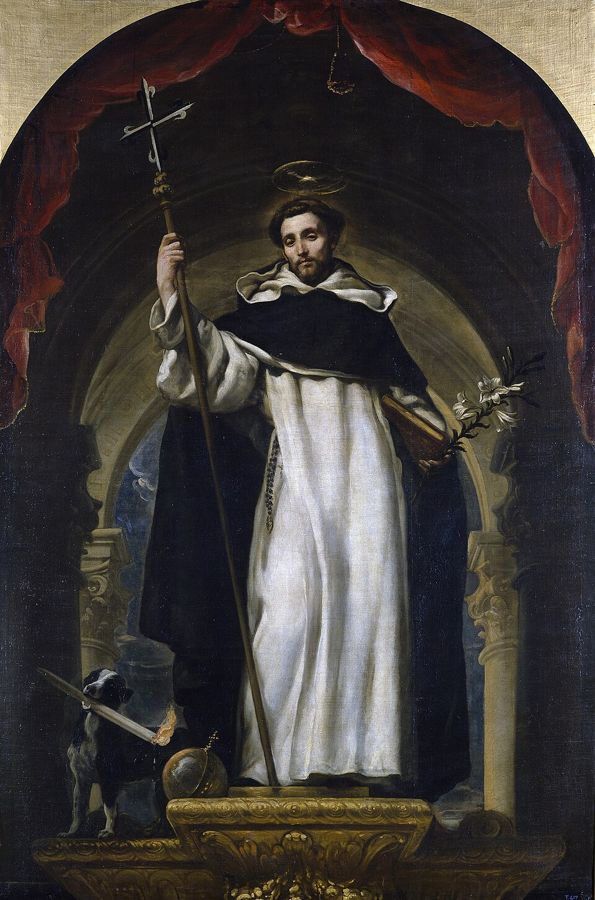
Dominic was born in 1170, at Caraloga, which is halfway between Aranda and Osma, in Old Castile. His parents had a noble name, that of Guzman, if not a noble lineage. His mother—so the legend goes—dreamed before his birth that she gave birth to a dog with a torch in its mouth, which set the world on fire. However, this was a later fable, stemming from the fact that the Dominicans, through a clever play on words, were called, or called themselves, Domini-canes, meaning the Lord’s dogs. When the Inquisitorial power, with its fears and tragedies, was placed in their hands, the torch that ignited many pyres and consumed numerous heretics became a clear addition to their symbolic animal.
His followers also borrowed from an old classical fable; bees settled on his lips, foreshadowing his remarkable eloquence. Even in his infancy, his serious nature began to show itself in other remarkable ways. He crawled from his soft bed to lie on the hard ground.
Dominic received the first part of his education from his uncle, a churchman, at Gamiel d’lzan. At the age of fifteen, he was sent to the University of Palencia, where he studied mainly theology for ten years. Two stories are recorded from this time that reveal the early signs of religious strength in his character. During a famine, he sold his clothes and, even more precious, his books covered with his notes, to feed the poor. When he was questioned about this, he nobly replied, “How can I read dead parchment when living men are perishing?”
He encountered a woman who was crying because her brother was a slave among the Moors. His passionate charity would have led him to sell himself to buy his freedom, if his friends had not intervened. Simple and pure of heart, he enjoyed the cheerful chatter of young girls more than the complaining gossip of old women, but the sweet flower of his childlike modesty was never harmed, as it never needed to be, by such company. This is all we know about the youth of Dominic. A few precious fruits that the late gatherer finds on the trees after the harvest has passed—according to the elegant thought of Lacordaire.
The Bishop of Osma had changed his chapter into regular canons, meaning those who lived together and followed a rule similar to a monastic community. Chrodegang of Metz was the first to transform his chapter in this way, and this example spread throughout the West. Without a rule, the clergy associated with a cathedral had no discipline and took advantage of their freedom to neglect their responsibilities.
The bishop appointed Diego de Azevedo as his prior and gave a canonry to Dominic when he was twenty-five years old. “Then,” says Jordan of Saxony, “he began to shine among the canons, his brethren, like a torch that burns, the first in holiness, the last in humility, spreading around him the fragrance of a life-giving life, like the scent of the incense tree in summer.” He spent both night and day in the church, watching without rest and praying, rarely showing himself outside the cloister, so he would not lose time for his contemplations. God had given him the grace to pray for sinners, the unfortunate, and the afflicted; he carried their sorrows into the inner sanctuary of his compassion, and this deep love, weighing on his heart, often resulted in tears.
It was his habit, rarely interrupted, to spend the night in prayer and communion with God, with his door closed. Sometimes, low moans could be heard coming from his troubled heart. His constant prayer was for true charity, a love that would be ready to sacrifice everything for the good of others, for he was convinced that he could not be a true member of Christ unless he devoted himself fully to winning souls. Dominic remained in Osma for nine years without any notable incidents.
Diego de Azevedo had succeeded to the Bishopric of Osma in 1201. He was a prelate of great ability and strong religious enthusiasm. He was sent to Denmark to negotiate the marriage of Alfonso VIII of Castile with a princess from that kingdom. He chose the like-minded Dominic as his companion. As soon as they crossed the Pyrenees, they found themselves in the midst of the Albigensian heresy; they could not ignore the contempt into which the clergy had fallen or the success of the sectarians. Their very host in Toulouse was an Albigensian. Dominic stayed up all night with him, arguing against his beliefs and enlightening him on the essential truths of the Christian faith. He did not leave until the man acknowledged his errors and returned to the Church. The bishop's mission in Denmark was thwarted by the unexpected death of the princess.
Before he returned to Spain, Azevedo and his companion decided to go on a pilgrimage to Rome. The character of the Bishop of Osma is evident from his proposal to Pope Innocent. He wanted to give up his bishopric and dedicate himself to the dangerous life of a missionary in Hungary. It is certain that Dominic would have joined him in this adventurous spiritual mission. However, Innocent ordered the bishop to return to his diocese.
On their way, the bishop and Dominic stopped in Montpellier. There, they encountered the three Papal Legates, Abbot Arnold of Citeaux, Brother Raoul, and Peter of Castelnau, who were all in their full glory. They had been given extraordinary powers by the Pope to suppress heresy and punish the misconduct of the clergy. They deposed the Bishop of Venders and suspended the Bishop of Beziers for refusing to excommunicate the magistrates of his city at their command. They instructed the Count of Toulouse to expel all heretics from the land. The Papal Legates traveled through the country in great splendor and luxury, accompanied by a large procession of horses and pack mules, along with a retinue dressed in fine clothing. Their calls for reform and their sermons were met with mockery.
In Toulouse, on their return from their journey, they met Diego de Azevedo and Dominic, to whom they expressed their disappointment at their lack of success. They could neither convince the heretics nor persuade their ruler to expel or eliminate them. “How do you expect to succeed with this worldly display?” replied the Spaniards. “Sow the good seed as the heretics sow weeds. Cast off these extravagant robes, renounce these richly adorned horses; go barefoot without purse or bag, like the Apostles; outwork, outfast, and outdiscipline these false teachers.” The Spaniards were not satisfied with just giving stern advice; the Bishop of Osma and his loyal Dominic returned their own horses, changed into simple monastic robes, and led the way on the spiritual mission. The Legates had no choice but to follow them.
Arnold of Citeaux, the abbot of abbots, was a man whose heart was hardened by pride, cruelty, and bigotry. One of his statements has been preserved by a fellow Cistercian. When the crusaders, under his leadership, were committing horrific acts against both Catholics and Albigensians during the infamous siege of Beziers, a messenger came running to report this indiscriminate slaughter and to ask for orders. “Kill them all,” replied the abbot, “God will know His own.” Brother Raoul was a submissive follower. Peter of Castelnau may have been made of better material; at least he died bravely for his faith and forgave his murderers as he died.
After his mission among the heretics failed, the Abbot of Citeaux left for Burgundy, claiming he had a chapter meeting of his order to attend. However, the two other legates, Don Diego and Dominic, set out on foot for Narbonne and Toulouse. They stayed in the towns and villages, preaching in the churches until they made some impact, and held public discussions with the heretics in the marketplaces.
But the group suffered a further decrease in numbers. Peter of Castelnau found this new way of conducting a mission burdensome. He withdrew, claiming it was dangerous for him to risk his life among angry heretics.
The story goes that, during one of the conferences, each side presented their arguments written out in full on parchment. Neither side would be convinced by the reasoning of the other, so it was decided to throw both documents into a fire. It is said that the arguments of the heretics were consumed in the flames, while those of Dominic showed miraculous resistance to burning. However, overall, the mission was a failure. Great results were not to be expected immediately; recent scandals and the common neglect of duties among the clergy could not be forgotten right away. Church leaders grew impatient. The grandeur of the Papal Legates did not impress, and the enthusiasm of Diego and Dominic did not convince the Albigenses.
Raymond of Rabesten was the Bishop of Toulouse. His tolerant and easygoing nature made him unsuitable for such an important position, especially when harsh measures were being considered. He was deposed by a decree from the Pope on the charge of simony (the act of selling church offices), and Foulques of Marseilles was appointed in his place. Foulques had been a lively troubadour—his romantic poems in Provençal have been preserved. He was married but developed a strong attachment to Azalais, the wife of Barral de Baux, the Lord of Marseilles. When Azalais discovered that Foulques was pursuing another woman, Laura de Saint Jorlan, who was her husband's sister, she dismissed him. In a fit of despair, Foulques took monastic vows at the Cistercian Monastery of Toronet and was elected abbot in 1200, when he was about thirty-five years old. Five years later, he was chosen as a suitable candidate to succeed Raymond de Rabesten. His previous reckless behavior flared up into a fervor of religious intolerance. There was no act of treachery or cruelty throughout the war in which the Bishop of Toulouse was not among the most aggressive, bloodthirsty, and unscrupulous.
“Your holiness is greatly deceived in the Bishop of Toulouse,” said the Count de Foix to Pope Innocent. “Under the guise of good faith and friendship, he is always plotting treachery. His actions are wicked. Because of his malice, the city of Toulouse has suffered destruction, devastation, and robbery. More than ten thousand men have died because of him.”
The murder of Peter of Castelnau led Pope Innocent III to call on all Christian princes in the West to unite in a crusade against the unfortunate Albigenses. We are fortunately not required to delve into the history and horrors of that war, which is the most atrocious conflict that has stained the pages of Christian history. There is absolutely no evidence that Saint Dominic had any role in advising or encouraging the massacres. His involvement in that infamous event is not mentioned by a single contemporary writer. It was not until a century after his death that his stricter followers claimed he was present, if not active, in inciting the brutal crusaders during battle, leading them, cross in hand, to victory and slaughter.
Similarly, the claim of Saint Dominic's presence at the trials where the unfortunate heretics were judged and condemned to be burned by the hundreds relies on late and unreliable testimony, particularly from Dominicans, who were inquisitors and sought to legitimize their authority by citing their founder's example. All that can be established is that, on one occasion, Dominic was involved in addressing, pleading with, and trying to convince some Albigenses, who, if they remained obstinate in their heresy, were destined for execution. It is more than likely that he attempted on many other occasions to convert a heretic and save him from his terrible fate. On one occasion, we know that he freed an Albigensian from his chains while he was being taken to execution.
Dominic established a convent at Prouille in the year 1206, thinking, and wisely thinking, that devoted, religious women were just as necessary in the midst of the heretics as self-denying and holy men. Many miracles are recorded from this period of Dominic’s life. Thierry d’Apolda relates an incident. A bishop, probably Foulques of Toulouse, was about to visit a part of his diocese dressed in all the threatening armor of war and the splendor of wealth. “It is not thus,” said the humble servant of God, “that the adversaries of the Faith are to be subjugated. Arm yourself, not with the sword, but with prayer; wear not the magnificence of the world, but be clothed with humility.”
Near Toulouse lived some noble ladies who had been alienated from the Faith due to the austerity of the lives of the heretical teachers, which stood in stark contrast to the luxury and laxness of the Catholic priests and prelates. Instead of seeking their ruin by denouncing them to the unyielding bishop, Dominic, at the beginning of Lent, asked them for hospitality. They granted it to him. He did not engage in any controversy with them, but throughout Lent he ate only bread and water. The first night, they made comfortable beds for Dominic and his companion; he declined them and asked for two hard boards, and on these the apostles lay until Easter. The silent example of these loving, meek souls touched the hearts of their hostesses, and they were restored to the true fold.
One day, while conversing with an Albigensian, the poor man told him that it was only his dire poverty that kept him from reconciling with the Church. Dominic told the man to sell himself as a slave and live on the proceeds in comfort and orthodoxy. However, the sacrifice was not necessary; money was provided for him without having to resort to this extreme measure.
Nine noble ladies asked him to show them whether their Manichaean doctrines were truly evil. He prayed, and behold, the spirit of Manichaeanism appeared as a great black cat and ran up the rope to hell. A lady of extreme beauty wished to leave her monastery and resisted all of the preacher’s arguments. She blew her nose, and it came off in her handkerchief. Horrified, she implored the prayers of Dominic. He put her nose back on, and the lady agreed to remain in the convent.
The Albigensian war, due to its length, seemed to create an unbeatable barrier for Dominic, whose ongoing goal was to establish a religious Order dedicated to preaching. He constantly prayed for peace, hoping that the horrific acts of the crusade would come to an end so he could work for the truth with a better tool than the sword. In the meantime, he is believed to have established the devotion of the Rosary.
The purpose of the Rosary was twofold. By dividing the Rosary into fifteen sections, each representing an event in the life of our Lord or the Blessed Virgin, he hoped to deeply engrave the Gospel history in the hearts of those who practiced this devotion, making the Incarnation a reality for their souls. The Albigensians did not believe in the Incarnation. Their belief system revolved around a constant struggle between spirit and body, and their ethics promoted the spirit's complete liberation from the flesh, which they viewed as inherently sinful.
The Albigensians rejected the dignity of the human body, the importance of the sacraments, and the future destiny of the body, which is resurrected through Christ. They acknowledged that Christ was a moral teacher but refused to accept His Resurrection and Ascension. However, the establishment of the Rosary had another purpose. Dominic intended it to not only strengthen faith but also to cultivate a habit of devotion. The poor and uneducated could not use prayer books and could not participate in the Church's liturgy, which was conducted in a language they did not understand. Their attempts at prayer were often confused, aimless, and even disrespectful due to their lack of knowledge.
Complex forms of prayer would not be suitable for these simple people. Dominic provided them with just two prayers: the Lord’s Prayer and the Hail Mary, to be used in remembrance of the great mysteries of the Christian faith.
and to be directed to such objects as at the time occupied the mind or troubled the heart of the worshipper. The Rosary was both the most flexible and the simplest system of prayer ever created. It is impossible to overstate the incalculable advantage it has provided to countless souls. It is true that it can degenerate into formalism, just like every other religious practice. However, for the uneducated, it has served as an excellent guide to faith and devotion, as shown by the experience of seven centuries.
In 1215, Dominic visited Rome to obtain approval from Innocent III for the Order of Preachers that he had founded, or was in the process of founding. Innocent hesitated to allow anyone other than consecrated bishops the freedom to preach to the people. He was being asked to approve a significant change in the practice of the Church, and before allowing it, he reasonably sought time to consider its advisability. He could not help but notice that the bishops, involved in political controversies and often absent from their dioceses for months or years due to diplomatic missions or leading troops in the camps of emperors, kings, or crusaders, could not regularly provide the people with the bread of the word of life.
Moreover, they were not often men with sufficient theological training or a devotional mindset to instruct the poor and convert sinners. The ministry of apostleship seemed to be fading from the Church when Dominic appeared and boldly requested that the Holy Father allow an Order to take on the important work that the bishops had failed to accomplish. A timely vision, it is said, along with his own common sense, certainly justified Innocent in giving his approval to Dominic's work.
What Innocent approved, Honorius III ratified, and Gregory IX canonized. The Society of Preachers went forth with full authority to preach the word in season and out of season, and everywhere. In a few years, it had spread throughout the West. Spain, France, Germany, Poland, and England were visited by the noble company of Preachers. “How beautiful on the mountains are the feet of them that bring good tidings, that publish peace, that bring good tidings of good, that publish salvation.” It is worth noting that the Order, founded to suppress heresy by preaching in Languedoc, was hardly organized before it left the chosen scene of its labors. Instead of focusing on Toulouse or any of the cities of Provence as the center of his operations, Dominic—four years after the battle of Muret, which finally defeated the Albigenses—permanently abandoned Languedoc. This behavior is the best evidence of Dominic's feelings about the crusade. On plains soaked with the smells of carnage, he could find no harvest. If the heretics were subdued, those who survived were too deeply scarred by wrongs, treachery, robbery, murder, and debauchery committed under the banners of the cross of Christ and the keys of Saint Peter to be influenced by holy example and gentle words. Generations must pass, and the great crimes of that unjust war must be forgotten before the dove of peace could return to that land, and hearts would open to the gentle influences of the loving Spirit.
In Rome, during Dominic's visit to receive the confirmation of his Order, he met Saint Francis, another pillar supporting the struggling Church. One night, according to legend, while he was in prayer, he saw in a vision the mother of God presenting two men before her Son. In one, he recognized himself; he saw the other the next day in beggar’s clothes in a church. He ran to him, embraced him, and said, “My companion, we will walk together, let us hold together, and none can overcome us.”
The kiss of Saint Dominic and Saint Francis has been passed down from generation to generation. Every year, on the feast of Saint Dominic, carriages leave Santa Maria sopra Minerva in Rome, the headquarters of the Dominicans, and go to the convent of the Ara Coeli for the General of the Franciscans and several of his brethren. The brown Capuchins are met in the church by the White Friars; in parallel lines, they advance from the porch to the choir, and the sons of Saint Francis sing the office of the friend of their founder in the church of the sons of Saint Dominic. After the conclusion of the office, they go to the refectory, break bread together, and part with an embrace.
After leaving the field in Languedoc, Dominic arrived in Rome in the year 1217, where he was appointed by Honorius III to be Master of the Sacred Palace, a position that has continued among his spiritual descendants. He was greatly respected by the elderly Cardinal Ugolino, who would later become Pope Gregory IX. In 1220, three years after he had departed from Languedoc, he served as the General of his Order and led an assembly in Bologna. By this time, Dominican convents had been established in Italy, Spain, Provence, France, Germany, and Poland, and the voices of Dominican preachers had reached every land.
In 1218, Dominic felt a strong desire to return to Spain, his beloved native Castile. He left Rome in the autumn. Brother Albert, who traveled with him, later shared amusing stories from their journey. He recounted how, when a dog tore Dominic's serge habit, Dominic patched the tears with small bits of clay. He also told of an incident with a talkative and angry hostess who scolded them for refusing to eat the meat she had prepared for their dinner. Dominic silenced her with a single word, and she did not speak again for eight months. When Dominic returned and saw her silent plea, he, to the dismay of her husband, restored her ability to speak.
Dominic stayed in Segovia, where he founded a convent. Every night, he spent time in the church. The inappropriate curiosity of some of his friars led them to invade his privacy and observe the secret communications of his soul with God. He believed that in the church alone, he could express his heart without any restraint. The spies saw him in a state of deep devotion before each altar, reciting the words of David: “My soul cleaves to the dust; revive me, O Lord, according to Your word!” “Lord, I have cried out to You; do not be far from me, do not remain silent, do not hold back, O God!” “Lord, hear me when I cry out to You, as I lift up my hands in Your holy place!” “I stretch out my hands to You; my soul longs for You like a thirsty land. Hear me, O Lord, quickly, for my spirit is faint; do not hide Your face from me, or I will be like those who go down into the pit.”
And soon, through the dark aisles, the sound of Dominic's sobbing could be heard as he reflected on his failures and shortcomings in that noble pursuit, closely following in the footsteps of his Savior. Sometimes, a passing moonbeam or the light of the sanctuary lamp would reveal the white figure of Dominic prostrate before an altar, or kneeling with arms outstretched in prayer, or standing on tiptoe in trembling rapture and self-forgetfulness, like a seraph ready to take flight. However, we might be seen as sharing the inappropriate curiosity of those who intruded on these sacred moments if we attempt to describe them. There are moments in every life that it is sacrilege to invade and reveal.
From Segovia, he went to Madrid, where he founded a convent for women, and then set out for Paris. On his journey, he was abandoned by all the brothers he had chosen to accompany him, except for three. As they traveled, they encountered groups of pilgrims, who fed them, and in return, were inspired by the pious teachings of Dominic. When it rained, Dominic sang aloud the “Ave Maris Stella” or the “Veni Creator.” He always carried the Gospel of Matthew and the Epistles of Paul with him, and when they reached an inn or rested under the trees, he would open them and read. His companions were often surprised and moved to see the emotions on his face as he read the sacred text; sometimes, the intensity in his eyes and his distant expression showed that his soul had shifted from study to meditation, or, by the movement of his lips, they guessed, to prayer. When he finished reading, he reverently kissed the book, as if to thank it for the blessed lessons it had given him.
On his journey, whenever he had a chance to speak to the peasants, he preached with passion. “What books do you study?” asked a young man after one of these sermons, which had touched and softened many rough hearts. “Above all, the book of charity,” answered Dominic. “Look at those roofs,” he would sometimes say to his companions as they saw the red tiles of a distant village. “What sorrows and cares, what sins and difficulties they cover. Oh! to lighten and relieve some of them as we pass by.” In the summer of 1219, Dominic descended for the last time the slopes of the white Alps and saw the plains of Italy basking in the sunlight, stretching blue to the horizon. He returned to Rome by way of Bologna and Florence. He had not forgotten the good sisters of Saint Sixtus, a convent he had founded in Rome during his long absence. He brought them from Spain a number of ebony spoons, which he had carried on his shoulders during his long journey through Paris.
In 1220, the first chapter of the Order was held at Bologna, as has already been mentioned. On his way to attend it, Dominic visited Saint Francis of Assisi at Cremona. While the two founders were talking together, some Franciscans approached and said, “Our convent is without good water; we ask you, servants of God, to intercede with the Lord, that He may bless our muddy well and make it clear.” It had just been dug. The two founders looked at each other, each inviting the other to respond. Then Dominic said to the friars, “Draw some of the water and bring it to us.” A bowl was produced, full of the murky liquid. A spring had been tapped, but it had not yet cleared itself.
Dominic said to Francis, “Father, bless this water in the name of the Lord.” Francis replied, “Father, you must bless it, for you are greater than I am.” Dominic took the bowl, made the sign of the cross over the water, and instructed that it be poured back into the well, whose waters were healed immediately.
One night, on his way, probably at Columba, near Parma, Dominic and his companions arrived at a monastery gate after all the monks had gone to bed. One of his attendants was about to knock. “Do not wake them,” said Dominic; “we can sleep on the step.” The exact time when Dominic established his Third Order is not known. He, along with S. Francis, recognized the need to expand the influence of their Order and to unite laypeople in a common bond through a new organization. Both founders therefore established Tertiaries, a third order connected respectively with the Society of S. Dominic or of S. Francis. The members lived in the world, amidst their secular occupations and families, bound by no monastic vows but deeply committed to the collective spirit. They were organized, each under their own prior, and were taught to cultivate personal holiness and to work, each in their position, to promote the faith and combat heresy and immorality. The Third Order, whether of S. Dominic or S. Francis, spread not only through its own ongoing influence and tireless activity, but it also had a vast number of supporters dedicated to its interests, full of enthusiasm, ready to advance the cause of both Christ and S. Dominic or S. Francis. These lay helpers, known as Tertiaries in the Society of S. Francis and Soldiers of Jesus Christ in the Society of S. Dominic, took the place that had been occupied by the heretics. The heretics had often been men and women who claimed to live a more pious and exclusively holy life than most of their neighbors, bound together by some common rule, and falling into heresy only because they were neglected by the Church. Now the Church, through Dominic or Francis, reached out to this group of people, welcomed them, and enlisted them in her army. One major attraction that the heretical communities had was taken from them, and the orthodox societies approved by the Holy See joined the cause of the Church.
Saint Dominic fell sick with fever and dysentery in Venice in July 1221. He refused to go to bed and instead sat up in his white serge habit, remaining silent and patient. He felt that he was dying and sent for his friars to give them his last words of encouragement. Following the doctors' advice, he was moved to Saint Mary of the Mountains, near Bologna. He began to decline rapidly. He heard a rumor that the religious community at Saint Mary intended to keep his body after his death for their church. “God forbid that I should rest anywhere but among my friars,” he said; “carry me into my own vineyard, that I may die there.”
He was transported to Bologna in the arms of his friars, who feared he would die with each step. There was no spare cell in the convent there. Brother Moneta gave up his own cell for him. His habit needed to be changed. Moneta removed his own tunic and gave it to the dying saint. Brother Rudolf held Dominic’s head on his lap and gently wiped the sweat away with a handkerchief. A group of brothers stood around weeping. “Do not weep,” said Dominic; “I may be more useful to you where I am going than I could be here.” Someone asked him where he would like to be buried. “Under the feet of my friars,” he answered. “Now make ready.” They prepared to administer the last sacrament to him. “Begin.” They recited the prayer for a departing soul. His lips moved until they reached the words, “Come to his aid, saints of God! Come, angels of the Lord, and bear his soul into the presence of the Most High!” At that moment, his lips ceased to move. His hands rose towards heaven. His body rests in the church of his Order in Bologna. In art, he is depicted with a star on his brow because, according to legend, his nurse once saw a star shining over his head while he slept.
Footnotes
- Caleruega: a town in Spain where S. Dominic was born.
- Lacordaire was a French priest and preacher known for his eloquence.
- Diego de Azevedo succeeded to the Bishopric of Osma in 1201.
- God will know His own.
- simony (the act of selling church offices)
- His licentious fires blazed forth in a fury of religious intolerance.
- “After having given the best part of his life to gallantry, he gave the other half without restraint to the cause of tyranny, murder, and plunder, and unfortunately, he profited from it.”
- Documents unpublished on the History of France; Fauriel, the Chronicle of the Albigenses.
- Thierry d’Apolda was a chronicler of the time.
- Manichaeanism was a religious belief system founded by the prophet Mani.
- S. Dominic: Saint Dominic, founder of the Order of Preachers.
- Dominic was appointed Master of the Sacred Palace by Honorius III.
- Cardinal Ugolino later became Pope Gregory IX.
- The Gospel of Matthew and the Epistles of Paul are parts of the New Testament.
- Saint Sixtus is a title for several early Christian martyrs and popes.
- Brother Moneta gave up his own cell for him.
- In art, he is depicted with a star on his brow.
Baring-Gould’s own footnotes, in modern English.
Read the original 1870s text
Baring-Gould’s sources: Roman Martyrology. Canonized by Gregory IX. in 1233, and his festival appointed for August 5. Paul III., however, threw it back to August 4, so as not to interfere with the feast of Our Lady of the Snows. Authorities: — 1. Jordan of Saxony wrote the first life of S. Dominic before his canonization, 1233; 2. an encyclical letter on the translation of the blessed Dominic, also by Jordan of Saxony, written about 1234; 3- the Acts of Bologna, containing the evidence of nine of his disciples concerning his miracles and virtues, dated August 30, 1233; 4. the Acts of Toulouse, containing the testimony of twenty-six persons to his acts during the twelve years he was in Languedoc; 3. the Life of the Blessed Dominic, by Constantine de’ Medicis, B. of Orvieto, written between 1242 and 1247; 6. a Life written by the Blessed Humbert, general of the order, written before 1234; 7. the Chronicle of the Friars Preachers, by the same Humbert, June, 1202 — 1234; 8. a Life by Bartholomew of Trent, written between 1234— r2Si; 9. Lives of the Friars of the Order of Preachers, by Gerard de Frachet, drawn up by order of the general chapter at Paris, in 1236; 10. the Narrative of Sister Cecilia, one of the nuns under the direction of S. Dominic. Cecilia related all the particulars of the saint that she could remember to Sister Angelica, who wrote them down under her eye; n. the Vatican Chronicle from the beginning of the order to 1263; 12. “The Seven Gifts of the Spirit,” by Stephen de Bourbon, who died a.d. 1261, contains many anecdotes of S. Dominic; r3. the Life of S. Dominic, by Rodriquez de Cerrati, written about A.D. 1266; 14. a Life by Thierry d Apolda in 1288. It is unnecessary to mention later lives. A list of all available sources of information will be found at the end of the P&re Lacordaire's Life of S. Dominic.] In a dream one night Innocent III., it is reported,' saw the great edifice of the Church tottering to its fall. Then S. Dominic.
…suddenly there emerged from obscurity two men, one in grey, rope-girdled, the other in white with black cloak, and held up the falling building. He recognised afterwards in the faces of S. Francis of Assisi, and S. Dominic, the stays of the Church. And, to all appearances, the Church was crumbling down when they arose, springing up from different quarters, without concert, to avert the threatening ruin.
The Church was rich; ecclesiastics were well fed; their flocks starved for the bread of life. Preaching was the prerogative of the bishops; it was not entrusted to priests. And the bishops lived only in cities, in the midst of splendour, mixed up with political concerns, too careless or too busy to teach. The sacraments of the Church may have been, and probably were, minisitred with regularity in the parish churches, but there was no irktruction to make men value them, no heart-stirring appeals to their conscience to make them repent of sin and turn to God. The crying scandal and want of the times were — the scandal of the wealth, luxury, indolence of the clergy, and the want of instruction. Francis of Assisi founded an order of Mendicants, of men full of zeal for poverty, hating riches, shunning idleness; Dominic of Caraloga instituted a Society of Preachers. The scandal and the want indicated had caused deep disaffection in Languedoc and Northern Italy. The cruel persecution of the Manichaeans by the Eastern emperors had sent successive waves of these heretics into Western Europe. They penetrated it in two streams, one by way of Bohemia, where the Bulgarians, Beghards, formed obscure, yet dangerous sects, the centres of activity whence sprang the great revolt of the Hussites in later days; the others came by way of the sea, and inundated Lombardy and Languedoc; in Lombardy they were known as the Patarines, in Languedoc as the Albigenses. Their zeal, pure morals, earnest preaching, and the simplicity of their system drew multitudes to them, and the Church in the south of France trembled to find itself outnumbered by sectaries, who, if they taught strange doctrine, lived good lives; if they were not Christians — as they certainly were not — yet put to shame those who were.
How was this devastating heresy to be met ? Man had his scheme; God had one very different. The Pope summoned a crusade, and the pleasant fields of Toulouse and Provence became a slaughter-house, from which the smoke of blood went up to Heaven; but He who promised to be ever with His Church, who warned His disciples not to gather up the tares out of the field lest they should pluck up the wheat with them, He met the evil otherwise. “The Spirit of God breatheth where He wills, and thou canst not tell whence He cometh or whither He goeth.” From Italy and Spain God called up two men to the work, very different in character, but one in earnestness of purpose and grasp of the situation.
Dominic was born in ir7o, at Caraloga, half-way between Aranda and Osma, in Old Castile. His parents were of noble name, that of Guzman, if not of noble race. His mother— so runs the legend — dreamed before his birth that she bore a dog with a torch in his mouth, which set the w°rld on fire. But this was an after fable, originating in the fact that the Dominicans, by a pleasant pun, were styled, or styled themselves, Domini-canes, the Lord’s dogs. And when the Inquisitorial power, with its terrors and tragedies, was lodged in their hands, the torch which kindled so many pyres and consumed so many heretics, became an intelligible adjunct to their symbolical animal.
His votaries borrowed also the old classical fable; the bees settled on his lips, foreshowing his exquisite eloquence. Even in his infancy, his severe nature, among other wonders began to betray itself. He crept from his soft couch to lie on the hard ground.
The first part of his education Dominic received from his uncle, a churchman, at Gamiel d’lzan. At fifteen he was sent to the university of Palencia,, where he studied, chiefly theology, for ten years. Two stories are recorded of this period, which show the dawn of religious strength in his character. During a famine he sold his clothes, more precious still, his books covered with his annotations, to feed the poor. When remonstrated with, “ How can I peruse dead parchment when breathing men are perishing ?” was his noble answer.
He met a woman weeping because her brother was a slave among the Moors [the Muslims of North Africa and Spain]: his enthusiastic charity would have made him sell himself to purchase his redemption, had not his friends interfered. Simple and pure of heart, he found pleasure in the bright prattle of young girls, rather than in the querulous gossip of old women, but the sweet flower of his childlike modesty was never injured, as it never need be, by such association.1 This is all we know of the youth of Dominic. A few precious fruit, which the late gleaner finds on the trees, after the harvest is passed — according to the graceful thought of Lacordaire.
The Bishop of Osina had changed his chapter into regular canons, those who lived in common, and under a rule approaching to a monastic institute. Chrodegang of Metz had first thus transformed his chapter, and the example spread through the West. Without rule, the clergy attached to a cathedral were under no discipline, and took advantage of their liberty to neglect their duties. The bishop 1 Ubi semetxpsum asserit in integritate carnis divina gratia conservation, nondum illam imperfectionem evadere potuisset, quia magis afficiebatur juvencularum colloquiis quam affatibus vetularum." This passage was carefully erased from the life of the saint by the chapter of his order. See Acta Sanct. Aug. 4, Vit. S. Dominic, c. x. ^appointed as his prior Diego de Azevedo, and conferred a canonry on Dominic, when twenty-five years old. “ Then,” says Jordan of Saxony, “he began to shine among the canons, his brethren, as a torch that burns, the first in sanctity, the last by his humility, shedding around him the odour of a life-giving life, a fragrance like the incense tree in the summer weather.... He spent night and day in the church, watching, without rest, with prayer, scarcely showing himself outside the cloister, lest he should lose leisure for his contemplations. God had given to him grace to pray for sinners, the unfortunate and the afflicted; he carried their sorrows into the inner sanctuary of his compassion, and this sad love, oppressing his heart, broke forth in tears. It was his habit, rarely interrupted, to pass the night in prayer and communion with God, his door closed. Sometimes his voice was heard in low moanings coming from his troubled heart. His incessant prayer was for a true charity, a love which would be ready to sacrifice everything for the good of other men, for he was well persuaded that he could not be a true member of Christ unless he devoted himself with all his powers to win souls.” Dominic remained at Osma nine years, devoid of incident Diego de Azevedo had succeeded to the Bishopric of Osma (a.d. i 201). He was a prelate of great ability, and of strong religious enthusiasm. He was sent to Denmark to negotiate the marriage of Alfonso VIII. of Castile with a princess of that kingdom. He chose the congenial Dominic as his companion. No sooner had they crossed the Pyrenees, than they found themselves in the midst of the Albig'ensian heresy; they could not close their eyes to the contempt into which the clergy had fallen, or to the prosperity of the sectaries; their very host at Toulouse was an Albigensian. Dominic sat up all night with him, controverting his doctrines, enlightening him on the great truths of the Christian religion; •S'. Dominic.
and he did not' leave till the man had submitted to acknow-. ledge his errors and re-enter the fold of the Church. The mission of the bishop in Denmark was frustrated by the unexpected death of the princess.
Before he returned to Spain Azevedo, with his companion, resolved upon a pilgrimage to Rome. The character of the Bishop of Osma appears from his proposal to Pope Innocent. He wished to abandon his bishopric, and devote himself to the perilous life of a missionary in Hungary. That Dominic would have been his companion in this adventurous spiritual enterprise none can doubt. Innocent commanded the bishop to return to his diocese. On their way, the bishop and Dominic stopped at Montpellier. There they encountered,, in all their pomp, the three Legates of the Pope, Abbot Arnold of Citeaux, the Brother Raoul, and Peter of Castelnau. They had been invested by the Pope with extraordinary powers to suppress heresy and punish the excesses of the clergy. They deposed the Bishop of Venders, and suspended the Bishop of Beziers for refusing to excommunicate at their command the magistrates of his city. They ordered the Count of Toulouse to expel all heretics out of the land. The Papal Legates travelled through the country in the utmost splendour and luxury, with a vast cavalcade of horses and sumpter mules, and a retinue in rich attire. Their exhortations and their sermons were met with derision. At Toulouse, on their return from the circuit, they were met by Diego de Azevedo and Dominic, and to them lamented their want of success. They could neither convince the sectaries, nor induce their sovereign to expel or exterminate them. “ How expect success with this secular pomp ?” replied the Spaniards. “ Sow the good seed as the heretics sow tares. Cast off these gorgeous robes,', renounce these richly caparisoned palfreys; go barefoot* without purse or scrip, like the Apostles,; out-labour, out-fast, out-discipline these false teachers.’' The Spaniards were not content with these stern admonitions; the Bishop of Osma and his faithful Dominic sent back their own horses, stripped themselves to the modest monastic gaberdine, and led the way on the spiritual campaign. The Legates were constrained to follow. Arnold of Citeaux, the abbot of abbots, was a man whose heart was sheathed with the triple iron of pride, cruelty, and bigotry. Of his sayings one has been preserved by a brother Cistercian [strict Benedictine reform begun at Cîteaux in 1098]. When the crusaders, under his direction, were massacring with every conceivable atrocity Catholics as well as Albigensians, in the memorable infamous taking of Beziers a messenger came running to record this indiscriminate butchery, and ask for orders. “ Kill all,” answered the abbot, “ God will know his own.”1 Brother Raoul was an obsequious follower. Peter of Castelnau was perhaps made of better stuff. At least, he died courageously enough for his faith, and dying forgave his murderers. After his mission among the heretics had failed, the Abbot of Citeaux departed for Burgundy, making the excuse that he had a chapter of his order to attend; but the two other legates, Don Diego and Dominic, set forth on foot for Narbonne and Toulouse. They tarried in the towns and villages, preaching in the churches till they had made some impression, holding public conferences with the heretics in the market-places.
But the party suffered a further diminution. Peter of Castelnau found this new system of conducting a mission irksome; and under the excuse that it was dangerous for him to expose his life among exasperated heretics, he also withdrew.
The story is told that, in one of the conferences, each party appeared with their arguments written out in full on parchment. Neither party would plead conviction by the reasoning 1 Caisarius Heisterb. Dial. Mirac. Dist. v c\ ax. of the other, and it was decided to throw both documents into a fire. It is said that the arguments of the heretics were consumed in the flame, but those of Dominic exhibited miraculous incombustibility. But on the whole the mission was a failure. Great results were not to be expected all at once; scandals were too recent, neglect of their duties too common, among the clergy to be forgotten immediately. Churchmen became impatient. The pomp of the Papal Legates had not dazzled, the enthusiasm of Diego and Dominic had not convinced, the Albigenses. Raymond of Rabesten was Bishop of Toulouse; his tolerant and easy disposition rendered him an unfit person to occupy such a distinguished position when sharp measures of unusual severity were meditated. Upon the charge of simony he was deposed by a decree of the Pope, and Foulques of Marseilles was elevated in his room. This man had been a gay troubadour — his amorous poems in Provengal have been preserved. He was a married man, but formed an ardent attachment for Azalais, the wife of Barral de Baux, Seigneur of Marseilles. The lady, finding that the gallant Foulques showed ardour in the pursuit of another lady, Laura de Saint; Jorlan, the sister of her husband, dismissed him. In a fit of despondency, Foulques took monastic vows in the Cistercian Monastery of Toronet, and was elected abbot in 1200, when he was about thirty-five years old. Five years after, he was fixed upon as a suitable person to succeed Raymond de Rabesten1. His licentious fires blazed forth in a fury of religious intolerance. There is no act of 1 Hist. Littdraire de la France, xviii. p. 586, &c. “Apr&s avoir donnd la moitid de sa vie & la galanterie, il livra sans retenue l'autre moitié à la cause de tyrannie, du meurtre, et de spoliation, et malheureusement il en profita.” “Your holiness is greatly deceived in the Bishop of Toulouse,” said the Count de Foix to Pope Innocent; “under show of good faith and amity he is always concerting treachery: his actions are devilish: through his malignity the city of Toulouse has suffered ruin, waste, and robbery: more than ten thousand men have perished through him.” Documents inddits sur l'Hist. de France; Fauriel, la Chronique des Albigeois, treachery or cruelty throughout the war in which the Bishop of Toulouse was not the most forward, sanguinary, unscrupulous.
The murder of Peter of Castelnau occasioned the summons of Pope Innocent III. to all Christian princes in the West to unite in crusade against the luckless Albigeuses.. Into the history and horrors of that, the most atrocious war which has stained the page of Christian history, we are fortunately not called to enter. There is absolutely no evidence that S. Dominic had any part in counselling or encouraging the massacres. His presence in that infamous drama is not noted by a single contemporary writer. It was not till a century after his death that his sterner followers boasted of his presence, if not his activity, in exciting the brutal crusaders in the day of battle, leading them, cross in hand, to victory and butchery.
So, too, the presence of S. Dominic on the tribunals where the unhappy heretics were tried for their lives, and given over to be burned by hundreds, rests on late and untrustworthy testimony, on that of Dominicans, when, they were inquisitors, and sought to establish as their sanction the example of their founder. All that can be proved is that, on one occasion, Dominic was employed in addressing, pleading with, and endeavouring to convince some Albigenses, who, if obstinate in their heresy, were destined for the fire. That he may have endeavoured on many other occasions to convert a heretic, and rescue him from his dreadful fate, is more than probable. On one occasion we know that he delivered an Albigensian from his chains on his way to execution.
Dominic established a convent at Prouille (a.d. 1206),' thinking, and wisely thinking, that devoted, religious women were as necessary in the midst of the heretics as were seifdenying and holy men. Many miracles are recorded of this period of Dominic’s life.1 Thierry d’Apolda relates an incident. A bishop, probably Foulques of Toulouse, was about to visit a part of his diocese in all the threatening panoply of war, and the splendours of wealth. “ It is not thus,” said the humble servant of God, “ that the adversaries of the Faith are to be subjugated. Arm yourself, not with the sword, but with prayer; wear not the magnificence of the world, but be clothed with humility.” Near Toulouse lived some noble ladies whom the austerity of the lives of the heretical teachers, contrasting gloriously with the luxury and laxness of the Catholic priests and prelates, had alienated from the Faith. Instead of compassing their ruin by denouncing them to the inexorable bishop, Dominic, at the beginning of Lent [the forty days of fasting before Easter], asked of them hospitality. It was accorded him. He entered into no controversy with them, but all Lent he ate but bread and water. The first night they made comfortable beds for Dominic and his companion; he declined them, and asked for two hard boards, and on these the apostles lay till Easter. The silent example of these loving, meek souls touched the hearts of their hostesses, and they were restored to the true fold. One day, in conversing with an Albigensian, the poor man told him that it was only his dire poverty which held him from reconciliation with the Church. Dominic bade the man sell him as a slave, and live on the proceeds in comfort and orthodoxy. But the sacrifice was not accomplished, money was placed at his disposal without having recourse to this extremity.
1 Nine noble ladies entreated him to show them whether their Manichasan doctrines were really evil. He prayed, and lo l the spirit of Manicheeism appeared as a great black cat, and ran up the hell rope. A lady of extreme beauty wished to leave her monastery, and resisted all the preacher’s arguments. She blew her nose, and it came off in her handkerchief. Horror-stricken, she implored the prayers of Dominic. He put her nose on again, and the lady consented to remain in the convent. VOL. IX. 4 Lives of the Samts.
The Albigensian war, by its duration, seemed to place an invincible obstacle in the way of Dominic, whose constant design was to found a religious Order consecrated to the ministry of preaching. Peace was the incessant object of his prayers, when the sickening atrocities of the crusade might be at an end, and he might labour for the truth with a better weapon than the sword. In the meantime he is thought to have established the devotion of the Rosary. The object was twofold. By dividing the circle of the Rosary into fifteen sections, each commemorating an incident in the life of our Lord or of the Blessed Virgin, he, hoped to impress the Gospel history deeply on the hearts of those who used this devotion, and thereby to make the Incarnation a reality to their souls. The Albigensians disbelieved in the Incarnation. Their doctrine was that of a perpetual conflict between spirit and body, and their ethical system consisted in an exaltation of the spirit to complete emancipation from the flesh, whose every appetite and function was gross and sinful. The dignity of man’s body, the value of the sacraments, the future destiny of the flesh, risen through Christ, were denied by the Albigensians, who allowed that Christ was indeed a teacher of morality, but disdained to believe in his Resurrection and Ascension. But the institution of the Rosary had another object., Dominic designed that it should serve not only to deepen faith, but also to build up a habit of devotion. The poor and ignorant could not use manuals of prayer, could not join in the liturgy of the Church conducted in a language unintelligible to them. Their rude efforts at prayer were liable through ignorance to become incoherent, purposeless, and even profane. No elaborate forms of prayer would suit these simple souls. Dominic gave them only two the Lord’s Prayer and the Hail Mary, to be used in commemoration of the great mysteries of the Christian faith S. Dominic.
and to be directed to such objects as at the time engrossed the mind or distressed the heart of the worshipper. The Rosary was at once the most elastic and the simplest system of prayer ever devised. Of the incalculable advantage it has been to myriads of souls it is impossible to speak too highly. That it is liable to degenerate into formalism is true of it as of every other religions exercise. But to the ignorant it has proved an admirable manual of faith and devotion, as testified by the experience of seven centuries. In 1215 Dominic visited Rome to obtain from Innocent III. his approbation of the Order of Preachers he had founded, or was in process of founding. Innocent hesitated about committing to other tongues than those of consecrated bishops, the liberty to preach to the people. ' It was a revolution in the practice of the Church he was asked to sanction, and before permitting it he reasonably sought delay in which he might consider its advisability. He could not but see that the bishops, mixed up as they were with political controversies, absent from their dioceses for months, years, on legations, or at the head of their troops in the camps of emperors, kings, or crusaders, could not dispense to the people the bread of the word of life with regularity. Nor were they often men of sufficient theological training, or devotional bent of mind, to be able to instruct the poor and convert the sinner. The ministry of apostleship seemed to be dying out of the Church when Domiuic appeared and boldly asked that the Holy Father would permit an Order to undertake the great work in which the bishops had failed. A timely vision, so it is said, his own common sense, certainly, warranted Innocent in giving his sanction to the work of Dominic.
What Innocent approved, Honorius III. ratified, and Gregory IX. canonized. The Society of Preachers went forth with full authority to preach the word in season and out of season, and everywhere. In a few years it had spread throughout the West. Spain, France, Germany, Poland, and England were invaded by the noble company of Preachers. “ How beautiful on the mountains are the feet of them that bring good tidings, that publish peace, that bring good tidings of good, that publish salvation.”1 It is worthy of observation that the Order, founded for the suppression of heresy by preaching in Languedoc, was hardly organized before it left the chosen scene of its. labours. Instead of fixing on Toulouse, or any of the cities of Provence as the centre of his operations, Dominic — four years after the battle of Muret, which finally prostrated the Albigenses — for ever abandoned Languedoc. Such conduct is the best evidence on the feelings with which Dominic t regarded the crusade. On plains, reeking with the odours of carnage, he could glean no harvest. If the heretics were subdued, those who survived were too deeply wounded by wrongs, treachery, robbery, murder, debauchery wrought under the banners of the cross of Christ and the keys of S. Peter, to be amenable to the influence of holy example and gentle words. Generations must pass, the great crimes of that iniquitous war must be forgotten, before the dove of peace could revisit that land, and hearts would open to the gentle influences of the loving Spirit.
At Rome, on the visit made by Dominic to receive the confirmation of his Order, he met S. Francis, that other pillar holding up the tottering Church. One night, so runs the legend, being in prayer, he saw in vision the mother of God presenting two men before her son. In one he recognised himself, he saw the other next day in beggar’s garb in a church. He ran to him, clasped him in his arms, and said, 11 My companion, we will walk together, let us hold together, and none can overcome us.”
1 Isaiah lii. 7. S. Dominic. The kiss of S. Dominic and S. Francis has been transmitted from generation to generation. Every year, on the feast of S. Dominic, carriages leave Santa Maria sopra Minerva, at Rome, the head quarters of the Dominicans, and go to the convent of the Ara Cceli, for the General of the Franciscans, and a number of his brethren. The brown Capuchins are met in the church by the White Friars; in parallel lines they advance from the porch to the choir, and the sons of S. Francis sing the office of the friend of their founder in the church of the sons of S. Dominic. After the conclusion of the office they adjourn to the refectory, break bread together, and separate with an embrace.
After abandoning the field in Languedoc, Dominic came to Rome (a.d. 1217), where he was appointed by Honorius III. to be Master of the Sacred Palace — an office since perpetuated among his spiritual descendants. He was held in the highest honour by the aged Cardinal Ugolino, the future Pope Gregory IX. In the year 1220, three years after he had left Languedoc, he stood, as the General of his Order, at the head of an assembly at Bologna. Italy, Spain, Provence, France, Germany, Poland, had now their Dominican convents; the voices of Dominican preachers had penetrated into every land.
In 1218 a yearning had come over the heart of Dominic to revisit Spain, his dear native Castile. He left Rome in the autumn. Brother Albert, who accompanied him, afterwards told odd stories of the journey; how, when Dominic had his serge habit tom by a dog, he sealed up the rents with little dabs of clay; how, when a voluble and abusive hostess stormed at them for refusing to eat the meat she had cooked for the travellers’ dinner, Dominic imposed silence on her by a word, and the woman’s tongue did not wag again for eight months; till Dominic, on his way back, at her mute appeal, to the despair of her husband, restored its glibness to the paralysed member.
Dominic tarried at Segovia, where he founded a convent. Every night he spent in the church. The indelicate curiosity of some of his friars prompted them to pry into his privacy, and watch the secret communions of his soul with God. In the church alone,.as he thought, he could pour out his heart without restraint. The spies saw him in ecstasy of devotion before each altar, the words of David pouring from his lips: “My soul cleaveth to the dust, quicken me, O Lord, according to thy word l” “ Lord, I have cried unto thee, turn not far from me, keep not still silence, refrain not thyself, O God !” “ Lord, hear me, when I cry unto thee, whilst I lift up my hands in thy holy place !” “ I stretch forth my hands unto thee; my soul gaspeth unto thee as a thirsty land. Hear me, O Lord, and that soon, for my spirit waxeth faint; hide not thy face from me, lest I be like unto them that go down into the pit.” And anon, through the dark aisles would sound the convulsed sobbing of Dominic, as he numbered his failures, his shortcomings in that lofty walk, the close treading in the footsteps of his Saviour. Sometimes a passing moonbeam, or the light of the sanctuary lamp exhibited the white form of Dominic prostrate before an altar, or kneeling up with arms widespread in prayer, or standing on tiptoe in tremulous rapture and self-unconsciousness, like a seraph poised ready for flight. But we may be thought to partake of the vulgar inquisitiveness of those who intruded on these sacred scenes, if we attempt to describe them. There are moments in every life which it is sacrilege to intrude on and unveil.
From Segovia he went to Madrid, where he founded a convent for women, and then started for Paris. He was deserted on his road by all the brethren he had chosen to accompany him, except three. As they travelled they fell August in with bands of pilgrims, who fed them, and in return were edified by the pious exhortations of Dominic. When the rain fell Dominic sang. aloud the “ Ave Maris Stella,” or the “Veni Creator.” The Gospel of S. Matthew and the Epistles of S. Paul he carried ever with him, and on reaching an inn, or resting under the trees, would open them and read. His companions were often surprised and touched to see the play of emotion in his face as he read the sacred page; and sometimes the fixedness of his eyes, and air of abstraction, showed that his soul had passed from study to meditation, or by the movement of his lips, they judged, to prayer. When he had done reading, he reverently kissed the book, as though to thank it for the blessed lessons it had given him..On his road, whenever he had an opportunity to address the peasants, he preached with fervour. “ What books do you study?” asked a young man, after one of these sermons, which had touched and melted many rough hearts. “ Above all, the book of charity,” answered Dominic. “ Look at those roofs,” he would say sometimes to his companions, as they saw far off the red tiles of some little village. “ What sorrows and cares, what sins and difficulties they cover. Oh ! to lighten and remit some of them as we pass by.” In the summer of 1219 Dominic descended for the last time the flanks of the white Alps, and saw basking in the sunlight, and extending blue to the horizon, the plains of Italy. He returned to Rome by Bologna and Florence. He had not forgotten the good sisters of S. Sixtus, a convent he had founded at Rome, during his long absence. He brought them from Spain a number of ebony spoons, which he had carried about with him in his long round by way of Paris, on his shoulders. In 1220 the first chapter of the Order was held at Bologna, as has been already related. On his way to attend it Dominic visited S. Francis of Assisi at Cremona. Whilst the two patriarchs were conversing together, some Franciscans approached and said: “ Our convent is without good water; we pray you, servants of God, to intercede with the Lord, that He may bless our muddy well and make it limpid.” It had been newly sunk. The two patriarchs looked at one another, each inviting the other to reply. Then Dominic said to the friars, “ Draw some of the water, and bring it ns.” A bowl was produced full of the turbid fluid. A spring had been tapped, but it had not as yet purified itself.
Dominic said to Francis, “ Father, bless this water in the name of the Lord.” Francis replied, “ Father, you must bless it, for you are greater than I am.” Dominic took the bowl, made the sign of the cross over the water, and bade it be poured back into the well, whose waters were healed immediately.
One night, on his way, probably at Columba, near Parma, Dominic and his companions arrived at a monastery gate after all the monks had gone to bed. One of his attendants would have knocked. “Do not wake them/ said Dominic; “we can sleep on the step.” At what time Dominic instituted his Third Order is not exactly known. He, as well as S. Francis, saw the necessity of widening the influence of their Order, and of uniting seculars in a common bond, by some new organization. Both patriarchs accordingly instituted Tertiaries, a third order in connexion respectively with the Society of S. Dominic or of S. Francis. The members lived in the world, in the midst of their secular Avocations, their families, bound by no monastic vows but deeply imbued with the corporate spirit. They were organized, each under his own prior, and were taught to cultivate personal holiness, and to labour, each in his station, to advance the faith and combat heresy and immorality. The Third Order, whether of S. Dominic or S. FranAugust cis, spread, not merely by its own perpetual influence and unwearied activity, it had everywhere a vast host of votaries wedded to its interests, full of enthusiasm, ready to advance the cause both of Christ and of S. Dominic or S. Francis. These lay coadjutors, these Tertiaries, as they were called in the Society of S. Francis, Soldiers of Jesus Christ, as they were designated in the Society of S. Dominic, took the place which had been occupied by the heretics. The heretics had been often men and women affecting a more pious, exclusively holy life than the generality of their neighbours, bound together by some common rule, and falling into heresy only because neglected by the Church. Now the Church extended, through Dominic or Francis, her hands to this class of people, took them to her, and enrolled them in her army. One great attraction presented by the heretical communities was wrested from them, and the orthodox Societies approved by the Holy See enlisted in the cause of the Church.
S. Dominic fell sick of fever and dysentery at Venice, in July, 1221; he would not go to bed, but sat up in his white serge habit, silent and patient. He felt he was dying, and sent for his friars, to give them his last exhortations. At the advice of the doctors he was moved to S. Maria degli Monte, near Bologna. He began to sink rapidly. He heard a rumour that the religious of S. Maria had resolved on retaining his body, after his death, for their church. “God forbid that I should rest anywhere but among my friars,” said he; “ carry me into my own vineyard, that I may die therein.” He was transported to Bologna, in the arms of his friars, who feared he would die at each step. There was no spare cell in the convent there. Brother Moneta gave up his own. His habit must be changed. Moneta pulled off his own tunic, and gave it to the dying patriarch [the title of the bishops of the great ancient sees: Rome, Constantinople, Alexandria, Antioch, Jerusalem]. Brother Rudolf held Dominic’s head on his ft * bosom, and gently wiped the sweat away with a handkerchief. A ring of brothers stood round weeping. “ Do not weep,” said Dominic; “ I may be more useful to you where I am going than I could be here.” Some one asked him where he would like to be buried. “ Under the feet of my friars,” he answered. “ Now make ready.” They prepared to administer to him the last sacrament. “ Begin.” They recited the recommendation of a departing soul. His lips moved till they came to the words, “ Come to his aid, saints of God ! come, angels of the Lord, and bear his soul into the presence of the Most High !” when his lips ceased to move. His hands rose towards heaven. His body reposes in the church of his Order at Bologna. In art he is represented with a star on his brow, because in legend it is said that his nurse once saw one shining over his head as he slept.