This Saint’s Story
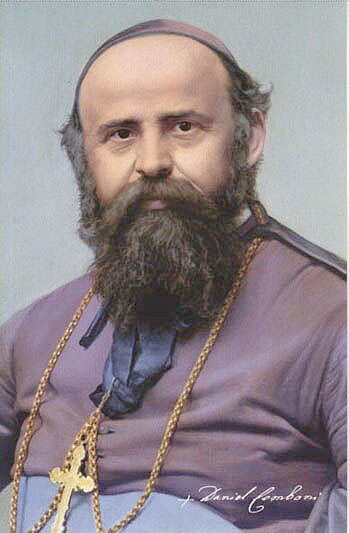
He was the fourth of eight children, with only he surviving to adulthood. At twelve, he was sent to study at a religious school in Verona, where he excelled in languages and medicine. By 1849, he had committed to dedicating his life to missions in Africa, inspired by stories of martyrs.
In 1857, Comboni set off for Sudan with five fellow missionaries. They encountered numerous challenges, including harsh weather, illness, and the deaths of some companions. Despite these difficulties, Comboni's determination grew stronger, famously stating, 'Either Africa or death.' After a brief return to Italy due to illness, he resumed his mission work, developing new strategies to address the dire conditions he observed in Africa.
While in Rome in 1864, Comboni had a transformative experience that led him to create his 'Plan for the Rebirth of Africa.' This plan emphasized empowering Africans to evangelize their own communities. He traveled extensively across Europe to raise awareness and funds for his mission, appealing to various leaders and the general public. His efforts resulted in the establishment of the Comboni Missionaries in 1867 and the Comboni Missionary Sisters in 1872, marking a significant step in including women in missionary work.
In 1877, Comboni was appointed Vicar Apostolic of Central Africa, which confirmed the Church's acknowledgment of his contributions. However, he faced immense challenges, including droughts and famines that devastated local populations. Despite these trials, he remained committed to fighting against slavery and worked tirelessly to establish new missions. He gave himself to the African people until his death from cholera on October 10, 1881, in Khartoum.
Comboni was declared Blessed by Pope John Paul II on March 17, 1996, and was canonized (officially declared a saint by the pope) on October 5, 2003. His legacy continues through the work of the Comboni Missionaries, who serve in various countries, embodying his mission to support the most marginalized.