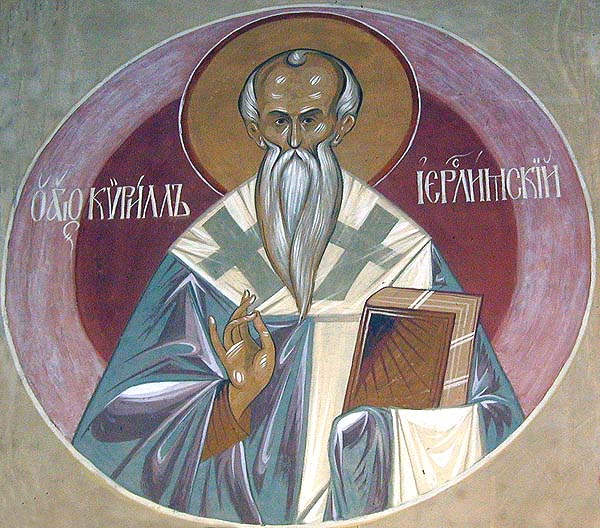
St. Cyril of Jerusalem

Cyril, Bishop of Jerusalem and Doctor of the Church (a title the pope gives to a saint whose teaching is of special value to the whole Church), was born about 315.

Read the essentials →
Feast February 14 · Patriarch

St. Cyril of Jerusalem

Current feast

February 14
Verified · General Roman Calendar

Traditional feast

March 18
1914 / pre-1969 calendar, per Baring-Gould (1897)

Represents

Patriarch

Feast days

Feast: February 14
Traditional: March 18

This Saint’s Story

The Catholic Encyclopedia admits that little is known of his life, which must be pieced together from Epiphanius, Jerome, Rufinus, and the fifth-century historians Socrates, Sozomen, and Theodoret (5th-century bishop and church historian). He was ordained priest by St. Maximus, Bishop of Jerusalem, and succeeded him about 350. The circumstances are disputed: St. Jerome tells a hostile story of an Arian (followers of Arius's teaching that the Son is a created being, not fully God)-backed intrigue, while Socrates says Acacius of Caesarea drove out Maximus; Baring-Gould judges such accounts inconsistent with probability.

Cyril soon quarrelled with Acacius, apparently over the rights of Jerusalem against the metropolitan see of Caesarea, and perhaps also over doctrine. In 357 Acacius had him exiled on the charge of selling church goods during a famine. He returned after the Council of Seleucia in 359, was driven out again in 360, restored under Julian in 361, and banished once more by Valens in 367, remaining in exile until 378. In all he spent many years of his episcopate away from his flock.

In 381 he attended the Council of Constantinople, which proclaimed the Nicene faith, and there formally accepted the homoousion. His fame rests on the Catecheses: an introductory address, eighteen Lenten instructions for those preparing for baptism, and five mystagogical instructions given in Easter week to the newly baptized. Delivered in Constantine's basilica on Calvary, they explain the Creed, baptism, confirmation, and the Eucharist, and the Encyclopedia praises their clear, dignified, and devout style. They describe how the communicant should make the left hand a throne for the right and receive the Body of Christ, answering Amen.

A letter of his to the Emperor Constantius describes a great cross of light seen in the sky over Jerusalem early in his episcopate, stretching from Calvary to the Mount of Olives. He died probably on 18 March 386, the date on which his feast is kept.

Struggles & surrender

His struggles

  • Exile and slander ·
    He was deposed three times by Arian-leaning bishops and emperors, once for selling church treasures to feed the starving. He spent about sixteen years in exile and kept returning to his flock.

What he represents

How he teaches us to live

Drawn from themes in the original account

Stay faithful when it costs you. Holding firm under pressure is part of this story.

Celebrate this saint’s feast day. Remember him on February 14 with a short prayer, and ask for his help.

The full story

Baring-Gould’s account retold in modern English

Read the full story · 2,107 words · about 9 min

Cyril succeeded Maximus as the patriarch of Jerusalem around the year 350. The story that Maximus was removed and Cyril was appointed by Acacius, the Bishop of Cæsarea, does not align with what is likely and contradicts the testimony of the second general Council, which confirmed the proper nature of Cyril's consecration. Another story, which Jerome believed, claims that Cyril received the position from Acacius on the condition that he renounce the ordination given to him by Maximus. This story is completely unbelievable and likely originated from the biases of a strict faction that distrusted Cyril.

The paschal season of 351 was notable in Jerusalem for the bright appearance of a cross that appeared in the sky over the city. This event made a significant impact, and Cyril sent a report about it to Constantius.

Cyril, a man of gentle spirit and a true peacemaker, lived during very challenging times. The Arian party held power due to the emperor's support, and many bishops were semi-Arians. They did not deny the divine nature of Christ as being of the same substance as the Father, but they questioned the wisdom of expressing this doctrine in clear terms that could not be misunderstood. Those who were fearful, not fully enlightened by the Holy Spirit, and lacking the sharp theological insight that characterizes the Church's doctors hesitated and delayed action. Cyril understood that it was unwise to adopt a harsh stance towards these weaker brothers, as it might push them into the arms of the Arians. He was firm in his own faith and sought to avoid the reckless zeal of some Catholics who were determined to create a split between those who walked in the clear light of Catholic certainty and those who were still in confusion. He worked with conciliatory words to prevent such a disaster.

At the end of 357 or the beginning of 358, a significant change occurred in Jerusalem. For two years, Cyril had been forced to oppose Acacius's demands. He argued that Jerusalem, as the mother Church with an "Apostolic throne," and recognized for honor in the Nicene Council, deserved independence from Cæsarea, which Acacius refused to grant. Cyril was also at odds with Acacius on theological grounds because he upheld the orthodox doctrine.

Acacius now called a small council of bishops who supported him, which Cyril chose not to attend. This was seen as defiance, and he was seriously accused of committing an offense by selling some church ornaments to provide food for the poor suffering from famine. Sozomen states that he sold church treasures and sacred veils. Theodoret mentions a vestment made of cloth of gold that was presented by Constantine to be worn by the bishop during baptisms. Such an accusation does Cyril honor and places him alongside other notable bishops, such as Ambrose, Augustine, Exuperius, Gregory the Great, and Ethelwold of Winchester, who similarly upheld the principle that the law of love is the highest law of all. It is noteworthy that in this situation, as in the case of John Chrysostom, the alliance of strict formalism was found not with orthodoxy, but with heresy.

At the synod convened by Acacius, Cyril was condemned and expelled from Jerusalem. He appealed, with more formality than was usual in such cases, to "a higher court." He went to Antioch, where he learned that the patriarch Leontius had died and that no one had been appointed as his successor. Ultimately, he found refuge in Tarsus, where Silvanus, the bishop and one of the best of the semi-Arians, welcomed him, ignoring the objections from Acacius. This situation connected Cyril with the semi-Arian party for the next few years. He exemplifies the fact that this group included individuals of whom Athanasius could say, in his admirable ability to recognize substantial unity despite verbal differences, "We do not treat as enemies those who accept everything else that was defined at Nicæa and only hesitate about the word consubstantial; for we do not attack them as raging Arians, nor as people who oppose the fathers, but we discuss the matter with them as brothers with brothers, who mean what we mean and differ only about the word."

Considerable excitement was caused in Antioch in 350 by the ordination of Aetius as deacon by the patriarch Leontius. Aetius, the most detestable of the extreme Arians, had gone through many changes in his life. He had been a vinedresser's slave, a goldsmith, a medical man, a guest and pupil of Arian bishops, and a professor of the argumentative logic in which the heresy was initially expressed. He was the first to openly claim that the Son was essentially different from the Father. Leontius intended for Aetius's diaconate to be a means of spreading Arianism. However, Flavian and Diodorus, the leaders of Catholicism in Antioch, had formally threatened to break communion with him, so Leontius decided it was best to depose Aetius. Now that Leontius was dead, his position was taken by Eudoxius, the scheming and completely irreligious bishop of Germanicia. He gained his promotion through deceit and the help of court eunuchs, and he openly supported Aetius, whose views he had adopted. The state of confusion and discord had become unbearable, and a General Council was called. Discussions were held to determine the best location, and Emperor Constantius listened to the harmful advice of Acacius and his faction, which suggested splitting the single council into two in hopes of being able to "divide and govern." Constantius agreed, and Ancyra and Ariminum were chosen as the two locations. However, Ancyra was later deemed unsuitable, and it was decided that one part of the council would meet at Seleucia instead of Ancyra.

The extreme Arian Valens was governing in the West. Both councils convened in 359. Four hundred bishops from the West, including some from Britain, gathered at Ariminum. About eighty of them were Arians, mostly from the more radical faction.

The Eastern bishops met at Seleucia, numbering one hundred and sixty. Of these, the vast majority, one hundred and five, were semi-Arians, while others were opportunistic followers of Acacius. Only a small group of Egyptians remained loyal to the faith of Nicæa; nevertheless, the council of Seleucia restored S. Cyril to his see, overturned his deposition ordered by Acacius, and deposed both Acacius and Eudoxius of Antioch.

In the meantime, trickery and violence were at work in Ariminum. A creed approved by the Arian emperor was sent to the bishops, and they were falsely assured, based on imperial authority, that the council of Seleucia had accepted it. The bishops' patience began to wear thin. They dreaded spending the winter on the shore of the Adriatic; they were completely exhausted from such a long stay in Ariminum, and their fatigue made them more willing to compromise. One bishop after another signed the imperial creed; however, about twenty bishops resisted, led by two from Gaul, Phœbadius and Servatius. Taurus, the emperor's officer assigned to maintain order and enforce his agenda, used both threats and pleas. Eventually, through a miserable argument, Valens achieved his goal and secured a scandalous victory for Arianism, which also revealed the dishonesty that marked the Arian approach.

Acacius returned to Constantinople filled with anger, determined to destroy the semi-Arians and Cyril. He convinced Constantius to allow a council to be called to meet in Constantinople the following January, in 360. About fifty bishops attended. Acacius dominated the assembly; Aetius was made a scapegoat by the Acacians for having too openly expressed the error they were trying to spread secretly. The council then deposed the leading semi-Arians, but not for doctrinal reasons. Cyril of Jerusalem and Silvanus of Tarsus were deposed, and with the emperor's support for their decisions, they were exiled. At the same time, the insincerity of their condemnation of Aetius was demonstrated by the elevation of Eudoxius, who was Aetius's main supporter, to a bishopric in Constantinople on January 27th. On February 15th, he dedicated the restored church of the Eternal Wisdom, for which Constantius provided magnificent vessels, curtains, and altar cloths adorned with gold and jewels. During the ceremony, Eudoxius began his sermon with the words, "The Father is irreligious, the Son is religious." This caused a disturbance; the bishop urged the people to calm down. "Surely the Father worships none, and the Son worships the Father!" This statement prompted laughter, and it became a popular joke in the capital. This was the man Acacius and his manipulated council had chosen to replace Cyril. Eudoxius was well-suited to continue the old traditions of Arian irreverence.

The emperor Constantius died on November 3rd, 361, and Julian, having recalled the exiled bishops, allowed S. Cyril to return to his see.

The unfortunate man who was now the ruler of the empire had been a hypocrite in his Christian faith for about ten years. As soon as he was declared emperor, he openly declared himself a restorer of the old religion. It was then that he "washed off the laver" of baptism by horrifically immersing himself in bull's blood, and he tried to cleanse his hands from the touch of the bloodless Sacrifice by holding the entrails of sacrificial animals in them. He set up an image of Fortune in the large church, and while he was sacrificing there, Maris, the bishop of Chalcedon, who was now a blind old man, was brought to him at his own request and rebuked his impiety. "Will your Galilean God cure your blindness?" asked Julian. "I thank my God," replied Maris, "for the blindness that saves me from seeing the face of an apostate."

Julian's final attack on Christianity was his attempt to rebuild the temple of Jerusalem. He indeed wanted to help the Jews in their desire to renew the Levitical sacrifices and to secure their loyalty to his government despite its paganism; but his main goal was to undermine the Gospel by reconstructing the temple that it had explicitly condemned, thus reviving the system that the temple had symbolized and centered around.

The excited hopes of the Jews were shown in the scene that followed the imperial order, when silver spades and mattocks were used, and earth was removed from the excavations in the fine dresses of delicate women. The faith of the Christians was expressed through Cyril's denunciations of the destined failure. Full of confidence, he proclaimed that the project, far from succeeding, would demonstrate to everyone the impossibility of resisting God's decree. His faith must have been great, for every sign was against him. The pagan historian, Ammianus Marcellinus, tells us what happened next. After all possible support had been provided by the authorities, "fearful balls of fire breaking out near the foundations with repeated attacks scorched the workmen several times and made the site inaccessible; and in this way, after stubborn repulses by the fiery element, the undertaking was brought to a halt." Various details are added by Christian writers, such as an earthquake, a whirlwind, fire from heaven, a luminous cross in the sky, and marks of crosses on the garments of the Jews. It is possible that there is some exaggeration in these accounts, and that natural forces were involved in the fiery eruption itself. However, the fact that these forces manifested at that particular moment will seem coincidental, as people say, only to those who do not appreciate the tremendous seriousness of the situation—the unparalleled historical position of Julian, the mystery of evil in his overall policy, and the particularly anti-Christian malice of this attempt to contradict Christ's words.

"His arrows, not aimed at the Church, but at her Lord," could easily be turned back against him by a demonstration of "the finger of God," as real and awe-inspiring as any of those natural events that served as signs of judgment against Pharaoh.

Julian promised, in his anger, according to Orosius, to take revenge on S. Cyril for his failure when he returned from the Persian war. However, this return never happened. Cyril was exiled again by the Arian emperor Valens in 367. He returned in 378, when the emperor Gratian ordered the restoration of the Catholics. He found his diocese torn by division and corrupted by heresy. Adultery, robbery, and poisoning were widespread. The council of Antioch in 379, aware of the terrible state of the diocese, sent Gregory of Nyssa, who was already tasked with reforming the churches of Arabia, to help him calm tensions and reduce immorality; however, his efforts were unsuccessful. In 381, S. Cyril attended the General Council of Constantinople and agreed to the condemnation of the semi-Arians and Macedonians. He died in 386 at the age of seventy.

Footnotes

  1. Jerome was an early Christian scholar and translator known for his Latin Vulgate translation of the Bible.
  2. Sozomen states that he sold church treasures and sacred veils.
  3. Theodoret mentions a vestment made of cloth of gold that was presented by Constantine to be worn by the bishop during baptisms.
  4. Athanasius could say, in his admirable ability to recognize substantial unity despite verbal differences.
  5. S. Cyril refers to Saint Cyril.
  6. Acacius was a bishop in Constantinople who played a significant role in Arian controversies.
  7. Eudoxius was a bishop who supported Arianism and was known for his controversial statements.
  8. Ammianus Marcellinus was a Roman historian who documented events of his time.
  9. Orosius: a Christian historian from the early 5th century.
  10. Arian: relating to a Christian heresy that denied the divinity of Jesus.
  11. Antioch: an ancient city in modern-day Turkey, significant in early Christianity.
  12. Gregory of Nyssa: a Christian bishop and theologian from the 4th century.

Baring-Gould’s own footnotes, in modern English.

Read the original 1870s text

Baring-Gould’s sources: Roman, Greek, and Syriac Kalendars. Authorities:—Sozomen, Theodoret, and his own writings.

Cyril succeeded Maximus in the patriarchal see of Jerusalem [a bishop’s “see” is his diocese, named from his seat (Latin sedes)], about the year 350. The story that Maximus was deposed, and Cyril substituted by Acacius, Bishop of Cæsarea, is inconsistent with probabilities, and with the testimony borne by the second general Council to the canonical regularity of his consecration. The other tale, which Jerome credited, that Cyril obtained the see from Acacius on condition of disclaiming the ordination which Maximus had bestowed, is utterly incredible, and probably sprang from the prejudices of a rigid party which mistrusted Cyril.

The paschal season of 351 was marked at Jerusalem by the luminous appearance of a cross, which appeared in the sky over the city. It produced a great impression, and S. Cyril sent an account of it to Constantius.

Cyril, a man of gentle spirit, eminently a peace-maker, was cast in times of great difficulty. The Arian [followers of Arius, who taught that the Son is a created being, not fully God] party was in power, through the favour of the emperor; and a large number of prelates were semi-Arians; not disbelieving in the divine nature of Christ as consubstantial with the Father, but doubting the expedience of stating the doctrine in plain words which could not be misunderstood. All who were timorous, not thoroughly illumined with the Holy Spirit, and wanting in that keenness of theological discrimination which makes doctors of the Church, hesitated and temporised. It was inexpedient to take too harsh an attitude towards these weak brethren, and drive them into the arms of the Arians, and this Cyril felt. Firm in his own faith, deprecating the injudicious fire of some Catholics who were resolved at all costs to produce a rupture between those who walked in the clear light of Catholic certainty, and those who fluttered in the twilight, he laboured with words of conciliation to avert such a catastrophe.

At the end of 357, or the beginning of 358, an important change took place at Jerusalem. For two years Cyril had been forced into opposition to the demands of Acacius. He maintained for Jerusalem, as the mother Church, possessing an "Apostolic throne," and marked out for honour in the Nicene Council, an independence of Cæsarea which Acacius would not grant; and he was also obnoxious to Acacius on theological grounds, as holding the orthodox doctrine.

Acacius now summoned a small council of bishops of his own party, which Cyril declined to attend. This was regarded as contumacy; and he was gravely accused of having committed an offence in selling some of the church ornaments to provide food for the famine-stricken poor. Sozomen says that he sold Church treasures and sacred veils. Theodoret mentions a vestment of cloth of gold presented by Constantine to be worn by the bishop when baptizing. Such an accusation does Cyril honour, and ranks him with other illustrious prelates, Ambrose, Augustine, Exuperius, Gregory the Great, Ethelwold of Winchester, who all in like manner sanctioned the principle that the law of love is the highest law of all. It is worth remark that in this case, as in that of S. John Chrysostom, the alliance of a narrow formalism was found, not with orthodoxy, but with heresy.

By the synod convened by Acacius, Cyril was condemned and expelled from Jerusalem. He appealed, with more formality, as it appears, than had been usual in such cases, to "a higher court;" proceeded to Antioch, where he found that the patriarch [the title of the bishops of the great ancient sees: Rome, Constantinople, Alexandria, Antioch, Jerusalem] Leontius was dead, and that no one had been appointed his successor; and ultimately found a welcome at Tarsus, where Silvanus, the bishop, one of the best of the semi-Arians, received him, in disregard of the remonstrances from Acacius. This circumstance brought Cyril, for the next few years, into connection with the semi-Arian party; and he illustrates the fact that it contained men of whom Athanasius could say, in his noble readiness to discern substantial unity under verbal difference, "We do not treat as enemies those who accept everything else that was defined at Nicæa, and scruple only about the word consubstantial; for we do not attack them as raging Arians, nor as men who fight against the fathers, but we discuss the matter with them as brothers with brothers, who mean what we mean, and differ only about the word."

Considerable excitement had been caused in Antioch in 350 by the ordination of Aetius as deacon, by the patriarch Leontius. This man, the most odious of the extreme Arians, had gone through many changes of life, as a vinedresser's slave, a goldsmith, a medical man, a guest and pupil of Arian bishops, and a professor of that disputatious logic in which the heresy was at first embodied. He was the first to affirm openly that the Son was essentially unlike the Father. Leontius intended his diaconate to be a means of propagating Arianism. But Flavian and Diodorus, the pillars of Catholicism in Antioch, had threatened formally to renounce his communion; and he thought it best to depose Aetius. Now Leontius was dead, and his throne was filled by Eudoxius, the intriguing and thoroughly irreligious bishop of Germanicia. He gained his promotion by fraud, and the aid of court eunuchs; and he openly patronized Aetius, whose views he had imbibed. The state of confusion and discord had become intolerable, and a General Council was resolved upon. Consultations were held as to the best place; and Constantius the emperor lent his ear to the mischievous counsel of Acacius and his party, which recommended the breaking the single council into two, in the hopes of being able thereby to "divide and govern." Constantius agreed, and Ancyra and Ariminum were named as the two places. But Ancyra was afterwards thought unsuitable, and it was decided that one portion of the council should meet at Seleucia instead of Ancyra.

The ultra-Arian Valens was governing in the West. Both councils met in 359. Four hundred bishops of the West, including some from Britain, assembled at Ariminum. About eighty were Arians, for the most part of the advanced school.

The Easterns met at Seleucia, and numbered one hundred and sixty; of these the great majority, one hundred and five, were semi-Arians, and of the rest a party were shifty followers of Acacius. Only one small party of Egyptians were loyal to the faith of Nicæa; nevertheless the council of Seleucia restored S. Cyril to his see, annulled his deposition decreed by Acacius, and deposed Acacius himself, and Eudoxius of Antioch.

In the mean time trickery and violence had been at work at Ariminum. A creed approved by the Arian emperor was sent to the bishops, and they were most falsely assured on imperial authority, that the council of Seleucia had accepted it. The bishops' patience began to give way. They shrank from a winter on the shore of the Adriatic; they were utterly weary of so long a sojourn at Ariminum, and their weariness disposed them to concession. Bishop after bishop signed the imperial creed; but about twenty held out, headed by two Gallicans, Phœbadius and Servatius. Taurus, the emperor's officer, appointed to keep order and enforce his object, tried both menaces and tears. At last, by a miserable sophistry, Valens carried his point, and won for Arianism a scandalous victory, whilst it exposed the untruthfulness which characterized the Arian policy.

Acacius had returned to Constantinople with wrath in his heart, resolved to ruin the semi-Arians and Cyril. He persuaded Constantius to allow a council to be summoned to meet at Constantinople next year, January, 360. About fifty bishops were present. Acacius ruled the assembly; Aetius was made a scape-goat by the Acacians for having too boldly given expression to the error which they sought to propagate insidiously. The council then deposed the leading semi-Arians, but not on doctrinal grounds. Cyril of Jerusalem, and Silvanus of Tarsus were deposed, and with the emperor's power to back their decisions, they were driven into banishment. At the same time the unreality of their censure of Aetius was shown by the enthronement of Eudoxius, who was his chief supporter, at Constantinople, on Jan. 27th. On Feb. 15th he dedicated the restored church of the Eternal Wisdom, for the service of which Constantius offered splendid vessels, curtains, altar-cloths, blazing with gold and jewels. In the midst of the ceremonial, Eudoxius began his sermon with these words, "The Father is irreligious, the Son is religious." A commotion followed; the bishop bade the people calm themselves. "Surely the Father worships none, and the Son worships the Father!" A burst of laughter followed this speech, which became a good jest in the society of the capital. This was the man Acacius and his packed council had set up, when they cast down Cyril. Eudoxius was well fitted to hand on the old traditions of Arian profanity.

The emperor Constantius died, Nov. 3rd, 361, and Julian having recalled the exiled bishops, S. Cyril returned to his see.

The unhappy man who was now lord of the empire had been for some ten years a hypocrite in his Christian profession. No sooner was he proclaimed emperor, than he openly professed himself a restorer of the old religion. Then it was that he "washed off the laver" of baptism by a hideous self-immersion in bull's blood, and sought to cleanse his hands from the touch of the bloodless Sacrifice by holding in them the entrails of victims. He set up an image of Fortune in the great church, and while he was sacrificing there, Maris, bishop of Chalcedon, now a blind old man, was led up to him at his own request, and rebuked his impiety. "Will thy Galilæan God cure thy blindness?" asked Julian. "I thank my God," said Maris, "for the blindness which saves me from seeing the face of an apostate."

The last of Julian's attacks upon Christianity was his attempt to rebuild the temple of Jerusalem. He did indeed wish to aid the Jews in their desire of renewing the Levitical sacrifices, and to secure their attachment to his government in spite of its paganism; but his main object was to confound the Gospel by raising up the fabric which it had expressly doomed, and thus reviving the system of which that fabric had been the symbol and centre.

The rapturous hopes of the Jews were expressed in the scene which followed the imperial mandate, when silver spades and mattocks were employed, and earth was carried away from the excavations in the rich dresses of delicate women. The faith of the Christians was expressed by Cyril's denunciations of the predestined failure. Full of confidence he proclaimed that the enterprise, so far from succeeding, would prove to all men the impossibility of resisting the decree of God. Great must have been his faith, for every appearance was against him. The heathen historian, Ammianus Marcellinus, tells us what ensued. After all possible assistance had been given by the authorities, "fearful balls of fire breaking out near the foundations with repeated attacks, scorched the workmen several times, and rendered the place inaccessible; and in this way, after obstinate repulses by the fiery element, the undertaking was brought to a stand." Various details are added by Christian writers, as of an earthquake, a whirlwind, fire from heaven, a luminous cross in the air, and marks of crosses on the garments of the Jews. It is possible that in these particulars there is an element of exaggeration, and that in the fiery eruption itself, natural agencies were employed. But that those agencies should manifest themselves at that particular crisis will appear accidental, as men speak, to those only who do not estimate the exceeding awfulness of the occasion,—the unparalleled historical position of Julian, the mystery of iniquity in his general policy, and the specially anti-Christian malignity of this attempt at a confutation of Christ's words.

"His shafts, not at the Church, but at her Lord addrest," might well be cast back upon himself by a manifestation of "the finger of God," as real and awe-inspiring as any of those natural phenomena, the presence of which under particular circumstances made them a sign of judgment against Pharaoh.

Julian promised, in his vexation, says Orosius, to revenge his failure on S. Cyril on his return from the Persian war. But this return never took place. Cyril was again exiled by the Arian emperor Valens, in 367. He returned in 378, when the emperor Gratian ordered the restoration of the Catholics. He found his diocese rent by schism, corrupted by heresy. Adultery, robbery, and poisoning were general. The council of Antioch in 379, informed of the deplorable condition of the diocese, sent Gregory of Nyssa, already charged with reforming the churches of Arabia, to assist him in pacifying spirits, and repressing immorality; but his labours were without result. In 381, S. Cyril was present at the General Council of Constantinople, and subscribed the condemnation of the semi-Arians and Macedonians. He died in 386, at the age of seventy.
Learn more about this saint →Their full life, teachings, every verified quotation in their own words, legacy, and free public-domain reading.

Help us add to this saint's story

Everything is read by a person before anything appears. Facts are checked against trusted sources first.

Facts are welcome; a source link helps (optional).With your permission we may share it on this page.

Nine days · Free

Pray the novena
with us.

One short email a day for nine days. The day's prayer, a line from St. Cyril of Jerusalem's story, and a nudge to keep going.

Also on March 18
A

St. Alexander of…

March 18 · Martyr, Bishop
N

St. Narcissus of Gerona

March 18 · Martyr, Bishop
F

St. Frigidian or…

March 18 · Bishop
← All 1970 saints in the library
Sources & notes

Feast-day sources

Story sources

Sources

Credits

Image: Saint Cyril of Jerusalem.jpg · Wikimedia Commons · Public domain, via Wikimedia Commons

Image: Wikimedia Commons, Wikimedia Commons (Public domain)

Retold in plain modern English from Baring-Gould’s public-domain text, sentence by sentence, keeping the same facts and order. Short explanations in parentheses are ours.

From Sabine Baring-Gould, The Lives of the Saints, new edition in 16 vols. (London: John C. Nimmo, 1897), digitized text from Project Gutenberg. Public domain in the United States. Reproduced unedited, except for short bracketed notes in grey that we added to explain names and terms (“S.” is the old abbreviation for Saint). Some history and judgments reflect 19th-century scholarship.

Notes

Story retold in our own words from the cited sources.